

Leaf Chemistry and Microbes Combine to Boost Disease Resistance in Black Currants
Powdery mildew is one of the most destructive fungal diseases affecting black currants, infecting leaves, stems and young fruits while reducing yield and fruit quality. Chemical pesticides provide short-term control but raise environmental and health concerns. Increasing evidence shows that plants rely not only on genetic defenses but also on interactions with microorganisms living on their surfaces and on metabolite-mediated signaling.
Researchers from Northeast Agricultural University recently completed a comprehensive analysis of phyllosphere metabolites and microbial communities in resistant and susceptible black currant cultivars. The study, published in Horticulture Research, used high-throughput sequencing and metabolomic profiling to uncover how resistant plants coordinate metabolic and microbial responses following powdery mildew infection. The team demonstrated that specific metabolites promote the enrichment of beneficial microbial taxa and suppress fungal growth, offering new insights into natural disease resistance mechanisms.

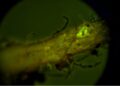
The mechanism of resistant cultivar enhances resistance to PM pathogens in the black currant phyllosphere.
The researchers compared a resistant cultivar (“16A”) and a susceptible cultivar (“Bright leaf”) to investigate how leaf structures, metabolites and phyllosphere microbiota respond to powdery mildew infection. Resistant plants exhibited thicker leaf tissues and fewer stomata, forming inherent physical barriers that reduced pathogen entry. Metabolomic analysis identified 534 differentially accumulated metabolites, with resistant plants showing elevated levels of salicylic acid, trans-zeatin and griseofulvin — metabolites previously linked to disease responses. Network analysis of microbial communities revealed significantly higher bacterial and fungal diversity in the resistant cultivar, along with greater fungal network complexity. Keystone microbes associated with resistance included Bacillus, Burkholderia and Penicillium, all known for antagonistic or protective functions.
Correlation analyses showed that key metabolites strongly influenced beneficial microbial groups, acting as biochemical cues that recruit “disease resistance effectors” in both bacteria and fungi. Functional predictions further indicated enhanced pathways related to environmental adaptation and signal transduction in the resistant cultivar. Experimental validation demonstrated that spraying griseofulvin, salicylic acid, or trans-zeatin on susceptible plants reduced disease severity, with 150 mg/L griseofulvin showing the strongest inhibitory effect on fungal development and spore cycling. These findings collectively reveal an integrated, metabolite-driven microbiome strategy underlying disease resistance.
“The study shows that resistant black currant cultivars do not rely on a single defense mechanism. Instead, they coordinate structural traits, metabolite production, and microbial recruitment to limit powdery mildew development,” the researchers explained. They emphasized that metabolites such as salicylic acid, trans-zeatin, and griseofulvin serve as critical regulators linking plant physiology with microbial community assembly.
Long-Term Pesticide Exposure Accelerates Aging and Shortens Lifespan in Fish
Long-term exposure to low levels of a common agricultural pesticide can accelerate physiological aging and shorten lifespan in fish — a finding from new research led by University of Notre Dame biologist Jason Rohr with potentially far-reaching implications for environmental regulations and human health.
The study, published in Science, shows that chronic exposure to the insecticide chlorpyrifos at concentrations too low to cause immediate toxicity causes fish to age faster at the cellular level.
The research began with field studies in China, where collaborators examined thousands of fish collected over several years from lakes with differing levels of pesticide contamination. Rohr and colleagues observed that fish living in contaminated lakes lacked older individuals, while populations in relatively uncontaminated lakes included many older fish. This pattern suggested that fish were not failing to add to their populations, but rather were dying earlier in life.

“When we examined telomere length and deposition of lipofuscin in the livers of the fish, well-established biological markers of aging, we found that fish of the same chronological age were ageing faster in the contaminated than in the clean lakes,” said Rohr.
Chemical analyses revealed that chlorpyrifos was the only compound found in the fish tissues that was consistently associated with signs of aging. These include shortened telomeres, which act like the plastic caps on shoelaces and decrease fraying in chromosomes, and lipofuscin deposition, a build-up of “junk” like old proteins and metals within long-lived cells.
However, to determine whether chlorpyrifos was the direct cause, researchers needed to conduct controlled laboratory experiments with concentrations matching those measured in the wild. In this laboratory experiment, chronic low-dose exposure to chlorpyrifos caused progressive telomere shortening, increased cellular aging and reduced survival, particularly in fish from the contaminated lakes that were already physiologically older.
“Although the laboratory results closely matched the field observations, it was possible that a missed high-dose exposure event in the field, rather than chronic low-dose exposures, caused the reduced lifespan,” said Rohr. To rule out this driver, Rohr and colleagues conducted another laboratory experiment demonstrating that short-term exposure to much higher doses caused rapid toxicity and death but did not accelerate aging through shortened telomeres and increased lipofuscin. This demonstrated that long-term accumulation of exposure to extremely common low concentrations — not brief high-dose spikes — was responsible for the observed aging.
The loss of older individuals can have serious ecological consequences, as older fish often contribute disproportionately to reproduction, genetic diversity and population stability. “These findings also raise broader concerns because telomere biology and aging mechanisms are highly conserved across vertebrates, including humans,” Rohr said.
While the European Union has largely banned chlorpyrifos, it remains in use throughout China, parts of the United States and many other countries. However, the aging effects observed in this study occurred at concentrations below current U.S. freshwater safety standards.

“Our results challenge the assumption that chemicals are safe if they do not cause immediate harm,” Rohr said. “Low-level exposures can silently accumulate damage over time by accelerating biological aging, highlighting that chemical safety assessments must move beyond short-term toxicity tests to adequately protect environmental and human health.”
Forest Loss is Driving Mosquitoes’ Thirst for Human Blood

In addition to the recently recognized hydrological concerns stemming from loss of forests worldwide — particularly deforestation’s effect on the small water cycle — researchers have now discovered another alarming consequence.
Running along Brazil’s coastline, the Atlantic Forest supports an extraordinary range of life, including hundreds of species of birds, amphibians, reptiles, mammals and fishes. Much of that richness has been lost. Human development has reduced the forest to roughly one third of its original size. As people move deeper into once-intact habitats, wildlife is pushed out, and mosquitoes that once fed on many different animals appear to be shifting their attention toward humans, according to a study published in Frontiers in Ecology and Evolution.
This is significant because mosquitoes spread viruses such as Yellow Fever, dengue, Zika, Mayaro, Sabiá and Chikungunya. These infections can pose serious health risks and may lead to long-term complications.
As deforestation continues and human settlements expand into forested areas, many plant and animal species disappear. Mosquitoes respond by altering where they live and how they find food, often moving closer to people.
| But Do We Even Know Where the Forests Are? For decades, global efforts to combat climate change and protect biodiversity have relied on a high-tech promise: that satellite-derived maps can tell us exactly where the world’s forests are. But a new study from the University of Notre Dame reveals that these digital baselines are often in sharp disagreement, creating confusion that threatens to undermine effective climate funding and international development efforts. Because these maps determine everything from carbon storage estimates to the enactment of conservation policies, even small discrepancies can have serious consequences for both people and the planet. The study reveals major differences among the world’s most widely used forest datasets. When comparing eight of the most popular datasets, the researchers found that their identification of forest locations concurred only 26 per cent of the time. The problem stems from how different researchers define “forest” and the digital technology they use to view forests, said researcher Daniel C. Miller. “When land is viewed from the sky, it’s difficult to know at a global scale whether something is a forest or not… Some might consider a small patch of trees to be a forest, but for others, only a large, dense area of trees will count.” The study found that the discrepancy among datasets creates major uncertainty, sometimes by a factor of 10. For example, some maps might count a savanna interspersed with trees as forest based on a 10 percent canopy cover threshold, while others require 50 percent. These small definitional differences can flip millions of hectares from “forest” to “non-forest” in an instant. The researchers used case studies from Brazil, India and Kenya to show how these digital maps affect human lives and global policy challenges. In India, for example, the estimated number of people living in poverty near forests fluctuated from 23 million to 252 million depending solely on which map was used. Miller warned that if forest definitions continue to vary, countries could overestimate — or dangerously underestimate — their carbon sequestration potential. |
Vermicompost May Be a Powerful Tool Against Antibiotic Resistance
The World Health Organization has named antimicrobial resistance one of the most serious threats to modern medicine, and livestock production is a major part of the problem. When animals receive antibiotics, resistance genes accumulate in their manure, and if that manure is spread on fields without proper treatment, those genes can move into soil, water, crops and eventually the human gut. Conventional composting helps, but its performance is unstable, and, in some cases, key resistance markers can even rebound during the composting process.
Vermicomposting uses earthworms and their associated microbes to transform raw manure into a stable, crumbly product known as vermicast. Under carefully controlled moisture, temperature and nutrient conditions, this mesophilic process not only recycles waste into fertilizer but also achieves multi-pathway reduction of antibiotic resistance genes. Studies summarized in the new review show that vermicomposting can reduce the total abundance of resistance genes by roughly 70 to 95 percent and mobile genetic elements by up to 68 percent, often outperforming traditional compost piles.

As earthworms burrow and feed, they increase porosity and aeration in the manure, maintaining oxygen rich conditions that suppress many anaerobic bacteria that often carry resistance genes and support faster breakdown of residual antibiotics. Inside the earthworm gut, mechanical grinding, digestive enzymes and a specialized microbiome further damage resistant bacteria and disturb both intracellular and extracellular DNA.
A key advantage lies in how earthworms restructure the microbial community. Their activity shifts the system away from fast-growing opportunistic bacteria that frequently host resistance genes toward more stable, functionally beneficial groups involved in decomposition and nitrogen fixation. At the same time, vermicomposting lowers the abundance of mobile genetic elements such as plasmids and integrons, which are the vehicles that shuttle resistance genes between bacteria through horizontal gene transfer.
Beyond the gut, earthworm epidermal mucus and coelomic fluid act as a biochemical interface in the composting mass. This mucus contains carbohydrates, proteins, lipids and bioactive molecules including antimicrobial peptides, lysozymes and DNases that can damage bacterial cell membranes, generate reactive oxygen species and directly degrade resistance genes. Laboratory studies cited in the review show that coelomic fluid can cut multidrug-resistant E. coli populations by several orders of magnitude within hours and can remove over 90 percent of extracellular resistance genes through DNA cutting activity.
Mucus also alters microbial behavior by interfering with bacterial communication systems and gene expression. In one mechanistic study, exposure to earthworm coelomic fluid led to thousands of bacterial genes being up or down regulated, disrupting pathways that bacteria rely on for coordination and conjugation. Network analyses indicate that after earthworm processing, the statistical links between resistance genes and their bacterial hosts weaken, suggesting that vermicomposting ecologically decouples resistance traits from the microbes that carry them.
Performance improves further when vermicomposting is combined with functional materials such as biochar, zeolite or clay minerals. These additives can adsorb antibiotics and heavy metals, easing stress on earthworms and microbes while stabilizing pollutants and reducing the selective pressure that favors resistant bacteria. In trials summarized by the authors, pairing earthworms with biochar or mineral amendments increased earthworm growth, accelerated organic matter degradation, improved humification and raised removal rates for both resistance genes and heavy metal resistance markers.
Together, earthworm activity, mucus-derived biochemistry and tailored additives create a multi-level containment system that acts from molecules to whole ecosystems. The result is a more robust, stable reduction of antibiotic resistance genes than is typically achieved in conventional composting alone, while producing a high-quality organic fertilizer that can improve soil structure, water retention and plant nutrition.
Despite these advantages, the authors caution that significant challenges remain before vermicomposting can be deployed widely as an antibiotic resistance control strategy. Different earthworm species vary in their tolerance to antibiotics and environmental conditions, and key operating parameters such as stocking density, feedstock composition, temperature and moisture must be fine-tuned for each type of agricultural waste. Large scale systems must also address climate sensitivity, reactor design, automation and the logistics of maintaining healthy earthworm populations at industrial scale.

| What Could Possibly Go Wrong?!? Scientists Use Gamma Radiation to Quickly Toughen Nitrogen-Fixing Bacteria. Heat-resilient biofertilizers could help crops cope with rising temperatures, but engineering them has been slow and uncertain. A new study from researchers at the National Institutes for Quantum Science and Technology (QST) in Japan — who have apparently never watched any of the Incredible Hulk extended universe movies — shows that pairing experimental evolution with controlled gamma-ray mutagenesis can accelerate the path to heat-tolerant nitrogen-fixing bacteria, shortening development timelines and opening practical routes to more reliable, climate-ready microbial products for agriculture, food processing, pharmaceuticals, and biofuel production. The study was published in the journal Mutation Research. The team focused on Bradyrhizobium diazoefficiens USDA110, a bacterium used to help soybean and other legumes capture nitrogen. While the wild-type grows best at around 32–34°C and stalls at ~36°C, QST researchers raised culture temperatures stepwise from 34°C to 37°C over 76–83 days and irradiated populations ten times at specific doses, then selected the lines that continued to form robust colonies at 36°C. A clear “sweet spot” emerged: around 40 Gy produced the greatest number of stable, heat-tolerant lines, whereas higher doses (80–120 Gy) initially yielded more tolerant lines but with smaller colonies and traits that faded when selection relaxed, consistent with an excess of deleterious mutations. In practical terms, the method lets researchers tune the mutation load to favor beneficial changes while preserving overall fitness. |