

The Small Water Cycle Is Currently Vicious
A new study from the University of California San Diego has identified an unexpected influence on global crop stability: the original source of rainfall.
Published in Nature Sustainability, the research follows atmospheric moisture back to the place where it first evaporated, whether from the ocean or from land surfaces such as soil, lakes and forests. Sunlight heats these surfaces, converting water to vapor that rises into the atmosphere and eventually returns as rain.
Ocean-derived moisture — the large water cycle — can travel across continents within large weather systems, including atmospheric rivers, monsoons and tropical storms. Moisture that comes from land, often referred to as recycled rainfall or the small water cycle, is created when water evaporates from nearby soils and vegetation, fueling more localized storms. According to the study, the ratio of ocean to land moisture strongly shapes regional drought risk and agricultural productivity.
“Our work reframes drought risk — it’s not just about how much it rains, but where that rain comes from,” said Yan Jiang, the study’s lead author. “Understanding the origin of rainfall and whether it comes from oceanic or land sources gives policymakers and farmers a new tool to predict and mitigate drought stress before it happens.”
Using nearly 20 years of satellite measurements, the researchers quantified how much of global rainfall begins as land-based evaporation. They found that when more than roughly one-third of precipitation originates from land, croplands become significantly more susceptible to drought, soil moisture declines, and yields drop. Ocean-driven systems generally produce heavier and more consistent rainfall while land-driven systems tend to produce lighter and less predictable showers, making crops more vulnerable during stages when water is essential.

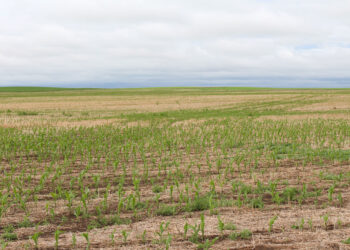
This discovery offers a new method for identifying regions at higher risk and for planning water and crop management strategies more effectively. “For farmers in areas that rely heavily on land-originating moisture — like parts of the Midwest or eastern Africa — local water availability becomes the deciding factor for crop success,” Jiang explained. “Changes in soil moisture or deforestation can have immediate, cascading impacts on yields.”
In the Midwest, droughts have grown more frequent and intense in recent years, despite the region’s status as one of the world’s most productive agricultural zones. “Our findings suggest that the Midwest’s high reliance on land-sourced moisture, from surrounding soil and vegetation, could amplify droughts through what we call ‘rainfall feedback loops,’” Jiang said. “When the land dries out, it reduces evaporation, which in turn reduces future rainfall — creating a self-reinforcing drought cycle.” Farmers in the Midwest may need to focus on soil moisture conservation, irrigation efficiency and strategic timing of planting to limit the risk of compounding drought effects.
East Africa faces a different but equally serious challenge. Rapid growth of croplands and the ongoing loss of nearby rainforests threaten the moisture sources that help sustain the region’s rainfall. “This creates a dangerous conflict,” Jiang said. “Farmers are clearing forests to grow more crops, but those forests help generate the rainfall that the crops depend on. If that moisture source disappears, local food security will be at greater risk.”
The study emphasizes that forests and natural ecosystems play a critical role in maintaining rainfall. Through evaporation and transpiration (when plants produce moisture), forests release large amounts of water vapor into the atmosphere, helping form clouds that later produce rain over surrounding croplands.
“Upland forests are like natural rainmakers,” Jiang said. “Protecting these ecosystems isn’t just about biodiversity — it’s about sustaining agriculture.” The research introduces a new framework that links land-use decisions, rainfall patterns and agricultural planning. This approach may become increasingly important as regions look for strategies to strengthen drought resilience.
While Melatonin Puts Us to Sleep, It Wakes Plants Up
Melatonin, a hormone produced in the brain and reproduced synthetically in labs, is America’s sleep drug of choice. It is taken by roughly 27 percent of U.S. adults, helping control the body’s circadian rhythm or internal clock — signaling that it’s time to go to bed.

Yet for plants, melatonin performs a seemingly opposite task — it promotes plant growth and alleviates abiotic stresses. The results were recently reported in iScience.
“In plants, the internal clock can adjust the phase of various biological processes, such as gene expression, metabolic regulation and protein stability, to coincide with daily and/or seasonal cycles,” said Imad Aijaz, the paper’s first author. “Because of this, circadian regulation enhances photosynthesis and growth rates and may influence crop flowering, seed yield, and responses to biotic and abiotic stresses.”

Like people, plants produce their own melatonin, plus they get help from microbes that live near their roots and also produce the hormone. “Melatonin-producing microbes can enrich soils, enhancing melatonin availability, uptake, and transport within plants to improve stress tolerance and growth,” said Khan.
Taking Big Food to Court Over Ultra-Processed Foods
In a first-of-its-kind lawsuit, the city of San Francisco has sued ten of the nation’s largest food and beverage manufacturers, accusing them of marketing ultra-processed foods (UPFs) that have contributed to widespread chronic illness and burdened local health systems. The complaint, filed in California Superior Court by City Attorney David Chiu on behalf of the People of the State of California, targets companies including Kraft Heinz, Mondelez, Post, Coca-Cola, PepsiCo, General Mills, Nestlé USA, Kellogg, Mars and Conagra Brands.
Ultra-processed foods are defined in the city’s court papers as industrially formulated products made from former whole foods that have been broken down, chemically modified and reassembled with additives such as emulsifiers, artificial colors, flavor enhancers, non-nutritive sweeteners and other ingredients not found in a typical home kitchen. These products now make up an estimated 70 percent of the U.S. food supply, and consumption has been linked to a range of chronic health conditions, including Type-2 diabetes, cardiovascular disease, certain cancers and depression.
San Francisco’s lawsuit alleges that the defendants designed UPFs to be addictive, marketed them deceptively and misrepresented their risks, leading to what the city describes as a public health crisis that disproportionately affects children and low-income communities. The complaint seeks injunctive relief, civil penalties and restitution to offset the substantial healthcare and social costs borne by cities and counties treating diet-related diseases.
City officials have drawn comparisons between the tactics used to promote ultra-processed foods and the marketing strategies once deployed by Big Tobacco, citing aggressive advertising to children and vulnerable populations that has shaped lifetime consumption patterns. The suit invokes California’s Unfair Competition Law and public nuisance statutes in urging the court to order changes in corporate practices and compensation for public health impacts.
Industry groups representing the named companies have pushed back, arguing that there is no universally accepted definition of ultra-processed food and that many products cited as harmful contain essential nutrients and meet regulatory safety standards. They also note ongoing efforts to reformulate products with reduced sugar, sodium and artificial additives.
For organic and regenerative farmers, the lawsuit highlights growing scrutiny of industrial food systems and reinforces longstanding calls for diets rooted in whole foods and transparent processing standards — trends that could influence both public policy and consumer behavior in the years ahead. Whether the battle will ultimately be won by cultural changes or by government regulation remains to be seen.
Long-Held Glyphosate Safety Study Retracted
A highly influential scientific paper concluding that glyphosate-based herbicides — including Monsanto’s Roundup — pose no health risk to humans has been formally retracted by the journal Regulatory Toxicology and Pharmacology more than 25 years after its original publication. The move, announced in late November 2025, underscores growing concerns about research integrity in studies that have shaped regulatory policy for one of agriculture’s most widely used weed killers.
The 2000 review long served as a cornerstone citation for regulators and industry alike in asserting glyphosate’s safety. It found no evidence of carcinogenicity, reproductive toxicity, or endocrine disruption at typical exposures. Regulators around the world, including the U.S. Environmental Protection Agency, have cited this and similar papers in evaluations of glyphosate’s risk profile.
The retraction was prompted by serious ethical concerns about the study’s independence and transparency, according to RTP’s editor-in-chief. Internal documents released in litigation — including the so-called “Monsanto Papers” — revealed that Monsanto employees may have played a substantive, undisclosed role in writing the paper. The retraction notice cited misrepresentation of authorship contributions, reliance on unpublished Monsanto studies and conflicts of interest that undermine confidence in the paper’s conclusions.
“This article has been widely regarded as a hallmark paper in the discourse surrounding the carcinogenicity of glyphosate and Roundup,” the retraction notice stated, noting that uncertainty about authorial independence and data sources means its findings can no longer stand.
The timing of the retraction coincides with renewed legal and regulatory scrutiny of glyphosate. Bayer, which acquired Monsanto in 2018, is defending thousands of lawsuits alleging that exposure to glyphosate caused non-Hodgkin’s lymphoma and other cancers. Meanwhile, the EPA is conducting its cyclical registration review of glyphosate, and the debate over the herbicide’s safety continues among scientists.