
By understanding population ecology, lifecycles and habitat, farmers can guide ecosystems toward balance instead of fighting endless outbreaks
By now, most of you reading this have realized that the cavalry isn’t coming to save the day. The silver bullet — a shelf-stable, miracle-in-a-jug pest-and-disease cure that turns fields into advertising photos doesn’t exist. Anything that might seem like a “miracle cure” seems to throw side effects all over the place: paperwork, licensing, specialized equipment — and all of that costs money.
Those of us stubborn enough to have worked through the years to create diverse and complex systems have stayed in the game. We’re not the “poor, suffering farmers” that you see on the news. We’ve noticed something: ecosystems don’t really have pest problems. They don’t really have disease problems. They have balance. It’s the increasingly sterile monocultures that have the problem.

Just ask any of the old-timers at Acres U.S.A. We may grow grains, dairy, produce or poultry — we’re all different — but all of us have noticed pest and disease issues declining the longer we practice ecological agriculture. In eco-agriculture systems, our job isn’t to control nature but to learn how it works and then to relate with it, intensely and intentionally.
Think of two different approaches to maneuvering upstream through river rapids. One is the jet boat with twin 500s — engines roaring, smacking its way from wave to wave. Just think of the size of the equipment, the fuel, and the wear and tear on the machinery and, especially, the pilot. Farming that way kills.
The ecological pest and disease manager is more like an experienced kayaker: reading the current, understanding how the waves and eddies work, and using the force of the river itself to pull and push the boat upstream.
Both techniques will get you upstream. One requires a more thorough understanding of how the system works and is more of an interaction. The other is more about telling the system what to do and how to do it, based on what you want.
Ecological pest and disease management is less about killing things and more about designing your system so that you don’t need to kill things in the first place. You design your system to mimic natural systems and let it solve its own problems all by itself. It’s more about understanding population ecology, pest and disease lifecycles, habitat management, soil and plant nutrition, genetic resistance, and appropriate timing. Design the system ahead of time to prevent the problems up front so you don’t have to solve them later. Get the pieces lined up and steer your system into the future — and your sprayer will begin to collect dust.
Here are some of the elements involved in ecological control.
Population Ecology: Pests Aren’t “Bad” — They’re Telling You Something
Plant a field of only broccoli or potatoes and you know who will show up. You’ve provided the perfect habitat for things that eat broccoli or potatoes. You have accidentally created a pest feedlot — a vast monocrop buffet, with very few predators to keep things in check.
The study of population ecology tells us two things:
- Every organism reproduces as fast as its food supply and environment will allow.
- Every population is controlled by something that eats it, infects it or competes with it.
When we plant a thousand acres of one highly palatable, genetically shallow crop, we have just pulled the pin on a population-ecology hand grenade. The pest doesn’t show up because it’s “mean.” It shows up because we built a five-star restaurant with no bouncer.
The eco-farmer asks:
- What controls this pest or disease naturally in diverse ecosystems?
- How do we put those controls back?
- How can we block, deflect, distract, or repel it by designing natural controls into our system?
The pests and diseases that affect our crops have predators, parasites, pathogens, and competitors that attack them in turn. How can we design a system that allows them to perform that function?
Lifecycle Disruption: Hit Them When They’re Vulnerable
Chemical control is a full broadside intended to overwhelm one’s adversary. IPM (Integrated Pest Management) strives to fine-tune the timing so as to reduce the ammunition used — more like a “surgical strike.” It’s an improvement on the full-chemical method — but ecological thinking helps us to design systems that prevent the problem by understanding more about the system.
Every pest and pathogen has weak spots in its lifecycle:
- overwintering stages
- exposed egg or larval periods
- narrow timing of emergence
- host-switch moments
- mating swarms
- soil-borne juvenile stages
When we see adult insects chewing leaves, or widespread foliar disease, we might actually be too late for simple control. Use the opportunity to ask: When is this organism actually easiest to interrupt? My life changed when I realized that planting my squash crop earlier in order to get have higher-priced, early-season availability was not worth the hassle of dealing with the vine borers and root maggots that appeared at that time. My later-planted squash was in its critical stage after the first big hatch. On top of that, the first big hatch didn’t reproduce as vigorously because it didn’t have the food source it needed.
Timing your crop planting may require switching varieties. I went from 110-day delicata and butternut to 75-day acorn squash. I planted early field peas to “hold the ground” as pests emerged, and I disked them in before late-planted green beans, beets or kale. I avoided early leafy greens to miss the flea-beetle hatch. Early planting of other crops can help you miss corn borers, earworms, potato leafhoppers and armyworms (along with an additional disk-harrowing to disrupt lifecycles).
Other examples of lifecycle disruption and timing happen in ecological systems:
- Poultry or hogs can run through orchards after harvest in the fall to break pest and insect cycles by eating dropped fruit, larvae and pupae. The benefits of this are even more noticeable when you run your animals through in the spring, but there’s the whole timing issue. Since I was certified organic, I had to rotate livestock out of the orchards in May in order to be able to legally harvest apples or chestnuts in October. Cherries, blueberries and hazelnuts had to have livestock excluded until after harvest.
- Properly timed grazing with enough animals takes out weed seed heads before maturity. I never imagined that cattle would overgraze thistles until I saw it with my own eyes.
- In irrigated regions, flooding or drying a paddock at the right time can knock back parasites.
- Mechanical disturbance (mowing, tilling) overwintering sites collapses next year’s population before it starts. This is a double-edged sword, though. In the early 2000s, research from UW Madison found the highest number of ground beetles (a predatory insect) overwintering under the leaves of comfrey. Mowing overwintering sites can also knock back your beneficials.
If you’re into the war analogy with pests and diseases, relax a little. We will never win this war. All that we have to do is to break the cycle enough to get a crop in, and then we repeat the process so as to not let the pest population soar. Pest populations will probably never hit zero — they merely need to stay below economically damaging levels while the rest of the ecosystem gains strength.
Habitat Enhancement for the Real Workforce: Beneficial Organisms
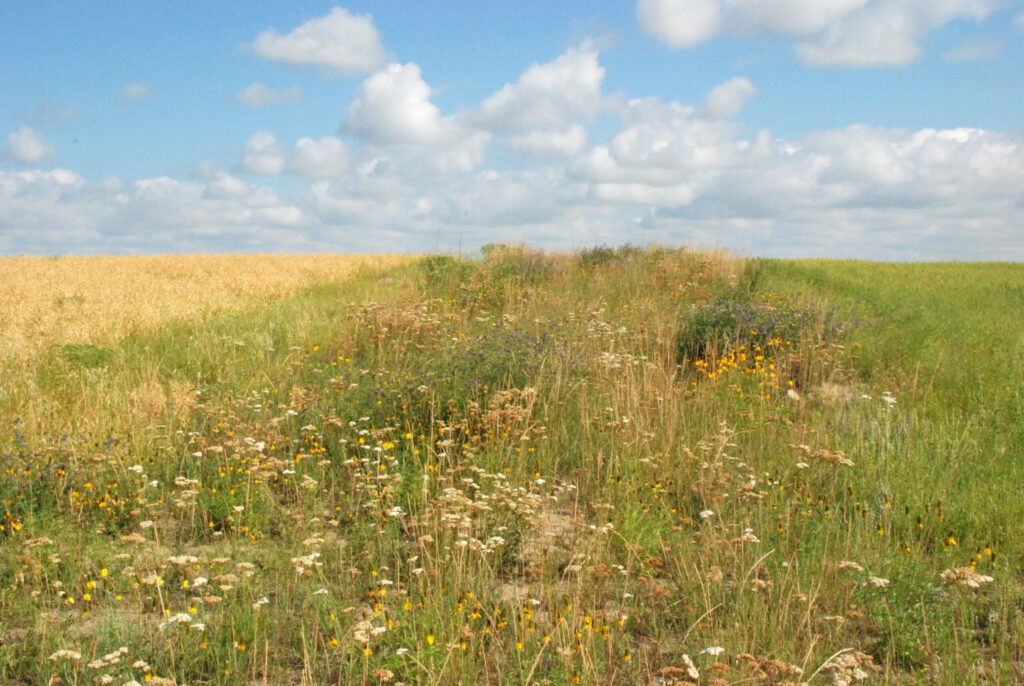
Beneficial habitat isn’t just a feel-good pollinator strip to satisfy your organic inspector or the people on the farm-tour bus. It is the structural design of your farm ecosystem. It is the almost invisible web of beneficial insects, birds, bats, reptiles and microbes that exists across the entire ecological farm or ranch.
The web of beneficials is your true “spray rig.” It’s also cheaper than diesel. Think of all the bugs you might not want to see on your operation: earworms, potato beetles, root maggots, cutworms, thrips, leafhoppers, tomato hornworms, coddling moth, sawflys, mites, aphids, and more — all of these pests have one thing in common: at some time during their life they are all food for other organisms. But here’s the key: they will only show up if they can live there.
Our job is to keep predators fed and housed year-round so they will be available when our pests need removal. We can do this with habitat enhancement.
- First and foremost, plant oak trees! (See my article on this in the September 2024 issue.) Oak trees host more insect species than any other tree in the Americas, and 99 percent of those species are host-specific and will not eat your crops. Oaks feed birds and other predators when there are no “pests” in your fields. When pests emerge, the birds will be there and ready to eat.
- Between fields, plant continuously flowering strips of natively adapted plants throughout the season as food and breeding grounds for parasitoid wasps and hoverflies. Throw in buckwheat every month or so; I’ve never seen more hoverflies than in buckwheat.
- Leave messy, undisturbed edges, with fallen chunks of bark or mushroom logs for ground beetles
- Build bat and owl perches and nest boxes. Hawk roosts help with gophers, ground squirrels, mice and rats.
- Create water sources scattered throughout the property! Farm ponds are vital for dragonfly and amphibian breeding.
Hedgerows, silvopasture, alley cropping, and multi-level perennial systems create permanent housing for beneficials. Instead of a naked corn-and-soy landscape where predators starve between outbreaks, strive to build year-round pest control.
Beneficials shouldn’t need to be another input. All that they need is groceries and a roof. Provide both and they’ll show up for work before you do.
Soil Mineral Balance: Nutrition Underlies the Plant Immune System
Plant health isn’t just NPK and a prayer. It’s the full mineral orchestra in natural slow-release form:
- calcium for cell-wall strength
- trace elements for enzyme systems
- magnesium for chlorophyll
- boron and zinc for reproductive health
- sulfur for protein formation
Insects and diseases recycle weak plants. They are the janitors — not the villains.
Balanced soil minerals, re-awakened soil biology and organic matter management (green, brown and blue carbon) shift the farm from pest attraction to pest resistance. I can hear Gary Zimmer now jumping up and down: “Balance your minerals! Activate your biology! Manage your decay cycle!” Tools include mineral amendments based on soil testing, compost and compost teas, liquid ferments, deep-rooted plants to re-mine minerals leached deep into the soil, managed grazing to recycle nutrients, healthy populations of soil life, and more.
Once mineral balance and overall soil health improves, pests stop being a crisis and start being a monitoring tool. Problems become our teachers.