

Ontario farmer Ray Halma cut his feed bill in half by moving pigs daily through cover crop strips in the middle of his sweet corn
Acres U.S.A. What was your inspiration for building these moveable pig pens?
Ray Halma. The idea came from one of our visits to the Acres conference. Jason Mauch was speaking on what they were doing with their mobile pens. His is completely autonomous and ours is not, but in principle, he was doing what we’ve adapted here.

I wanted something with firm perimeter fencing, because pigs are so hard to keep in. We used to pasture a couple hundred pigs when I was a kid, and I just remember year after year how much time we spent chasing pigs. It did not matter what kind of a fence we had.
Acres U.S.A. Even electric.
Halma. The problem with electric was that in one hour, they’d dig right underneath the electric fence. They’re just so smart. You’d lower the wire and come back a little while later, and the hole was just a little deeper.
That gave me the idea of having a firm perimeter fence but moving it enough that they never have a chance to dig underneath it. They’ll do their rooting, but they’re never in the same spot long enough to dig underneath and escape.
Acres U.S.A. What does the design look like in terms of square footage?
Halma. It’s about 24 feet by eight feet, so almost 200 square feet.
Acres U.S.A. So, you’re planting your corn and leaving an eight-foot strip that you’re planting cover crops into.
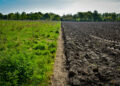
Halma. Right. This is in our sweet corn field. The cover crops are in a strip across our half-acre sweet corn plots.

We’ve been experimenting with different cover crops. The year we started, it was just on wheat. We had wheat growing, and when it was a foot tall, we wheeled this thing out there and they did fine on it. Then we harvested the wheat, and the next year we grew a multi-species cover crop, and that’s when we realized how much better they thrived on the multi-species cover crop.
They absolutely love the root crops. They inhale the Austrian winter peas. And that diverse cover crop is just so much better at weed suppression as well. My preferred mix is a third oats, 15 percent Austrian winter peas, 10 percent each crimson clover and forage peas, 7 percent hairy vetch, and the rest faba beans, nitro radish, turnips, pearl millet, sorghum sudangrass, sunflowers, sun hemp, and phacelia.
Acres U.S.A. How often do you move them through the cover crop strip?
Halma. When they’re smaller, once a day, but when they get bigger, twice a day.
Acres U.S.A. And how many pigs are in the coop?
Halma. We started with two, but now we have six, and that’s comfortable.
Acres U.S.A. You’ve got a sheltered area too; do you keep the pigs inside that shelter area when you’re moving them, so you’re not trampling them?

Halma. Well, they get smart. We don’t have to do that anymore. We were worried about that at the beginning, but now, when they hear the machine come up, they’re alert and it’s no problem. They go right to the front and walk toward the new stuff.
Acres U.S.A. What about supplemental feed?
Halma. We are a feed company as well, so we do have a basic hog grower that we supplement, but their feed cost is literally half of what we were doing when they were in the barn. It made our pork go from breakeven to actually making money.
Acres U.S.A. And water?
Halma. There’s a tank that’s usually good for two to three days, and then we just have one of those white IBC totes on the back of our UTV, and we have a little Milwaukee cordless pump on it, and it pumps like crazy — faster than your garden hose. Those couple hundred gallons are transferred really quickly, and you’re good for a few days again. It’s gravity flow — just a float system on the water bowl.
Acres U.S.A. And you’re selling them directly to customers, right?
Halma. Yes, we have a retail store on the farm here.
Acres U.S.A. What about scalability? How many do you have right now, and how many can you envision having?

Halma. It is scalable. Right now we’re just doing enough to keep our store supplied, and it’s growing, but we’re going to add them as needed. It takes about a month and a half to two months to take them from 75 pounds to 250, and so we just keep it full all the time.
These are not heritage pigs, though. These are PIC pigs. They’re a high-muscle, fast-growing pig. We tried the heritage breeds, and everybody loves the heritage, and I like how they look. But when you’re talking about dressed meat, it’s hard to beat the new breeds. And to be quite honest, raising them the way we are, I don’t think there’s any drawback. I don’t think there’s any less flavor in our pork. I think it has mainly to do with how they’re fed.
Acres U.S.A. Can you give a rough estimate of how much it costs in materials to build one of these pens?
Halma. I think you could build it for $3,000. I have a buddy who’s a millwright, though, and they’re throwing steel out all the time, so I have a good supply of steel whenever I need it. And I have good help who can weld well.
Acres U.S.A. How do you move the pen?
Halma. It’s got wheels on one side and a hitch on the other. But we never hook up to the hitch. We just push it with our Kubota UTV. It has a big grill guard on the front, and we just pull up to it and give it a little push. The whole thing literally takes less than 10 seconds to move it every day.
Acres U.S.A. What time of year do you stop? I assume you’re not doing this in the winter in Ontario.
Halma. Last year we had a beautiful fall, so we went right to December. We’re planning to start up again as soon as it’s green, which will probably be about May 1st.
Acres U.S.A. Are you buying in the piglets or farrowing?
Halma. We are buying in piglets, but farrowing in the moveable pen could easily be done.