Acres U.S.A.® Magazine
  • Articles
    • News
    • Ecological farming
      • Climate
      • Environmental Issues
      • Farm management & planning
      • Human health
    • Livestock
    • Farm
    • Crop
      • Crop management practices
        • Ag technology
        • Cover crops
        • Crop nutrition
          • Crop protection
          • Diseases
        • Crops
        • Fruits
    • Soil
    • Opinion
  • Resources
    • Magazine
    • Online Learning
    • Newsletters
    • Free Articles
    • Blog
  • Magazine Issues
    • 2026
      • February 2026
      • January 2026
    • 2025
      • December 2025
      • November 2025
      • October 2025
      • September 2025
      • August 2025
      • July 2025
      • June 2025
      • May 2025
      • April 2025
      • March 2025
      • February 2025
      • January 2025
    • 2024
      • December 2024
      • November 2024
      • October 2024
      • September 2024
      • August 2024
      • July 2024
      • June 2024
      • May 2024
      • April 2024
      • March 2024
      • February 2024
      • January 2024
    • 2023
      • December 2023
      • November 2023
      • October 2023
      • August 2023
      • July 2023
      • June 2023
      • May 2023
      • April 2023
      • March 2023
      • February 2023
      • January 2023
    • 2022
      • December 2022
      • November 2022
      • October 2022
      • September 2022
      • August 2022
      • July 2022
      • June 2022
      • May 2022
      • April 2022
      • March 2022
      • February 2022
  • About Us
    • Our History
    • Our Staff
    • Contact Us
    • Community
      • Soil Health Primer Resources
  • Events
    • Eco-Ag Conference
    • Farm Weird Event
    • Viroqua On Farm Event
  • Subscribe
  • Login
  • Register
No Result
View All Result
  • Articles
    • News
    • Ecological farming
      • Climate
      • Environmental Issues
      • Farm management & planning
      • Human health
    • Livestock
    • Farm
    • Crop
      • Crop management practices
        • Ag technology
        • Cover crops
        • Crop nutrition
          • Crop protection
          • Diseases
        • Crops
        • Fruits
    • Soil
    • Opinion
  • Resources
    • Magazine
    • Online Learning
    • Newsletters
    • Free Articles
    • Blog
  • Magazine Issues
    • 2026
      • February 2026
      • January 2026
    • 2025
      • December 2025
      • November 2025
      • October 2025
      • September 2025
      • August 2025
      • July 2025
      • June 2025
      • May 2025
      • April 2025
      • March 2025
      • February 2025
      • January 2025
    • 2024
      • December 2024
      • November 2024
      • October 2024
      • September 2024
      • August 2024
      • July 2024
      • June 2024
      • May 2024
      • April 2024
      • March 2024
      • February 2024
      • January 2024
    • 2023
      • December 2023
      • November 2023
      • October 2023
      • August 2023
      • July 2023
      • June 2023
      • May 2023
      • April 2023
      • March 2023
      • February 2023
      • January 2023
    • 2022
      • December 2022
      • November 2022
      • October 2022
      • September 2022
      • August 2022
      • July 2022
      • June 2022
      • May 2022
      • April 2022
      • March 2022
      • February 2022
  • About Us
    • Our History
    • Our Staff
    • Contact Us
    • Community
      • Soil Health Primer Resources
  • Events
    • Eco-Ag Conference
    • Farm Weird Event
    • Viroqua On Farm Event
  • Subscribe
No Result
View All Result
Acres U.S.A.® Magazine
No Result
View All Result
Home Magazine issues July 2022

Companion Planting for Pest Management

Caitlin Tucker by Caitlin Tucker
October 30, 2024
in July 2022
0
Companion Planting for Pest Management

Nasturtium, catnip: Flowering nasturtium and catnip interplanted with cucumbers, peas and eggplant in a high tunnel may help to attract and retain natural enemies of aphids, spider mites, flea beetles and other pests of these crops.

0
SHARES
8
VIEWS
Share on FacebookShare on Twitter

The art and science of adding plants to reduce pests

Caitlin Tucker

Companion planting is the practice of growing a diverse set of plants together for synergistic benefits. 

Perhaps the most well-known example is the practice of growing the “three sisters” —corn, squash and beans. The relationships between these three plants are easy to visualize and appreciate. We can see that the towering corn plants provide a natural trellis for the beans to climb. We know that beans and their bacterial partners supply the nitrogen that the corn and squash require, and we can see the lush vegetation of the squash plants outcompete weeds for the benefit of all. 

To understand how companion planting can be used to manage pests, we must first understand how insects interact with plants in the environment. 

Insects rely on different cues to locate their host plants. Airborne chemical cues, called “volatiles,” play a significant role, especially at a distance. They are readily produced by plants and serve different ecological functions. They can aid in plant-to-plant communication, attract pollinators, be used to deter herbivores and attract natural enemies. And yes, insect pests can use volatiles to locate their hosts! 

Visual cues also factor in. Signals like the shape of a plant’s leaves, the color of its flowers or its size help a pest find the perfect place to feed or lay its eggs. With this knowledge, we can use different planting arrangements to protect our cash crops from pests. 

Anti-pest Companion Crop Systems

Masking is a way to “hide” the cash crop by growing companion plants that physically or chemically obscure it. As a result, the pest has a difficult time orienting to the crop. This is also where the “inappropriate landings theory” comes into play. Research shows that some pests require several consecutive landings on the host plant before they will lay their eggs. If, in a diverse planting of crops, the insect makes an “inappropriate” landing on a non-host plant, they will not achieve that optimal number of consecutive landings and will fly off to look for another plant for egg laying. 

Fragrant herbs like sage, dill, hyssop and German chamomile have been shown to effectively mask cole crops from cabbage butterflies; planting basil alongside tomatoes reduces egg laying by hornworm adult moths; and marigolds interplanted with either onions or cole crops have been found to reduce egg laying by onion root maggot and cabbage root flies. 

Trap cropping is a practice in which a more attractive crop or mixture of crops is used to draw a pest away from your cash crop. With the pest concentrated on your trap crop, you can now focus management on a more targeted area. That management may be a targeted pesticide application, timely crop destruction, hand removal, vacuuming, etc. The design of a trap crop system requires knowledge of the pests’ biology and behavior. Is the pest highly mobile? That is, how likely are they to travel a distance to reach the trap crop? 

Another important factor includes the timing of the trap crop planting. This should occur a few weeks ahead of the cash crop planting so that pests are immediately lured to the trap crop. This may impact whether you choose to plant your trap crop on the perimeter, at the ends of beds or in strips throughout the field. 

A well-known trap crop in vegetable systems is Blue Hubbard squash. When planted along the perimeter of squash fields it effectively lures squash vine borer and squash bugs away from the cash crop. Other examples include the use of hot cherry peppers to pull pepper maggots away from bell pepper plantings, various mustard varieties to protect other cole crops from flea beetles, and strips of alfalfa to protect strawberries from tarnished plant bug damage. 
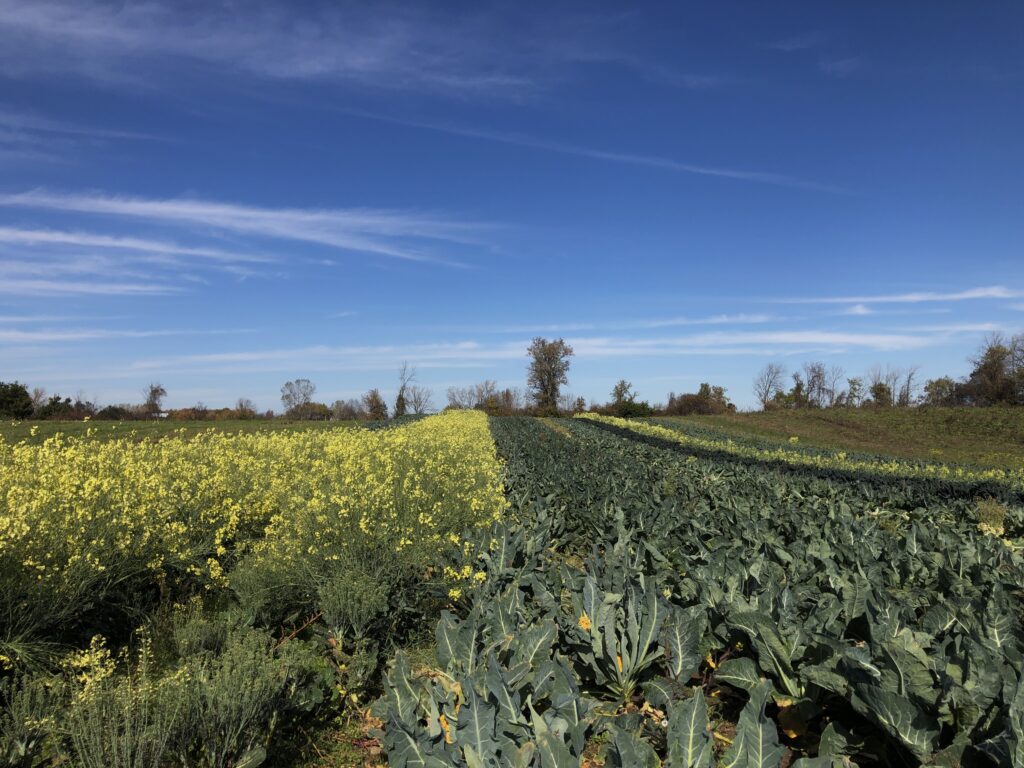
Flowering brassicas: Strips of mature brassica crops are allowed to flower in order to attract natural enemies that may control pests on the cauliflower and kale plantings next to them.

Push-pull systems take trap cropping one step further by not only incorporating plants that are more attractive to “pull” a pest away from the crop, but also integrating plants that “push” or deter the pest from the cash crop. 

The push-pull system was developed by researchers in Kenya to help small-acreage farmers manage stemborers and a weedy pest called Striga in their maize and sorghum plantings. Desmodium, the “push” plant, not only emits volatiles that repel stemborer moths but also controls the Striga through a combination of competition for resources and allelopathy. Napier grass, the “pull crop,” is a more attractive plant for stemborer moths to lay their eggs on. As a bonus, when the larvae hatch and begin feeding, the grass produces a sticky sap that causes the larvae to get stuck and perish. It’s a win all-around! 

In vegetable systems, recent research shows success in using marigolds as a “push” and mustard greens as a “pull” to manage various pests of kale. 

Attracting Natural Enemies 

The enemy of my enemy is my friend! We can attract insect predators and parasitoids by incorporating beneficial habitat into our farmscape. Beneficial habitats offer natural enemies protection from predators or harsh environmental conditions, sites for reproduction and development, shelter for overwintering, and alternative food sources like pollen and nectar. Including insectary strips in your fields, intercropping with cover crops, incorporating both annual and perennial species into the landscape or planting hedgerows are ways you can improve natural, biological control on your farm. 

To have the most success with companion planting for pest management, it is important to consider the biology and behavior of the pest you are trying to manage, how companion plants will affect your overall crop rotation and whether your companion plants will compete with your cash crops for resources like light, water and nutrients. 

Caitlin Tucker is an Organic Consultant with Rodale Institute based out of Buffalo, New York. Please visit rodaleinstitute.org/consulting for more information.  

← Previous Eco-update Next Eliminating the Burndown Pass →
Tags: July 2022
Caitlin Tucker

Caitlin Tucker

Caitlin Tucker is an Organic Consultant with Rodale Institute based out of Buffalo, New York. Please visit rodaleinstitute.org/consulting for more information.


Next Post
Regenerating Soil with Betsy Ross

Regenerating Soil with Betsy Ross

  • Trending
  • Comments
  • Latest
The Most Important Livestock in Our Fields

The Most Important Livestock in Our Fields

July 1, 2024
Glyphosate Does What It’s Designed to Do — Kill

Glyphosate Does What It’s Designed to Do — Kill

February 19, 2025
The Take-Half, Leave-Half Fallacy

The Take-Half, Leave-Half Fallacy

July 1, 2025
White snakeroot

Toxic Forages?

September 1, 2025
We Don’t Need Another Bridge — We Need an Off-Ramp

We Don’t Need Another Bridge — We Need an Off-Ramp

3
Under One Roof

Under One Roof

3
A Rose By Any Other Name

A Rose By Any Other Name

2
Terra Preta’s Biological Advantage

Terra Preta’s Biological Advantage

2
Don’t You Dare Disparage Sugar!

Don’t You Dare Disparage Sugar!

February 3, 2026
February 2026 • Issue #656

February 2026 • Issue #656

February 1, 2026
Fungal Exchange Capacity

Fungal Exchange Capacity

February 1, 2026
ECO-MEETINGS

ECO-MEETINGS

February 1, 2026

Recent News

Don’t You Dare Disparage Sugar!

Don’t You Dare Disparage Sugar!

February 3, 2026
February 2026 • Issue #656

February 2026 • Issue #656

February 1, 2026
Fungal Exchange Capacity

Fungal Exchange Capacity

February 1, 2026
ECO-MEETINGS

ECO-MEETINGS

February 1, 2026

About ACRES USA

Acres U.S.A.® Magazine

Acres U.S.A.® is North America’s oldest publisher on production-scale organic and regenerative farming. For more than 50 years, our mission has been to help farmers, ranchers and market gardeners grow food profitably and sustainably, with nature in mind.

Visit Our Advertisers

Magazine Issues

  • News
  • 2025
    • June 2025
    • May 2025
    • April 2025
    • March 2025
    • February 2025
    • January 2025
  • 2024 Articles
    • December 2024
    • November 2024
    • October 2024
    • September 2024
    • August 2024
    • July 2024
    • June 2024
    • May 2024
    • April 2024
    • March 2024
    • February 2024
    • January 2024
  • December 2023
    • December 2023
    • November 2023
    • October 2023
    • August 2023
    • July 2023
    • June 2023
    • May 2023
    • April 2023
    • March 2023
    • February 2023
    • January 2023
  • December 2022
    • November 2022
    • October 2022
    • September 2022
    • August 2022
    • July 2022
    • June 2022
    • May 2022
    • April 2022
    • March 2022

Contact Acres U.S.A

  • Contact Us
  • About Us
  • Advertise With Acres U.S.A.
  • My Subscription

Learn

  • Resources
  • Events
  • Magazine
  • Newsletters
  • Free Articles
  • Webinars
  • Online Courses
  • Bookstore

Our All Socials

Follow With Us...

  • My account
  • News
  • Ecological farming
  • Refund and Returns Policy
  • Privacy & Policy

© 2024 Acers USA Magazine

Welcome Back!

Login to your account below

Forgotten Password? Sign Up

Create New Account!

Fill the forms below to register

All fields are required. Log In

Retrieve your password

Please enter your username or email address to reset your password.

Log In
No Result
View All Result
  • HOME
  • ARTICLES
    • News
    • Farm
    • Ecological farming
    • Livestock
    • Crop
      • Crop management practices
      • Cover crops
      • Crop nutrition
      • Crop protection
      • Crops
      • Ag technology
    • Soil
    • Opinion
  • RESOURCES
    • Magazine
    • Online Learning
    • Newsletters
    • Blog
    • Free Articles
  • MAGAZINE ISSUES
    • 2025
      • June 2025
      • May 2025
      • April 2025
      • March 2025
      • February 2025
      • January 2025
    • 2024
      • December 2024
      • November 2024
      • October 2024
      • September 2024
      • August 2024
      • July 2024
      • June 2024
      • May 2024
      • April 2024
      • March 2024
      • February 2024
      • January 2024
    • 2023
      • December 2023
      • November 2023
      • October 2023
      • August 2023
      • July 2023
      • June 2023
      • May 2023
      • April 2023
      • March 2023
      • February 2023
      • January 2023
  • ABOUT US
    • Our History
    • Our Staff
    • Contact Us
    • Community
      • Soil Health Primer Resources
  • EVENTS
    • Eco-Ag Conference
    • On-Farm Viroqua Event
    • Farm Weird
  • SUBSCRIBE
  • Login
  • Sign Up
  • Cart

© 2024 Acers USA Magazine

Are you sure want to unlock this post?
Unlock left : 0
Are you sure want to cancel subscription?