

Agronomist Kish Johnson shares how a focus on the plant health pyramid eliminated Japanese beetle pressure on his home orchard
Acres U.S.A. I know you’re an agronomist and the director of Advancing Eco Agriculture’s international development initiatives, but I wanted to talk with you about your home orchard; could you start by describing it a bit?

Kish Johnson. Sure. The orchard is probably about an acre of semi-standard and standards, which is more aesthetically enjoyable for me than having everything on trellis, like in a modern commercial orchard. And that’s generally manageable; it works out to about 50 trees or so.
I have a lot of heritage Virginia and English varieties. It turns out that Thomas Jefferson was interested in a lot of the English varieties I grew up with in England — Cox’s orange pippin, etc. The hope is to go toward boutique cider production at some point.
Acres U.S.A. And you planted this five or six years ago?
Johnson. Exactly.
Acres U.S.A. All apples or other fruits as well?
Johnson. It’s about 97 percent apple, with just a couple of pear varieties and peach and plum. I’m debating whether to continue with peach. Here in central Virginia we’re getting more double frosts with high heat in between, and it just nukes early leaves and blossoms.
Acres U.S.A. Where exactly in central Virginia are you?
Johnson. In between Lynchburg and Appomattox. I had been in Pennsylvania managing more intensive orchard production — semi dwarfs, some trellised — and two things happened. Number one, being so close to the Amish community around Lancaster, land prices were getting ridiculous. I couldn’t find land to scale up. And then my wife’s mother passed away unexpectedly, and we were trying to find a way to live closer to family so we could help out.
We found an amazing deal here in Virginia — 120 acres for next to nothing. It was an estate sale, but the people had had livestock and were actually doing pretty decent rotational grazing. Even though it had been in cotton and tobacco, it had some of the best fields in the area — just from having a once- or twice-weekly rotation.
It’s classic Virginia heavy red clay. The soils weren’t too bad, but they were absolutely dead biologically.
Acres U.S.A. So, did you do the wise thing and not plant immediately — instead doing a year or two of cover crops — or, like me, did you feel like you had to get trees in the ground right away?
Johnson. I was definitely eager to get the trees in, but I had a year or so where I did a few things. I planted in the second year, but yeah, I made some mistakes. I put way too much Sea-90 on, so I had to flush all the sodium out. That being said, I did make big efforts to plant the orchard with a strong biological focus, using biological inoculants and providing “food and housing” to the biology in the planting hole.
Acres U.S.A. Did you have Japanese beetle damage starting early on? And in terms of dealing with them — the easy answer is that you just get your Brix up to 15 and you’ll never have any insect damage, right? But obviously that’s easier said than done.
Johnson. Yeah, and I have some skepticism around Brix. It can be an oversimplification. We know, for example, that unless you’re really consistent and can understand the root causes of high Brix levels, you can easily see high Brix from a state of catabolism — when the tree is actually extremely stressed. That can be a reason why it’s pushing out more and more sugars. “I’ve got to find a way to create the next generation or to support myself,” it thinks. The leaves can have high Brix because the tree is stressing out or even potentially dying, depending on those stresses.
The first year after I planted wasn’t too bad, so I definitely relaxed a little. But then going into the second season, it was the classic experience of “Wow, I’m getting defoliated big time.” And of course they were younger trees, so there was a greater vulnerability there. Pretty early on I saw the devastating impact of having that kind of defoliation. And nobody’s got the time to go out and knock each beetle off into a bucket of water. That’s a losing battle.

Acres U.S.A. So what did you do? What has been effective? I assume you did some sap testing?
Johnson. Yes, sap testing was a good component, but even without that I was already committed to a pretty robust fertility program. My backstory is that I’d been connected to the late Michael Phillips. He was an inspiration for holistic orcharding, for me especially. It was through Michael that I became aware of AEA because he had started using AEA products. When I joined AEA, I started as an agronomist and was actually consulting for Mike, right up until when he passed.
Our nutritional approach for young trees that aren’t yet in production is essentially the same as for mature trees, in the sense that you’re really looking to balance the chemistry and to have that long-term goal of building a robust microbiome. That’s where the real magic is — when you’ve got that active biology working in your favor for the orchard.
So, I’d already come up with a pretty robust fertility regime, but what really spiked my interest is the idea that we haven’t really found the limit of manganese, in terms of what is excessive. In my climate here in central Virginia, where the summers are hot, manganese plays a big role in water hydrolysis, as well as in the regulation between calcium and potassium. So I was throwing out manganese and micros pretty heavy. My manganese rate was about two gallons to the acre of our Rebound manganese. I was really curious to see if there was an upper limit for it.
Acres U.S.A. What would that translate to for a powdered manganese sulfate — to dissolve it and put it into a foliar? I know it’s chelated differently.
Johnson. And that’s the hard thing. I mean, if you’re using manganese sulfate, you’re heading in the right direction. But even with our Rebound manganese, it was one of the products that took a little bit longer to get right, especially on the foliar side. I wasn’t looking at my soils — I wasn’t wasting time trying to get manganese to the trees through the root system. There’s plenty of manganese here in our regular Virginia clay soils, and we need to change the oxidation state by getting the biology going to start seeing that soil manganese released, but my focus early on was on foliars and trying to get manganese inside the plant.
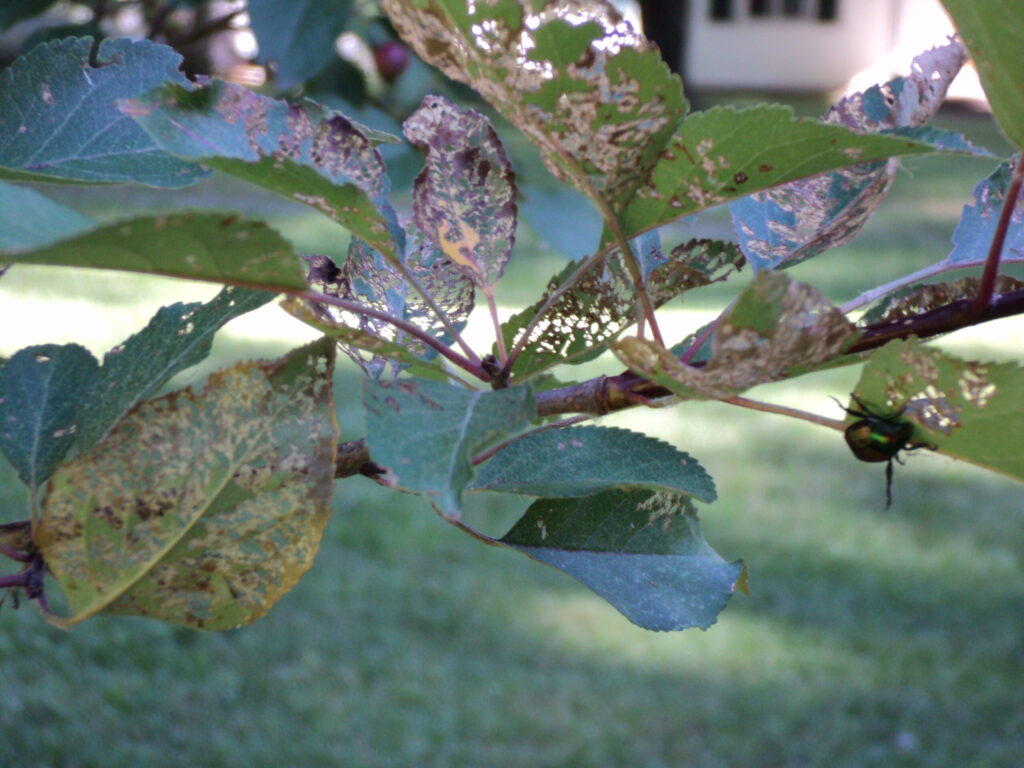
I was also working hard on level two of the plant health pyramid — trying to work on protein synthesis. I’d had a little bit of aphid pressure, but that was quickly disappearing. By year three, all of a sudden I wasn’t seeing Japanese beetles anymore at all on the apples. I had a couple of control trees and could see the beetles on those, so I knew it wasn’t just a fluke. But I wasn’t ready to say anything about it — I wanted at least a couple seasons of consistency to be sure it wasn’t just anecdotal — to have some level of clinical trial to it. And now I’ve had three years with no Japanese beetles.
Acres U.S.A. Do you have boron in your soil naturally? Or do you think it was the foliar applications of that as well that did the trick?
Johnson. Sulfur and boron are leachable nutrients, so even if you’ve got them in your soil matrix, it’s probably leaching — at least further down in the soil profile, if not completely out. My main soil strategy was lots of gypsum — 250 pounds or so per acre. It’s not until recently that I’ve split that up. I was putting it all out at once, as opposed to putting in out around different critical points of influence.
It’s only been in this last season that I started doing a little bit more magnesium and boron in the soil application. But yes — everything else has been foliar. Holocal — our calcium product — has a little bit of boron, or the older version did, and then I was using Rebound boron. And that’s definitely helped, especially around the time of cell division. Calcium’s just a stubborn thing to actually get where it needs to go — both into the tree and then also within the tree. That’s where boron is really helpful — helping calcium be more mobile.
Acres U.S.A. But manganese has been the one unexpected element that has been more helpful than others, you think?
Johnson. Yeah. Like I said, I was really curious about its upper limits — a good zone. Manganese is so important with its role in photosynthesis, water hydrolysis and regulating calcium — technically, it down-regulates potassium, which makes more room for calcium as the two can be antagonistic.
Acres U.S.A. And do you use any microbials in foliar products as well, to try to help the phyllosphere?
Johnson. Candidly, I’ve been really inconsistent with foliar biology. For me it was just a practicality — I was already spending quite a significant amount on my soil biology inoculations. If any of the biology was going out, it was more focused on soil.
But I would say that the main thing I’ve done that’s specifically contributed to Japanese beetles not being an issue has been focusing on micronutrients. I use lots of seaweed; it’s kind of a 1990s technology, but it works. There’s a lot of great data that shows that seaweed helps with systemic stress resistance.
And then I’ve just been working my way up the plant health pyramid. Every fall, when possible, I’ve done our soil primer. I actually put out OP-8 because I was concerned that I was getting a lot of glyphosate drift. But where I’ve seen the responses really kick in has been working on those foliar applications, especially with a strong focus on mitigating stress. We know that Japanese beetles come out during higher temperatures, which are already stressful times. Making sure you stay on top of water management and micronutrients is really important.