Acres U.S.A.® Magazine
  • Articles
    • News
    • Ecological farming
      • Climate
      • Environmental Issues
      • Farm management & planning
      • Human health
    • Livestock
    • Farm
    • Crop
      • Crop management practices
        • Ag technology
        • Cover crops
        • Crop nutrition
          • Crop protection
          • Diseases
        • Crops
        • Fruits
    • Soil
    • Opinion
  • Resources
    • Magazine
    • Online Learning
    • Newsletters
    • Free Articles
    • Blog
  • Magazine Issues
    • 2025
      • October 2025
      • September 2025
      • August 2025
      • July 2025
      • June 2025
      • May 2025
      • April 2025
      • March 2025
      • February 2025
      • January 2025
    • 2024
      • December 2024
      • November 2024
      • October 2024
      • September 2024
      • August 2024
      • July 2024
      • June 2024
      • May 2024
      • April 2024
      • March 2024
      • February 2024
      • January 2024
    • 2023
      • December 2023
      • November 2023
      • October 2023
      • August 2023
      • July 2023
      • June 2023
      • May 2023
      • April 2023
      • March 2023
      • February 2023
      • January 2023
    • 2022
      • December 2022
      • November 2022
      • October 2022
      • September 2022
      • August 2022
      • July 2022
      • June 2022
      • May 2022
      • April 2022
      • March 2022
      • February 2022
  • About Us
    • Our History
    • Our Staff
    • Contact Us
    • Community
      • Soil Health Primer Resources
  • Events
    • Eco-Ag Conference
    • Farm Weird Event
    • Viroqua On Farm Event
  • Subscribe
  • Login
  • Register
No Result
View All Result
  • Articles
    • News
    • Ecological farming
      • Climate
      • Environmental Issues
      • Farm management & planning
      • Human health
    • Livestock
    • Farm
    • Crop
      • Crop management practices
        • Ag technology
        • Cover crops
        • Crop nutrition
          • Crop protection
          • Diseases
        • Crops
        • Fruits
    • Soil
    • Opinion
  • Resources
    • Magazine
    • Online Learning
    • Newsletters
    • Free Articles
    • Blog
  • Magazine Issues
    • 2025
      • October 2025
      • September 2025
      • August 2025
      • July 2025
      • June 2025
      • May 2025
      • April 2025
      • March 2025
      • February 2025
      • January 2025
    • 2024
      • December 2024
      • November 2024
      • October 2024
      • September 2024
      • August 2024
      • July 2024
      • June 2024
      • May 2024
      • April 2024
      • March 2024
      • February 2024
      • January 2024
    • 2023
      • December 2023
      • November 2023
      • October 2023
      • August 2023
      • July 2023
      • June 2023
      • May 2023
      • April 2023
      • March 2023
      • February 2023
      • January 2023
    • 2022
      • December 2022
      • November 2022
      • October 2022
      • September 2022
      • August 2022
      • July 2022
      • June 2022
      • May 2022
      • April 2022
      • March 2022
      • February 2022
  • About Us
    • Our History
    • Our Staff
    • Contact Us
    • Community
      • Soil Health Primer Resources
  • Events
    • Eco-Ag Conference
    • Farm Weird Event
    • Viroqua On Farm Event
  • Subscribe
No Result
View All Result
Acres U.S.A.® Magazine
No Result
View All Result
Home Magazine issues June 2022

When the Sun Doesn’t Shine

Acres U.S.A. by Acres U.S.A.
November 28, 2024
in June 2022
0
When the Sun Doesn’t Shine

Zook hay mule — Barn-dried hay is irresistible to mules.

0
SHARES
8
VIEWS
Share on FacebookShare on Twitter

How to barn-dry square bales to make high-quality hay

Interview with Sam Zook, President of Keystone Bio-Ag

Acres U.S.A.: For this method, are you barn-drying loose hay or do you bale it first?

Zook: We do everything in small square bales. We bale it out in the field and then bring it into the barn to dry. People want clean, dry hay for horses without mold.

We’re in southeastern Pennsylvania and have high humidity. We’ll usually have one of our cuttings dry in the field, but it normally takes three and a half days — almost four days — to get good, dry horse hay. Sometimes dairy farmers will use less than completely dry hay, but it’s just not worth the risk for horses. 

With this method, two nice days is all we need. We cut it before noon, or at least around one or two o’clock, and we bale it the next evening. We’ll often ted it once or twice in the meantime. But don’t ask me what the moisture content is when we bale it, because I don’t know. It’s kind of an art. 

By that evening of the second day it’s still nice and green. It’ll keep its color after the drying — it’s usually about as green after drying as before. Without the fan drying it would get mowburnt. It would ferment a little bit. It just gets brown. 

I really like this method because it can make hay dependably. If it’s predicted to be nice weather, you cut it one day and put it in the barn the next. It’s not that hard to get hay almost finished by drying it out in the field like normal; it’s that final touch that’s very challenging. We just do that in the barn with the fan. 

Acres U.S.A.: So what does that look like in the barn? How are the square bales arranged and where does the fan go? 

Zook: We have a typical post-and-beam barn with 16 feet between the posts, and it’s about 45 feet long. So we build a mow that’s about 16 feet wide by 45 feet long. We set the fan at the front of the barn and we drive in the back. 

The fan is in a box. It’s a 4-foot fan. We built a plywood box that we can stack the hay around. 

I talked with an old-timer about this before I started. They actually did this back in the ’40s. It was a very common practice in this area. 

The key is to stack the hay so as to leave a tunnel down the middle of the mow — about 2 feet wide and as high as the fan is — 4 feet — to blow the air down. We stack the hay equally on either side of the tunnel and on top and on both ends. We stack it fairly tight, so there’s no easy out for the air; it has to push out through all the hay. We made a 2×4 frame to put on the top of the tunnel for support so the bales don’t fall down into the tunnel. 

So if you were inside this 2-foot by 4-foot tunnel, there’d be about 7 feet of hay stacked above you and to your left and right. The fan is behind you, and ahead of you, at the end of the barn, is another wall of 7 feet of hay. 

The reason for the box for the fan is so that we can stack seven bales above it, and so we can stack hay tight up against the box as well. 

We’ve done as many 900 bales in one mow. The number of bales isn’t as important — we’ve done as few as 350. We just brought the sides in a little bit, but we use the same principle.

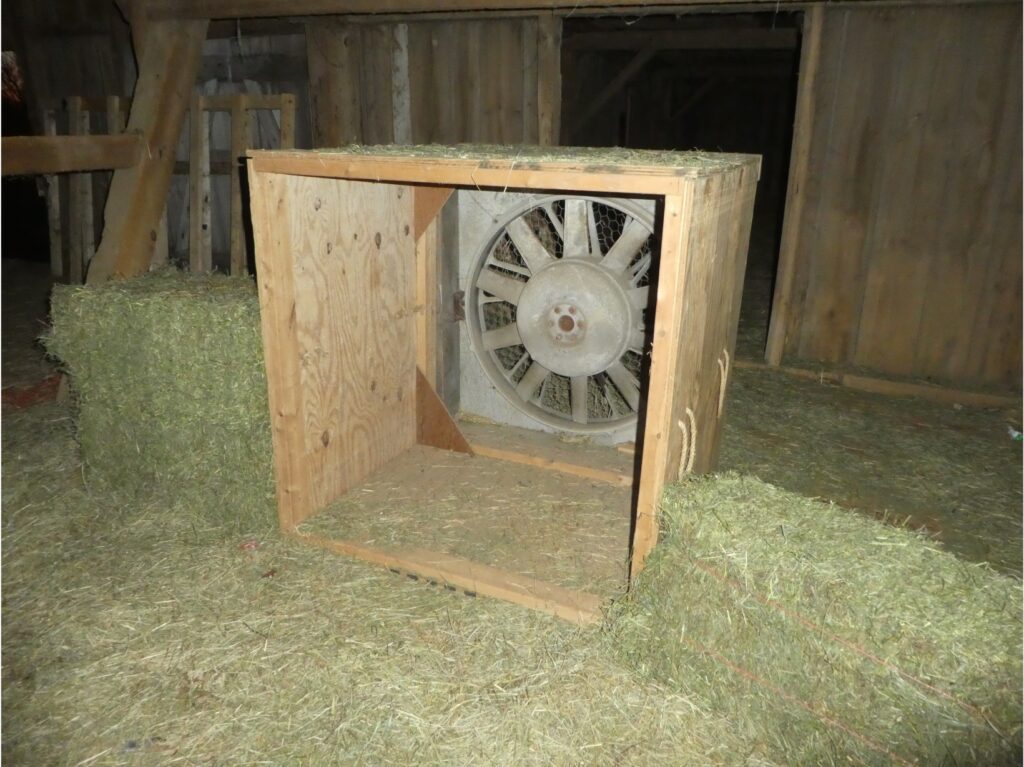
Zook fan — The fan Sam Zook uses to dry square bales in his barn

Acres U.S.A.: What horsepower is the fan?

Zook: It’s a 4-horsepower motor and pulls 18 amps — single phase 220 volt. It takes some power, but it’s not going to be too bad for your power bill. It creates a lot of static pressure.

Acres U.S.A.: How many days is the fan blowing?

Zook: It depends a little bit on how wet the hay is. The very first batch I made I thought this method was going to dry really wet hay. The bales I made were so heavy I could hardly pick them up — they must have weighed 120 pounds. I ended up throwing those out — they didn’t dry. 

I usually figure a minimum of four or five days running 24/7. Then, to finish it off, I shut the fan off overnight and run it another couple of days during the afternoon for four or five hours. It won’t heat anymore at that stage, and the afternoons are when there’s the least amount of moisture in the outside air.

It depends a little bit on the humidity. With fairly dry weather it won’t take quite as long. 

Ideally, I’d put a little bit of heat to it. I could cut the run time in half. I experimented with loose hay and blowing heated air. In two or three days it was done. 

Acres U.S.A.: But baling it in the field makes it a lot easier logistically than using loose hay.

Zook: It does. 

Acres U.S.A.: Is the end product uniform? Are the bales from the outside edges of the mow as dry as the ones nearest the fan?

Zook: The ones on the inside tend to be a little drier than the ones on the way outside corners. But I’ve found that if I make my mow square it helps. 

Acres U.S.A.: And after this is all done, it’s essentially top-quality horse hay.

Zook: Pretty much. It’ll be top price at auction every single day. And you don’t lose a cutting to rain as easily. 

Acres U.S.A.: Do you notice a difference in quality from first cutting to second to third — the same with this method as for regular hay?

Zook: Not really, no.

← Previous Treating Flies Negatively Treats the Soil Next Mobile Meat Slaughter: Silver Bullet or Siren Call? →
Tags: June 2022
Acres U.S.A.

Acres U.S.A.

North America’s oldest publisher on production-scale organic and regenerative farming. For more than 50 years, our mission has been to help farmers, ranchers and market gardeners grow food profitably, regeneratively, and with nature in mind.

Next Post

July 2022 • Issue #613

  • Trending
  • Comments
  • Latest
The Most Important Livestock in Our Fields

The Most Important Livestock in Our Fields

July 1, 2024
Glyphosate Does What It’s Designed to Do — Kill

Glyphosate Does What It’s Designed to Do — Kill

February 19, 2025
The Take-Half, Leave-Half Fallacy

The Take-Half, Leave-Half Fallacy

July 1, 2025
White snakeroot

Toxic Forages?

September 1, 2025
We Don’t Need Another Bridge — We Need an Off-Ramp

We Don’t Need Another Bridge — We Need an Off-Ramp

3
Under One Roof

Under One Roof

3
A Rose By Any Other Name

A Rose By Any Other Name

2
Terra Preta’s Biological Advantage

Terra Preta’s Biological Advantage

2
Don’t You Dare Disparage Sugar!

Don’t You Dare Disparage Sugar!

February 3, 2026
February 2026 • Issue #656

February 2026 • Issue #656

February 1, 2026
Fungal Exchange Capacity

Fungal Exchange Capacity

February 1, 2026
ECO-MEETINGS

ECO-MEETINGS

February 1, 2026

Recent News

Don’t You Dare Disparage Sugar!

Don’t You Dare Disparage Sugar!

February 3, 2026
February 2026 • Issue #656

February 2026 • Issue #656

February 1, 2026
Fungal Exchange Capacity

Fungal Exchange Capacity

February 1, 2026
ECO-MEETINGS

ECO-MEETINGS

February 1, 2026

About ACRES USA

Acres U.S.A.® Magazine

Acres U.S.A.® is North America’s oldest publisher on production-scale organic and regenerative farming. For more than 50 years, our mission has been to help farmers, ranchers and market gardeners grow food profitably and sustainably, with nature in mind.

Visit Our Advertisers

Magazine Issues

  • News
  • 2025
    • June 2025
    • May 2025
    • April 2025
    • March 2025
    • February 2025
    • January 2025
  • 2024 Articles
    • December 2024
    • November 2024
    • October 2024
    • September 2024
    • August 2024
    • July 2024
    • June 2024
    • May 2024
    • April 2024
    • March 2024
    • February 2024
    • January 2024
  • December 2023
    • December 2023
    • November 2023
    • October 2023
    • August 2023
    • July 2023
    • June 2023
    • May 2023
    • April 2023
    • March 2023
    • February 2023
    • January 2023
  • December 2022
    • November 2022
    • October 2022
    • September 2022
    • August 2022
    • July 2022
    • June 2022
    • May 2022
    • April 2022
    • March 2022

Contact Acres U.S.A

  • Contact Us
  • About Us
  • Advertise With Acres U.S.A.
  • My Subscription

Learn

  • Resources
  • Events
  • Magazine
  • Newsletters
  • Free Articles
  • Webinars
  • Online Courses
  • Bookstore

Our All Socials

Follow With Us...

  • My account
  • News
  • Ecological farming
  • Refund and Returns Policy
  • Privacy & Policy

© 2024 Acers USA Magazine

Welcome Back!

Login to your account below

Forgotten Password? Sign Up

Create New Account!

Fill the forms below to register

All fields are required. Log In

Retrieve your password

Please enter your username or email address to reset your password.

Log In
No Result
View All Result
  • HOME
  • ARTICLES
    • News
    • Farm
    • Ecological farming
    • Livestock
    • Crop
      • Crop management practices
      • Cover crops
      • Crop nutrition
      • Crop protection
      • Crops
      • Ag technology
    • Soil
    • Opinion
  • RESOURCES
    • Magazine
    • Online Learning
    • Newsletters
    • Blog
    • Free Articles
  • MAGAZINE ISSUES
    • 2025
      • June 2025
      • May 2025
      • April 2025
      • March 2025
      • February 2025
      • January 2025
    • 2024
      • December 2024
      • November 2024
      • October 2024
      • September 2024
      • August 2024
      • July 2024
      • June 2024
      • May 2024
      • April 2024
      • March 2024
      • February 2024
      • January 2024
    • 2023
      • December 2023
      • November 2023
      • October 2023
      • August 2023
      • July 2023
      • June 2023
      • May 2023
      • April 2023
      • March 2023
      • February 2023
      • January 2023
  • ABOUT US
    • Our History
    • Our Staff
    • Contact Us
    • Community
      • Soil Health Primer Resources
  • EVENTS
    • Eco-Ag Conference
    • On-Farm Viroqua Event
    • Farm Weird
  • SUBSCRIBE
  • Login
  • Sign Up
  • Cart

© 2024 Acers USA Magazine

Are you sure want to unlock this post?
Unlock left : 0
Are you sure want to cancel subscription?