
Acres U.S.A.® Magazine
  • Articles
    • News
    • Ecological farming
      • Climate
      • Environmental Issues
      • Farm management & planning
      • Human health
    • Livestock
    • Farm
    • Crop
      • Crop management practices
        • Ag technology
        • Cover crops
        • Crop nutrition
          • Crop protection
          • Diseases
        • Crops
        • Fruits
    • Soil
    • Opinion
  • Resources
    • Magazine
    • Online Learning
    • Newsletters
    • Free Articles
    • Blog
  • Magazine Issues
    • 2026
      • February 2026
      • January 2026
    • 2025
      • December 2025
      • November 2025
      • October 2025
      • September 2025
      • August 2025
      • July 2025
      • June 2025
      • May 2025
      • April 2025
      • March 2025
      • February 2025
      • January 2025
    • 2024
      • December 2024
      • November 2024
      • October 2024
      • September 2024
      • August 2024
      • July 2024
      • June 2024
      • May 2024
      • April 2024
      • March 2024
      • February 2024
      • January 2024
    • 2023
      • December 2023
      • November 2023
      • October 2023
      • August 2023
      • July 2023
      • June 2023
      • May 2023
      • April 2023
      • March 2023
      • February 2023
      • January 2023
    • 2022
      • December 2022
      • November 2022
      • October 2022
      • September 2022
      • August 2022
      • July 2022
      • June 2022
      • May 2022
      • April 2022
      • March 2022
      • February 2022
  • About Us
    • Our History
    • Our Staff
    • Contact Us
    • Community
      • Soil Health Primer Resources
  • Events
    • Eco-Ag Conference
    • Farm Weird Event
    • Viroqua On Farm Event
  • Subscribe
  • Login
  • Register
No Result
View All Result
  • Articles
    • News
    • Ecological farming
      • Climate
      • Environmental Issues
      • Farm management & planning
      • Human health
    • Livestock
    • Farm
    • Crop
      • Crop management practices
        • Ag technology
        • Cover crops
        • Crop nutrition
          • Crop protection
          • Diseases
        • Crops
        • Fruits
    • Soil
    • Opinion
  • Resources
    • Magazine
    • Online Learning
    • Newsletters
    • Free Articles
    • Blog
  • Magazine Issues
    • 2026
      • February 2026
      • January 2026
    • 2025
      • December 2025
      • November 2025
      • October 2025
      • September 2025
      • August 2025
      • July 2025
      • June 2025
      • May 2025
      • April 2025
      • March 2025
      • February 2025
      • January 2025
    • 2024
      • December 2024
      • November 2024
      • October 2024
      • September 2024
      • August 2024
      • July 2024
      • June 2024
      • May 2024
      • April 2024
      • March 2024
      • February 2024
      • January 2024
    • 2023
      • December 2023
      • November 2023
      • October 2023
      • August 2023
      • July 2023
      • June 2023
      • May 2023
      • April 2023
      • March 2023
      • February 2023
      • January 2023
    • 2022
      • December 2022
      • November 2022
      • October 2022
      • September 2022
      • August 2022
      • July 2022
      • June 2022
      • May 2022
      • April 2022
      • March 2022
      • February 2022
  • About Us
    • Our History
    • Our Staff
    • Contact Us
    • Community
      • Soil Health Primer Resources
  • Events
    • Eco-Ag Conference
    • Farm Weird Event
    • Viroqua On Farm Event
  • Subscribe
No Result
View All Result
Acres U.S.A.® Magazine
No Result
View All Result
Home Ecological farming Farm management & planning

Water for Cattle Farms

Acres U.S.A. by Acres U.S.A.
March 20, 2024
in Farm management & planning, General
0
Water for Cattle Farms
0
SHARES
8
VIEWS
Share on FacebookShare on Twitter

If you (hopefully) read John Kempf’s article in this issue of Acres U.S.A., you’ll recall the story he told about a dairy farmer in Ohio who begrudgingly realized that his high-clay soils — no matter how high the organic matter — needed drain tile in order to move water out of his pastures at certain times of the year. Yields went up 40-50 percent. John’s punch line was that in order to take yields to an even higher level, the farmer would need to also add irrigation. Such is the environment we live in. We need to acknowledge the fact that at some point, every operation experiences excess water, and adding drain tile would improve things; simultaneously, every farm at some point experiences drought and could benefit from irrigation. Doing one, not to mention both, isn’t economically feasible on many operations. But as a simple proposition, yields and quality would improve if every farm always had access to both in order to maintain optimal levels of soil moisture.

Keeping It Green by Jim Gerrish is a very practical manual for managing livestock via rotational grazing on irrigated pastures. It’s published by Stockman Grass Farmer — a publication similar to this one, except that it focuses exclusively on livestock operations. Gerrish covers five categories of irrigation and discusses the pros and cons of each, particularly in relation to grazing livestock.

Flood irrigation, which relies on various dams and diversions to streams, is the simplest and least expensive irrigation system. It works best with land that has just 1-2 percent slope, although it can handle up to 8 percent.

Solid-set sprinklers, hand lines, and wheel lines are different types of sprinkler systems that are linear in nature; Gerrish acknowledges the limitations of these: that cattle are prone to rub against and destroy manmade objects in their pastures, and protecting them with electric fence presents the risk of shorting out the fence.

Line-pod systems, like the New Zealand-made K-Line, are sprinklers connected by HDPE pipe that the farmer drags in a line behind a vehicle. They can water 6- to 8-acre pastures, enabling rotational grazing on small- to mid-sized farms.

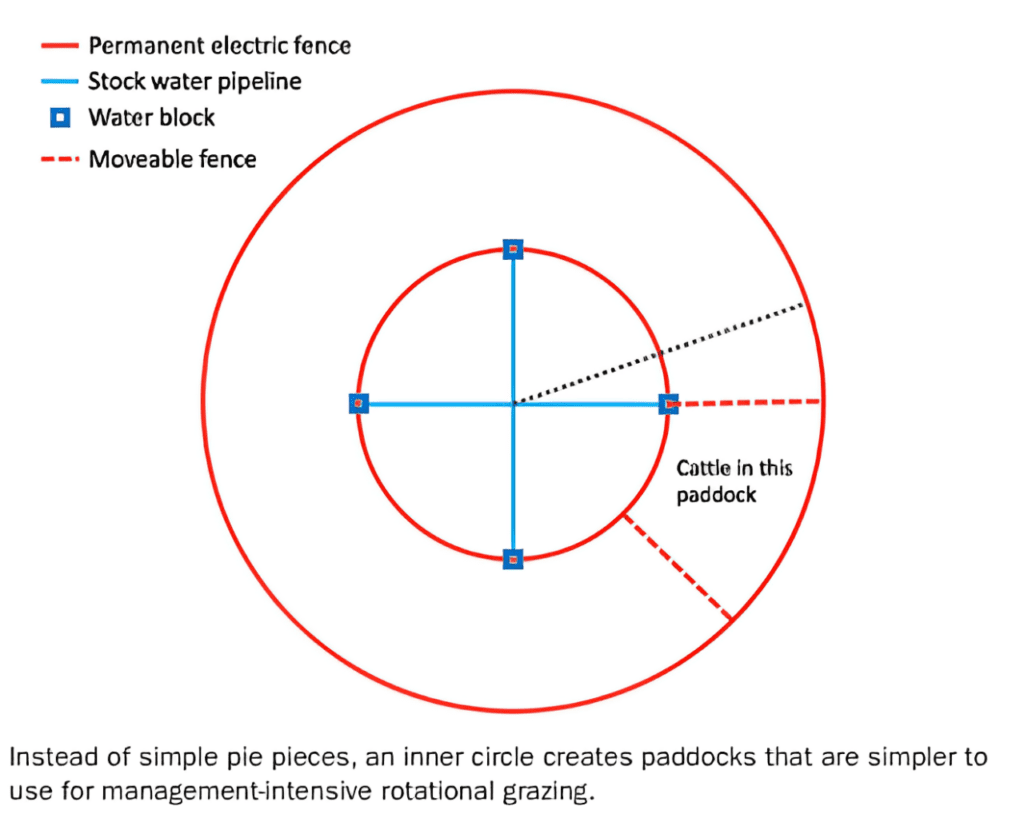
Center-pivot irrigation is of course ubiquitous in some parts of the country, although using such a system for grazing is not. Gerrish helpfully includes diagrams of how he breaks down grazing cells within these — instead of simple pie slices, he installs a fence halfway between the outer ring of the pivot and the center, and then puts in four water tanks spaced evenly around the inner circle.
Subsurface irrigation is seldom used for pastures due to cost, but Gerrish describes the conditions in which it may make sense and some basic principles for design. The book also contains a short discussion of water rights. It’s obviously not comprehensive, especially since this is such a complicated and controversial subject in the West. But it’s a helpful reminder to those of us east of the Mississippi that we should at least maintain a measure of gratitude that we don’t have to worry about such things!

Gerrish concludes the book with discussions of fertigation for pastures, getting the most out of an irrigation system, and the economics of each option. This is admittedly a niche topic — not every livestock operation has irrigation, although this book could certainly help persuade some who are on the fence to get it. And Gerrish doesn’t really deal with the environmental/ecological issues associated with pumping from (and helping to deplete) ancient water reservoirs — although he does encourage the use of “active” water from reservoirs that are being restocked, as opposed to “passive” ones that are not being significantly recharged. The challenges and ethics of the use of passive sources is covered in plenty of other resources; Gerrish assumes their use.

I’ll end with an anecdote from my cattle days. The farm I worked on was trying —financially unsuccessfully — to grass-finish cattle on heavy clay soil in Alabama. There’s a separate conversation to be had about what “grass-finished” really means — legally, albeit perhaps not ethically, it means that it’s OK to feed non-corn, non-soy feedstocks such as peanut meal and cottonseed. Even with purchased feed, though, it was only really possible to finish cattle there a few months of the year.

There was a farm in our network, though, that was able to produce excellent “grass-finished” cattle most of the year. They had sandy soils, but they were able to meet their targets because they had irrigation. They would feed the cattle and rotate them through the pastures, and they would seed and irrigate behind the cattle so they always had a good supply of grass.

As in this example — a location with 45+ inches of annual precipitation — irrigation has the potential to make a farming operation quite a bit more profitable. This book does an excellent job of explaining how.


← Previous Management-Intensive Agronomy Next ECO-MEETINGS →
Tags: Cattle Farms
Acres U.S.A.

Acres U.S.A.

North America’s oldest publisher on production-scale organic and regenerative farming. For more than 50 years, our mission has been to help farmers, ranchers and market gardeners grow food profitably, regeneratively, and with nature in mind.

Next Post

ECO-MEETINGS

  • Trending
  • Comments
  • Latest
The Most Important Livestock in Our Fields

The Most Important Livestock in Our Fields

July 1, 2024
Glyphosate Does What It’s Designed to Do — Kill

Glyphosate Does What It’s Designed to Do — Kill

February 19, 2025
The Take-Half, Leave-Half Fallacy

The Take-Half, Leave-Half Fallacy

July 1, 2025
White snakeroot

Toxic Forages?

September 1, 2025
We Don’t Need Another Bridge — We Need an Off-Ramp

We Don’t Need Another Bridge — We Need an Off-Ramp

3
Under One Roof

Under One Roof

3
A Rose By Any Other Name

A Rose By Any Other Name

2
Terra Preta’s Biological Advantage

Terra Preta’s Biological Advantage

2
Don’t You Dare Disparage Sugar!

Don’t You Dare Disparage Sugar!

February 3, 2026
February 2026 • Issue #656

February 2026 • Issue #656

February 1, 2026
Fungal Exchange Capacity

Fungal Exchange Capacity

February 1, 2026
ECO-MEETINGS

ECO-MEETINGS

February 1, 2026

Recent News

Don’t You Dare Disparage Sugar!

Don’t You Dare Disparage Sugar!

February 3, 2026
February 2026 • Issue #656

February 2026 • Issue #656

February 1, 2026
Fungal Exchange Capacity

Fungal Exchange Capacity

February 1, 2026
ECO-MEETINGS

ECO-MEETINGS

February 1, 2026

About ACRES USA

Acres U.S.A.® Magazine

Acres U.S.A.® is North America’s oldest publisher on production-scale organic and regenerative farming. For more than 50 years, our mission has been to help farmers, ranchers and market gardeners grow food profitably and sustainably, with nature in mind.

Visit Our Advertisers

Magazine Issues

  • News
  • 2025
    • June 2025
    • May 2025
    • April 2025
    • March 2025
    • February 2025
    • January 2025
  • 2024 Articles
    • December 2024
    • November 2024
    • October 2024
    • September 2024
    • August 2024
    • July 2024
    • June 2024
    • May 2024
    • April 2024
    • March 2024
    • February 2024
    • January 2024
  • December 2023
    • December 2023
    • November 2023
    • October 2023
    • August 2023
    • July 2023
    • June 2023
    • May 2023
    • April 2023
    • March 2023
    • February 2023
    • January 2023
  • December 2022
    • November 2022
    • October 2022
    • September 2022
    • August 2022
    • July 2022
    • June 2022
    • May 2022
    • April 2022
    • March 2022

Contact Acres U.S.A

  • Contact Us
  • About Us
  • Advertise With Acres U.S.A.
  • My Subscription

Learn

  • Resources
  • Events
  • Magazine
  • Newsletters
  • Free Articles
  • Webinars
  • Online Courses
  • Bookstore

Our All Socials

Follow With Us...

  • My account
  • News
  • Ecological farming
  • Refund and Returns Policy
  • Privacy & Policy

© 2024 Acers USA Magazine

Welcome Back!

Login to your account below

Forgotten Password? Sign Up

Create New Account!

Fill the forms below to register

All fields are required. Log In

Retrieve your password

Please enter your username or email address to reset your password.

Log In
No Result
View All Result
  • HOME
  • ARTICLES
    • News
    • Farm
    • Ecological farming
    • Livestock
    • Crop
      • Crop management practices
      • Cover crops
      • Crop nutrition
      • Crop protection
      • Crops
      • Ag technology
    • Soil
    • Opinion
  • RESOURCES
    • Magazine
    • Online Learning
    • Newsletters
    • Blog
    • Free Articles
  • MAGAZINE ISSUES
    • 2025
      • June 2025
      • May 2025
      • April 2025
      • March 2025
      • February 2025
      • January 2025
    • 2024
      • December 2024
      • November 2024
      • October 2024
      • September 2024
      • August 2024
      • July 2024
      • June 2024
      • May 2024
      • April 2024
      • March 2024
      • February 2024
      • January 2024
    • 2023
      • December 2023
      • November 2023
      • October 2023
      • August 2023
      • July 2023
      • June 2023
      • May 2023
      • April 2023
      • March 2023
      • February 2023
      • January 2023
  • ABOUT US
    • Our History
    • Our Staff
    • Contact Us
    • Community
      • Soil Health Primer Resources
  • EVENTS
    • Eco-Ag Conference
    • On-Farm Viroqua Event
    • Farm Weird
  • SUBSCRIBE
  • Login
  • Sign Up
  • Cart

© 2024 Acers USA Magazine

Are you sure want to unlock this post?
Unlock left : 0
Are you sure want to cancel subscription?