

Why one farmer in dryland eastern Colorado chose cover crops
John Heermann is a 32-year-old farmer in northeast Colorado. He grows cover crops with small grains on the 2,000 acres he rents. In this interview he discusses the benefits and challenges of dryland farming with cover crops.
Acres U.S.A.: Can you describe where you farm and what type of rotation you use?
Heermann: I farm about 2,000 acres dryland in the northeast corner of Colorado. I grow a number of different things. I don’t really have a set rotation. So, this year, I have wheat and rice, and oats and peas and winter peas. And I have some millet and some buckwheat. I’ve grown chickpeas in the past, and flax and milo and vetches.
Historically, April, May and June is the wettest period; our average rainfall is about 17 inches.
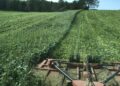
I started using cover crops eight years ago. I pretty much always plan a cover crop behind the summer-harvested crop. My wheat or rye or peas or oats — anything that’s harvested in the July-August period — I always try to get a cover crop behind it. It’ll be a 12- to 15-species mix, generally.
If I’m harvesting that in the summer and I’m going back to a spring or summer crop the next year, I usually try and get something in that cover crop that will overwinter. Usually it’s a grass, like a wheat or rye, or a triticale or a ryegrass. Some of the vetches will overwinter, and yellow clover does pretty good out here for overwintering.
I’m a big proponent of keeping a living root in the soil as many days out of the years as possible. I try to have 300-plus days a year with something photosynthesizing and building my soil.
Acres U.S.A.: After the winter cover crops, what are planting in the spring?
Heermann: I don’t have any row crops, so we plant millet or oats or peas, or possibly a buckwheat. Oats and peas, for example, are planted in March, and then we’re still combining them about the same time as wheat harvest. But buckwheat and the millets are more of a crop like corn, time-period wise. They’re planted in June and not harvested till September
Generally, I haven’t been putting a cover crop behind my summer crops, because usually I go right back to a wheat or a rye or a winter pea.
Acres U.S.A.: My understanding is that most dryland farmers in Colorado plant wheat and take it off in July or so, and then they do an entire year of fallow before planting wheat or rye again. And their reasoning for that would be that they don’t have enough moisture — that the cover crop would take up moisture that’s needed for the cash crop. Is that something that you’ve experienced? Why do you do something different?
Heermann: About 10 years ago I was in that boat. And there’s still a lot of guys that do that out here.
Pardon my French, but I think that’s a crock of shit. NRCS did some infiltration tests last year on my farm and some other conventional fields. I’ve been doing cover crops and continuous crops for eight years on the field they tested, and it was infiltrating four inches an hour. In a conventional fallow field — even if it was no-till — the infiltration was less than a half inch an hour.
When it rains out here, generally in the summer, it’s not a three-day, half-inch rain. You get two inches in 20 minutes or something. So, my whole philosophy now is that it doesn’t matter what your average rainfall is, if you haven’t built your soils to capture what you get.
If you do the standard fallow system, there’s basically two years without a crop, and you get 34 inches of rain, but you can still see the soils are suffering when it’s dry. There’s a lot of studies that show that fallows are about 30 percent efficient. So what do you do with the other 70 percent of the rain you got? You’re going to lose it through evaporation — which does your soil no good — or you can photosynthesize and lose it through transpiration, which puts carbon and exudates back into your soil and builds your soil up.
Acres U.S.A.: When you are doing wheat, how do you ensure that you have enough moisture in order to get it to germinate?
Heermann: Well, the guys who are doing the fallow generally plant wheat by the 10th of September, whereas I might not have my preceding crop out by then. I’m planting toward the back end of September, into October.

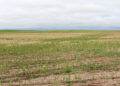
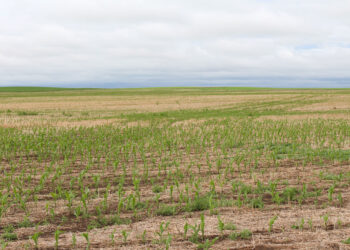
This year, the guys that had summer fallow and tilled it, some of those fields look horrendous, because they got poor germination and windblown soil. The wind just sawed it off, so there’s huge blank spots out there. I planted immediately after the combine, and I had very good stands. Plus I didn’t lose any soil to wind erosion.
And I was able to capture all the snow. That’s another thing — I try and have something standing out there — stubble — going into the winter months, to be able to catch snow.
Acres U.S.A.: Why don’t the guys who are doing fallow no-till?
Heermann: I think it’s a combination of tillage and just not having anything growing out there. I just don’t think there’s any way you can build soils without having plants photosynthesizing. One of the biggest misconceptions is that organic matter in your soil comes from organic material aboveground. But from what I’ve read, that’s entirely false. Most of it comes from the roots and the microbes in the soil. You need plant matter aboveground to protect your soil and keep it covered. That’s part of it. But there’s no way to build up soil without having plants belowground — cover crops with a diverse set of roots doing different things.
When we first got into it, it seemed like it was all roses and fairy tales. You just plant these cover crops and you’ll be the best farmer ever. But it takes some dedication and time — you aren’t gonna see results overnight. In this environment it takes a while.
Last year — year seven — was when I really started seeing a lot of things happening — as far as water infiltration and just looking at the soil — walking over it, it just feels different. Worms are back and it’s really well aggregated.
Acres U.S.A.: Do you think the thing holding other guys back from doing this is just patience —not waiting long enough to see the results? Why do you think some people aren’t really taking up these practices — cover crops specifically?
Heermann: Yeah, I would say that. It’s a systems approach. It takes dedication and time to see the course to the end. You’re gonna have to spend some extra money those first couple of years, and you might not see an immediate return on that investment — it’s going to cost more upfront.
Acres U.S.A.: If you’re renting, then you’re probably not going to have the motivation to do these long-term practices, correct?
Heermann: I actually rent every acre I farm — I don’t personally own anything. I just tried to educate my landlords about what I was doing and got them on board with it. Showing them things that have improved in their soil helped. I did that with one landlord, and I farmed for him for 10 years and then he wanted to sell his land. We had a good enough relationship that even though I couldn’t purchase it, my parents were able to. We were the first call.
The summer fallow — a part of it is influenced by crop insurance. Summer fallow guys are getting a better yield on their wheat than I might with continuous crops and cover crops, but it also takes them two years to grow one crop. And they had a ton of expenses — tilling or spraying or whatever. The way I look at it, a 60-bushel wheat yield for them is going to be the same as a 30-bushel wheat yield for me. When I’m getting back into wheat, seed cost is my first expense — I don’t have 10 passes out there tilling or three herbicide applications.
Acres U.S.A.: How much of a factor does age of the farmer play in this — just being open to trying something new?
Heermann: I think that’s part of it. I have some friends and know some people who struggle with this. Maybe they’re my age and want to do something different, but Dad’s still holding the reins. Sometimes there’s hesitation to let them do new things. They’re under a magnifying glass. And it doesn’t always pan out the first year. So then Dad’s like, “We tried, but it doesn’t work.” But it takes time.
I think one of the biggest windows for getting started with this is that there’s a lot of people in our area who grow wheat and then go back to corn the next year — into that wheat stubble. But you combine in July, and they’re not planting corn again till next May. So there’s 10 months there. It’s not necessarily considered a fallow period, but it is. I feel like that’s the best opportunity for us out here to do cover crops — behind that summer crop — because you can get 10 months of plants building up your soil.
NRCS has done a lot of like moisture profile work — comparing it to if you don’t plant any cover crops. And by springtime, compared to not doing cover crops, it’s pretty much identical, as far as moisture availability. Even if I do use up a little more moisture, my soils have more capacity to get moisture without being waterlogged during that those wet months of April, May and June.
Acres U.S.A.: Having more organic matter in your soil automatically means you’re able to hold more water, right?
Heermann: Yeah, you get 45,000 gallons of water for every 1 percent increase in organic matter. Some of my fields were under 1 percent when I started. I think my best ones are 2.7 or so now. So it’s definitely improved.