

Cover crops can help reduce nutrient excesses in hoophouse production
Editor’s note: This article originally appeared in Rural Heritage magazine.
Most of the time, the farmer’s footsteps are the best fertilizer. Walking the crops, it is often possible to spot a nutrient deficiency and correct it with the appropriate soil amendment. Unfortunately, detecting a nutrient excess is much more difficult. By the time nutrient levels are high enough to compromise plant health, it is too late to prevent the problem.
Although soil testing is not a substitute for the farmer’s footsteps, lab analysis can measure what we cannot see in the soil. Routine soil testing is especially helpful in high tunnels because fertility levels are likely to rise faster in these covered structures than out in the field, where precipitation moves nutrients and salts down through the soil.
Rarely a problem for field production, the accumulation of mineral salts from fertilizers, manure and compost can become a concern within just a few years of growing in a high tunnel. At a high enough concentration, these soluble salts can make it difficult for plant roots to take up moisture, a condition called “chemical-induced drought.” Soil salinity may cause poor seedling establishment, dehydrated leaves and reduced yields. A build-up of the most common salts — namely, calcium, magnesium, sodium, chloride, sulfate and bicarbonate — may also leave a telltale white film on the soil surface.
In 2017, Penn State horticulture specialists Elsa Sanchez and Tom Ford documented that plant growth issues due to elevated soluble salts were a common problem for greenhouse growers. Only four of the 27 farms in their High Tunnel Soil and Irrigation Water Quality Project had soluble salts below .40 mmhos/cm (millimhos per centimeter) — a level that generally does not cause salinity concerns. Over 1.21 mmhos/cm is considered saline and not desirable for greenhouse soils. Almost half of the tunnels tested above this threshold.
The average soluble salts level for the 27 farms was 2.02 mmhos/cm — 2.39 for the 19 conventional growers in the study and 1.16 for the eight farms that were certified organic or used organic practices. For the 16 tunnels that received compost and/or manure, the average was 2.19, including both the seven lowest and three highest results in the project.
In their Extension bulletin “High Tunnel Soil Test Report: Soluble Salt Levels,” Sanchez and Ford provide recommendations for mitigating soil salinity: avoid nutrient sources containing animal manure (a single heavy application of manure-based compost may increase soluble salts high enough to affect plant health); use irrigation water and fertilizers with low salt levels; do not overapply nutrients; occasionally remove the high-tunnel plastic over winter to allow rain and snow to naturally leach out the dissolved salts, or leave the hoophouse uncovered for an extended period when it is time to replace the plastic; leach the salts out of the topsoil with overhead irrigation. Six inches of irrigation water are usually sufficient to leach 50 percent of the soluble salts out of the top foot of soil. To remove 90 percent of the salts, 24 inches of water may be necessary.
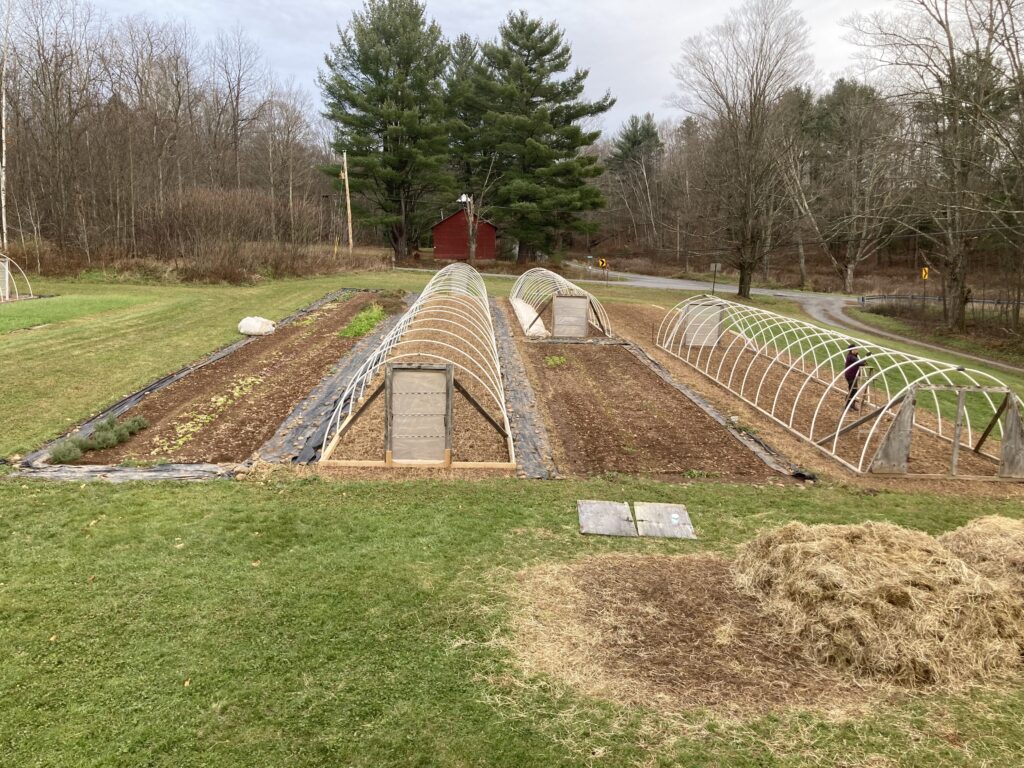
Our high tunnel management utilizes the first two recommendations, making the last two suggestions unnecessary. We take the poly cover off the hoophouses every winter, and we move the tunnels regularly. Our rotation is two years of high tunnel vegetables followed by two years of cover cropping, then back to hoophouse produce again.
Twenty-seven years into this hoophouse/cover crop rotation, our tunnel that was sampled for the Penn State project had 0.14 mmhos/cm soluble salts — the lowest in the study. The downside of this salinity prevention strategy is that removing the greenhouse plastic every winter limits the use of the portable hoophouses to season extension, significantly reducing the income potential compared to year-round production in a permanent greenhouse.
Phosphorus and potassium levels were above optimum on most of the farms in the Penn State project, including our hoophouse, which had 586 lb/A (pounds per acre) phosphate and 702 lb/A potash. (Penn State uses the Mehlich 3 extraction method to determine phosphorus and potassium levels, which are reported as phosphate [P205] and potash [K20] in pounds per acre. The numbers will not be the same coming from labs that report their results in elemental phosphorus or potassium in parts per million or that use different extraction methods, such as Bray, Olsen or Modified Morgan.)
Although ideal nutrient ranges have not been established for high-tunnel crops, phosphate values over 321 lb/A and potash above 336 lb/A “exceed crop needs” for field production. The average for the project was 1,580 lb/A phosphate and 1,282 lb/A potash, with no apparent link between current compost usage in the high tunnels and excessive soil nutrients.

Sanchez and Ford state in their “High Tunnel Soil Test Report: Soil Nutrient Levels” that “having nutrients in the ‘exceed crop needs’ category can be as bad as being in the ‘deficient’ category. High soil nutrient levels might not only represent an economic loss, but may also result in crop, animal or environmental problems…. When using compost, be aware that most composts do not contain nutrients in balanced amounts needed by plants. They can have an excess of phosphorus and potassium relative to plant demand for nitrogen.”
In the nutrient management study for peppers, one inch of compost supplied 441 lb/A of nitrogen, 1,345 lb/A phosphate and 1,559 lb/A potash — twice as much for the two-inch application. The recommendation for peppers was only 100 lb for each of these nutrients.
If phosphorus and potassium are not already too high in the soil, Sanchez and Ford recommend using compost in moderation and relying on soil amendments, such as feather meal or dried blood, to provide most of the nitrogen for organic vegetables. These slaughterhouse wastes have an analysis of 12-13 percent nitrogen and do not contain phosphorus or potassium.
Unfortunately, we made the common mistake of relying solely on compost for fertilizer over the first 20 years of hoophouse production. We did not soil test regularly because the crops looked healthy. So we were shocked when a 2010 Penn State soil test showed very high soil nutrients. We were fortunate not to experience the crop quality issues, insect pressure and reduced yield reported by growers whose soil phosphorus and potassium was high enough to tie up trace minerals in the soil.
Alarmed by the excessive levels of phosphorus and potassium, we removed the top-growth of the cover crops to intentionally draw down the surplus nutrients in the soil, and we cut back the application rate of our horse manure compost to four gallons per 100 square feet. Based on a 2018 compost analysis, this application rate of 8 yards per acre provides 50 lb/A phosphate and potash — more in balance with the nutrients leaving the soil via the sale of the vegetables. Since this application rate only provides 45 lb/A nitrogen — much of it not available the first year — we purchased peanut meal (8-1-1) from Fertrell to supply most of the nitrogen for the high-tunnel produce. (For side dressing long-term crops, such as kale or collards, we use ground organic roasted soybeans, out of concern for customers with peanut allergies.)
Seven years later, the 2017 soil test for the Penn State project verified that these changes had substantially reduced phosphorus and potassium, although the levels still exceeded crop needs. Now we have shifted our focus to increasing soil organic matter. The 3.6 percent reading on our 2017 report falls within the 2-5 percent range considered a good target for Pennsylvania field production. However, the vast majority of the farms in the high tunnel study had higher soil organic matter than us. The average was an impressive 6.3 percent.
Generally, more is better when it comes to this leading indicator of soil health, because organic matter provides so many benefits, such as improved soil tilth, moisture retention and nutrient availability. However, Sanchez and Ford note that “organic matter accumulates in high tunnels much quicker than in the field. At too high levels, problems from a nutrition imbalance can occur. When values reach about 15 percent or more, the soil acts more like a soilless media or potting soil.” Other concerns with very high soil organic matter include weak root support, poor soil wetting, nitrate pollution and accelerated carbon loss to the atmosphere when the soil’s organic matter capacity has been saturated.
Going forward, our goal is to increase soil organic matter in the portable hoophouses to 5 percent by planting cover crop cocktails, using tarps to reduce tillage, and increasing the compost rate. Instead of adding more horse manure compost, which would import additional phosphorus and potassium, our plan is to recycle the existing nutrients in the soil by making the extra compost from the cover crop top-growth.
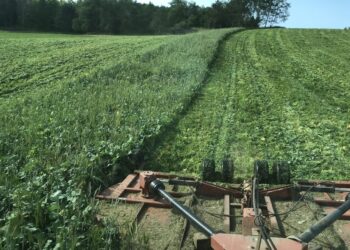
Of course, we could just leave the mowed cover crop residues on the soil, which would be a lot less work. On the other hand, we have learned the hard way that a cover crop mulch can create ideal habitat for slugs. More importantly, leaders in regenerative vegetable production such as Paul and Elizabeth Kaiser of Singing Frogs Farm and John Jeavons, founder of Grow Bio-Intensive, claim that composting the aboveground biomass conserves more carbon than leaving the residues on the soil surface or tilling them into the earth. Time will tell if the extra effort is worth it.
We will continue the hoophouse/cover crop rotation because this system seems like a surefire way to keep soluble salts at a low level. We are also committed to soil testing every few years to make sure soil organic matter, phosphorus and potassium are trending in the right direction and to monitor the minor nutrients as well as pH.
To round out soil fertility management, the many farmer footsteps required for greenhouse production provide ample opportunity to evaluate crop health.
Anne and Eric Nordell of Beech Grove Farm in Trout Run, Pennsylvania, have been growing vegetables and cover crops since 1983 and have been certified organic since 1987. Read more of their articles at covercropsincorporated.wordpress.com.