Compost can help farming systems build soil function over time — when it is treated as a soil amendment rather than a fertilizer substitute
Across much of the Midwest, the standard corn-soybean rotation is already working. Fertility programs are dialed in, soils are productive, and yields are generally consistent year after year. The most practical approach, then, is to look for ways to improve the system without disrupting what already works.
In high-performing conventional systems, compost is not a rescue input, and it is not a replacement for a fertility program. It is better understood as a low-risk tool — one that can be introduced carefully to evaluate whether soil function, structure, and biological activity can be improved over time without creating new problems in the process.
Function Over Fertility
One of the most common mistakes when evaluating compost is to treat it like fertilizer. On paper, compost contains nitrogen, phosphorus, and potassium. It’s easy to run those numbers through a nutrient budget and assume it can substitute for part of a conventional fertility program. In practice, though, that approach breaks down quickly.
Only a small fraction of the total nitrogen in compost, often in the range of 10–15 percent, is plant-available in the first year. Attempting to meet crop nitrogen demand with compost alone would require application rates high enough to drive phosphorus levels well beyond what the crop needs.
The key to this paradigm shift is to start seeing compost as a soil amendment, not a fertilizer. Its primary role is not to supply nutrients in the short term, but to contribute organic matter, introduce biologically active material, and gradually influence soil structure. Framed this way, compost is not competing with a fertility program; it is operating alongside it, targeting a different part of the system.
A Practical Entry Point
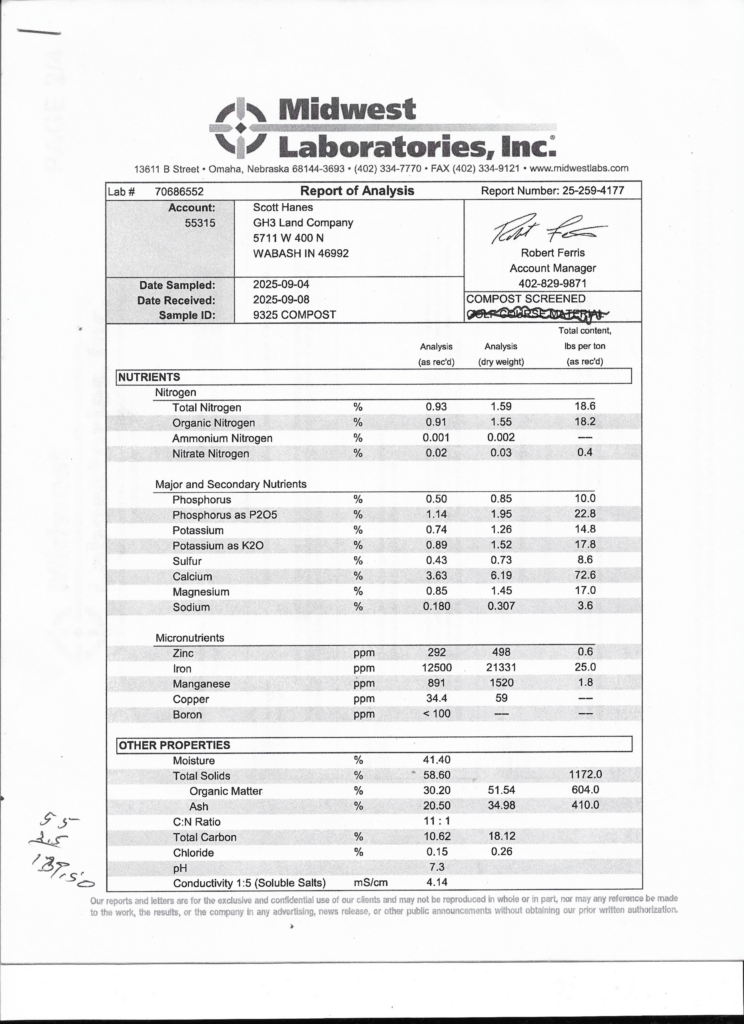
Most composts used in row crop systems fall into a similar range: moderate nutrient content paired with a significant amount of stabilized organic matter. A typical analysis might show roughly 18–20 pounds of total nitrogen per ton, organic matter around 30 percent, and a C:N ratio near 11:1.
It’s important to interpret these numbers in context. The nutrient content is real, but it’s modest relative to crop demand. The organic matter fraction, on the other hand, represents a more durable input — material that contributes to soil structure and supports biological activity over time rather than driving immediate yield response. This places compost firmly outside the role of a primary fertility source. Its value lies in soil building, biological stimulation, and gradual improvement in how the system functions, rather than in supplying nutrients on a season-by-season basis.
For most high-performing conventional operations, the most effective way to evaluate compost is not to commit across the entire farm, but to start small and treat it like any other management trial. A few strips or a defined block are enough to generate meaningful observations under real conditions. This approach keeps risk low while allowing for a clear comparison against standard practice. The goal is not to prove a point in one season, but to see how the system, particularly the soil, responds over time.
Before discussing application rates, it is useful to define the type of compost this recommendation is based on. The analysis shown here represents a stable, mature compost with moderate nutrient levels, a C:N ratio near 11:1, and organic matter around 50 percent on a dry weight basis — typical of well-processed materials. Composts in this general range can serve as a practical reference point. Materials that are significantly higher in salts, nutrients, or moisture may require adjustment.
A practical baseline rate for compost application on a functioning conventional farm with a corn-soy rotation is 2 tons per acre (as received), applied ahead of corn. This provides a measurable input of organic matter and nutrients without pushing the system too far. For growers interested in testing response across a slightly wider range, 3 tons per acre can be included as a comparison.
Higher rates should be approached with caution. Without a clear soil test justification, pushing beyond this range increases the risk of unnecessary phosphorus loading and elevated salt levels without a corresponding agronomic benefit.
In terms of timing, flexibility is one of the advantages of compost. Applications can be made either in the fall or pre-plant in the spring. Given the low proportion of immediately available nitrogen, fall applications carry minimal risk of nitrogen loss compared to more soluble sources.
Placement is straightforward. Compost is typically broadcast uniformly across the field. Where feasible, light incorporation — such as a shallow disc pass — is often preferred to position the material within the active root zone and to improve soil contact. In reduced-tillage systems, surface application remains a practical and acceptable option.

Corn vs. Soy
Within a corn-soybean rotation, corn is the more logical entry point for compost applications. Corn has a higher overall nutrient demand and tends to be more responsive to changes in soil condition, particularly early in the growing season. Improvements in tilth, water retention, drainage, and root environment are more likely to translate into observable differences with corn than with soybeans.
Soybeans operate under a different set of constraints than corn, and that changes how compost should be used. Rather than relying on external nitrogen inputs, soybeans meet most of their nitrogen demand through biological fixation. Early-season nitrogen comes from the soil, but as nodulation develops, the plant increasingly supplies its own needs. Introducing additional nitrogen into that system, particularly early, can interfere with nodulation and reduce the efficiency of that process.
For this reason, direct compost applications ahead of soybeans should be avoided or limited. Where used, rates in the range of 1–2 tons per acre are generally sufficient and help avoid unintended nutrient loading. In most cases, the better approach is to skip direct application altogether and allow soybeans to benefit from the residual effects of compost applied ahead of corn. Improvements in soil structure, moisture dynamics and biological activity carry forward into the soybean year without introducing the risk of disrupting nitrogen fixation.
A Short-Term Reality Check
In a well-managed system, the first year after applying compost is unlikely to produce dramatic results. Yield is likely to remain unchanged, and the nitrogen contribution will be minimal relative to the overall fertility program. From a crop performance standpoint, the field may appear largely unchanged. But that does not mean nothing is happening.
The earliest changes tend to show up in the soil itself. Surface tilth may improve slightly. Aggregation in the topsoil can become more noticeable. Water infiltration following rainfall may be more consistent, and fields may work a little easier under marginal planting conditions.
These are subtle shifts, but they are meaningful. They influence how the soil handles water, how roots move through the profile and how the field responds to stress. Early responses are physical and in the soil, not yield-related.
Why Use Compost at All?
After compost is applied, the effects begin to accumulate over multiple seasons. Soil structure becomes more stable, with stronger aggregation and better continuity through the surface layer. Biological activity increases as organic material and microbial populations build. Water dynamics shift as well — both infiltration and retention improve, allowing the soil to handle rainfall more effectively while holding moisture longer during dry periods.
These changes translate into more consistent field conditions. Trafficability improves, particularly in wetter springs, and the system is better equipped to withstand periods of stress, including late-season drought. All these things contribute to crop health and improved yield and quality.
This is a different kind of response than what shows up in a single season’s yield data. The improvements are system-level, influencing how the field performs across a range of conditions rather than producing a clear, immediate signal on a yield map.
Economics: Delayed but Important
Compost carries a clear upfront cost. Material, hauling and application all add to the per-acre expense; in a system that is already profitable, that cost has to be justified. The return does not typically show up as a single-season yield increase. It develops more gradually, and often indirectly.
Over time, there is potential for reduced reliance on herbicides as soil cover and biological activity improve. Labor requirements may shift as fields become easier to manage under a wider range of conditions. Improvements in soil structure can increase water efficiency, reducing stress during dry periods and improving trafficability in wet conditions. As nutrient cycling becomes more active, there may also be opportunities to make measured reductions in fertilizer inputs.
These changes are incremental and do not arrive all at once. Over time, they begin to shift how the system functions. The goal is not to eliminate inputs; it is to place them more strategically. In that context, compost represents a shift in investment, away from short-term correction and toward long-term soil function. For those focused on long-term land stewardship, compost application is a logical addition to the system.
Compost is not a silver bullet. When approached as a short-term input, compost is often misapplied. It is not a reliable yield driver in the first year, and it does not function as a replacement for a fertility program.