

An interview with John Hartsough of Creekside Farms on soil conservation, adapting with the times, and the independence found in farming
Acres U.S.A. Your family farm has deep roots in Indiana and the Midwest. Can you share a bit of the history?
John Hartsough. The story begins with my great-grandfather, Daniel Lantise Hartsough. He farmed over 100 acres in Pleasant Township back in the 1890s, but like many farmers during that time, he lost the land — likely a result of the agricultural downturn worsened by the Panic of 1890. Falling crop prices, tightening credit, and rising debt made it difficult for small farmers to hang on. In 1903, he moved to Chester Township and started again with 40 acres. My grandfather, William Young Hartsough, added another 40 acres nearby, and eventually both farms grew to 120 acres each. By 1960, they were joined together. Over time, we added a few more pieces. Today, the home farm spans 283 contiguous acres.
Acres U.S.A. What kind of operation was it during those early years?
Hartsough. It was always a diversified operation — beef cattle, pigs, chickens, and field crops like hay, oats, wheat and corn. Soybeans came later, originally as a forage crop. They used horses for power, and manure was the main source of fertility. Cream was separated and sold, with the skim milk going to pigs. Most of what they grew was for on-farm use. Corn, for instance, was mainly fed to livestock. It wasn’t really a cash crop like it is today. There might’ve been some grain taken to a local elevator, but this was more of a subsistence model. You’d grow what you needed to feed the animals and the family.

They had what was called a “grain bank.” Farmers would take corn to the elevator, and the elevator would grind it into feed and bring it back. Grinding on the farm wasn’t as common back then. Later, Dad and I had our own grinder and mixer — we made all our own rations.
One of my earliest jobs was helping Dad grind feed. We had a hammer mill that ran off a flat belt from the tractor. The feed would drop into the mixer, and Dad would add bagged supplements — probably protein and minerals like calcium. We’d fill burlap bags with the finished ration, and I’d drag the full bags away while he filled the next one. That’s how I first learned to be useful on the farm.

Acres U.S.A. You’ve shared some interesting historic farm photos; can you explain them a bit?
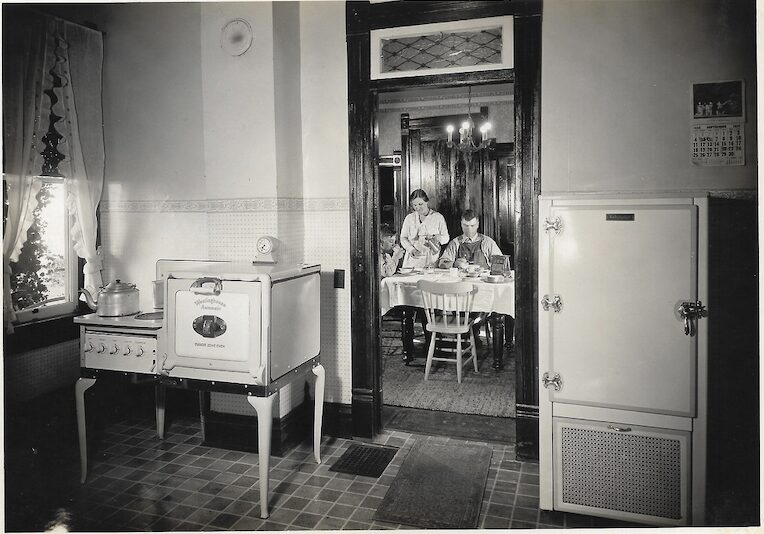
Hartsough. Sure! Those photos were taken in 1932 and were actually commissioned by the International Harvester Company for advertising purposes. All the equipment shown is International Harvester, and one of the pictures even ended up on the November 1934 page of their calendar — that same calendar is still hanging in my office today.
There’s also a family story tied to those photos. My grandpa was an early adopter of tractors. He and my grandma had gone to Kriegbaum & Sons, the International Harvester dealer in Huntington, Indiana, to pick up tractor parts. On the way out, they passed a display featuring an electrically powered vacuum pump milker, and possibly a cream separator. My grandma casually mentioned that it might be nice to have one of those. Jim Kriegbaum overheard her, and that evening after milking was done, he showed up at their farm and stayed until midnight. He must’ve made the sale!
Acres U.S.A. You had electricity that early on the farm?
Hartsough. My great-grandfather signed an easement for power poles to go across the north field back in 1921, but it wasn’t officially recorded with the county until 1934. Those poles carried electricity to North Manchester from Huntington. Since the photos are from 1932 and show powered equipment, we think the farm first had electricity around 1928.
Acres U.S.A. What a rich history to have documented. Have you dedicated your whole career to the family farm?
Hartsough. Not entirely. In my twenties I studied physics at Manchester College, then earned a master’s in agricultural engineering from Purdue in 1969, focusing on environmental control in confinement livestock systems. That really sparked a passion for animal care. I graduated during the Vietnam War, and like all young men at the time, I had to report for military service. I was raised in the Anabaptist tradition, and when I registered with the military at 18, I had marked that I was a conscientious objector. So, I had to line up “alternative service.”
That summer I worked in Oak Ridge, Tennessee, at a research facility where they’d done uranium enrichment for the Manhattan Project — so there was a lot of nuclear research going on. I was assigned to the animal research division. When the first atomic bomb was detonated in Alamogordo, New Mexico, some cattle nearby had been exposed to fallout. They brought those animals to Oak Ridge to study the long-term effects of radiation on living tissue. I worked under a veterinary pathologist from Kansas State. I took notes during necropsies — documenting what organ systems were affected, how the radiation manifested in tissue. It was a powerful experience, watching science try to piece together the impacts of something so destructive. That was my introduction to veterinary medicine, in a way, and it planted a seed.
I served my alternative service for the Vietnam war in Morocco. I was assigned to a leprosy rehabilitation center in the Middle Atlas Mountains, affiliated with a hospital in Casablanca. The operation was well-established by the time I arrived, with apples, pears, potatoes, wheat, sheep, dairy cattle and breeding chickens — we’d send fertilized eggs to a French-run commercial incubator in Casablanca. When the French director left, it was just me and a Swiss volunteer named Fritz managing everything. The project was under the Jesuits and connected through Eirene, a conscientious objector program started by the Brethren Volunteer Service in postwar Germany.

It was an incredible experience that clarified a lot for me. I had thought about coming home early, but I stayed and realized I didn’t want to pursue abstract high-tech physics—I wanted to do something more grounded and practical. When I came back to the U.S. I earned my veterinary degree and worked as a veterinarian for several years.
Acres U.S.A. What eventually brought you back to the farm? And how did your experiences off the farm guide your management style when you returned?
Hartsough. I always felt tied to the farm, even when I was away. As a kid, I turned down playing Little League because I felt more useful contributing to the farm. That sense of purpose always stuck with me.
In the spring of 1980, my father called me — he was recovering from prostate surgery and couldn’t plant the crops. I told him not to worry and came home. That was it. I left veterinary practice and returned to the land.
There was a bit of tension at first. Even though I had a Ph.D. and years of experience, my dad still didn’t think I could plant corn right. He stood on the tractor, unable to sit due to surgery, and did it himself. That’s just how it was — passing on the farm came with a steep learning curve and a healthy dose of humility.
Acres U.S.A. What kind of changes did you implement once you returned?
Hartsough. One major shift came in 2002 when I started a dairy heifer replacement business. We repurposed the old hog barns and expanded the operation to raise around 2,000 calves a year. I developed my own feed ration — high protein, with soybean meal, distillers’ grains, and fine-ground alfalfa meal. I added about 7 percent alfalfa to mimic natural grazing. It helped stimulate healthy rumen development — those papillae in the stomach always looked good when I did my own necropsies. I also used ingredients I trusted. I tended to run a slightly higher protein level than what was typical. I paid close attention to trace minerals, making sure they were balanced. We even added a bit of extra copper based on research I’d read.
A big part of our low death rate was due to practicing preventative medicine. When calves got sick, we didn’t reach straight for antibiotics — we focused first on fluid therapy. A lot of times, the issue was dehydration. If you can keep a calf hydrated with the right balance of electrolytes — sodium, potassium, all the right elements — you can stay ahead of the game. Of course, we still had cases where antibiotics were necessary, especially since we were bringing calves in from different sources.
I was always thinking about what a calf would be doing naturally — like out on pasture with its mother. Pretty early on, a calf starts nibbling at whatever’s around — grasses, forbs, a bit of everything. A lot of conventional rations use oats or soy hulls to add fiber, but I thought, why not use a natural plant product like alfalfa? It’s high in protein and also contains keratin and other natural compounds, so that’s why I included that.

Also, early on I made a habit of doing a necropsy on every calf that died because I wanted to know what was going on. Sometimes I’d send tissue or bacteriology samples to the state diagnostic lab. I got to know the folks there pretty well — we had a good working relationship. I’m very proud to say the mortality rate was consistently around 2 percent, well below the 10 percent industry benchmark. It was gratifying to apply veterinary science to a real system I built from the ground up.
Acres U.S.A. How would you describe your farming philosophy for field crops?
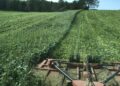
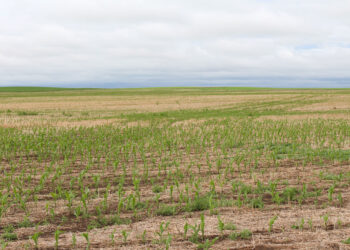
Hartsough. It’s centered around conservation. Serving on the local soil and water conservation board changed my thinking. It made me question fall tillage and helped me appreciate the protective value of surface residue. We’ve totally phased out fall tillage. Instead, we use a single light spring pass — about four inches deep — with sweeps that undercut and flip residue. I run what I call the “Mulch Master,” which helps maintain surface residue and gives a nice seedbed.
Our main fertility input is manure. We apply 6,000 gallons per acre every other year on soybean stubble before corn. That’s been enough — we haven’t used commercial fertilizer on our 120-acre West Farm in over four years.
Acres U.S.A. Have yields followed suit?
Hartsough. Surprisingly, yes. I’ve consistently applied around 180 to 190 units of nitrogen per acre since the 1980s. Yields used to be 180 bushels per acre; now we’re seeing closer to 200. I haven’t changed the inputs. I think it’s genetics — but also I’ve improved soil structure and organic matter. When I till now, the ground crumbles. It used to bake into bricks when I was a kid.

Acres U.S.A. How are you managing soil health and fertility?
Hartsough. We do soil testing every two acres, every four years, and apply nutrients variably using GPS. It’s more efficient and environmentally sound. We also use injected hog manure — incorporated with coulters to minimize odor and nitrogen volatilization. It’s a clean system and follows state environmental rules.
We used municipal sludge for six years, too. It was injected like the manure, and we did baseline heavy metal tests beforehand. It was a cost-effective nutrient source when it was available. I’m not a fan of side dressing — another pass over the field, another time-intensive step. At that point in the season, I’d rather not mess with it.
Acres U.S.A. Any experience with cover crops or biological amendments?
Hartsough. I’ve trialed cereal rye. It’s promising but can backfire if not terminated on time. I’ve found it draws moisture from the soil, which can delay planting, and that can be an issue given our narrow planting widow. I’ve also tried microbial inoculants in planter-box lubricants. I’m curious, but I need real data, not just anecdotes. If it’s measurable, I’m all ears.
Acres U.S.A. What’s been your biggest challenge?
Hartsough. Weed control in the early years. When I first took over the farm in 1985, I was idealistic — I wanted to manage everything with cultivation. Rotary hoes, row cultivators, etc. But a few wet springs, and the foxtail got ahead of me. I learned the hard way. It taught me that ideals have to be grounded in practical outcomes. Now I rotate crops and chemistry and use herbicides strategically. It’s a balance.
Acres U.S.A. Are your practices financially sustainable?
Hartsough. They are. Less tillage means lower fuel use. The equipment lasts longer. My planter coulters used to wear out every other year—now they last much longer because the ground is softer and we’re only tilling about four inches down. We’re not over-applying nutrients, and the manure is free, thanks to a local partnership.
Acres U.S.A. What are you exploring next?
Hartsough. Well, I’m 77 years old, so I phased out dairy replacement heifers several years ago. Now I’m experimenting with split nitrogen applications to allow for true no-till. I’m also curious about hemp as a fiber crop, but there are a lot of hurdles to get over there. And I’m learning more about soil biology — how microbial communities interact with nutrients. I want my practices to be evidence-based and adaptive.
Acres U.S.A. Any favorite farm hacks?
Hartsough. For decades, I could fix just about anything with a wrench, some baling wire, and a bit of patience. That self-reliance saved me countless hours and dollars. But with newer tractors and precision ag tools, the troubleshooting now starts with a laptop. That shift has been frustrating at times. You used to feel the machine when it had a problem. Now, you read it off the code. I still keep a pretty analog mindset when I can — simple tools, fewer moving parts, more control in my hands. So, keep it simple when you can.
Acres U.S.A. If you could only keep one tool, what would it be?
Hartsough. A good utility tractor. It’s the backbone of nearly everything on the farm.
Acres U.S.A. If you could share a meal with any farmer from history, who would it be?
Hartsough. I’d like to talk with Edward Faulkner, who wrote Plowman’s Folly. I’d ask him how his ideas have held up in today’s context of biological farming.
Acres U.S.A. What do you hope future farmers will say about your work 100 years from now?
Hartsough. That I stewarded the land with care and left the soil in better shape than I found it.
Acres U.S.A. Can you describe a moment — however small — when you looked around and thought, “Yes, this is exactly why I farm”?
Hartsough. One moment that stands out was during harvest. The sun was just setting, and I was finishing the last pass in a field that had been in our family for over a century. Everything had gone right that year — good weather, healthy crops, strong yields. I looked up and realized that the same soil my great-grandfather walked is still producing, still sustaining. It’s hard to explain, but in that moment, I felt like I was part of something much larger than myself.