

The market is signaling growing demand for food grown regeneratively
Our food system today is characterized by degradation … and this starts with the soil.
According to the FAO, 33 percent of the Earth’s soils are already degraded, and over 90 percent could become degraded by 2050. Each year, an estimated 24 billion tons of fertile soil are lost due to erosion. That’s 3.4 tons lost every year for every person on the planet. Globally, agriculture and overgrazing account for well over 50 percent of this, according to the FAO/UNEP. Degradation can occur from a variety of practices, including the use of heavy machinery, over-tillage, the misuse of fertilizers and pesticides, and the lack of biodiversity.
Agricultural soil degradation not only has implications on the farm — including potential impacts to soil productivity and overall farm resilience — but also for the environment, climate and human health. As soil and soil health is degraded on farms, waterways and biodiversity are affected. In fact, the global food system is the #1 driver of biodiversity loss, with 86 percent of species at risk, according to the United Nations Environmental Program. Furthermore, one only need look as far as the Gulf of Mexico dead zone to understand the far-reaching impacts of chemically intensive agricultural practices on water quality and the species that depend on it.
Intensive production practices also drive greenhouse gas emissions — making agriculture a net contributor to climate change instead of the solution it could be if properly managed as a carbon sink. Finally, and perhaps less talked about, chemical agriculture not only impacts environmental and human health, but degraded soils also have reduced nutrient levels, which, in turn, can negatively influence the nutrient density of crops and contribute to declines in human health and nutrition.
That’s the bad news.
Market Signals for Regenerative Agriculture
The good news is that there is a growing ecosystem of producers, organizations, companies and brands working to build non-extractive and regenerative farming and food systems that are founded on principles of soil, ecological and human health. Regenerative agriculture — at scale — has an answer to most of the challenges to the current system, with positive impacts that include agronomic, operational, environmental, consumer and climatic/ecosystems-level benefits.
While the key stats reported above describe what’s wrong with the food system, there are a growing number of market signals that point to continued momentum toward a new regenerative food system. We’ll explore those here.
Growth of Certified Organic
Using certified organic as one proxy for movement toward regenerative, the USDA National Agricultural Statistics Service reports that from 2011 to 2021,
- Certified-organic cropland grew 79 percent, to 3.6 million acres
- Pastureland and rangeland grew 22 percent, to 1.3 million acres
- Certified-organic operations grew 90 percent, to 17,445 farms
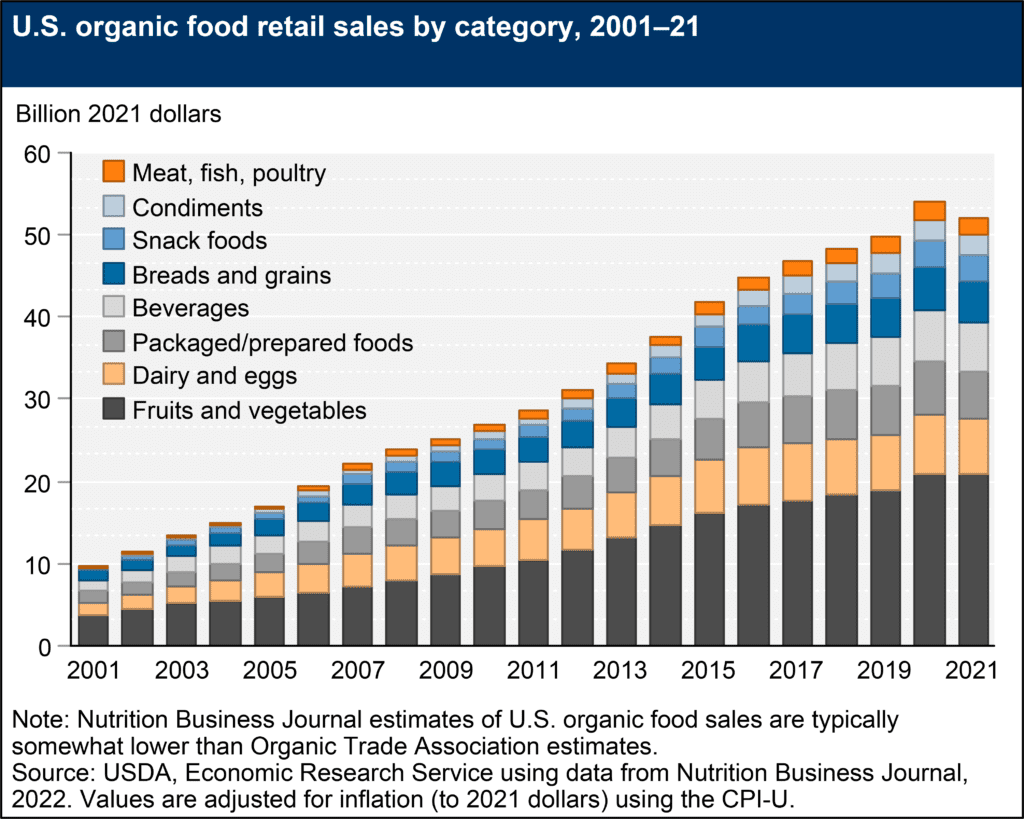
U.S. sales (adjusted for inflation) of organic food products was reported by the Nutrition Business Journal to have grown by 93 percent, to $52 billion, between 2001 and 2021.
Use of Cover Crops
The use of cover crops is one of the most commonly understood regenerative practices and is a good proxy for regenerative agriculture adoption. The most recent SARE/CTIC National Cover Crop Survey found a steady increase in average acreage planted to cover crops per farm between 2015 and 2019 — a 40 percent average increase in that period.
Increase in Regenerative Brands and Labeling
The number of consumer packaged goods (CPG) brands focused on regenerative is on the rise.
At the recent 2023 Natural Products Expo West — which gathers more than 60,000 attendees and more than 3,000 exhibitors in the natural products sector each March in Anaheim — the number of exhibitors making regenerative claims increased by 19 percent over 2022, according to analysis by Wolf Tree Ventures. Meanwhile, the number of different types of certification, labeling and verification schemes designed to identify regenerative products is also on the rise, with programs that include Land to Market from Savory Institute, Regenified, Green America’s Soil Carbon Initiative, and Regenerative Organic Certified, among others. In the past five years, according to consumer products insight platform Planet FWD, regenerative claims have grown 130 percent, representing one of the fastest-growing types of claims.
Increased Interest from Corporates
Growing commitments from nations and multinational CPG companies reflect growing awareness of the critical role regenerative agriculture plays. G20 nations have pledged to restore 1 billion hectares of degraded land by 2030, according to the United Nations. At the same time, in 2021 the number of multinationals making corporate commitments to incorporating regenerative agriculture into their supply chains took off, with JBS, Mars, Nestle, PepsiCo, Walmart and others joining early adopters like Danone and General Mills. 2022 saw continued commitments from others. These all point to the growing awareness of the global imperative for agriculture and food to shift from a contributor to a solution for environmental degradation, climate, human health and more.
Capital Investment in Regenerative
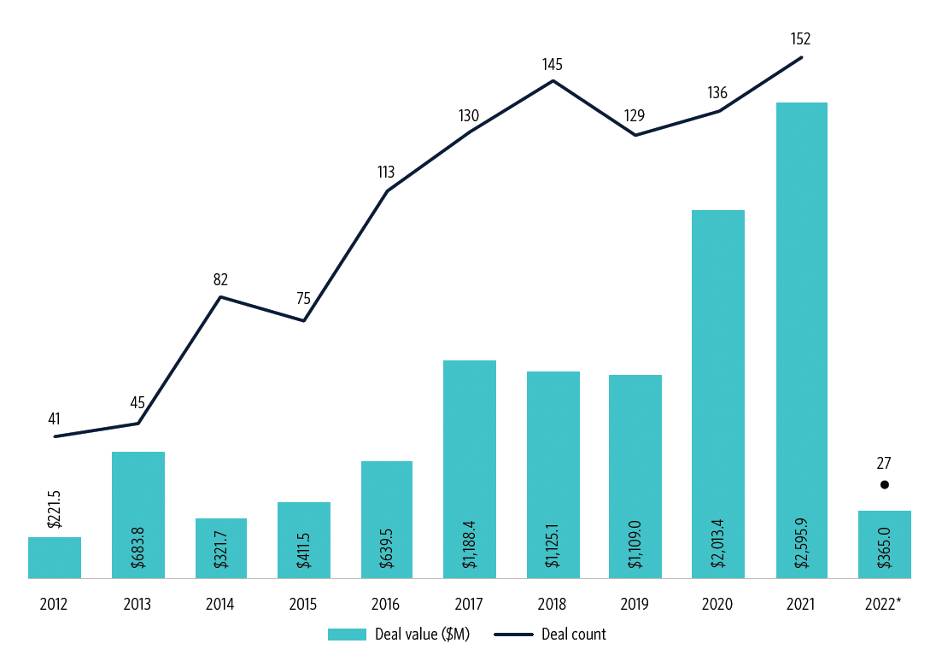
There has been a steady increase in investment in regenerative agriculture and food projects across the value chain in the past years, coming from a variety of capital sources, including private equity, venture capital (VC), philanthropic foundations and corporates. VC investment, for example, has seen dramatic increases in both the total value of the deals and the deal count, increasing significantly over the past ten years, according to Pitchbook data. The number of deals in regenerative agriculture has grown 270 percent (from 42 in 2012 to 152 in 2021) and the value of the deals has grown more than tenfold in the same period.
Four major areas of investor interest that address regenerative agriculture are leading this growth: biologicals, which offer biological solutions to reduce the use of synthetics pesticides; remote sensing, which includes imagery analytics and in-field sensors; field machinery, which includes precision equipment that reduces chemical inputs and soil compaction; and herd management, which includes tools to track and move livestock in rotational grazing systems.
Drivers of Regenerative Agriculture Expansion
So, what’s driving these market signals? In short: external factors influencing decisions on the farm and demand coming from off the farm.
On the Farm
On the farm we are seeing a myriad of factors contributing to decisions to adopt new practices and entire systems, including increasing pressure on farm economics, rising climate risk, on-farm health and safety concerns, and environmental concerns. In industrial commodity production systems, already razor thin margins are being exacerbated by low commodity prices, combined with rising input costs, which led to stagnation or decline in overall farm profitability in 2019. Rising input prices, in particular, continued to impact profitability in 2021 and 2022.
Meanwhile, regenerative systems are offering an increasingly attractive alternative. It is true that farmers shifting to regenerative practices can be met by many barriers — including lack of technical expertise and financing, cultural disapproval, and a transitional period of decreased profits — but regenerative farming systems can ultimately lead to positive economic outcomes that can leave farmers better off financially. These outcomes are the result of three systemic improvements:
- Reduced input costs
- Growing diverse and higher-value crops and accessing new markets that reward the attributes of regenerative products, and
- Creating more resilience, which helps the system withstand volatile and potentially costly weather and climate risk
An increasing amount of research is leading to the same conclusion: that regenerative systems can be more profitable — including a 2018 study by Lundgren and LaCann across 40 fields that showed regenerative systems had 70 percent higher profit than conventional.
Demand
Consumers today are increasingly seeking to understand where their food comes from and how it was produced. They also want their food to reflect their values — and today that means food that is good for people and the planet. They want safe, chemical-free and nutritious foods. They also want to know about and reduce the climate impact of the food and fibers they consume, making traceability of increasing importance.
These consumer desires continue to influence purchasing decisions. According to Planet FWD,
- 55 percent of all growth in CPG came from sustainably marketed products from 2015 to 2019
- Consumers will pay a 39 percent premium for sustainably marketed products compared to conventionally marketed counterparts
- 69 percent of consumers have changed the products they use due to concern about climate change
Even as many consumers still may not know the term “regenerative,” they do understand and want some of these beneficial attributes that regeneratively produced goods can offer. This will continue to drive the demand for and value of regenerative farming systems.
Pressure to Decrease Scope 3 Emissions
The building consumer demand described above is pulling on producers to change the way they produce food and fiber products, but producers are not the only ones being pulled. Companies of all sizes are feeling pressure from consumers, investors and regulators to change the way they produce products.
The desire for corporates, and food companies in particular, to make commitments to regenerative is driven by at least two factors:
- Increasing demand from consumers for the attributes that regenerative ingredients and foods represent (as discussed above) — which therefore results in a need to secure supply from regenerative farmers, and
- The necessity to address Scope 3 emissions. Scope 3 emissions are indirect emissions that are not directly from a company but are tied to them in their value or supply chain. In the food system, these emission account for more than 90 percent of a packaged food company’s total emissions on average, according to Rabobank.
As public and private pressure mounts to clean up climate impacts of companies, food companies can’t stay idle. By addressing their agriculture and food supply chains and applying more regenerative systems, these companies can make significant strides.
The Way Forward
The global agricultural system is facing some pretty big hurdles as it grapples with a history of degradation and the opportunity for a future of regeneration. The path to the latter may be challenging, but momentum continues to build behind regenerative farming practices and the systems around them. The market signals shared here demonstrate this, and the drivers indicate that growth will continue. It will be up to a myriad of market players — farmers and many others — to capitalize on the growing opportunities.
Sarah Day Levesque is a strategic advisor to AcresUSA and is the founder and managing director of Regenerative Food Systems Investment. You can learn more about her work at rfsi-forum.com.