
Microbes improve plant immunity and crop quality through Induced Systemic Resistance
For most of modern agriculture, plant immunity has been treated as a fixed trait, something built into the genetics rather than managed through inputs. Resistance is bred into the genome, while pest or disease load is controlled with chemical inputs. The underlying assumption is straightforward: assemble the right genetic package, then protect it. That approach has worked fine, but it leaves out a fundamental aspect of how plants function under field conditions.
Plants do not operate in isolation. They exist within dense, biologically active microbial systems that directly influence how they grow, defend, and allocate energy. In natural systems, plants are never a monoculture. They develop within dense, biologically active environments where microbial interactions continuously shape growth, defense, and resource allocation. What we often treat as a fixed trait is, in practice, highly responsive to the living system surrounding the plant. Across roots, leaves, and stems, the plant is engaged in ongoing chemical exchange with bacteria and fungi. Within this context, immunity in the field is not fixed — it is regulated by microbes.
The same plant genotype grown in sterile media, compared to biologically active soil, exhibits markedly different behavior. The genetics haven’t changed, but the biological signaling environment is different. Because of the mere presence of diverse soil microbes, plant defense responses shift, metabolic pathways are adjusted, and the overall physiological state of the plant becomes responsive to its surroundings. What appears genetically determined under controlled conditions becomes flexible in the field.
A specific plant/microbe interaction called Induced Systemic Resistance (ISR) provides one of the clearest demonstrations of this dynamic. ISR is not triggered by infection but by the presence of beneficial soil microbes. Certain microbes colonize the plant without causing harm and, in doing so, alter how the plant prepares for stress at a biochemical level. Rather than fully activating defense when these microbes are present, ISR acts more like a priming system that we all take for granted. The plant enters a primed state characterized by faster response, more efficient activation, and improved readiness before stress occurs. The physiological state of the plant is adjusted in advance of any pest or disease challenge.
Fundamentally, this is plant biochemistry — but it’s worth understanding for growers. This is also because any of the compounds associated with defense — phenolics, pigments, and aromatic compounds — also define crop quality. They influence flavor, color, shelf life, and nutritional value. When microbial interactions alter defense chemistry, they simultaneously alter quality outcomes. In this sense, the boundary between defense and quality becomes blurred, since the same biochemical pathways are foundational to both.
Microbes Flip the Switch
ISR is often associated with plant growth–promoting rhizobacteria, but it is not limited to bacteria. Fungi, including mycorrhizal symbionts, can cause similar beneficial effects. What matters is not the category of organism but the nature of the interaction, and that interaction is inherently variable rather than guaranteed.
ISR is highly context-dependent. Even closely related microbial strains can produce different outcomes depending on the crop, soil chemistry, moisture conditions, and stress environment. As a result, ISR does not behave like a consistent input that can be applied with predictable results. It is better understood as an outcome that emerges when the appropriate biological conditions are established.
This distinction is important because microbes are often marketed as if they carry fixed functions. In practice, the plant does not respond to the identity of a product or organism but to the signals those organisms produce. Those signals depend on which microbes are present, how effectively they establish, and the environment in which they are operating.
Certain microbial groups appear repeatedly in ISR research and field use because they are reliable producers of these signals. Species of Pseudomonas are among the most studied, colonizing the root surface and releasing compounds that indicate microbial presence and that trigger systemic changes in plant responsiveness. Bacillus species are widely used in commercial products due to their durability and ability to survive formulation and storage while still producing signaling compounds that can prime plant responses. Trichoderma, commonly described as a biocontrol fungus, can also induce systemic effects through close association with roots and the exchange of signaling metabolites. Arbuscular mycorrhizal fungi, while best known for their role in nutrient exchange, can improve plant defense chemistry once established, influencing both resistance and overall plant performance.
Across these diverse organisms, a consistent pattern emerges. The plant is not responding to a specific microbe but to chemical signals that indicate biological activity. The plant hears or senses these signals, and they are integrated through internal pathways that regulate defense responses and influence how resources are allocated throughout the plant.
So, diversity becomes a functional factor rather than a descriptive or aesthetic one. Different organisms produce different sets of signals, and while a single strain may activate part of the system, a more complex community expands the range of inputs the plant receives. As the signaling environment broadens, more pathways are engaged, and the overall response becomes more stable.
ISR, in this sense, is defined by the quantity and diversity of information the plant is able to interpret.
How the Plant “Reads” the Signal
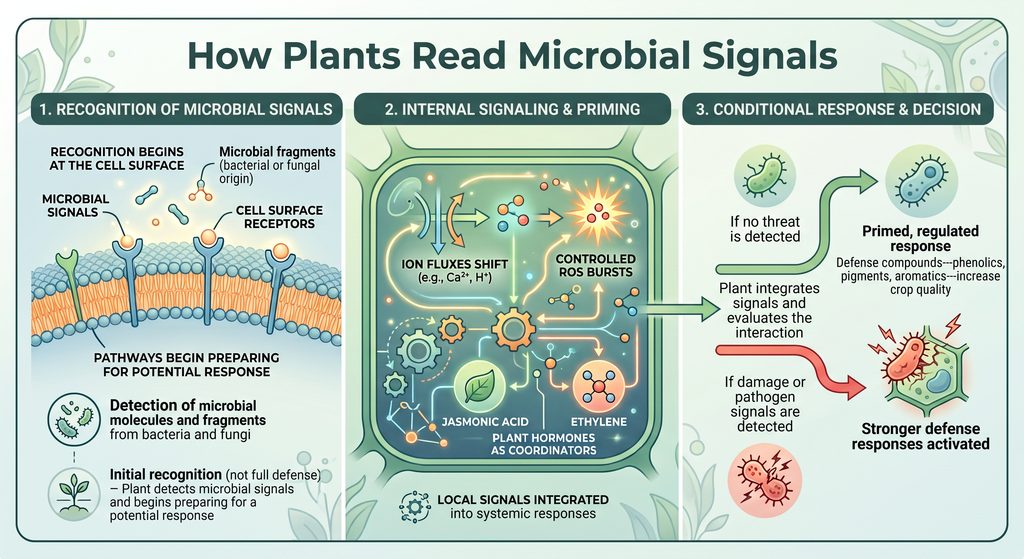
Plants do not distinguish between “beneficial” and “pathogenic” organisms in the way those terms are often used in management. Instead, they recognize something more fundamental: the presence of life. This recognition begins at the cell surface, where plants detect microbial signals — fragments of bacterial and fungal origin that indicate biological activity. The initial response is not a full defensive reaction but a form of awareness in which the plant registers that it is interacting with a living system.
This perception rapidly initiates internal signaling. Ion fluxes shift, reactive oxygen species are generated in controlled bursts, and signaling pathways begin preparing the plant for a potential response. These processes are part of a broader framework through which plants engage with microbes in general. Whether the interaction escalates depends on subsequent events. If the microbe introduces damage or virulence factors, the plant activates stronger defense responses. If not, the response remains regulated and does not progress to full activation.
ISR-inducing microbes operate within this controlled space. They are detected by the plant but do not trigger injury, allowing the immune system to be engaged without damaging the plant. The result is a primed state in which the threshold for defense activation is lowered and the speed of response is increased when a more serious stressor is encountered. Although no visible change has occurred, the physiological state of the plant has been altered.
This shift is coordinated through plant hormones, particularly jasmonic acid and ethylene, which function as integrators of local signals into whole-plant responses. These pathways are especially relevant for managing stresses associated with tissue damage, including insect feeding and certain pathogen types. Rather than maintaining a constant defensive posture, the plant becomes more nimble and more responsive, enabling faster and more coordinated reactions when stress does occur.
In practical terms, the difference is one of timing. An unprimed plant responds only after stress begins, whereas a primed plant is already positioned to respond, allowing it to act more quickly and with greater efficiency.
What Farmers Can Do with this Knowledge
Understanding this relationship between plants and soil microbes becomes useful when it moves from concept to management. If microbes act as signals that shape plant behavior, then soil biology becomes a fundamental part of how the crop is programmed.
The most reliable way for farmers to support that system is continuity. ISR depends on ongoing interaction between roots and microbes, which means keeping living roots in the soil for as much of the year as possible, or utilizing a cover like mulch. Cover crops, interseeding, and relay systems extend that window, maintaining an active rhizosphere rather than forcing the system to reset each season. When that continuity is maintained, microbial networks persist, and plant responses remain tuned over time instead of being repeatedly rebuilt after soil microbes are damaged by herbicide, for example.
That continuity only functions if the environment supports it. Microbial performance is less about adding products and more about maintaining habitat and carbon flow. Compost, mulches, reduced disturbance, and steady organic inputs create the conditions where microbes can establish, persist, and interact meaningfully with the plant. ISR does not require extreme biomass, but it does require stability. Without that stability and respect for the Law of Return, even well-selected inoculants tend to produce inconsistent results, or no results at all.
Practices such as fumigation, repeated sterilization, or aggressive broad-spectrum inputs can remove the signals that drive this priming process, particularly during early root establishment when plant–microbe relationships are being formed. These modern tools still have a place, but their use benefits from timing and recovery strategies. A functional microbiome behaves more like an asset than an input, requiring ongoing management rather than isolated application.
Biological products still fit within this framework, but their role shifts. Rather than acting as stand-alone solutions, bugs in a jug function as additions to an existing biological system. Bacillus, Pseudomonas, Trichoderma, and mycorrhizal inoculants perform most consistently when applied in environments where they can establish — on seed, at transplant, or within a protected root-zone window — and where they are supported by adequate carbon and moisture conditions. Inoculants do not replace soil biology; they contribute to it.
As these complex soil systems begin to function, the outcomes are often gradual rather than immediate. ISR rarely eliminates disease pressure outright. More commonly, it appears as improved stress tolerance, more stable canopy performance under variable conditions, and greater consistency in crop quality. Shifts in color development, aroma, uniformity, and balance often serve as early indicators that the plant is operating differently. Over time, the system becomes less prone to failure, even if it does not produce dramatic yield increases in the short term.
These principles can be applied across both regenerative and conventional systems. ISR can be introduced as a layer of resilience by establishing biological signaling early — through seed treatments, transplant dips, in-furrow compost applications, or early organic fertigation, when root systems and communication pathways are still developing. From that point forward, conventional tools can be used more selectively and strategically, rather than as default responses.
Even relatively small adjustments can create space for biological processes to function. Reducing unnecessary sterilization in high-value zones, maintaining microbial compatibility in tank mixes, and aligning applications with favorable environmental conditions can preserve microbial viability and improve the consistency of biological inputs already in use.
Timing also plays a critical role. Many ISR-associated pathways are most relevant to stress involving tissue damage, including insect pressure and certain pathogen groups. When these risk periods are predictable, priming in advance can reduce the severity of outbreaks and expand available management options, even when additional interventions remain necessary.
Success is often best measured through reduced variability. Fewer sudden breakdowns, less extreme stress expression, and more consistent performance across a field all indicate that the plant is operating with a wider margin of response. That stability carries clear agronomic and economic value, even when it does not immediately translate into higher yields.
At a broader level, ISR reframes how the plant is understood. It is not simply a fixed genetic system responding to external inputs, but a responsive organism interpreting its environment. The genome defines what the plant is capable of, while the microbial environment influences how that potential is expressed in the field. Soil is not just a substrate but an active information system, and plant chemistry is one of its outputs.