
Slow it, sink it, spread it, sprout it, sap it, sweat it, sky it, suction it
The saying “slow it, sink it, spread it” has become an activation mantra for water cycle restoration in permaculture, eco-restoration, and regenerative agriculture. It was coined by Brock Dolman. The phrase describes a hydrological methodology distinct from what Brock calls the “drainage paradigm” of the Drain Age, in which rain is rapidly funneled away through sewage systems, pipes, and tile drainage.
Instead, “slow it, sink it, spread it” is about working with the landscape to keep water moving through living systems. Vegetation, richer soils, earthworks, swales, rain infiltration ponds, beaver dam analogs, leaky weirs, gabions, zai pits, half-moon crescents, johads, and other techniques all help rainfall infiltrate the ground, recharge aquifers, and restore natural water cycles.
At a recent visit with Brock at the Occidental Arts and Ecology Center in California, I shared with him my extension of his slogan: “Slow it, sink it, spread it, lift it, hop it.” In this expanded version, “lift it” refers to the way vegetation draws water upward through plants, while “hop it” refers to the small water cycle — the movement of moisture through evapotranspiration and atmospheric processes that allows water to travel across landscapes and even continents. It also comes with an accompanying lemma: “lift it < sink it.” If we lift water through vegetation without first restoring the soil’s ability to hold water, we risk drying out the land.
Brock liked the idea. He is a poet with words; even in everyday conversation, he often speaks in alliteration, rhythm, and memorable phrases. He built on the idea and suggested an alliterative variation: “Slow it, sink it, spread it, suck it, skywater it.” Nik Bertulis, an eloquent speaker on ecology and water, joined the brainstorming, and together we all came up with another variation we liked: “Slow it, sink it, spread it, sap it, sweat it, sky it.”
“Sap it” refers to vegetation drawing water upward through living systems. “Sweat it” points to transpiration and transpirational cooling. “Sky it” describes evapotranspiration moving water into the atmosphere, where it can eventually return as rain.
We might also include the way water helps generate more vegetation: “Slow it, sink it, spread it, sprout it, sap it, sweat it, sky it.” The vegetation itself becomes part of the water cycle as it is absorbing, redistributing, cooling, and returning water to the atmosphere.
One of the reasons the “slow it, sink it, spread it” mantra was so useful was that it suggested water should not simply leave the system through runoff and rivers, but that we can also direct it into the groundwater cycle.
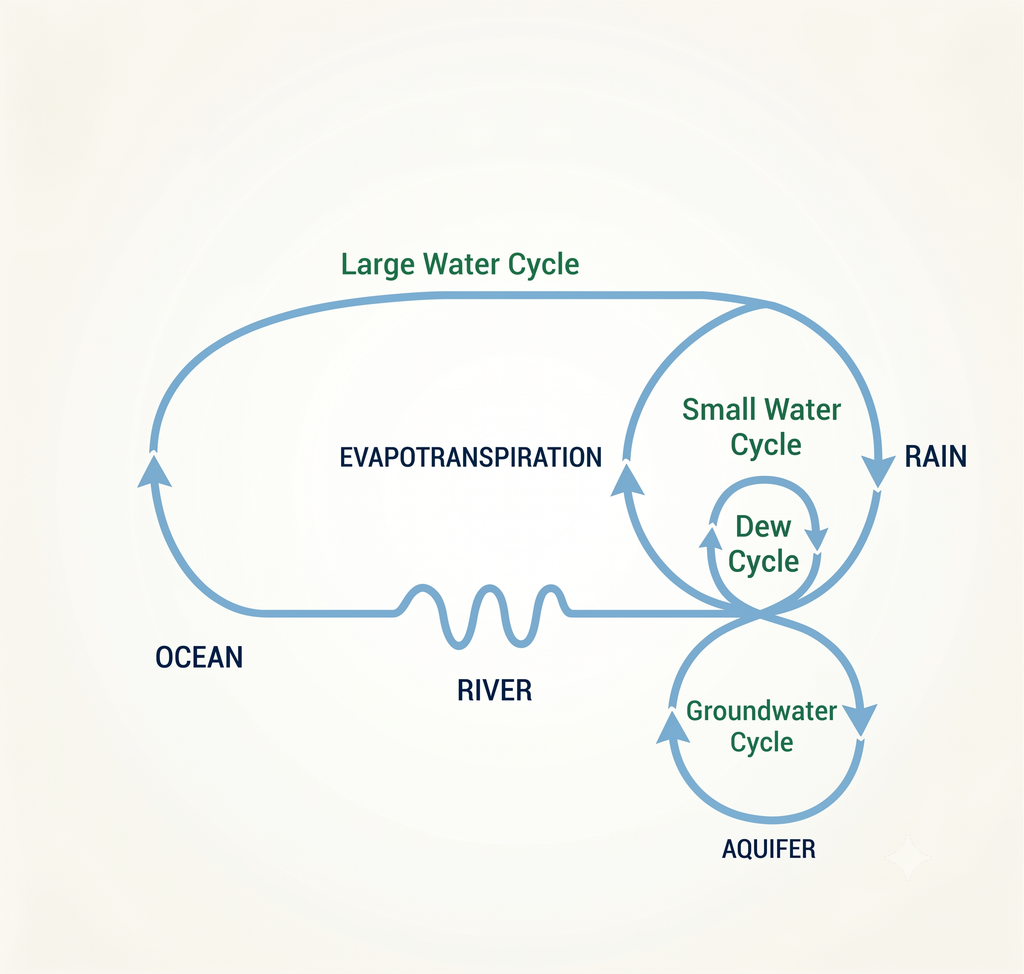
The addition of “sap it, sweat it, sky it” expands the picture by including the dew cycle and the small water cycle (precipitation recycling). The extended slogan helps connect these different water pathways.
As I pondered it further, I realized we could also connect it to the large water cycle, the movement of ocean moisture inland that helps create rainfall. Large forests like the Amazon, the Congo rainforest, and the Indonesian rainforests can influence the large-scale water cycle. The Biotic Pump hypothesis proposed by Gorshkov and Makarieva argues that the vacuum created by water condensation acts as a suction force, drawing in ocean air. A related, more conventional mechanism for large-scale atmospheric moisture transport has been proposed by UCLA meteorologist Rong Fu, who suggests that latent heat release from condensation in the Amazon and Congo rainforests causes this sucking of ocean air towards itself. So, we can add “suction it,” giving us “slow it, sink it, spread it, sprout it, sap it, sweat it, sky it, suction it.” These actions help activate the living architecture of the Earth by connecting the four water cycles.
Manlio De Domenico writes a newsletter called Complexity Thoughts. He recently discussed the complexity science behind living architectures and the importance of loops: “The simplest use of a loop is to preserve reachability, since if one route is blocked then another route may still connect two parts of the system … In metabolism, this can mean that flux can be ‘rerouted’ after a specific reaction is disrupted for some reason. In signaling, it can mean that partially overlapping pathways transmit similar information. In ecological networks, matter or energy may continue to move through alternative species interactions when one link weakens.”
What our slogan describes is the process that enables multiple pathways for water to move through a system. If we experience several years of drought, vegetation has alternative pathways to access water. The system can shift water from the wet season into the dry season.
A familiar challenge to hydrologists is flooding during the wet season and water scarcity during the dry season. We can tackle this issue with nature-based solutions. Slowing the water with beaver dam analogs, richer soils, and other landscape interventions allows the system to function more like a living one, rerouting and storing water. The system becomes more adaptable. It shifts water from the wet season to the dry season via the lower groundwater cycle loop, instead of it all escaping sooner via runoff and rivers. It delays the system to fit the ecosystem’s needs.
Now, by adding the upper loop — the small water cycle — we are connecting another pathway into this living system. It enables the landscape to adjust by creating additional ways to bring moisture back into the ecosystem. The land can generate more rainfall through precipitation recycling, creating a different way of transporting water across landscapes.
If ecosystems depended only on ocean moisture, rainfall would exponentially decline as distance from the ocean increased because moisture would continuously drop out. Instead, healthy landscapes act more like relay stations, continually recycling and redistributing water.
De Domenico also writes that “a feedback loop exists when a variable affects its own future through the system.” He describes loops as processes of production: “A process is closed when its outputs help regenerate the components or conditions that make the process possible … Kauffman’s autocatalytic-set idea made catalytic closure central: a set of molecules can collectively catalyze reactions that generate members of the same set.”
What we are doing is further linking together and restoring multiple water cycles. This allows the system to better respond to its own future by creating multiple pathways for hydration. Water can arrive through the atmosphere, be stored in the ground, and be shifted through time. The system can better handle drought, store excess water from floods, and maintain hydration that reduces vulnerability to large fires. With this increased hydration, vegetation grows more abundantly, soils become richer, and the landscape becomes better at running its own water cycle. As soil stores more water, trees can help move water deeper into the ground during wet periods and draw it upward during dry periods.
The system also develops its own climate regulation mechanisms. It can adjust temperature by bringing water upward through evapotranspiration — the sweating and perspiring function of the living landscape. The dew cycle acts as a humidity system. I have noticed in old-growth forests that they can remain cool and humid even while surrounding environments are dry and hot. Soil also helps regulate temperature, holding heat during colder seasons, while water supports the microbiome and organisms that create richer soils.
An autocatalytic set is one that catalyzes itself into being. Vegetation, soil, fungi, bacteria, and water together create a system that can autocatalyze itself into a more complex and living architecture.
I have always been fascinated by the idea of autocatalysis. I think it may be one of the bridge concepts that integrates hydrology, climate science, ecology, permaculture, regenerative agriculture, and ecological restoration. It suggests how we can nudge the Earth into a phase space where it can more easily reshape its own water cycles and ecosystems, allowing the exponential potential of regeneration to emerge.
“Slow it, sink it, spread it, sprout it, sap it, sweat it, sky it, suction it” is a set of guiding principles for transforming the Earth into a more living, autocatalytic architecture. It helps create a circulatory system with more interconnected water loops, enabling the planetary system to better self-organize, adapt, and regenerate.