

Studies at Dr. William Albrecht’s University of Missouri research fields confirm his theories
Dr. Timothy Reinbott is the director of Sanborn Field — the research farm at the University of Missouri where Dr. William Albrecht conducted much of his research.
William Albrecht came to the University of Missouri in 1916 as he was finishing his Ph.D. from the University of Illinois. His career spanned the next seven decades and continues to leave a legacy of connecting soil properties to human and animal health.
Dr. Albrecht was trained as a microbiologist soon after the relationships between different species of rhizobia and legumes were discovered in the late 1800s. His early work focused on the different species of rhizobia bacteria specific for each legume species, and for many years his lab produced various legume inoculants to distribute to farmers. His first Missouri Agriculture Experiment Station publication, from 1919, detailed the proper method of inoculation of legume seeds.
His focus soon turned to how soil carbon and nitrogen influenced soil microorganisms. Much of his work was carried out at Sanborn Field here at the University of Missouri. Established in 1888, Sanborn Field is the third-oldest continuous research center in the world, with 38 unique plots and treatments, many of which have not changed since its establishment.
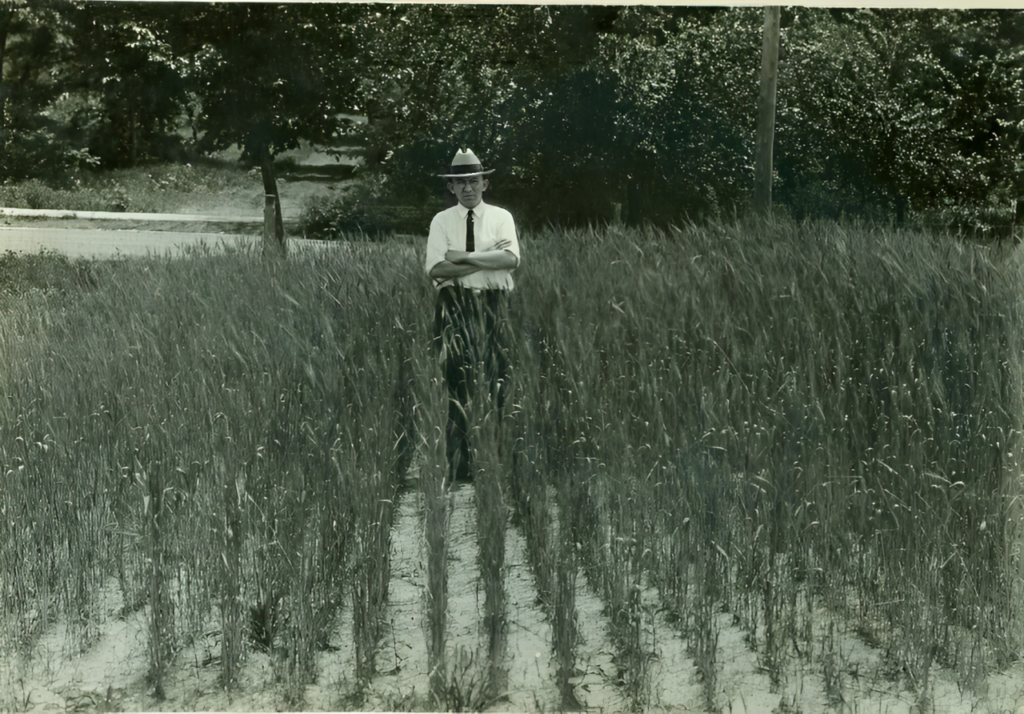
Dr. Albrecht was interested in soil factors that are responsible for soil microbial activity. In 1938 — the 50th anniversary of Sanborn Field — he analyzed soil cores from the fields and concluded that soil organic matter degradation (soil microorganism activity) depended on soil nutrition — in particular, soil N, Ca, K and possibly P, regardless of the crop species (Albrecht, 1939).
The 1920s and 1930s were a very special time at the University of Missouri. Faculty and students during this period — including, besides Albrecht, such important soil scientists as Hans Jenny, Richard Bradfield, Leonard Baver, Frank Duley and M. F. Miller — made important contributions to soil science that we take for granted today, including the basics of soil chemistry; how climate affects nitrogen, organic matter and yield; the basic factors of soil formation (climate, organisms, topography, parent material and time); and the basics of colloidal clay structure and exchange capacity.
Dr. Albrecht understood that these new developments in soil science were related to soil microbiological activity. He developed and tested hypotheses in the field and lab on interrelationships between chemical (nutrient) and physical soil properties that ultimately affect soil microbiological activity and crop productivity. The basis for understanding these soil property interactions and their relationships began in the 1920s and continued throughout his career.
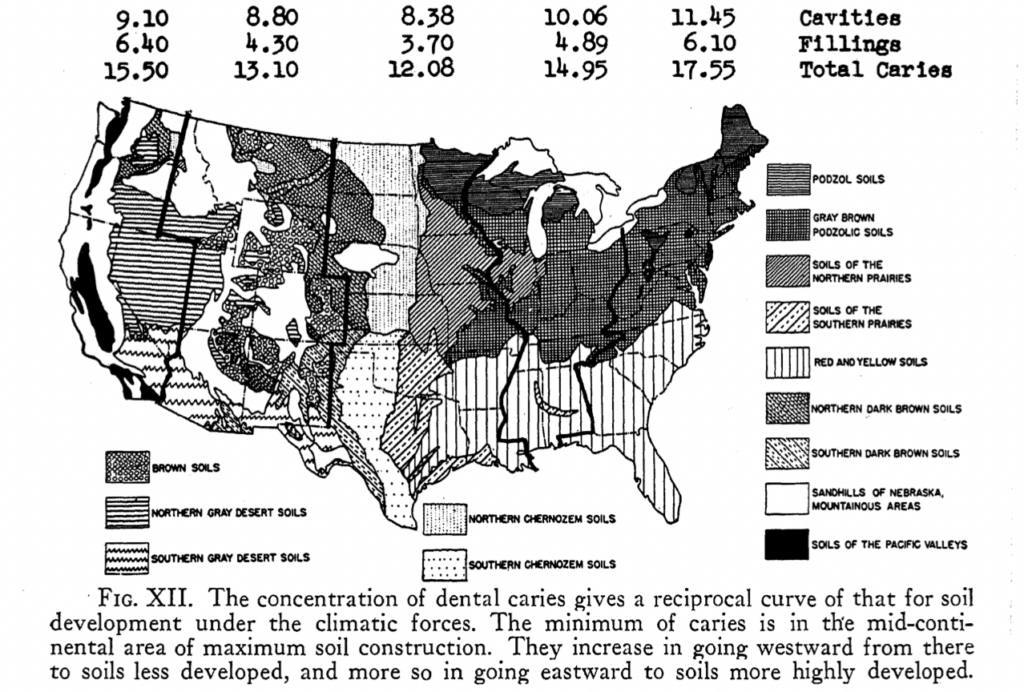
Albrecht was not satisfied with how these soil properties were interrelated; he soon began to connect soil health with plant and animal health (human health). His classic work with rabbits and other mammals demonstrated that animal health was directly related to the nutrition of the soil. He demonstrated that the classic saying “You are what you eat” was true. By using the dental records of U.S. Navy draftees during World War II, he was able to correlate availability of Ca and P in the area in which the enlistee had grown up with number of fillings and cavities. Most people in those days consumed foods that were grown locally, and this was reflected in the health of their teeth (Our Teeth and Our Soils, 1948). The highest rates of fillings and cavities were in the humid eastern U.S., where soil nutrients had been exhausted in previous decades. Dental health also decreased in a westward direction to the western prairie, where Ca/P precipitated and was unavailable.
Dr. Albrecht’s short film The Other Side of the Fence (1948) elegantly summarized the connection between soil, plant and animal health. It remains a classic to this day.
Many have criticized the work of Dr. Albrecht because it was done before modern experimental statistics, but Dr. Albrecht routinely conducted randomized replicated experiments and published many refereed journal articles in the leading soil science journals. He was also the president of the Soil Science Society of America in 1939 — an honor that is only bestowed on those who have demonstrated excellence in soil research, education and outreach. When Dr. Albrecht retired in 1959, he had 118 technical papers and over 200 popular press articles based upon his research.

Some modern soil scientists dismiss Dr. Albrecht’s principles, citing the many discoveries in soil science since Albrecht’s retirement. The truth is that Dr. Albrecht would embrace those discoveries and would be fascinated to learn that plants can regulate needed soil microorganism species by exuding different organic compounds that shift the microorganism population to the plant’s needs. However, he would remind us that the plant can only function to its greatest efficiency if the plant’s nutrient status is sufficient to produce the required organic acids.
One of the biggest hang-ups for many soil scientists today is the basic foundation of the Albrecht system — his percent base saturation goals for Ca, Mg, K and Na. Often this is erroneously referred to as the “ratio” of soil cations — a term that does not reflect the actual base saturation of those cations. Dr. Albrecht taught that the cation exchange capacity of the “ideal” soil should be 68 percent Ca, 12 percent Mg and 5 percent K, with H and Na below 1 percent.
Trained as a classic agronomist in the 1980s, I too scoffed at the principles of the Albrecht system as being out of date. However, there was evidence that these principles may have some relevance. To end any doubts for myself and others, I decided once and for all to conduct replicated field trails to determine if Dr. Albrecht was correct.
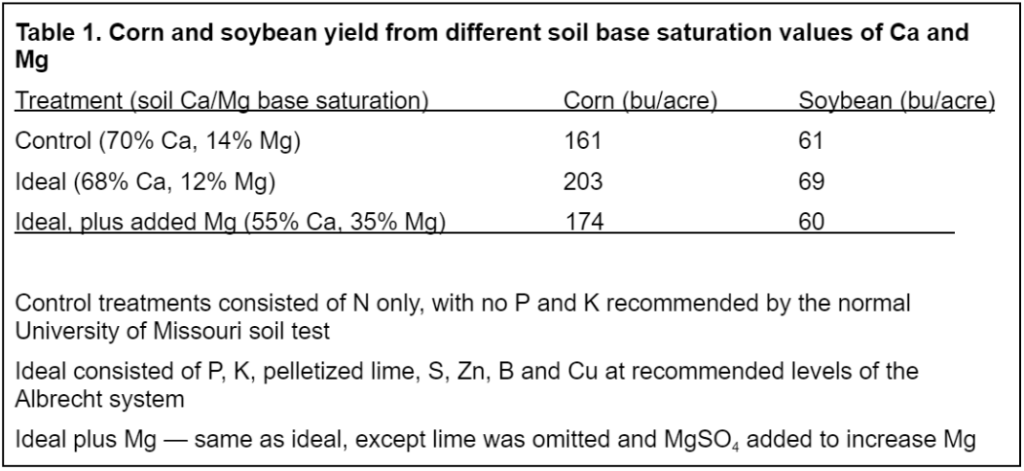
Working with Neal Kinsey (Kinsey Agricultural Services, Charleston MO), a series of randomized and replicated treatments were developed that differed in their Ca/Mg base saturation and macro- and micronutrient fertility. These fields were planted into a corn/soybean rotation. Although we started with a soil that was fairly balanced — 70 percent Ca and 14 percent Mg — in different plots we were able to lower the Ca percent base saturation to 55 percent and raise the Mg percent base saturation to 35 percent through the addition of MgSO4 and K2SO4. We balanced other plots to achieve the ideal 68 percent Ca and 12 percent Mg base saturation levels.
The results indicate that both corn and soybean grain yield responded to base saturation changes, with the greatest responses during dry years (Table 1). Corn grain crude protein levels were also changed, with the highest values in the balanced soil (8.1 percent) and significantly lower values in the control (7.5 percent), and with 7.5 percent in the soil that was higher in percentage Mg base saturation.
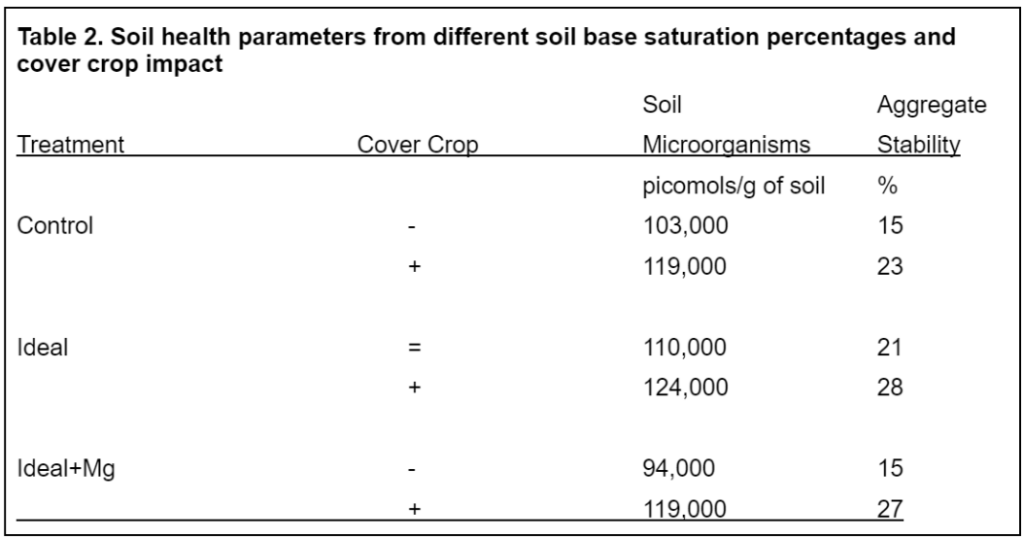
Each plot was also divided into a split plot, with half planted to a cover crop mix after corn or soybean harvest and the other half not planted to cover crops. Soil health parameters were examined, and the analysis indicated that a balanced soil has greater soil microbial abundance (soil biological property) and aggregate stability (soil physical property) compared to the control or when Mg was added in excess (Table 2).
This finding is not surprising, since Ca is important in building soil structure links of soil clay particles by bridging the negative charges on the clay, whereas Mg repels soil clay particles because a hydration shell masks the positive charges on the Mg atom. Modern published journal articles indicate these differences in soil flocculation and dispersion based upon Ca and Mg soil base saturation.
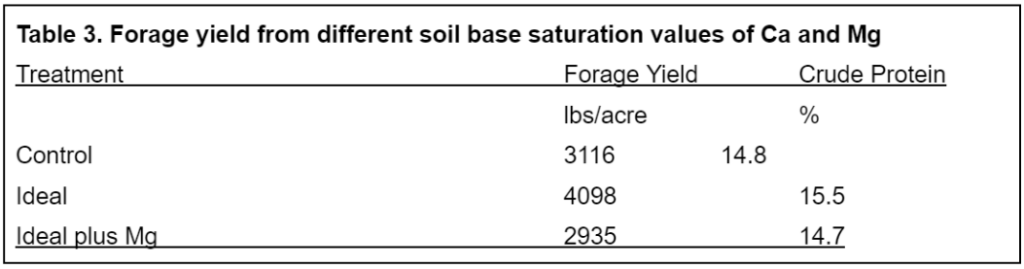
Forage yield responded similarly as grain in the first year of a study, increasing as the base saturation of Ca and Mg was adjusted closer to 68 percent Ca and 12 percent Mg compared to control and when MgSO4 was added (Table 3). Although not statistically significant at 0.05 probability, crude protein also increased when the soil was balanced and sufficient P, K, S and micronutrients were added.
In 2017, Ph.D. graduate student Saranya Norkaew analyzed a suite of soil health parameters and found that there were distinct differences at Sanborn Field based upon soil fertility and crop rotation (Figures 3a and 3b). Manure was a key to improving soil microorganism activity and soil physical structure (aggregate stability). When wheat was in the rotation, these soil health parameters were greater than when planted continuously to corn, regardless of fertility management. These findings have implications for cover crop mixes that include a cereal crop to improve soil health — either through extending the growing season and feeding the soil microorganisms or changing root structure to positively influence soil microbiology.
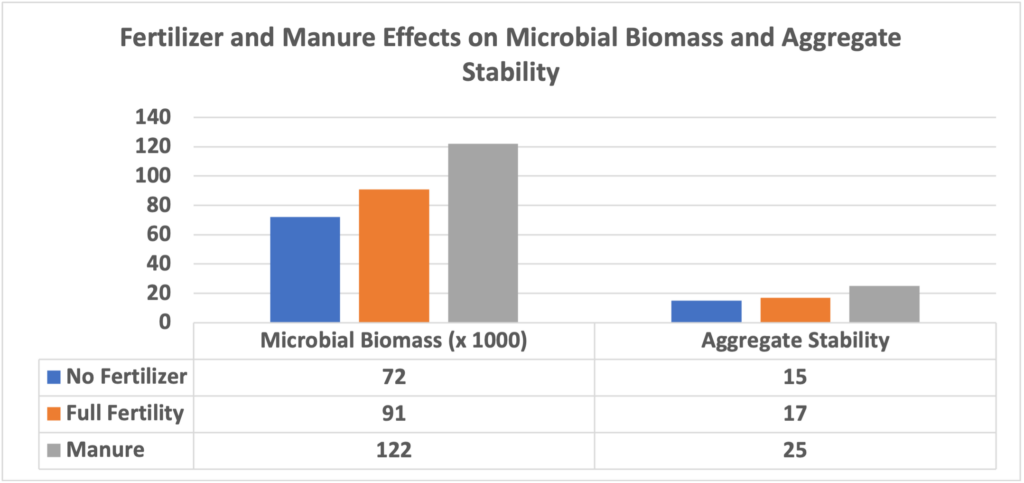
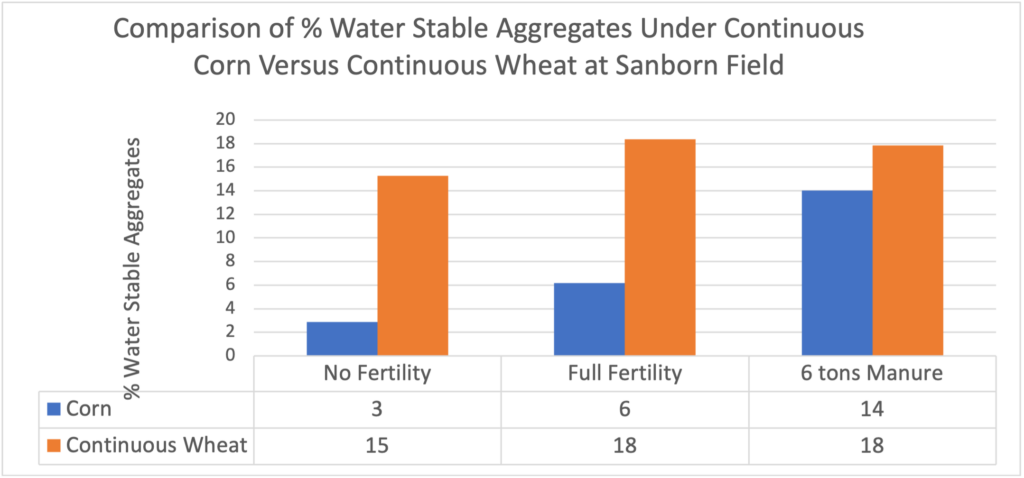
The changes in these soil health parameters due to fertility show that Dr. Albrecht’s 1939 hypothesis was correct: soil microorganisms are dependent on soil nutrient levels. Albrecht’s work on improvement of soil physical and chemical properties leading to improved soil microbial abundance, and how increased microbial abundance leads to improved soil physical and chemical properties, is being proven and continues to be important for growers.
The genius of Dr. William Albrecht — considered by many to be “The Father of Soil Health” —was that he understood the principles of soils, plants and animals and was able to draw conclusions on how they interacted. Did this lead to controversy within his own discipline and others? Sure, but Dr. Albrecht was not content to simply stay within a narrow focus. He was a truly visionary agriculturist.