

Acres U.S.A.® Magazine
  • Articles
    • News
    • Ecological farming
      • Climate
      • Environmental Issues
      • Farm management & planning
      • Human health
    • Livestock
    • Farm
    • Crop
      • Crop management practices
        • Ag technology
        • Cover crops
        • Crop nutrition
          • Crop protection
          • Diseases
        • Crops
        • Fruits
    • Soil
    • Opinion
  • Resources
    • Magazine
    • Online Learning
    • Newsletters
    • Free Articles
    • Blog
  • Magazine Issues
    • 2026
      • March 2026
      • February 2026
      • January 2026
    • 2025
      • December 2025
      • November 2025
      • October 2025
      • September 2025
      • August 2025
      • July 2025
      • June 2025
      • May 2025
      • April 2025
      • March 2025
      • February 2025
      • January 2025
    • 2024
      • December 2024
      • November 2024
      • October 2024
      • September 2024
      • August 2024
      • July 2024
      • June 2024
      • May 2024
      • April 2024
      • March 2024
      • February 2024
      • January 2024
    • 2023
      • December 2023
      • November 2023
      • October 2023
      • August 2023
      • July 2023
      • June 2023
      • May 2023
      • April 2023
      • March 2023
      • February 2023
      • January 2023
    • 2022
      • December 2022
      • November 2022
      • October 2022
      • September 2022
      • August 2022
      • July 2022
      • June 2022
      • May 2022
      • April 2022
      • March 2022
      • February 2022
  • About Us
    • Our History
    • Our Staff
    • Contact Us
    • Community
      • Soil Health Primer Resources
  • Events
    • Eco-Ag Conference
    • Farm Weird Event
    • Viroqua On Farm Event
  • Subscribe
  • Login
  • Register
No Result
View All Result
  • Articles
    • News
    • Ecological farming
      • Climate
      • Environmental Issues
      • Farm management & planning
      • Human health
    • Livestock
    • Farm
    • Crop
      • Crop management practices
        • Ag technology
        • Cover crops
        • Crop nutrition
          • Crop protection
          • Diseases
        • Crops
        • Fruits
    • Soil
    • Opinion
  • Resources
    • Magazine
    • Online Learning
    • Newsletters
    • Free Articles
    • Blog
  • Magazine Issues
    • 2026
      • March 2026
      • February 2026
      • January 2026
    • 2025
      • December 2025
      • November 2025
      • October 2025
      • September 2025
      • August 2025
      • July 2025
      • June 2025
      • May 2025
      • April 2025
      • March 2025
      • February 2025
      • January 2025
    • 2024
      • December 2024
      • November 2024
      • October 2024
      • September 2024
      • August 2024
      • July 2024
      • June 2024
      • May 2024
      • April 2024
      • March 2024
      • February 2024
      • January 2024
    • 2023
      • December 2023
      • November 2023
      • October 2023
      • August 2023
      • July 2023
      • June 2023
      • May 2023
      • April 2023
      • March 2023
      • February 2023
      • January 2023
    • 2022
      • December 2022
      • November 2022
      • October 2022
      • September 2022
      • August 2022
      • July 2022
      • June 2022
      • May 2022
      • April 2022
      • March 2022
      • February 2022
  • About Us
    • Our History
    • Our Staff
    • Contact Us
    • Community
      • Soil Health Primer Resources
  • Events
    • Eco-Ag Conference
    • Farm Weird Event
    • Viroqua On Farm Event
  • Subscribe
No Result
View All Result
Acres U.S.A.® Magazine
No Result
View All Result
Home Ecological farming

Milton Whitney, Regenerative Advocate?

Anneliese Abbott by Anneliese Abbott
May 2, 2026
in Ecological farming, May 2026
0
Milton Whitney, Regenerative Advocate?

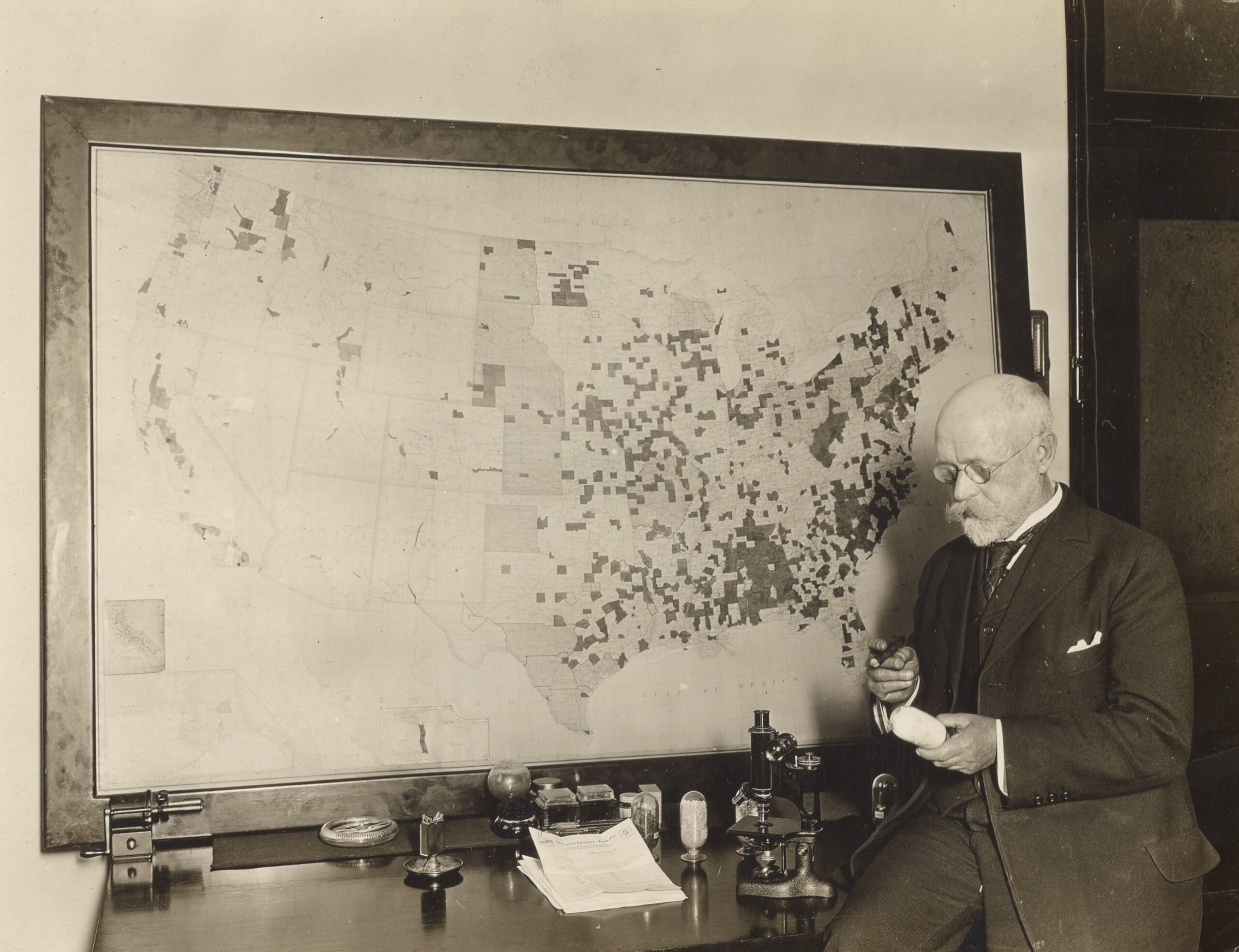
Whitney with a map of the the soil surveys he directed. (Science History Institute)

0
SHARES
10
VIEWS
Share on FacebookShare on Twitter

The man with the infamous “inexhaustible soil” comment may actually have been among the first to describe the ability of farmers to regenerate soil

Anneliese Abbott
Milton Whitney, 1860-1927, was the chief of USDA’s Bureau of Soils from 1894 to 1927. (Science History Institute)

Milton Whitney is the closest thing soil science history has to a villain. Not only did he have an abrasive personality and get in serious conflicts with most of his colleagues, but he’s gone down in infamy for making the following statement in a 1909 USDA bulletin titled Soils of the United States: “The soil is the one indestructible, immutable asset the Nation possesses. It is the one resource that cannot be exhausted; that cannot be used up.” That statement was often interpreted as implying that farmers didn’t have to worry about degrading their soils and could farm in any old way they pleased.

When I first wrote about Milton Whitney in an Acres U.S.A. article in 2018, I followed the consensus and framed him as a bad guy. Fortunately, before reprinting that article in my new book, I decided to go back and read the “inexhaustible soil” quote in context to make sure I wasn’t misrepresenting him. When I did, I got quite the shock, because what Whitney was actually talking about was regenerative agriculture!

When Whitney analyzed the mineral contents of seemingly “exhausted” soils, they still contained seemingly ample amounts of minerals to grow crops. The only difference between “exhausted” and “fertile” soils of the same type was the presence of what he called “toxic organic bodies.” Organic chemistry methods were still too crude for Whitney to figure out the exact analysis or origin of these toxins, but one thing seemed clear — soil exhaustion had a biological factor that might be even more significant than any chemical factors. He also noted that organic fertilizers, like manure or legumes, were far more effective in “purifying” the soil of these toxins than chemical fertilizers.
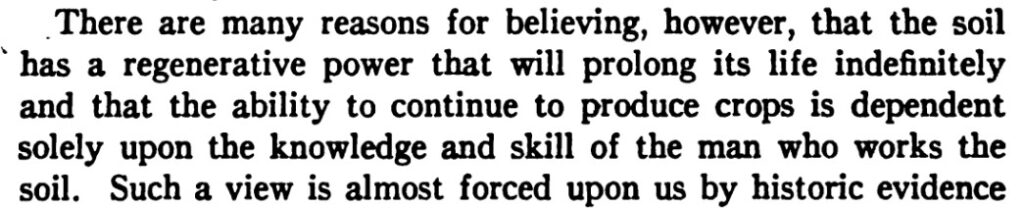
From Whitney’s Soil and Civilization: A Modern Concept of the Soil and the Historical Development of Agriculture, published by D. Van Nostrand, 1925.

Soil exhaustion, Whitney believed, was caused by poor farming practices, not simply a withdrawal of too many minerals from the soil bank account. “There is thus every reason to believe that with better methods of cultivation, more attention to crop rotation, and the introduction of livestock, the problem of the fertility of these soils will be satisfactorily worked out,” he concluded.

In 1925, just a couple years before he died, Whitney published Soil and Civilization. In this book, he proposed a new theory: that soil was not just an inert mass of chemicals but rather “a living thing, having many of characteristics of an animal.” A good farmer understood that the soil was a living organism and had a “sympathetic feeling and interest in his partnership with the soil.” Most importantly, because it was alive, soil had the ability to regenerate. “There are many reasons for believing, however, that the soil has a regenerative power that will prolong its life indefinitely and that the ability to continue to produce crops is dependent solely upon the knowledge and skill of the man who works the soil,” Whitney argued. That’s right — he actually used the word “regenerative”!

Placed in its original context, Whitney’s statement that the soil was “inexhaustible” was not as crazy as his contemporaries made it out to be. He was not saying that farmers could continue to degrade their land and still produce good crops. He was saying that if farmers started using better methods like crop rotation, animal and green manures, and mixed crop and livestock farming, they could regenerate exhausted soils and make them fertile once again. Most importantly, he was confident that regenerative farming could feed the world for thousands of years without chemical fertilizers.

Maybe Milton Whitney wasn’t such a bad guy after all.

← Previous A Multiplicity of Microbes Next A Lucrative Lawn →
Tags: History
Anneliese Abbott

Anneliese Abbott

Anneliese Abbott has a B.S. in Agronomy from Ohio State and an M.S. in Agroecology from the University of Wisconsin-Madison. She runs a small CSA in Michigan, is the author of "Malabar Farm," and is currently doing research on the history of organic farming in the United States.

Next Post
Yes, There Are Enough Organic Wastes

Yes, There Are Enough Organic Wastes

Please login to join discussion
  • Trending
  • Comments
  • Latest
The Most Important Livestock in Our Fields

The Most Important Livestock in Our Fields

July 1, 2024
Glyphosate Does What It’s Designed to Do — Kill

Glyphosate Does What It’s Designed to Do — Kill

February 19, 2025
USDA organic seal over American farm land

Losing Organic Farms

January 27, 2026
The Take-Half, Leave-Half Fallacy

The Take-Half, Leave-Half Fallacy

July 1, 2025
We Don’t Need Another Bridge — We Need an Off-Ramp

We Don’t Need Another Bridge — We Need an Off-Ramp

3
Under One Roof

Under One Roof

3
A Rose By Any Other Name

A Rose By Any Other Name

2
Terra Preta’s Biological Advantage

Terra Preta’s Biological Advantage

2
Yes, There Are Enough Organic Wastes

Yes, There Are Enough Organic Wastes

May 7, 2026
Apple blossoms infected with fire blight.

ECO-UPDATE

May 1, 2026
View from the Country

View from the Country

May 1, 2026
May 2026 • Issue #659

May 2026 • Issue #659

May 2, 2026

Recent News

Yes, There Are Enough Organic Wastes

Yes, There Are Enough Organic Wastes

May 7, 2026
Do GMO Crops Uptake Nutrients Differently?

Do GMO Crops Uptake Nutrients Differently?

May 2, 2026
ECO-MEETINGS

ECO-MEETINGS

May 2, 2026
The Solution Lies in Trees

The Solution Lies in Trees

May 2, 2026

About ACRES USA

Acres U.S.A.® Magazine

Acres U.S.A.® is North America’s oldest publisher on production-scale organic and regenerative farming. For more than 50 years, our mission has been to help farmers, ranchers and market gardeners grow food profitably and sustainably, with nature in mind.

Magazine Issues

  • News
  • 2025
    • June 2025
    • May 2025
    • April 2025
    • March 2025
    • February 2025
    • January 2025
  • 2024 Articles
    • December 2024
    • November 2024
    • October 2024
    • September 2024
    • August 2024
    • July 2024
    • June 2024
    • May 2024
    • April 2024
    • March 2024
    • February 2024
    • January 2024
  • December 2023
    • December 2023
    • November 2023
    • October 2023
    • August 2023
    • July 2023
    • June 2023
    • May 2023
    • April 2023
    • March 2023
    • February 2023
    • January 2023
  • December 2022
    • November 2022
    • October 2022
    • September 2022
    • August 2022
    • July 2022
    • June 2022
    • May 2022
    • April 2022
    • March 2022

Contact Acres U.S.A

  • Contact Us
  • About Us
  • Advertise With Acres U.S.A.
  • My Subscription

Learn

  • Resources
  • Events
  • Magazine
  • Newsletters
  • Free Articles
  • Webinars
  • Online Courses
  • Bookstore

Our All Socials

Follow With Us...

  • My account
  • News
  • Ecological farming
  • Refund and Returns Policy
  • Privacy & Policy

© 2024 Acers USA Magazine

Welcome Back!

Login to your account below

Forgotten Password? Sign Up

Create New Account!

Fill the forms below to register

All fields are required. Log In

Retrieve your password

Please enter your username or email address to reset your password.

Log In

Create a free account, or log in.

Gain access to read this article, plus limited free content.

Yes! I would like to receive new content and updates.

Upgrade your subscription

Support Acres USA and get full access to all content.
Upgrade Now
No Result
View All Result
  • HOME
  • ARTICLES
    • News
    • Farm
    • Ecological farming
    • Livestock
    • Crop
      • Crop management practices
      • Cover crops
      • Crop nutrition
      • Crop protection
      • Crops
      • Ag technology
    • Soil
    • Opinion
  • RESOURCES
    • Magazine
    • Online Learning
    • Newsletters
    • Blog
    • Free Articles
  • MAGAZINE ISSUES
    • 2025
      • June 2025
      • May 2025
      • April 2025
      • March 2025
      • February 2025
      • January 2025
    • 2024
      • December 2024
      • November 2024
      • October 2024
      • September 2024
      • August 2024
      • July 2024
      • June 2024
      • May 2024
      • April 2024
      • March 2024
      • February 2024
      • January 2024
    • 2023
      • December 2023
      • November 2023
      • October 2023
      • August 2023
      • July 2023
      • June 2023
      • May 2023
      • April 2023
      • March 2023
      • February 2023
      • January 2023
  • ABOUT US
    • Our History
    • Our Staff
    • Contact Us
    • Community
      • Soil Health Primer Resources
  • EVENTS
    • Eco-Ag Conference
    • On-Farm Viroqua Event
    • Farm Weird
  • SUBSCRIBE
  • Login
  • Sign Up
  • Cart

© 2024 Acers USA Magazine

Are you sure want to unlock this post?
Unlock left : 0
Are you sure want to cancel subscription?