

Eco-Farm: An Acres U.S.A. Primer — Lesson 2: The Forgiveness of Nature, Part 4
This is an excerpt from Charles Walters’ Eco-Farm — An Acres U.S.A. Primer, available from the Acres U.S.A. bookstore at bookstore.acresusa.corn. Read more excerpts from this book using the category “Eco-Farm” (https://members.acresusa.corn/magazine-features/eco-farm/).
16. Hybridization
Control of seeds has long been an economic objective. Thomas Jefferson once risked the death penalty to smuggle an upland rice seed out of northern Italy. Then as now someone wanted to protect a monopoly. History tells us that the trigger mechanism for Mexico’s revolt from Spain was sprung when a provincial padre was told he couldn’t plant grapes for altar wine, this also to protect the monopoly in Spain.
Of all the techniques ever used to control seed production, none have rivaled hybridization.
Hybridization has to do with combination of desirable characteristics found in two plants. The hybrid can be a cross between varieties, and sometimes between species. The details need not detain us. Suffice it to say that to produce purebred strains of, say, corn, by inbreeding, the breeder selects plants with known characteristics. These are heavy yielding plants with strong roots, stiff stalks, good ears, wide leaves and other desired qualities. These plants are inbred—in other words, forced to self fertilize.
The silk of an ear cannot be fertilized by pollen until it grows out through the husk. To inbreed, ears are covert by a paper bag. This prevents wind pollination, sometimes called open pollination, nature’s process whereby pollen from many corn plants is carried by air to settle down on receptive silks. There it germinates, sending down a pollen tube through which the sperm reaches the egg—or fertilization! Each kernel of corn has its own thread of silk and will not develop unless this thread has been pollinated.
In the inbreeding process pollen from the tassel of the same plant which bears the ear to be pollinated is shaken into another paper bag. The bag covering the ear is then quickly replaced with the bag containing the pollen. The corn is thus self-pollinated.
Hybrid seed corn is a first generation cross or hybrid between two or more inbred strains of corn.
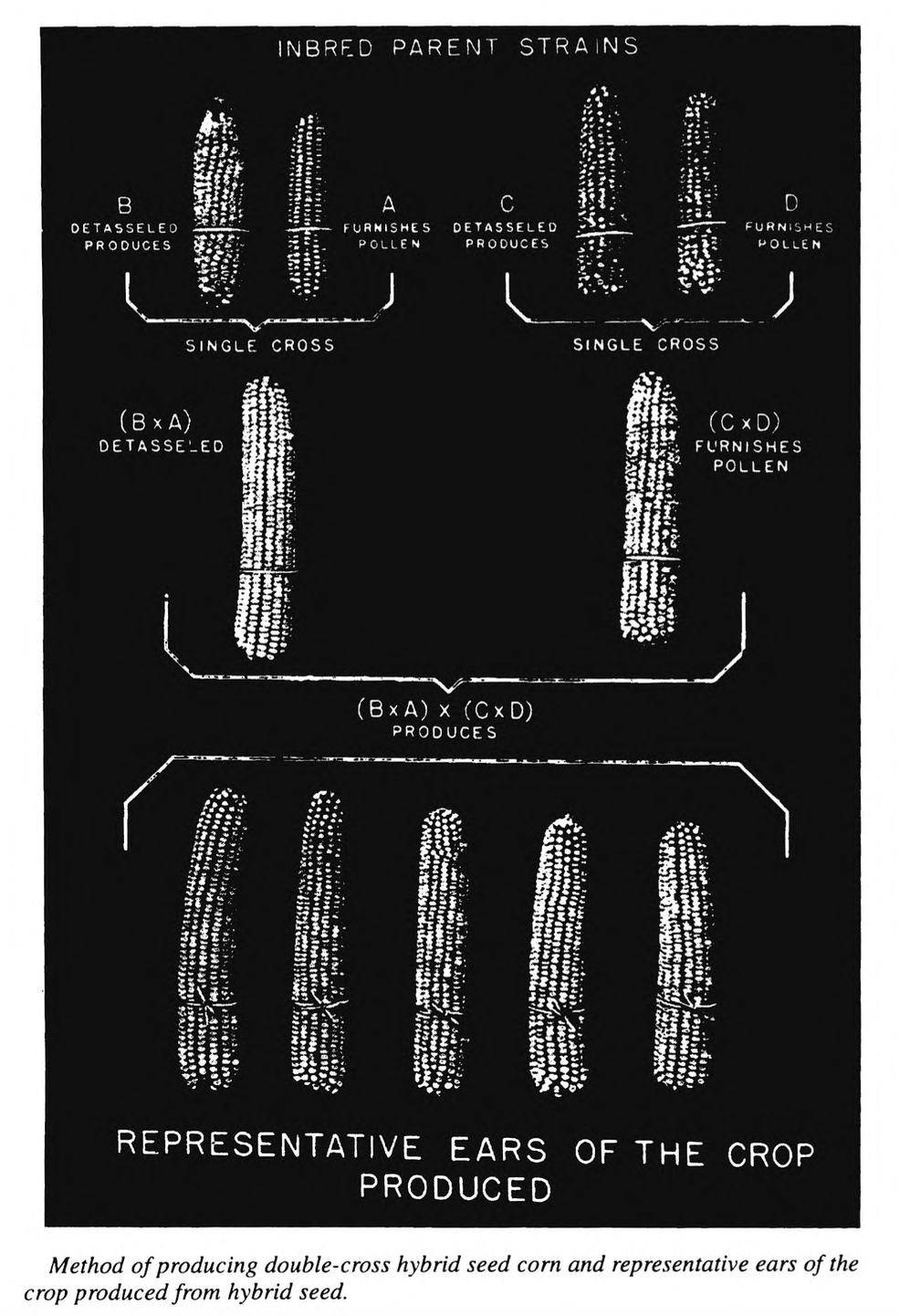
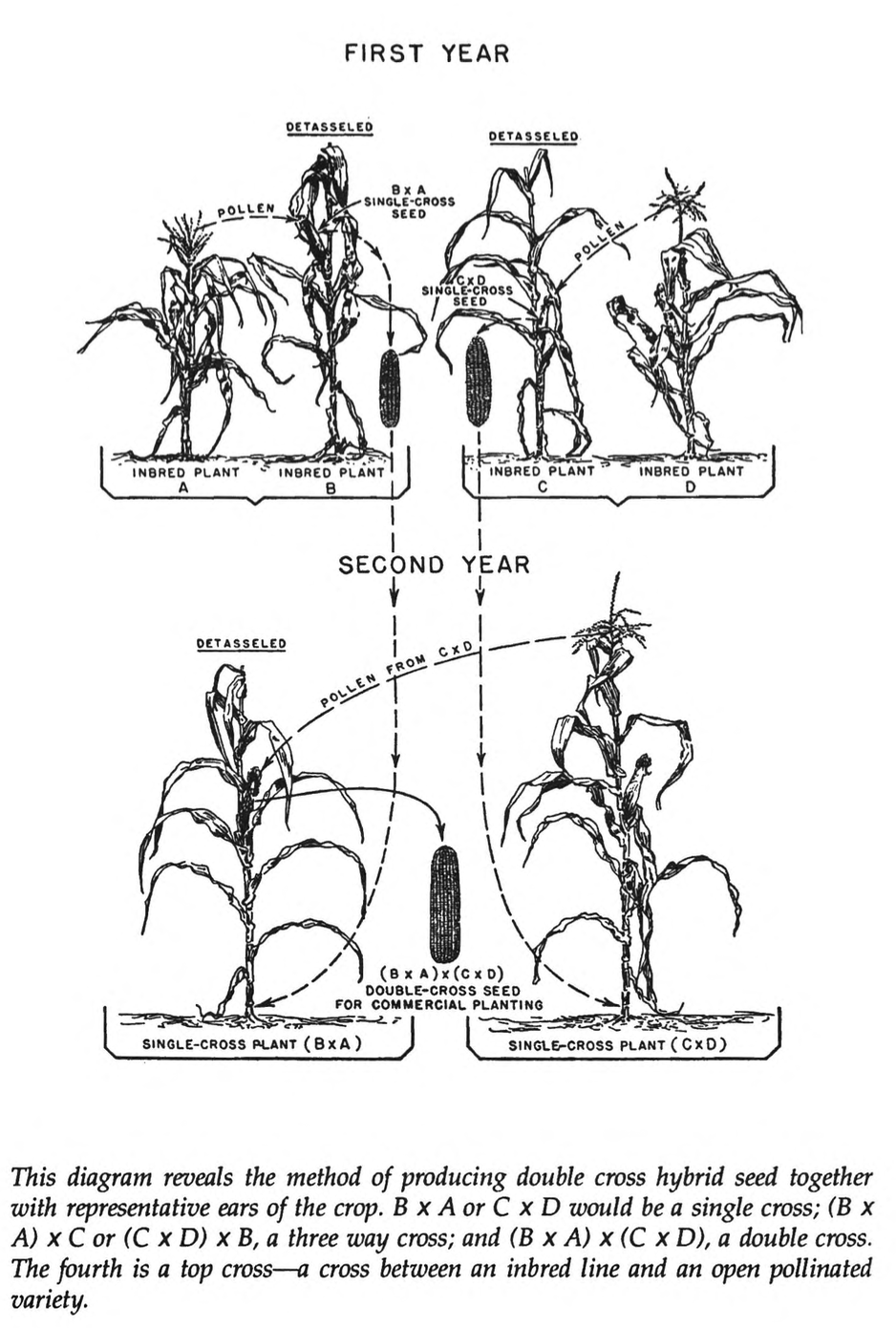
The USDA diagram presented here illustrates the method used in crossing four separate inbred plants to obtain two single crosses. Note how the single crosses are crossed to produce a double cross hybrid seed. Once a desirable hybrid combination has been determined, it can be reproduced repeatedly, simply by maintaining and recrossing the same inbred lines which have already been inbred to the point where each reproduction will give the same results.
Of all the commercial farm crops, corn is the least difficult to hybridize. Usually six rows of the seed-bearing parent, a ratio of one pollen parent to three seed bearing plants is the general rue. High school and college kids are usually employed to remove tassels of the six rows. As a consequence, the seed set will be hybrid.
Today corn, celery, carrots and onions are grown with hybrid seeds, corn and onions easily leading the way. There is a reason for this. Many hybrids are produced by hand crossing. This means emasculation, or removal of the anthers of flowers before pollen has spread, and at the same time protecting these flowers from insect and wind-spread pollen. Not many plants can stand the ordeal. As a consequence, a lot of emasculation and pollination is carried on in a greenhouse. Sometimes flowerbuds—cabbage, for instance—are opened artificially and pollen applied to the stigma. Bud pollination is used on self-compatible radishes.
There is always a question about how pure a seed crop can be kept. Commercial plants that are easily cross-pollinated by insects and wind are heterozygous for some characteristics. They can’t be put into sealed cages, at least when grown on a large scale.
The world has listened long and hard to science telling about hybrid vigors, about dwarf wheats to feed the world, about the much desired male sterility in plants—it prevents unwanted pollination—about those extra chromosomes in potatoes—tetraploid, meaning four, diploid, meaning two—about control of disease via genetics, about green beans with less pod fiber. There is even research afloat to produce a gasless bean. (There is such a bean, of course, one evolved by nature, but it yields poorly, and so far consumers have elected to endure pain in the intestines more than pain in the pocketbook.) In general, however, hybrids simply have less of a burden to carry—that is, reproduction of their species in the seed. This has accounted for more bins and bushels, often with greater protein and trace mineral deficiencies.
Nevertheless, the hybrid concept has swept most of the agricultural scene. When D. F. Jones of Connecticut Agricultural Experiment Station developed the double cross corn concept, the door flew open. From that moment on seed breeders worked long and hard with high-yielding, single cross parents. In 1933 only 0.3% of the American corn acreage was planted in hybrid seeds. By 1960 this figure had jumped to 95%. It is probably in excess of 98% at this writing.
Cytoplasmic male sterility hasn’t been limited to corn alone. It has reached out and touched pearl millet. Hybrid sorghum has largely replaced open pollinated varieties. Soybeans have largely replaced cowpeas for hay and green manure purposes, and hybrids became the name of the game during the 1930s—hybridization and backcrossing (followed by selection).
Even the buffalo grass has not escaped genetic engineering. The plant has staminate and pistillate on separate plants. This specialty has been used to produce the hybrid Mesa. In other words, seed fields are interplanted with selected clones of two dioecious parents.
All this is to simply illustrate that crop potential is determined largely before a farmer puts the first tool to the soil, even before he starts his seed bed and rootbed preparations. Many farmers hone close to low-priced seeds, seeds without the genetic potential needed to deliver a healthy, abundant crop. This is being penny wise and pound foolish, to use that folklore saying.
Seed selection has to be made while the production year is still on the drawing board. Climate figures, so does land. Germination time must be understood. Temperatures that can be endured, and water requirements—all must be made part of the decision process.
The decision is further complicated by the fact that most seeds can handle and germinate in a wide range of temperatures—usually slowly at the lower range, more rapidly as the soil comes alive at higher temperatures. Temperatures that run too high, on the other hand, may impede good germination.
| OPEN POLLINATION Some of the successes that have attended corn production may have been the result of distorted accounting procedures. In terms of nutrients, open pollinated still has an enviable record. Adolf Steinbronn of Fairbanks, Iowa put the matter in perspective by having two samples of corn tested for ingredients usually added to commercial feeds. One was a sample of hybrids he had grown. The other was OP corn. The OP corn contained 19% more crude protein, 35% more digestible protein, 60% more copper, 27% more iron and 25% more manganese. Compared to some 4,000 samples of corn tested in ten midwest states in a single year, Steinbronn’s OP corn contained 75% more crude protein, 875% more copper, 345% more iron, and 205% more manganese. The same trend has also been seen in the content of calcium, sodium, magnesium and zinc. It can therefore be said that OP could contain an average of over 400% more of these nutrients. Ernest M. Halbleib of McNabb, Illinois confirmed the failure of hybrid corn to uptake certain mineral nutrients. In comparing Krug OP corn and a hybrid in the laboratory of Armour’s Institute of Research, Chicago, spectrographic testing revealed the hybrid short of nine minerals. The hybrid failed to pick up cobalt and any other trace minerals. Both varieties had the same chance to pick up a balanced ration. “The reason I mentioned cobalt,” wrote Halbleib, “is that we found (on the 16 farms in test) that no hybrid picked up cobalt, and in all the tests the hybrid was short seven to nine minerals, always exhibiting a failure to pick up cobalt.” The core of vitamin B-12 is cobalt. Ira Allison, M.D., and others have found that a lack of cobalt is implicated as a cause of brucellosis and undulant fever, and cobalt is part of the cure. In the opinion of many eco-farmers, hybrid corn merely masks poor farming by producing bins and bushels without the nutrient goodies that are really corn’s reason for being. |
| IMMUNE PLANTS Much reliance is put on the belief that by selecting and propagating certain plants of a crop we eventually find those which will tolerate diseases like smut, rust, root rot and others. Much is said about freeing resistant crops, or those which will tolerate such troubles. We fail to see the germ diseases as attacks by these invading foreign proteins in their struggle to get their necessary protein while parasitically taking over organically elaborated materials of that kind as starter compounds from which to synthesize their own. We fail to see that immune plants are those getting enough soil fertility support for creating their own protective proteins or antibiotics in the same way as fungi make theirs to protect themselves from each other and to protect us similarly when we take their antibiotics into our blood stream.—William A. Albrecht, Ph.D. |
| WEATHER MODIFICATION Without expressing it this way, farmers know instinctively that there is a highly elastic envelope around spaceship earth. Scientists have used this knowledge of this energy continuum to engineer rain and drought, wind and hail, lightning and snowpack. Weather modification in fact emerged from WWII as a byproduct of smoke screen research. It marched off into the New Mexico desert, where Irving Langmuir, Ph.D., released nucleating materials to bring down rain—both locally and in the eastern states—at regular intervals. Cloud seeding materials cause release of latent heat, each gram of silver iodide capable of releasing a trillion calories of latent heat, thereby generating high winds. Unless seedings are engineered with precise mathematics, the likely result of cloud seeding is removal of snow and rain by forcing moisture aloft as ice crystals, and sending them down wind. Langmuir’s 88 weeks of research revealed that seedings in New Mexico could produce rains and floods in the Ohio River Valley five days after release. Indeed, Stokes Law decrees that tiny ice crystals can take a week to fall, this after being swept along by high velocity winds. A single gram of silver iodide can bring down 500,000 acre feet of rain. Unfortunately this rain can’t be pinpointed. Private, uncoordinated cloud seeding and inept public programs are riding a bonanza. With airplanes and ground generators, chemicals and promises, they seed everything in sight. The results have been the worst droughts since the dust bowl, and the worst floods, high winds and tornadoes in history. No mystical Act of God theory can assign blame for these uncomprehending acts of men. Farmers may not be able to do much about the weather—nature’s weather, or man’s weather—but they owe it to themselves to understand cause and effect. |