Acres U.S.A.® Magazine
  • Articles
    • News
    • Ecological farming
      • Climate
      • Environmental Issues
      • Farm management & planning
      • Human health
    • Livestock
    • Farm
    • Crop
      • Crop management practices
        • Ag technology
        • Cover crops
        • Crop nutrition
          • Crop protection
          • Diseases
        • Crops
        • Fruits
    • Soil
    • Opinion
  • Resources
    • Magazine
    • Online Learning
    • Newsletters
    • Free Articles
    • Blog
  • Magazine Issues
    • 2026
      • February 2026
      • January 2026
    • 2025
      • December 2025
      • November 2025
      • October 2025
      • September 2025
      • August 2025
      • July 2025
      • June 2025
      • May 2025
      • April 2025
      • March 2025
      • February 2025
      • January 2025
    • 2024
      • December 2024
      • November 2024
      • October 2024
      • September 2024
      • August 2024
      • July 2024
      • June 2024
      • May 2024
      • April 2024
      • March 2024
      • February 2024
      • January 2024
    • 2023
      • December 2023
      • November 2023
      • October 2023
      • August 2023
      • July 2023
      • June 2023
      • May 2023
      • April 2023
      • March 2023
      • February 2023
      • January 2023
    • 2022
      • December 2022
      • November 2022
      • October 2022
      • September 2022
      • August 2022
      • July 2022
      • June 2022
      • May 2022
      • April 2022
      • March 2022
      • February 2022
  • About Us
    • Our History
    • Our Staff
    • Contact Us
    • Community
      • Soil Health Primer Resources
  • Events
    • Eco-Ag Conference
    • Farm Weird Event
    • Viroqua On Farm Event
  • Subscribe
  • Login
  • Register
No Result
View All Result
  • Articles
    • News
    • Ecological farming
      • Climate
      • Environmental Issues
      • Farm management & planning
      • Human health
    • Livestock
    • Farm
    • Crop
      • Crop management practices
        • Ag technology
        • Cover crops
        • Crop nutrition
          • Crop protection
          • Diseases
        • Crops
        • Fruits
    • Soil
    • Opinion
  • Resources
    • Magazine
    • Online Learning
    • Newsletters
    • Free Articles
    • Blog
  • Magazine Issues
    • 2026
      • February 2026
      • January 2026
    • 2025
      • December 2025
      • November 2025
      • October 2025
      • September 2025
      • August 2025
      • July 2025
      • June 2025
      • May 2025
      • April 2025
      • March 2025
      • February 2025
      • January 2025
    • 2024
      • December 2024
      • November 2024
      • October 2024
      • September 2024
      • August 2024
      • July 2024
      • June 2024
      • May 2024
      • April 2024
      • March 2024
      • February 2024
      • January 2024
    • 2023
      • December 2023
      • November 2023
      • October 2023
      • August 2023
      • July 2023
      • June 2023
      • May 2023
      • April 2023
      • March 2023
      • February 2023
      • January 2023
    • 2022
      • December 2022
      • November 2022
      • October 2022
      • September 2022
      • August 2022
      • July 2022
      • June 2022
      • May 2022
      • April 2022
      • March 2022
      • February 2022
  • About Us
    • Our History
    • Our Staff
    • Contact Us
    • Community
      • Soil Health Primer Resources
  • Events
    • Eco-Ag Conference
    • Farm Weird Event
    • Viroqua On Farm Event
  • Subscribe
No Result
View All Result
Acres U.S.A.® Magazine
No Result
View All Result
Home Crop management practices Crops Fruits

Cracking the Regenerative Hazelnut — Part 2

Acres U.S.A. by Acres U.S.A.
June 26, 2024
in Fruits, Soil & plant health
0
Cracking the Regenerative Hazelnut — Part 2
0
SHARES
24
VIEWS
Share on FacebookShare on Twitter

An interview with Willamette Valley hazelnut grower Dan Brown

Acres U.S.A. In terms of floor management, are you planting cover crops or are you just letting stuff come up?
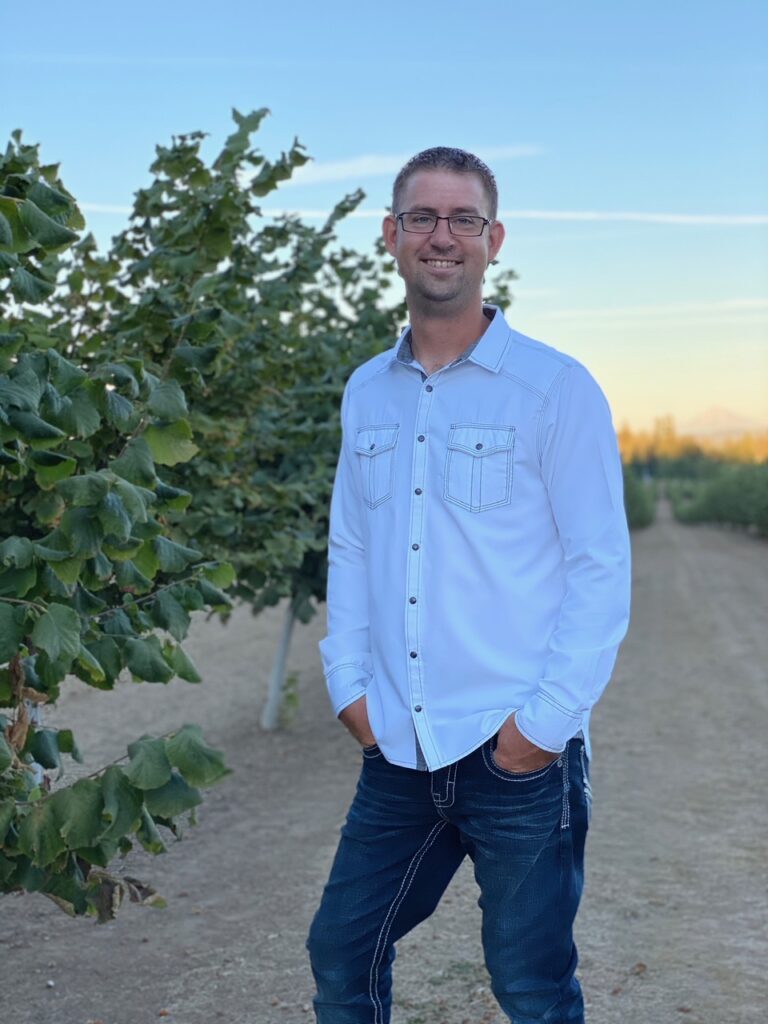
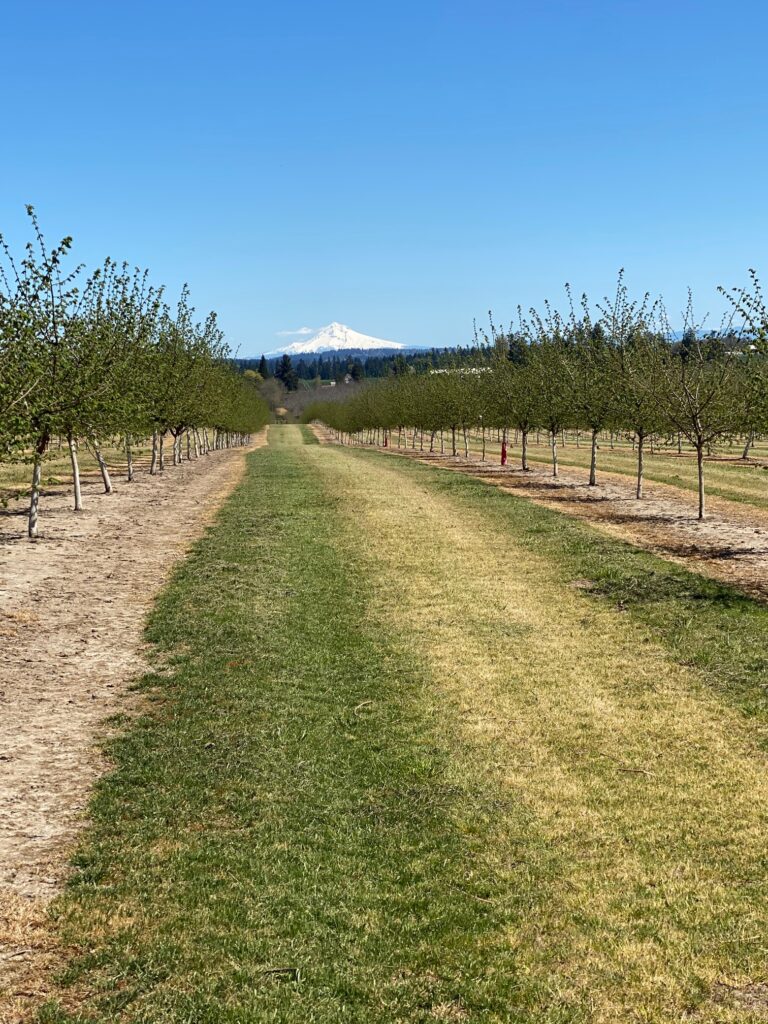
Brown. Both. We still keep the tree rows clean due to harvest. The way the mechanical harvest works to get the nuts out of the tree row, if there’s ground cover, it’s next to impossible. We haven’t figured out a way yet to not have bare ground at harvest. We keep the tree rows clean, but we leave about 60, 65 percent of the orchard width. A lot of them are just native weed veg cover. 

We have planted some cover crops. It’s a management challenge for us to get them in the ground. By the time we’ve finished harvest in the fall, it’s usually too cold and too wet to be able to put them in the fall, so it’s spring plant. There’s so many things going in the spring, so that’s a challenge.

Also, we don’t have really the right planting tool. All of that equipment has gotten very expensive in the last year with inflation. And nut prices have been very depressed, so we haven’t had any excess capital to go and buy a 30, 40, $50,000 seeder, planter or drill to be able to more efficiently plant a cover crop. Our ultimate aim is a permanent grass. We’re looking toward a creeping red fescue, mowing it probably three to five or six times a year. We use a flail mower; that’s our preferred method versus the rotary.

Acres U.S.A. Would you be interested in something like one of the mow-and-blow options, where it mulches it all up and then blows it onto the row?

Brown. I want to see it firsthand, and it would be an experiment to see if the blow essentially broke down and went away before harvest. That would be something I’d have to experiment with it.

Acres U.S.A. When exactly is harvest?

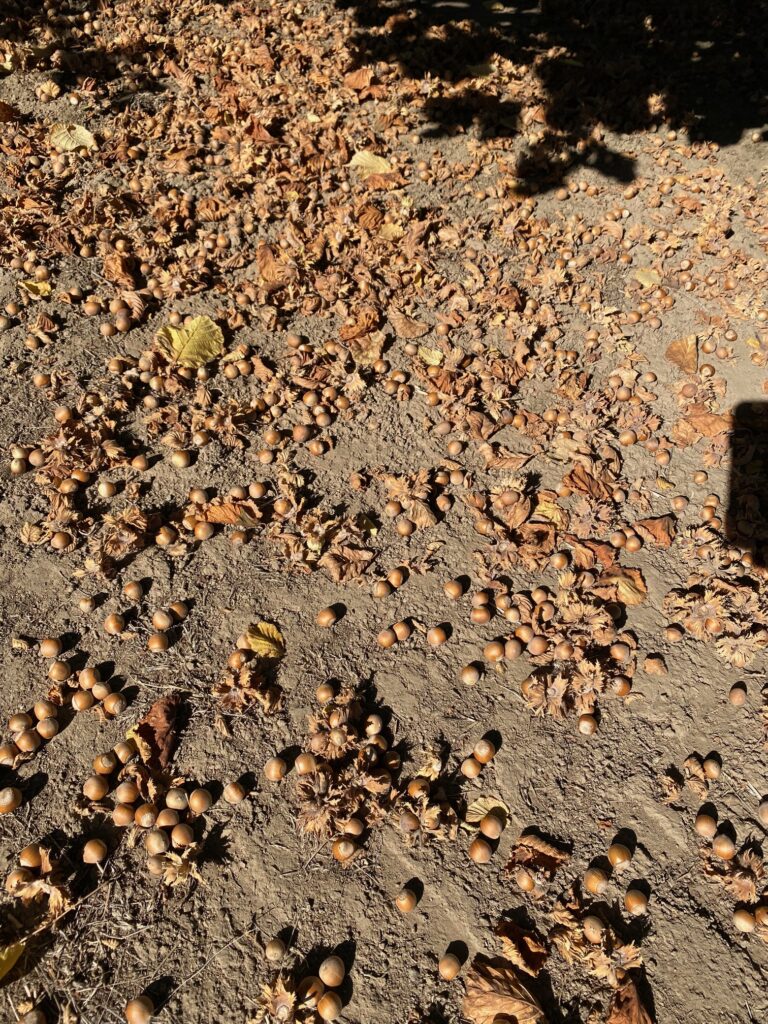
Brown. Harvest is September-October, and we try to be done by then. This year it was November-December also. We harvest off of the orchard floor. We don’t pick them off the tree, so they fall to the ground. There’s been a little bit of experimenting with shaking to try to get them down a little bit earlier, but it’s still minimal. About 98 percent of them fall naturally.
Acres U.S.A. Then your harvesting equipment is essentially a vacuum or a rake?

Brown. Yeah, there’s a sweeper that has tine bars and brings them to the middle with two passes, and then a harvester picks up the windrow and separates as much of the trash from the nuts as possible. Then the nuts go into a vessel to be delivered to a washing and drying station.

Acres U.S.A. What kind of results were you getting at first on sap analysis? Was there any particular nutrient or something that was really instrumental in helping the health of the trees?

Brown. Yeah. We have backed off of nitrogen significantly. We’re still experimenting a lot with that, but the college recommends 160 units of nitrogen bulk spread in the spring. That’s the industry standard. We are down to zero on the ground in some orchards; some are 20 to 40 on the ground units, and then foliar fed urea, but at probably 10 to 20 units a year. We’ve seen on some new variety trees no yield loss whatsoever with that.

Acres U.S.A. That’s got to have a pretty insignificant effect on your insect pressure, I would think, and disease.

Brown. That’s a huge, yes. On some new variety orchards, the trees have a healthier baseline, and we’ve been able to get to a level that we haven’t sprayed insecticide for two or three years now on some blocks.

Acres U.S.A. That’s great. How long does it take for a new tree that you plant to come to start to yield fully?

Brown. Full production is about 7 to 10 years. First harvest is typically 4 to 5.

Acres U.S.A. And in terms of marketing, there’s a lot of demand for hazelnuts and chestnuts, but more and more orchards are going in. Are you concerned about that, or do you think you have a good advantage just by being where you are — that you’d be able to weather that?

Brown. Both sides. The handlers all tell us they need more, but at the same time, some years there’s a world oversupply and the price collapses. It’s unknown. The marketing is very interesting for hazelnuts in the Willamette Valley. You basically deliver them to whichever handler you choose, and there are only five. Once they’re delivered, the price is whatever you get.

Acres U.S.A. In that sense, you’re a price taker, but are you doing any other direct marketing?

Brown. We do a little bit, but it’s very small. A few thousand pounds a year. A lot of it’s due to food safety rules and handler laws. If you sell, I believe, over 5,000 pounds a year, you’re required to be registered as a handler and follow all of the regulatory rules that go with that. Mostly paperwork — it’s huge. Then, if you want to crack and then sell kernels, that’s a whole other layer of regulation. That means personnel time and capital investment to be able to do that in a manner that fits the modern consumer — or, really, modern governmental regulatory rules. They’re really the bigger driver.

Acres U.S.A. What about the organic market? If you were able to get there with part of your orchard, does that dramatically change your marketing options? Obviously it would affect the price, but are there more options for marketing that way?

Brown. That’s actually very interesting. The country of Turkey raises 70 percent of the world’s hazelnuts, and most of those are grown organically. There really isn’t much of a premium because they can just import Turkish organic hazelnuts. Very few of the handlers will even deal with trying to process organic ones, so there really isn’t a benefit. There isn’t a lot of additional benefit right now to having certification.
Acres U.S.A. Do you have any inclination whether these new organic rules about the supply chain having — supposedly they’re going to crack down on imports and on third-party people, requiring them to be organically certified. Do you think that would have any effect on that Turkish market?

Brown. It’s hard to say. I think there’s actually currently a federal lawsuit about Turkish organic hazelnuts, so it’s being looked at, but I don’t know how intensively.

Acres U.S.A. And what those Turkish growers doing that they’re able to grow so many organic hazelnuts?

Brown. The Turkish hazelnut industry is made up of very small scale farms. There’s like a million farmers farming a couple million acres. They’re one- or two-acre farms, all using manual labor. There are some that are larger as well, but from my understanding it’s mostly hand labor. A lot of them are handpicked off the tree. They lay them out on a tarp on a sidewalk and the sunshine dries them. It’s very labor-intensive, but their cost of labor is so much lower.

Acres U.S.A. That’s ironic — that we can’t compete with this old-school, traditional way of doing it. Can you talk about your labor situation? How many folks do you have working, full-time versus seasonal?

Brown. We’re pretty light on labor. We’re currently looking to add another, but basically it’s me and my brother, and my dad’s still full time. 

Acres U.S.A. How is your succession going? Is he letting you make decisions, and is he all on board with all the ecological, regenerative moves you’re making?

Brown. Yes, I feel very blessed compared to a lot of farmers. He accepts it. I don’t know that he’s necessarily the most in favor of every regenerative decision I make, but he accepts it.

Acres U.S.A. That’s good. That’s really difficult sometimes. And what’s in the future? You said you’re going to be doing some DNA testing.

Brown. Yeah, I want to do some DNA testing, some different residue testing, just to see if that could be some of the reasons why our orchards have declined so rapidly. Maybe just the root mass on a tree that’s 30, 40 feet tall and 25, 30 feet in diameter — there’s not a lot of root structure on it.

Acres U.S.A. For residue cleanup, glyphosate cleanup, there are some products out there. I know the OP8 is one; have you used that?

Brown. Yeah, we’ve used some, and continue to use OP8 and other biological treatments — both the live stuff as well as a lot of the liquid fish oceanic products. We’re always trying to find effective calcium sources because we can never get the calcium levels up where we’d like to see them. They always seem to be low. Our native soil doesn’t have phosphorus deficiencies or potash deficiencies, so those aren’t big needs for us. Calcium is our biggest need.

Acres U.S.A. You’ve used some foliars for that, I assume.

Brown. Yeah, we foliar. The shift away from fungicide has been replaced with foliar fertilizer passes. I mean, if I had an unlimited budget, I would foliar fertilize every week or two. But hazelnuts don’t have the economics right now to justify that.


← Previous Pollination Next Hybridization: Controlling Seed Production →
Tags: HazelnutsWillamette Valley
Acres U.S.A.

Acres U.S.A.

North America’s oldest publisher on production-scale organic and regenerative farming. For more than 50 years, our mission has been to help farmers, ranchers and market gardeners grow food profitably, regeneratively, and with nature in mind.

Next Post
Hybridization: Controlling Seed Production

Hybridization: Controlling Seed Production

  • Trending
  • Comments
  • Latest
The Most Important Livestock in Our Fields

The Most Important Livestock in Our Fields

July 1, 2024
Glyphosate Does What It’s Designed to Do — Kill

Glyphosate Does What It’s Designed to Do — Kill

February 19, 2025
The Take-Half, Leave-Half Fallacy

The Take-Half, Leave-Half Fallacy

July 1, 2025
USDA organic seal over American farm land

Losing Organic Farms

January 27, 2026
We Don’t Need Another Bridge — We Need an Off-Ramp

We Don’t Need Another Bridge — We Need an Off-Ramp

3
Under One Roof

Under One Roof

3
A Rose By Any Other Name

A Rose By Any Other Name

2
Terra Preta’s Biological Advantage

Terra Preta’s Biological Advantage

2
Destroying Farmland for AI

Destroying Farmland for AI

March 12, 2026
Roundup glyphosate herbicide referenced in debate over national security executive order

ROUNDUP PIE

March 5, 2026
What Does “Cutting Red Tape” Mean for Eco-Ag?

What Does “Cutting Red Tape” Mean for Eco-Ag?

March 4, 2026
March 2026 • Issue #657

March 2026 • Issue #657

March 1, 2026

Recent News

Destroying Farmland for AI

Destroying Farmland for AI

March 12, 2026
Roundup glyphosate herbicide referenced in debate over national security executive order

ROUNDUP PIE

March 5, 2026
What Does “Cutting Red Tape” Mean for Eco-Ag?

What Does “Cutting Red Tape” Mean for Eco-Ag?

March 4, 2026
March 2026 • Issue #657

March 2026 • Issue #657

March 1, 2026

About ACRES USA

Acres U.S.A.® Magazine

Acres U.S.A.® is North America’s oldest publisher on production-scale organic and regenerative farming. For more than 50 years, our mission has been to help farmers, ranchers and market gardeners grow food profitably and sustainably, with nature in mind.

Magazine Issues

  • News
  • 2025
    • June 2025
    • May 2025
    • April 2025
    • March 2025
    • February 2025
    • January 2025
  • 2024 Articles
    • December 2024
    • November 2024
    • October 2024
    • September 2024
    • August 2024
    • July 2024
    • June 2024
    • May 2024
    • April 2024
    • March 2024
    • February 2024
    • January 2024
  • December 2023
    • December 2023
    • November 2023
    • October 2023
    • August 2023
    • July 2023
    • June 2023
    • May 2023
    • April 2023
    • March 2023
    • February 2023
    • January 2023
  • December 2022
    • November 2022
    • October 2022
    • September 2022
    • August 2022
    • July 2022
    • June 2022
    • May 2022
    • April 2022
    • March 2022

Contact Acres U.S.A

  • Contact Us
  • About Us
  • Advertise With Acres U.S.A.
  • My Subscription

Learn

  • Resources
  • Events
  • Magazine
  • Newsletters
  • Free Articles
  • Webinars
  • Online Courses
  • Bookstore

Our All Socials

Follow With Us...

  • My account
  • News
  • Ecological farming
  • Refund and Returns Policy
  • Privacy & Policy

© 2024 Acers USA Magazine

Welcome Back!

Login to your account below

Forgotten Password? Sign Up

Create New Account!

Fill the forms below to register

All fields are required. Log In

Retrieve your password

Please enter your username or email address to reset your password.

Log In
No Result
View All Result
  • HOME
  • ARTICLES
    • News
    • Farm
    • Ecological farming
    • Livestock
    • Crop
      • Crop management practices
      • Cover crops
      • Crop nutrition
      • Crop protection
      • Crops
      • Ag technology
    • Soil
    • Opinion
  • RESOURCES
    • Magazine
    • Online Learning
    • Newsletters
    • Blog
    • Free Articles
  • MAGAZINE ISSUES
    • 2025
      • June 2025
      • May 2025
      • April 2025
      • March 2025
      • February 2025
      • January 2025
    • 2024
      • December 2024
      • November 2024
      • October 2024
      • September 2024
      • August 2024
      • July 2024
      • June 2024
      • May 2024
      • April 2024
      • March 2024
      • February 2024
      • January 2024
    • 2023
      • December 2023
      • November 2023
      • October 2023
      • August 2023
      • July 2023
      • June 2023
      • May 2023
      • April 2023
      • March 2023
      • February 2023
      • January 2023
  • ABOUT US
    • Our History
    • Our Staff
    • Contact Us
    • Community
      • Soil Health Primer Resources
  • EVENTS
    • Eco-Ag Conference
    • On-Farm Viroqua Event
    • Farm Weird
  • SUBSCRIBE
  • Login
  • Sign Up
  • Cart

© 2024 Acers USA Magazine

Are you sure want to unlock this post?
Unlock left : 0
Are you sure want to cancel subscription?