

Water ecologist Alpha Lo explains the different water cycles and how farmers play a role in buffering rain patterns
Acres U.S.A. Could we start with your background? How did you become a climate water scientist?
Alpha Lo. I went to grad school in physics, and then afterwards I got into permaculture and did some work on some permaculture places. I was living in California, and there were so many fires there year after year. I started to wonder if there was some permaculture solution, because the only solution people were giving was just to cut down more vegetation.
I found a video by Zach Weiss about how you could actually create rain again with the small water cycle, and also how there are ways to hold more hydration in the land. So, that got me interested. And then I learned about Charles Eisenstein, who wrote a book called Climate, which talks about how water is a self-organizing force in the whole ecosystem climate. That kind of got me even more interested in water, and so I just started delving in more and more.

I got connected with a bunch of people, including a friend who ran a permaculture magazine, and we organized this Regenerative Water Alliance. The goal was to bring a lot of people together to discuss water, and it just kind of grew. Then I started writing about it, and more people started reading my blog, and my podcasts started getting attention. I’m back in graduate school now to do more research on this.
Acres U.S.A. Yeah, it’s really important work. A lot of our readers are at least familiar with these issues. We did an interview in the past with Walter Jehne, so I think people understand the idea that water plays a huge role in climate. And of course, ecological farmers are very familiar with the ideas of water sinking and spreading and trying to retain as much water on their farms as possible. But can you describe what the large water cycle is and then what the small water cycle is, and how they differ and why that’s important?
Lo. Sure. The large water cycle is the ocean moisture blowing in, and that adds moisture to the air, which then creates rain. Then the small water cycle, which is called “precipitation recycling” by the climate scientists, is where the land captures some of that rainfall. Instead of most of it becoming runoff, some of it can also get transpired up to add to the ocean moisture to create rain.
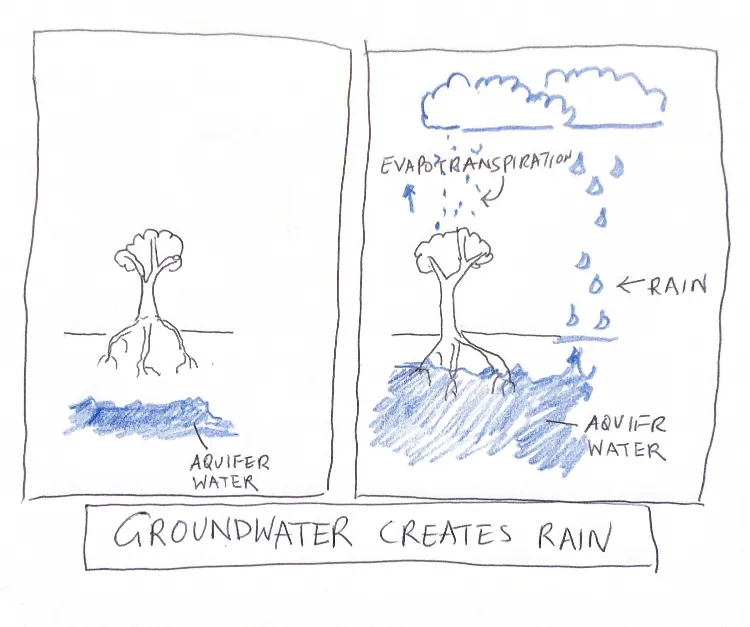
So, the small water cycle is really a key factor. If you don’t have forests, if you don’t have grassland, if you don’t have soil absorbing the rain, then it just becomes runoff. And then you have a lot less rain, because all of that is just going out to the river and out to the ocean immediately. That’s also why it’s important to slow the water down in the landscape and also why it’s important to recharge the aquifers, because the trees are also bringing water up from the groundwater with their root systems and putting that into the rain.
So, there’s actually actually a third cycle, which is the groundwater cycle. In addition to the small water cycle and the large water cycle, it’s also very important in creating rain.
Acres U.S.A. The large water cycle is continental, right? That wouldn’t be something that nations, even, or large landholders, could really change. But we can affect the small water cycle to some degree, correct? I know that’s one of the big questions — how much land do you have to regenerate to change some of these cycles?
Lo. But you can change the large water cycle too. That’s the idea of the biotic pump. It’s the theory that you can change the ocean moisture when it comes into the land two months earlier. Usually there’s this thing called the ITCZ — this rain band in the middle of the equator that moves up and down — and that tells you when the wet season and dry season is. But you can actually bring in that water earlier. Research has shown that the Congo rainforest and the Amazon rainforest actually change that — even that large water cycle.
Acres U.S.A. Can you explain the biotic pump idea a bit more?
Lo. It’s the mechanism whereby transpiration from the trees goes up, and then when the water vapor condenses, it creates a vacuum, because liquid water is thousands of times the volume of water vapor. So there’s this vacuum, and that can help suck in the ocean moisture. That’s the biotic pump. Ron Fuller, a professor at UCLA, has proposed a different mechanism. It’s basically that when the water condenses, it releases a lot of heat, and that also rises, and then ocean moisture can come in.
The biotic pump is a bit more of a controversial mechanism, but the latent heat mechanism is pretty standard. The important thing is that there is this mechanism that can bring in water — that the forest can change the circulation.
Acres U.S.A. This is the idea that trees or forests can help create rain, right?

Lo. Yes — we were just talking about doing this through the large water cycle. And then, of course, you can create rain through the small water cycle by absorbing the water. If you are a farmer, you’re probably going to be altering the small water cycle more — until you get to much larger cooperatively managed landscapes.
Acres U.S.A. Right. Can you talk a little bit too about the other ways that trees or the landscape could help create rain, in terms of putting out condensation nuclei?
Lo. Yeah, that is a major mechanism too. Trees, release terpenes, which then turn into these aerosols that can seed the rain. As we’ve cut down a lot of the forests in nature, we have fewer and fewer of these terpenes to seed the rain. Fungi spores, and also certain types of bacteria like Pseudomonas syringea, are also able to seed the rain. It’s like a microbiome of the atmosphere that’s seeding the rain. That’s also really important.
Acres U.S.A. Yeah, that’s fascinating. It seems like this is something that all of us can help with as a climate issue — just plant more trees. I think you’ve written about the differences between the focus on carbon dioxide in the atmosphere — which is a mechanism for heating the atmosphere — versus the role water plays. Can you talk about that and what the differences between those two mechanisms are?
Lo. Sure. Both the carbon and the water cycles affect the climate, but there are two things they’re affecting: one is the heat, and the other is the rain. So, in terms of heat, carbon is a greenhouse gas, and so is water. Also, transpiration can create clouds. So, if you’re creating high clouds, that traps the heat. If you’re creating low clouds, it actually reflects more heat, so it cools the earth. And there’s also something called transpiration cooling. It’s kind of like sweating. When trees, or even a landscape of grass, release water, that cools the landscape. Urban landscapes will be cooler where there’s more vegetation. So, that’s the heat aspect.
And then in terms of rain, carbon dioxide is creating this climate whiplash, because the hotter the air, the more water vapor you can store, and then it doesn’t rain as much. Then you have longer droughts, but when it does storm, there’s more water vapor in the air, so you have bigger storms. That’s called climate whiplash. And then also you have global warming from cutting down trees because of the water piece that we just talked about — how the large water cycle and small water cycle will affect the rain too. And I should add that the groundwater cycle is important too — as you drain the groundwater, that’s also lessening the rain.
So, for farmers, agroforestry is important, if you can do it. I know that’s hard. But I think the more trees you can grow on your land, and integrate with the crop, that’s important.
Acres U.S.A. So, that would be the main takeaway for farmers — try to incorporate tree crops as much as possible.
Lo. There’s a couple things. You want to increase your soil organic matter because for each 1 percent of organic content in your soil, you absorb 20,000 more gallons per acre-foot. The more fertilizers and pesticides, the more you usually degrade the soil, so it can’t absorb as much rain. That also doesn’t allow the water to infiltrate into the aquifers, so you’re not recharging them. A third thing you can do is to have more wetlands because the wetlands also recharge the aquifers. If your farm is able to withstand it, during the wet season, you can flood your farm. It may take a week to drain, but that recharges the aquifers, which is really important too. You could also build earthworks and swales to help infiltrate more rain into your aquifers.
Acres U.S.A. Explain what you mean by flood the farm.
Lo. It’s just a technique where you divert river water when levels are high. It takes a while to drain, but otherwise during the wet season, all that water would just run off into the ocean.
Acres U.S.A. Are there any tree species or types of silvoforestry or agroforestry that would work better than others in terms of releasing terpenes other cloud nuclei, or for recharging groundwater?
Lo. I’m not totally sure on the details of which trees are best. I assume the native ones in your area are best, usually. And there are certain trees that can reach deeper, like white oak. So, that can be useful.
| WATER ECOLOGY PRINCIPLES From Alpha’s blog: climatewaterproject.substack.com 1. Soil sponginess regulates landscape hydration, precipitation recycling and groundwater recharge. Soil moisture impacts rainfall patterns. Increasing the soil’s organic content increases its ability to absorb rain. 2. Forests and the water cycle co-regulate each other. Forests transpire water to create rain. That rain grows forests. Forest transpiration can cause largescale atmospheric circulation shifts, like bringing in the wet season earlier — e.g., Amazon rainforest transpiration causes the wet season to start two months earlier. 3. The microbiome cycle and water cycle co-regulate each other. Microbes and fungi spores seed rain. Rain and rivers transport the microbiome. Rain impacts the growth of ecosystems, which in turn grows the microbiome. The soil microbiome helps to regulate vegetation transpiration. 4. Wetlands cleanse water and recharge aquifers. Wetland plants absorb nutrients. Wetland microbiomes break down nutrients and pollutants. The microbiome processing of sediment affects how water filters to aquifers below. 5. Rain is a result of four interacting water cycles mediated by organisms. The four water cycles are the large water cycle (ocean to land to river), small water cycle/ precipitation recycling (air to land to air), groundwater cycle (tree roots bring water down in wet times, bring it up in dry times), and dew cycle. Forests, grasslands and the soil microbiome mediate how the small water cycle combines with the large water cycle. Tree roots can push water down during the wet season. They bring up groundwater during the dry season and transpire that water to combine with the small and large water cycles to help create rain. Vegetation mediates the dew cycle. 6. Slow water synchronizes the biogeochemical cycles. Slow water enables vegetation to grow, which means that the water cycle synchronizes better with the carbon cycle as well as other biogeochemical cycles — phosphorus, sulfur, nitrogen, etc. 7. Slow water moves water from the wet season to the dry season. Slow water recharges aquifers, which then enables springs to hydrate year-round and enables trees to bring up water in the dry season to create rain. 8. To exit or lessen the drought-fire-flood feedback loop, restore soil and the water cycle. Droughts increase fire risk. Fire leads to fewer roots holding soil in place. Intense fire leads to waxy hydrophobic surfaces forming on soil. This leads to more floods, with less vegetation and soil to absorb and slow rain. Restoring soil hydrates the landscape longer and lessens fires. Restoring soil after fire can restore its ability to absorb rain and thus lessens floods. Restoring the land after floods helps it to better absorb the following rains to hydrate the land. Restoring the small water cycle, the groundwater cycle, and the dew cycle lessens droughts and drought impact. 9. Green water helps run earth’s thermoregulatory system. This happens via transpirational cooling, cloud formation and meridional transport, and as a greenhouse gas. Low clouds cool the earth. High clouds warm the earth. Green water is defined as water used by plants. Green water facilitates the growth of vegetation, which sequesters carbon. 10. Ecosystems engage in niche construction that involves reconfiguring local and global water cycles. Ecosystems increase the small water cycle, shift the groundwater cycle, change river flows, and alter largescale circulation. 11. Evapotranspiration shapes largescale atmospheric water circulation and climate patterns. This occurs via water vapor condensation impacts and transpirational shifting of largescale atmospheric circulation structures like the Hadley cell, Rossby waves and jet streams. More forest transpiration means more powerful Hadley cells and Ferrel cells, which means less jet stream blocking, which means less climate whiplash and climate extremes. |