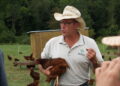


John Kempf and Ohio vegetable farmer Bob Jones discuss on-farm research, the link between flavor and nutrients, and managing light and other variables for nutrient density
John Kempf. Bob, tell us a little bit about your story — the background, the operation that you’re working with today, and how that all came to be.
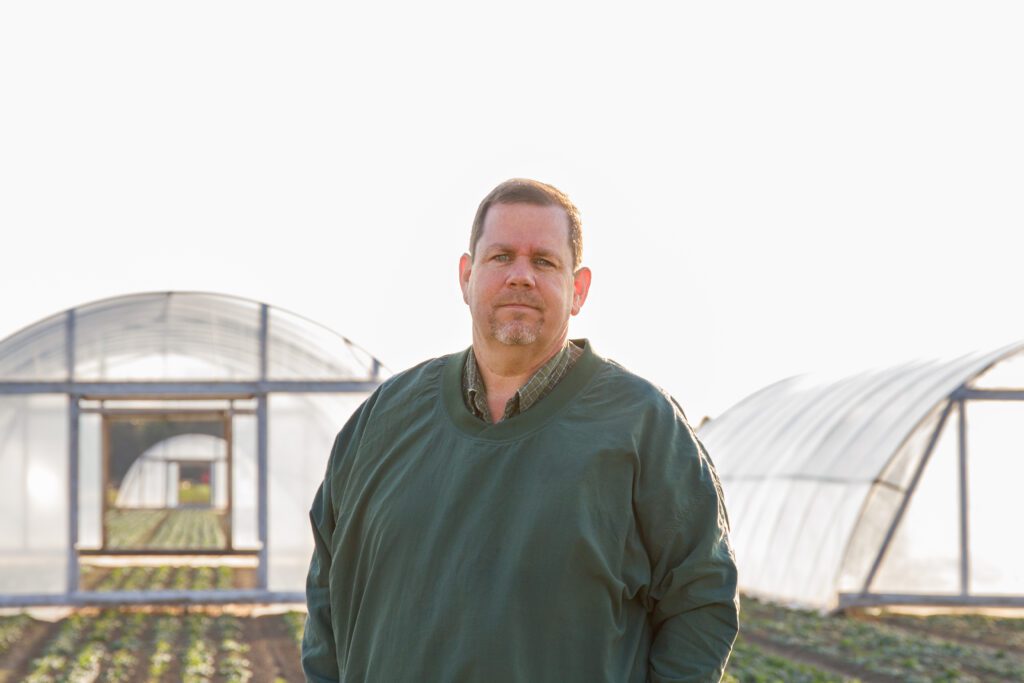
Bob Jones. Our family has been farming for over six generations. We have been growing vegetables on our farm here for about 60 years in this location. My brother Lee and I operate the farm together with an amazing team of folks. We are on a transition, or a continuum, if you will, of learning, and we certainly don’t have this all figured out by any stretch of the imagination, but we’re learning enough to excite us to try and learn more faster.
We came out of a wholesale operation that my father ran back in the ‘70s and ‘80s. At his peak he had about 1,200 acres of fresh market vegetables. He was selling wholesale to grocery chains anywhere east of the Rocky Mountains. We got a very good lesson in both economics and agronomics. We talk a lot in our operation about how modern agriculture in the U.S. today is broken both economically and agronomically.
He was a large wholesale grower in that economic model of borrowing operating capital. In the ‘80s — with the farm crisis — had loans up to 23 percent interest. His largest account was Kroger, and they were a 120-day pay. So we borrowed money at 23 percent and, in essence, loaned it to a wholesaler for five months, and we wondered why that model didn’t work. In 1983, our lending institution encouraged us to find a different advocation.
So we started over. We didn’t know anything other than vegetables. We went from 1,200 acres in 1983 to six acres in 1984. We went from large volume, very small margins, waiting for our money, to much, much smaller volumes with better margin because we were selling at a roadside stand and farmers markets, and it was cash. It was simply an economics 101.
At that same time that the economics weren’t working, the agronomics were broken as well. It was requiring greater and greater amounts of inputs to produce the same or less output, and that contributed to the economic downside. While we were at farmers markets in the mid- to late-’80s, we happened to meet some chefs in the Cleveland area. They started buying at the farmers market because they couldn’t get good quality product from their purveyors. We have been extremely fortunate in that chefs have taught a bunch of dirt farmers like us the food business. Many farmers today don’t understand they’re in the food business because they don’t have a direct connection to the end consumer. They’re in a commodity world.
Kempf. Yes, unfortunately.
Jones. That immediate feedback from your consumers is always helpful. It’s just not always fun. Because when you screw it up, they’re going to tell you, and you have to make it right, right away. We were very fortunate.
We’re now shipping fresh produce to restaurants in 50 states and 17 countries. It worked really well until COVID, when those restaurants all closed. That was not a fun time for any of us. But it caused us to diversify the operation. So now, instead of just being 100 percent restaurant, we also ship direct to homes in all 50 states.
This time of the year [December] we’re doing corporate gifting for doctor’s offices and attorney’s offices and hospitals and insurance companies. We also have a retail roadside stand, which we had not done in over 40 years; we brought that back. So we now have four different channels that we’re selling the same fresh produce through, and that has given us a strategy of diversification.
At the same time, we have been growing for flavor. Chefs have been extremely consistent in their demands of us over the past 40 years. They asked for flavor, for aesthetics, for shelf life, and for even more flavor. If a chef doesn’t have flavorful ingredients, they don’t have anything.
Home consumers are similar, but with a little variance. Home consumers want food that looks good, tastes good, is good for them and is clean. Although, they’re not really sure what that means. There’s a lot of confusion in the marketplace surrounding organic, regenerative, conventional. We don’t think, quite honestly, that it should be about the label you put on the food. It should be about the results of the tests on nutrient density that should qualify and quantify that food. We built it on farm lab several years ago, and we’re trying to correlate growing practice to both flavor and nutrition.
The medical community is also starting to pay much more attention now and ask better questions and teach us. We’re working with Dr. Nasha Winters, a holistic oncologist. We’re also working with a cardiologist and a microbiologist on gut health, and we’re learning as much as we possibly can about how to grow food that doctors want for their patients. So, our mission has evolved to growing exceptional vegetables, caring for each other in the land, and promoting a vegetable forward future.
Kempf. Wow, that’s incredible, Bob. Tell us a little bit more about the scope of your current operation. You have these four different distribution channels, and you mentioned that you started it with six acres back in 1984, but what does that look like today?
Jones. Today we’re operating about 400 acres of tillable land. Up until 2023 we were producing vegetables on about a third of that acreage, and then we would rotate around the farm. We are actually going to shrink that acreage a little bit. We are going to go from about a hundred acres down to 75 because we’ve felt like we’ve had too much waste of product. Our strategic plan for 2024 is to grow revenue by 10 percent but to actually shrink the acreage.
Many years ago my grandfather told me that his grandfather told him, if he couldn’t make money on a hundred acres, he knew he could make money on 10. I think what he was trying to teach me was to get the farm to the size that you can manage effectively and to do the very best job that you can. Better is better before bigger is better.
We don’t desire to be the largest farm. Our goal is to grow the best tasting, most nutritious and healthiest food for the folks that are consuming that food. We’re rotating around, using multispecies cover crops, growing our own cover crop seed. We’re now getting into some small heritage grains for our retail operation to complement the vegetables.
My son and his wife have started a permaculture operation on the old home farm, so they’ve got 20 acres of multispecies pasture. They’ve got a thousand apple trees planted in the pasture, and they are rotationally grazing beef, pork, turkeys, chickens, and ducks through there. We’ll take the first fruits into the retail stand and then convert the seconds into bacon.
Kempf. In addition to your vegetable produce operation, I know that at one point you also had a very significant salad greens and microgreens operation in the greenhouse. What is the current scale of that, and how does that piece contribute to the nutrient density angle that you’re seeking?
Jones. On our 400 tillable acres we grow between 75 and a hundred acres of vegetables and have about 15 acres of covered production. That 15 acres includes every type of covered technology that you can think of, from low tunnels to high tunnels to primitive 30-year-old greenhouses to glass greenhouses that are computer controlled. The microgreens are a big piece of that. We grow leafy greens both outdoors and indoors.
We provide product 12 months of the year to our customers. They demand that from us. It’s a little difficult in northern Ohio to have a 12-month production. We obviously don’t have 100 percent of our product offerings. We do a hundred varieties of heirloom tomatoes, but those are seasonal. We have about 10 varieties of summer squash for the blossoms and for the squash. Those are seasonal. We stretch those seasons with high tunnels a month earlier and a month later, but we want to have squash blossoms nine months of the year.
It’s kind of like how we want to go back and focus on seasonality for chefs and help them understand that there is a circadian rhythm to the earth — that it gives us different gifts at different times. We encourage chefs to have asparagus three meals a day for that 10-week period and then yearn for it the rest of the year. But then go into fresh green peas or green beans, and then in its summer squash, and end in fall squash.
There’s plenty of time for carrots and beets in the fall and in the winter because we can store those. The leafy greens, the microgreens, the edible flowers are 12 months of the year. We’re in agriculture, but we are really in the culinary business — and so we follow their schedule more than ours. Our busiest times of the year are the last two weeks of December, the week of Valentine’s and Mother’s Day week, because those are the three busiest restaurant timeframes of the entire year. When they’re busy, consequently we’re busy.
Kempf. I want to get back to the conversation about flavor and nutrient density and growing food as medicine. Let’s start with the flavor piece: how do you grow flavor?
Jones. It’s a very interesting question. Certainly, color is flavor. We often hear people talk about “eating the rainbow.” The better color you can have in a vegetable, the better flavor, and coincidentally the better nutrition you’re going to have. We don’t use any GMOs. We’ve been selecting open-pollinated heirloom varieties for decades and then trying to create as healthy a soil as possible, and then allowing those genetics to express themselves. It’s a little bit like good prenatal care.
Kempf: Not almost — it’s exactly the same!
Jones. We had been growing for flavor because that’s what our customers demanded of us. So, we took about learning good soil health. I give a lot of credit to those folks that I’ve learned from over the years. I started with the Basic Soils Seminar taught by Dan Skow in January of 2003. I took that class three times because I had to repeat it. I have to read everything a few times for it to really sink in. A local organic dairy farmer once told me, “You don’t know how much you have to know just in order to know how little you know.” A simplified version is, “We didn’t know what we didn’t know.” We were so naive to this whole thing.
Here’s a short list of people I’ve learned something from concerning soil diversity from a microbiological aspect. It starts with my dad. He was one of my best teachers. I miss him terribly. My brother Lee, Doc Skow, Edwin Blosser, John Kempf, Carey Reams, Steve Groff, Dave Brandt, Jimmy Emmons, Christine Jones, Elaine Ingham, Ray Archuleta, Adam Chappelle, Gabe Brown, Don Huber, Blake Vince. Raymond Yoder from Mt. Hope, Ohio taught me a lot about leadership. And Arden Anderson. And then I blend that with people like Jim Collins, Simon Sinek, Dave Ramsey, Seth Godin, Pat Lencioni. Diversity is the key to life — soil life, plant life, human life.
Kempf. You spoke about genetics and the work you’re doing with heirloom species. You mentioned that a decade ago you started working with nutrition, or really started appreciating the impact of nutrition. How has your operation evolved in both of those aspects?
Jones. From a genetics perspective, it is still totally focused on non-GMO, open-pollenated varieties. We have searched for and found plant breeders in different parts of the country and world that specialize in different crop families, and we have financially supported those. Plant breeders are like starving artists. They’re passionate about their work, but it may take them an entire career to find a real winner. In exchange, we could provide culinary evaluation with our customer base, which is what the plant breeders really desired — what characteristics are the most important, and what they should be selecting for. Not through genetic modification, but through genetic selection.
With cover crop and dry bean seed — the only two that I produce and save — we see generational improvement. When we grow generation two, generation three, generation four from seed that was saved from plants that were grown on our farm, in our location, and they become accustomed to this climate and these soils, you see generational improvement.
Kempf. How significant? This is a phenomena that many people talk about, and I’ve observed it in some instances to be remarkable improvement — not 5 or 10 percent, but in some cases as much as 30 to 40 percent improvements in as little as a single generation, in terms of plant expression and overall yield production.
Jones. Our observations are similar. There is significant statistical improvement. You wouldn’t notice a 5 to 10 percent improvement, but you would notice a 30 to 40 percent improvement. I’ve never done statistical analysis of that, per se. It requires an additional layer of management that we just don’t have the bandwidth for right now.
There are some crops that we just don’t have the best climate for. There’s a reason why there’s so much seed produced in the Pacific Northwest — they have great climate in those valleys in Washington, so we let them do what they do well. But we do want to grow crops that are more and more accustomed to this climate and these soils.
Kempf. And how has nutrition management evolved in your operation over the past 40 years?
Jones. First of all, when you compare to USDA averages, it’s a very low bar. Depending on what white papers you read, we have lost between 50 and 70 percent of the nutrient density of food produced in this country. Some of the work that I’ve seen was research that was conducted in the early ‘90s that looked at the nutrient density of food from 1940 through 1991, and at that time the average reduction in nutrient density was about 40 percent.
That was 30 years ago now. We believe that nutrient density in fresh produce today is decreasing at an increasing rate. In other words, it’s falling faster. The plant health pyramid that you put together, John — 99 percent of the food produced in this country would not meet the minimum of level one.
If you overlay nutrient density of food produced in this country with the incidences of human health maladies, there’s an inverse relationship: as our food nutrition has decreased, our health problems have increased. It also mirrors the advent of chemistry in agriculture. As we’ve used more tons per acre of synthetic inputs, our nutritional density has gone down and our health problems have gone up. We have the cheapest per capita spending of any industrialized nation in the world on food. And probably the highest per capita spending on healthcare.
There’s a direct connection there. The medical community is just now starting to take note of that and is saying, “Maybe we could use food as medicine.”
Soil health, as we all know and agree, is a three-legged stool: physical, chemical and biological. Addressing all three and finding practices that positively impact all three are the best. It starts with reliable soil testing, and there’s the whole debate around strong-acid or weak-acid extract — what soil test most closely replicates root exudates. Understanding base saturation, getting a balance in the soil, then testing plant sap.
We do plant sap analysis every other week, and then we foliar feed to make up those differences. It’s all about giving the plant what it needs and creating that optimal environment to the best of our ability so that plant genetics can express themselves and protect themselves.
There are so many unbelievable parallels between the human body and the plant — even to the ranges of minerals within sap and blood. There’s a reason why they line up and why nutritionally dense food helps the human body — because of those parallels.
We did struggle a little bit in our operation 10 years ago when we decided we wanted to not use any more herbicide. We came across the idea of the stale seedbed. We till, let the weeds germinate, till again very shallow, let the weeds germinate, till again very shallow, plant a crop, then cultivate it multiple times.
But we’re absolutely destroying soil fungal matter because we till so much. We’re on a journey right now of converting to no-till on large-seeded vegetables and strip-till for small-seeded vegetables. I have not been able to find examples of operations doing large-scale, no-till carrots and beets. I can find some no-till operations that are one to 10 acres, and most of those are not-for-profits, which I would prefer not to be.
Profitability is not a dirty word, and I also know that in regenerative agriculture, if you’re not direct marketing, it’s darn near impossible because you can’t differentiate your product. As a community of regenerative farmers, we have to be price makers, not price takers.
We’ve just been at this a really long time and so we understand how blessed we are to have developed this through culinary markets; the culinary market is funding the research. There isn’t anybody paying us for nutrient-dense food yet. I think that that market’s coming. I think the food-as-medicine market is expanding.
Kempf. You took the words out of my mouth — no, you’re not being paid for nutrient density, but you are being paid for flavor. And there are in fact many people who care about flavor — not just chefs. Earlier you described the characteristics that retail consumers are looking for, and flavor is one of them.
Jones. Right. My dad always used to say, “Kids don’t eat vegetables today because vegetables don’t taste good.” If vegetables tasted good, children would eat more of them. And so our job as farmers is to make sure that what we’re growing tastes good, and then the demand will follow.
Kempf. That’s such an obvious point, but I think it’s one that we often miss. There’s this obvious pattern of how quality and flavor influences behavior.
Jones. I remember Doc Skow teaching us about hay grown on a healthy farm and hay grown on a sick farm and cows being able to tell the difference. If you put a cake of hay from a healthy field and one from an unhealthy field in front of the cow, they would eat the healthy one and leave the other one for three days. And then when you would take the healthy one away, they’d go off of feed for three days, and when they started to starve, they’d finally eat the unhealthy hay. In many instances, the cows are smarter than we are.
Kempf. I used to have that perspective that cows and mice and wild animals were more sensitive than we are and that they’re smarter than we are, but as I observed different people, particularly children, I’m coming to the conclusion that in fact they’re not smarter than we are — we’ve just drowned out the information with all of our intellectual stimulation.
As we become adults and we force ourselves into certain patterns of behavior and thinking and so forth, we start paying attention less. We have that innate wisdom, that intuition, to select that which really is best for us, but most of us ignore it, or we drown it out.
Jones. So what you’re saying is we started out as children smarter than the cow, and then as we watered down our education, they became smarter than us.
Kempf. Well, I would say we started out as aware as the cow, and over time we lost that awareness.
Jones: I think you’re absolutely right. We’re starting to understand today that we may have gotten some of this wrong, and we’re going back and rethinking how we grow plants. My dad used to always that as farmers we’re just trying to become as good of farmers as they were a hundred years ago. That was before we tried to hit the easy button and make farming so simple. We’re having to go back and actually learn soil chemistry, soil biology. And when we do that, we will have greater results in everything we’re trying to accomplish.
Kempf. It’s relatively rare for a farming operation to have a laboratory associated with it, particularly a laboratory that focuses on identifying and defining a further understanding of nutrient density and optimal health. Can you tell us a little bit about what you’ve been learning with the lab?
Jones. We had heard from our customers for 25 years that the product we were supplying them tasted better and lasted longer than anything else they could buy. Part of that I’m sure was due to genetics because we were selecting and growing product varieties that the flavor had not yet been bred out of.
We all understand the concept of the Burger King tomato. Tomato breeders around the world did exactly what we asked them to do 75 years ago — breed of tomato that would be very consistent in size and shape and withstand a truck ride from Mexico to New York. Flavor was left along the side. We’ve now come back and picked those things up. Part of it was genetics. Part of it was the fact that we were picking it fresh and delivering it to the restaurant the same day. USDA tells us today that fresh produce loses about 10 percent of its nutritive value every day post-harvest. They also say that the average produce in a grocery store today is 14 days old.
Kempf. You’ve lost about 75 percent after 14 days according by that math.
Jones. I was never great at math, John, but that dog won’t hunt. As restaurant chefs were telling us, our product tastes good and lasts longer. But it was all very anecdotal information. We wanted to understand causation because we wanted to know how to do more of it.
The only way that we could figure out how to do that 25 years ago was to reach out to the land -grant institutions and ask them for help in researching this. I got a lot of snickers and sneers and laughs; they weren’t very interested. Today they’re a little more interested in how regenerative farming actually works — because it works.
So, we went about finding that out on our own because we weren’t getting any help through the research organizations in our state. We started a very simple, crude lab in an old truck and set it on the ground. Then just before COVID, we built a lab that would expand that concept and correlate the minerals, correlate the vitamins, the phytonutrients.
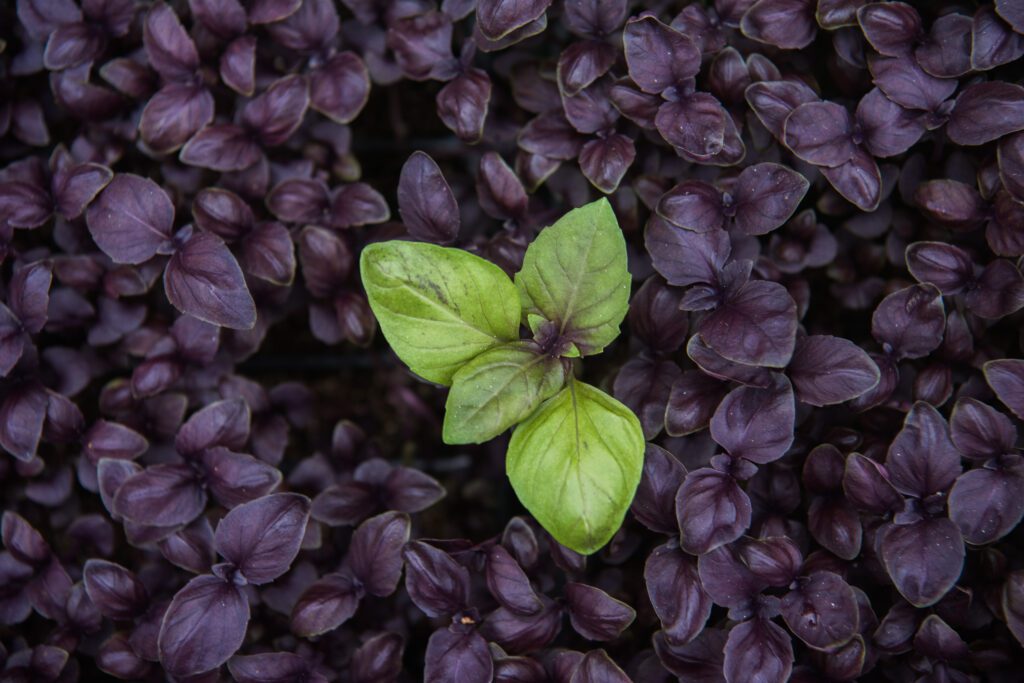
Because we also grow in the greenhouse, we also did a lot of light work — understanding light’s impact on plant growth. It’s fascinating science. We can actually change the flavor of basil by light. We can change it from sweet to spicy. We can increase phytonutrient uptake by what colors of the light spectrum we apply to the plant in the last 20 percent of its growth.
You can pull phytonutrients, you can pull color, you can pull flavonoids out. Once we started learning that in the lab and in the greenhouse, we could apply those same teachings in the field. We started understanding that for years, some of the sweetest spinach we sell to our customers was in the wintertime; we actually called it ice spinach, playing off of ice wines. It has very high sugar content in the shortest days of the year.
Kempf. And you have fairly cloudy weather during the winter months, correct?
Jones. Lower light levels, lower temperature, higher humidity. There’s an inverse relationship in spinach that we had no idea about. A cardiologist told us they wanted high-nitrate-nitrogen leafy greens. Nitrate converts to nitrite, which converts to nitric oxide. Nitric oxide is a blood-vessel dilator. You see beet chews and beet powders with nitric oxide. So they were asking us to produce high-nitrate-nitrogen leafy greens.
Agronomically, this was against everything I’d ever been taught. If you get the nitrate nitrogen too high, you’re going to have aphids — which I have proved before! So we have to do this in a controlled environment. In field-production spinach in the summertime you can get much higher nitrate content, but the sugars are very low. In the winter it’s an inverse relationship. The nitrates are dropping because you don’t get nitrogen uptake in cold soils, but you do get sugar concentration. So you have the very sweetest spinach in the wintertime, but you don’t get much nitrogen content in that sugar.
Those are the kinds of things we have learned over the years.
Kempf. I’m particularly intrigued by the light conversation. One of the pioneers of understanding the impact that light has on people and animals was a researcher named John Ott. His research is certainly worth reading and understanding. The limited light spectrum that we are exposed to from fluorescent and other types of light bulbs can actually have a significant detrimental health impact. As you learned about the influence of different light spectrums in the greenhouse, you were actually able to also take that and apply that knowledge to field production. What does that look like?
Jones. The controlled environment, where you can control variables, helped us to understand cause and effect.
We trialed dozens of light manufacturers in controlled environment because every light manufacturer I ever talked to said, “Tell us exactly what spectrum you want and we’ll build a fixture for you.” Well, I didn’t know what spectrum of light I wanted. Light is spectrum, which is color, intensity and duration. I didn’t know, and there wasn’t a book I could find that said, “Lettuce likes this spectrum and spinach likes this spectrum.”
Now, I know that red lettuce likes a different spectrum than green lettuce and all lettuce needs different intensity, duration and spectrum at stage zero versus stage one, two, three and four, and what happens in stage four of the growth of leafy greens when you subject it to blue light. We found a light manufacturer of a dynamic LED light, so we can actually set the frequency. LED diodes are all made in China and they’re all virtually the same; it’s the control of those lights that I needed. I can now set in the laptop that I want Tuscan sun on May 1st. And they have taken the measurements of intensity, duration and spectrum all over the world. This data is available, so then I can duplicate the sun.
I get an orange, low-intensity sunrise to a high-intensity white at midday, back to low-intensity white to sunset. And you can duplicate that and then manage to that. With leafy greens in a lab environment, it’s such a short season; you can replicate the cycles so much faster and learn quicker. We’re now managing the greenhouse lights with dynamic LED. We’re setting a daily light integral — how many light units we want that crop to receive.
It measures how much natural sun comes in on a sunny day and then makes up the difference. You’re getting energy management, but also light management. If you over-saturate a plant, it will shut down. It ties in very well to better understanding photosynthetic efficiency in the field — how does a healthy soil react in maximizing photosynthetic efficiency?
Because what we’re really selling is energy, right? Produce is energy for the human body. We’re converting light energy from the sun and CO2 and oxygen and water into another form of energy. Photosynthesis is just energy conversion. Our bodies take that in as food and convert it to energy again. Our job is to maximize the amount of energy that we can pack in and to do it as efficiently as possible while growing a great-flavored product. It’s a fascinating science. Creation is an amazing thing; if you laid it all out on a continuum, it’s a mile long and we understand the first few inches.
Kempf. Yes. You pointed out the differences in lighting desires between red and green lettuce. When you think about color variation on a leaf, to some degree that is going to be associated with the content of the various carotenoids, which are all photon receptors. So, you have the ability to intercept different wavelengths to varying degrees, and that is obviously going to produce a market influence.
Jones. Leaf temperature is different in red lettuce and green lettuce under the same light because of that. There are many different variables we didn’t know before now. We didn’t know what we didn’t know.
Kempf. Are you also measuring carbon dioxide flux in the crop canopy or in the environment, as you have these different variations of photosynthetic efficiency?
Jones. Absolutely. Because you can grow with less light at higher CO2. When you’re looking at energy management within a controlled environment area, you can raise the CO2 level and lower the amount of daily light integral needed to grow the crop. Understanding not only cause and effect, but cost of each, is critically important. When you get to larger-scale vertical growing where you’re talking about these LEDs becoming sole-source lighting versus supplemental lighting, you have to understand the relationship between photosynthesis, temperature, humidity, CO2, etc. — that’s another fascinating science.
Kempf. You might be one of the very few people who actually has a qualified perspective on the possible impact of CO2 on nutrient density. This is a question that has come up, and there have been a couple of research papers published. As I understand it right now, we don’t really know the full scope of how elevated CO2 levels in the environment are going to influence plants and influence crop nutrient density.
My understanding at this point is that for undomesticated plants — for wild plants growing in the environment — most of the data that I’ve seen points to elevated CO2 levels leading to declines in carbohydrate density and in protein density, which is interesting. But in managed crops and managed soil, where we are managing nutrition, it seems to be having the opposite effect — as CO2 increases, you’re actually getting increases in nutrient density. And it’s because that increased carbon dioxide level is also associated with nutrient management or with lighting management, as you are doing. What have you observed?
Jones. The first thing I would say is that we have not correlated CO2 to nutrient density yet. That’s on the radar, but we have not done the tests in the lab to correlate those. I would answer the question by saying that with light, like CO2, like nutrients in solution, there is always a correlation effect where one affects the other, but also there’s always a law of diminishing return.
Just like with light — at some point the plant reaches saturation of photosynthetic efficiency, and additional light in the early stages is inefficient at best, and at continued higher light levels it’s actually detrimental and the plants slow down. I had the opportunity to visit a 12-acre hydroponic pepper operation in Ontario two weeks ago. They’re now measuring electrical activity within the xylem and phloem at two different points on a pepper plant. Not electrical conductivity — electrical activity. When the clouds go away and the sun comes out, the plant is happier and the electrical activity speeds up in the plant to a point. You can get saturation, and when you get saturation, all of a sudden you don’t have what you need.
Looking at light saturation like CO2 saturation, there’s a law of diminishing return — you can have too much of a good thing. What I don’t understand yet is the correlation and the interaction between them. We do know that there is a direct impact between light and CO2 to photosynthetic activity. I would believe and surmise that there is absolutely the same correlation to nutrient density, but I have not calibrated that yet, or I don’t understand it completely.
Kempf. That’s a very important point, Bob. Thank you for emphasizing that again, because it means that when research is being conducted, even out in the field and open environment research, to evaluate the impacts of CO2 on nutrient density, we have to include lighting as a variable and recognize that research that is conducted in the southeastern United States doesn’t necessarily apply to more northern climates with different lighting conditions.
This is one of the fundamental criticisms I have about virtually all of the carbon sequestration research. There is this plethora of research being conducted and papers being written on the ability to sequester carbon. We understand the very wide range of variability that it has, but I have never once read a paper on carbon sequestration that measured the photosynthetic efficiency and the photosynthetic variability of the crop that they were measuring carbon sequestration for. Isn’t that the absolute fundamental prerequisite that we know can be highly variable?
Jones: That would determine to a great extent the efficiency of the sequestration in the first place.
Kempf. Yeah, it can vary by a factor of five X — so why aren’t we measuring it?
Jones. Right. Well, think about what the research community has done on nutrition. Dieticians like to blow apart a vegetable into its component parts. The best example I can give you is lycopene in a tomato. The scientific community has determined that lycopene is very effective at prevention of prostate cancer. And they say now that maybe you should have lycopene tablets or lycopene supplements. How about if we just eat the tomato? Because what we don’t know as the dietary community is what is the synergistic effect of all of the other compounds that are contained in that tomato. You can’t blow it apart and look at one individual thing in the absence of everything else around it. That’s not how nature works.
That’s why I’m such a big fan of on-farm research. We may not be as polished as the university researchers, but we can get to a meaningful conclusion much quicker — and, I might add, a lot more efficiently.
Kempf. Just as in the lighting example that we were just talking about, well-informed farmers as citizen scientists seem to often understand the large range of variables — multiple variables that can influence the outcomes of a study — more so than researchers who want to narrow things down to single-factor analysis.
Jones. I think that’s because we’re farmers and we’ve dealt our entire lives with a plethora of flexibilities or variables that impact our livelihood. It is weather, it is markets, it is all of these different things that come at you all at once. At the risk of referring to my father too much, he used to tell me when I was a younger farmer to plan on absolute ideal weather 20 percent of the time and you’ll never be disappointed. Have a plan for how you’re going to farm under ideal conditions, but then also have a plan for a drought year, or a very wet year, and how are you going to farm differently in that year than you would an ideal. Make a plan for all of those eventualities when you’re not in the heat of the battle.
In understanding variability in our world, we just have an advantage because we grew up on farms and in nature and we learned from those lessons, even though we probably didn’t know we were learning at the time. We were getting an education whether we understood it or not. That’s the wisdom of years, of seeing this cycle happen 20, 30, 40 times. There is value in that. I certainly don’t have this all figured out, but I understand more today than I did 20 years ago.
Kempf. There’s a great deal of value in the depth of experience. Decades of experience don’t count for everything, but they certainly count for an awful lot.