

An interview with Ben Falk, author of the second edition of The Resilient Farm and Homestead: 20 Years of Permaculture and Whole Systems Design
Acres U.S.A. I’ll ask you the best first question for a book author — what’s your book about?
Ben Falk. The book is a report on the experiments that we’ve undertaken to live in our landscape — to grow food, to be nourished, to be healthy, to revive the soil and the water cycle and the wildlife on site — to be as regenerative as possible while gleaning the most important basic needs that we have: food, water, medicine, health, wellbeing, spiritual sustenance, if you will, joy, a good life. And to generate as many high-value yields as we can from the site, while hopefully improving the ecosystem health of the site as much as possible.
So, that ranges from growing food to slowing, spreading and sinking water — we’re doing a lot of earthworks and waterworks to do better in drought conditions, or high-rainfall flood conditions. And we’re growing firewood and heating with wood in as efficient and effective ways as possible.
We’ve experimented heavily with ways to not just get space heat, but to cook and bake, and to get all of our hot water from our wood stove system. We’ve had a lot of success with that. We’re on version like 4.6 of these systems over the last 20 years, and now we’re basically getting all the heat and hot water we need, plus as much baking and cooking as we want, for three people, on two cords of wood, in an 1,800-square-foot house that’s not very well insulated. That’s not a lot of wood in a Zone 4 climate, without much sun in the winter.
Acres U.S.A. You say in one of the first chapters, “Regeneration involves seeing things as they could be, while resiliency requires dealing with things as they are.” Farmers obviously know the word “regenerate” — it’s become the concept du jour, although it’s pretty ill-defined — but they maybe don’t talk about resiliency as much. Can you discuss that a little bit?
Falk. Sure. I’d say the main piece of resiliency that we’re concerned with is the ability to keep a place regenerating — to keep our cells regenerating and the place regenerating. How are we able to bounce back from stresses and continue the work that we do on site, and the processes that are positive on site? You can be regenerative, or get good yields, in nice weather, but if you don’t have certain systems in place that can deal with a heavy rainfall year or a drought year, your resiliency’s low — and then your yields, and your ability to regenerate, plummet. They’re both really key.
I see regeneration as looking ahead toward what a place could be — how healthy could this place be? And resiliency is focused on, not the aspirational side, but on the problem side — what are the threats? What are our vulnerabilities? And dealing with those.
Resiliency and regeneration really have to go together — if we just focus on one, the other tends to be compromised.
Acres U.S.A. I really appreciate the assessment you have at the back of the book where you can assess how resilient your farm or operation is.
Falk. Oh, cool. Like all measurements, it’s imperfect, but it’s a good pattern revealer.
Acres U.S.A. It is. I thought it was interesting that it’s definitely skewed toward the soft skills — social connections, personal emotional skills, adaptability, etc.
Falk. That’s interesting. Yeah, I think in the first version of the book it was skewed toward hard skills. For this edition I really changed the weight. I think I was writing it as a challenge to myself.
Acres U.S.A. And, of course, both hard and soft skills are important. But it’s important to remember that if there is a summer like 1816 again, when it froze in every month of the year — that things are going to be bad, but they’ll be a lot better if you farm or if you know your farmer.
If you’re looking for a whole-systems approach to being resilient, how do you do that if there’s already existing infrastructure that is not super resilient? What do you do if you don’t have the resources to start from scratch?
Ben Falk. That’s a great question, and I think it gets at the larger picture of how to get the best result, knowing there’s no perfect result. Even with new site design, you’re going to make compromises — there’s no perfect site. And then, even more challenging is if a property already has a lot done on it that wasn’t built with resiliency and regeneration in mind.
The way we tend to approach this, in principle, is to figure out what would be optimal. So, pretend there’s nothing there. Forget that buildings or roads or fields are there — pretend they’re gone — what would be ideal? Lay out the ideal property in your mind, or on paper, or both. And then you start figuring out how to work with the fact that things are there. How can we maximize the effectiveness of the overall site if we had a better design, even if elements aren’t in the very best place.
Now, there are going to be compromises, of course, because bad decisions have effects that we have to deal with. It’s very common that people don’t make good decisions because they’re looking at everything around them as though it’s permanent. If you can forget the existing situation for a moment so you can see a more ideal situation, and then build it back up, and to work toward a more ideal situation, that helps a lot.
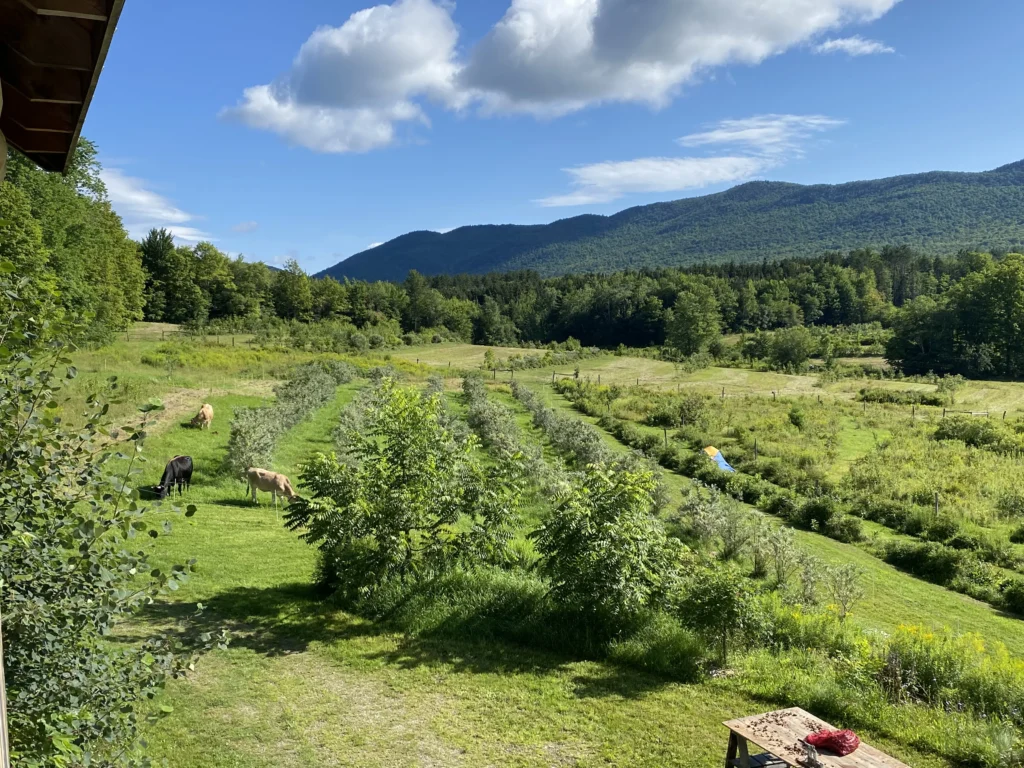
One of the things we see is people not looking at the land shape, which has huge implications, because if you want to work with water well, you really have to look at the land shape. If there’s a lot of trees and vegetation, and tall grass, and buildings on the place, that can be hard to do. You’ve got to forget all that’s there to really say, “What is the shape here? What are all the micro watersheds here?” You can have 10 little watersheds on five acres, and you have to be able to see all those.
The scale of permanence is really the best framework for doing this, because then you’re going to regard the most permanent things the most. I’m not changing land shape, short of huge bulldozers and dynamite, but the trees — I could plant more trees, or I could remove trees. So, those are somewhat impermanent. Let’s remove the tree layer and see what things look like. Scale of permanence and the permaculture zones of use are the two main frames we used for designing sites.
Acres U.S.A. You’ve done a lot of work with tree crops. Can you talk a little bit about the applicability of that for a commercial farm? I’m thinking a situation where a vegetable grower — either a market farmer or someone with a couple acres — realizes they need to diversify. Perennials are obviously resilient. They’re a good way to build some diversity. But there is a scale there where you really need to dive in and have some really deep knowledge to be able to grow and sell something commercially. Like, we grew most of our own food, but very little of it would be aesthetically pleasing enough to sell, or in the quantities needed at the time needed. That becomes really challenging, because we want to encourage farmers to diversify into some perennial crops, but it can be challenging. Do you have any insight on that?
Falk. It can be difficult. Like you said, if you’re going to grow fruit, you have to go big and grow some seriously nice-looking fruit if you’re going to sell it in this economy. That’s just not going to happen as a side project, unless you’re in the perfect climate. But certain crops are easier and can be doable. You can grow a lot of nicely marketable blackberries, blueberries, aronia, blackcurrant — some things are very easy. You just have to know the crop. But some things are really challenging and maybe shouldn’t be tried. Like apples here in Vermont — forget about it. You have to be a wizard to grow a good-looking organic apple, at any quantity, in this part of the world. So, that wouldn’t be a good choice. But you can grow a lot of extra blackcurrants without much work. Is there a market for that? Maybe; depends on what you turn it into right now — not necessarily straight.
But becoming more resilient doesn’t necessarily mean adding crops, even perennial ones. It may be other things. It might be services for people — you may be a mechanic on the side or do something else.
To me, though, the lowest-hanging fruit — no pun intended — is growing stuff for us to consume, that we then don’t have to buy. It’s not for me to grow something to sell. Everything I’ve ever grown to sell, once I sold it, I was like, “That wasn’t worth it. I’m not going to turn this into money. I’m just going to keep this stuff and do all sorts of other things for money.” Now, if someone doesn’t have other skills, or they don’t want to do certain other things and they want to be a farmer, then that’s not a satisfying answer. But personally, I’ve found way more reasons to not sell stuff than to sell stuff — to just grow it for ourselves.
Acres U.S.A. When we moved here a few years ago, I had read all kinds of books — like yours — and thought, “Well, it just makes sense to plant trees, so I’m going to plant a bunch.” And so I planted about 400 trees and berries, and it’s great. But I’m realizing, too, that in a couple of years when, Lord willing, I do have pretty good yield, it’s going to be a lot of work just to keep up with the drops! If you let fruit sit on the ground, you get a lot of disease. You have tons of fruit trees, and you’re not selling fruit; how do you manage all the drops?
Falk. That’s where animals come in. In the current economy, you can wave a magic wand and have, 1,000 feet of beautiful berries. But try paying someone to harvest all those berries and make a living selling that — forget it. So, we graze and we promote wildlife, and we hunt wildlife. And animals do the cleanup, and then we eat our cows on a cycle.
That’s the main way. And sometimes we invite friends over — turn it into social capital. We’ll invite the whole neighborhood over for when Nanking cherries are taking off. But yeah, it’s tricky. It’s very hard with a perishable crop. Nanking cherries can have huge years, but they’re also fickle. They go big some years and not others. They’re not reliable for us, and I’ve grown them for the better part of 20 years pretty seriously. They’re not like an aronia or a blackcurrant, where you’re going to get them pretty much every year.
But Nankings are going to grow in much wetter soil than most cherry trees. They’re much more adaptable to locations, and they’re a great size for having in zone one around your house as an edible landscape plant. They’re pretty much an all-star. They’re beautiful fire-engine-red fruits, but they’re a cherry, so they’re not the most shelf-stable thing by any means. We turn them into meads and ferments or mix them in with cider. Or we’ll even just put them in a crock and they’ll dissolve. They’ll be in an infusion, so to speak.
Acres U.S.A. I love how this book is the result of 20 years of experimentation. Many books come out of far less experience. But in terms of experimentation, how do you think farmers could be incentivized to experiment more?
Falk. Yeah, a lot of them can’t afford to. You can’t risk a crop for one year, and you don’t have the time to just try another crop. That was the idea behind agricultural land-grant colleges and extension services. Unfortunately, they’ve been hijacked by agribusiness and the largest corporations, like everything else. But we could revive that. USDA and certain states do fund some innovation. More of that would be better.
It shouldn’t really be on the farmer. I think farmers are just trying to survive. The best farmers are the ones who do experiment — but it’s like asking someone who’s already under the gun to come up with something new.
I think it needs to be supported institutionally, and by people who maybe don’t make their living as farmers. Like myself — I’m a site designer, land planner, and teacher and author. I have time that allows me time to experiment with land processes.
Acres U.S.A. In terms of society as a whole and people’s willingness to adopt resilient strategies — you have a video on YouTube that I thought was insightful. You had helped a town plant a bunch of apple trees in a public park a few years ago, and then nobody even came out to pick free apples. It doesn’t give me a ton of hope in terms of general society, that they’re going to be willing to adopt these changes willingly. It’s going to take some extreme pressures.
Falk. Yeah, I agree. That’s why losing cultural life ways and skills is a serious business. It will lead to a place like this, where there’s literally the highest-end, free, organic food, and instead of going to the park and simply picking it, people go to a store and spend a lot of money buying something of less quality. People busy and are under the gun and are in the grind of this whole system.
I’m not trying to just blame people for it. People have a lot of good reasons for what they do. But also, at the root, I think, is that we’ve just forgotten a lot. We’ve become so disconnected with where food comes from, and from what good food is.
I don’t have any easy answers for that. It’s a tough one.
Acres U.S.A. Yeah, I think so. You have a pretty long section in the book too about raising children on the farm/homestead. I think this is really difficult too. We have kids, and they like participating in growing food and raising animals, but we also don’t want to deny them normal societal things. I’m not even saying bad things — our kids don’t have smartphones or anything, but we let them do music and sports, and they go to school. They’re doing normal things in society. But it’s challenging to do these things like growing our own food that are theoretically optional — we could go to the grocery store — while feeling the pressure to still be involved in all the normal societal things.
Falk. I agree. We have a six-year-old, and we’re in that same boat. He wants to go skiing, and he’s in a gymnastics lesson right now — but he could be splitting wood with me. But we’re going to give him those choices, and we at least try to teach him and expose him to what he can. And ultimately, hopefully, he’ll be in a position to decide how much he wants to be in one or the other at some point.
Acres U.S.A. I guess I have some amount of pessimism about homesteading in that sense. A lot of people do it because they want to grow good food and have good food, and then they realize that it’s actually pretty hard to grow your own food. Or, it’s not that hard — but it takes devotion. That is difficult, right now, when it’s optional, because there’s always the grocery store, and when society expects your kids to do school and sports and church and everything else.
Falk. It takes a lot of time and a lot of vigilance — a lot of regular time.
Acres U.S.A. And regular time, at particular times. You have to do things at certain times. If you want to grow all your own tomatoes for your annual supply of tomato sauce, you can’t go on vacation when all the tomatoes get ripe.
But, I think the consolation in this is that all those people who try homesteading and figure out the challenges — those people still know that they want and need good food. And that provides market opportunity for local farmers to provide that for people.
Falk. Yeah. We’re still living in this time of massive convenience. But it’s not going to define our time forever. We will be forced to go back to a time when more than 1 percent of the population are producers of essential goods and services.
Acres U.S.A. It’s a great age for consumers right now. Not so much for producers.
Falk. I like the saying that we need a million new gardeners more than we need a thousand new farmers — for a regeneration of resiliency, if not for the national economy.
Acres U.S.A. And we need larger-scale farmers to have gardens as well!