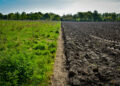

“I had two calls I dread last week,” Jeff Burbrink, Lagrange County, Indiana Extension educator, wrote in early June. “Homeowners who had used herbicides to control weeds in their driveways, and now the trees and some of the grass along the drives are dying.”
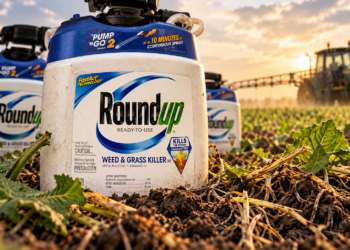
With growing evidence that glyphosate — the active ingredient in Roundup — is not as safe as they were led to believe, consumers are becoming wary of using the weedkiller. But they still want to be able to spray something on those pesky weeds in the driveway. So they’re trying other herbicides — ones that haven’t been in the news.
Unfortunately, most of the alternatives to glyphosate are much more toxic — both to people and to plants. The frantic homeowners who were calling Burbrink had inadvertently applied soil sterilants as a substitute for glyphosate. Soil sterilants can contain a variety of active ingredients, but the triazine herbicides (including atrazine) are the most commonly used.
Triazine herbicides persist longer in the soil than glyphosate and migrate more from where they are applied, causing damage to both woody and herbaceous plants in adjacent areas. They kill all of the soil microorganisms where they are applied (hence their designation as “soil sterilants”). And they’re no safer for humans than glyphosate, either. Like glyphosate, atrazine has a low acute toxicity to humans, but has also been linked to cases of non-Hodgkin’s lymphoma and other types of cancer. Another soil sterilant, bromacil, is both persistent and highly mobile in the soil – not to mention also being possibly carcinogenic.

Burbrink’s tale should be a warning to the current push to specifically ban glyphosate. Monsanto successfully marketed glyphosate for years by assuring consumers that it was the safest herbicide on the market. “Safest” has turned out to not be very safe, after all. But as bad as glyphosate is, the alternatives are still worse.
There’s no such thing as a safe herbicide. Instead of pushing to ban glyphosate or any other specific chemical, eco-ag advocates should emphasize farming systems that don’t require herbicides at all. Only when we can successfully demonstrate that herbicides are unnecessary will we be able to prove that the risks of herbicide use outweigh the benefits. Then, and only then, will we be able to phase out the use of all herbicides — not just glyphosate.
[Photo from University of Minnesota Extension: https://apps.extension.umn.edu/garden/diagnose/plant/turf/circular.html]