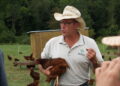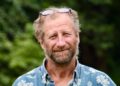
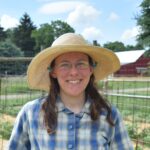

Fred Kirschenmann, who was honored with the Acres U.S.A. Eco-Ag Achievement Award in 1998, died on September 13
How can we create an ethical, sustainable agricultural system in the United States?
That was the life passion of Fred Kirschenmann—North Dakota organic grain farmer, agricultural ethics professor, and sustainable agriculture advocate.
Born to a North Dakota farm family in 1935, in the midst of the Dust Bowl, Fred watched agribusiness replace soil conservation after World War II. He saw firsthand how industrial agriculture depopulated rural areas, destroyed community life, polluted land and water, and made agriculture completely dependent on fossil fuels and other nonrenewable resources.
After completing his PhD in philosophy at the University of Chicago, Fred became a professor in religion and philosophy. But he never lost interest in agriculture, and after his father had a heart attack in 1976, Fred returned to the family farm and converted it to organic production. It was a steep learning curve, but he persevered and, after five years, had made the land more productive under a diversified organic crop rotation than it had been as a chemical-soaked monoculture.
Fred remained active in the organic and biodynamic farming communities while continuing his career in agricultural ethics. As the phrase “sustainable agriculture” became more commonly used in the 1980s, Fred was one of those who helped shape its meaning, serving as director of the Leopold Center for Sustainable Agriculture at Iowa State University from 2000 to 2005.
The greatest challenges facing agriculture in the twenty-first century, Fred said in 2005, will be fossil fuel depletion, environmental degradation, climate change, and a bankrupt farm economy. “The day of cheap oil is over,” he said. “What kind of agriculture thrives on energy efficiency? That looks like the most promising approach.”
Fred called for “a new vision for agriculture,” one that “honors a strong ecological standard, that adopts economic models that serve both people and the environment, that uses adaptive rather than control management strategies, and that engages the producers and eaters in a common cause.”
“The biggest issue right now is that we need to make a cultural shift,” Fred said in a 2020 interview for Civil Eats. “We can’t continue using this input-intensive system as the inputs get depleted, because all of those inputs are non-renewable.” Fred put his hope for the future in young regenerative farmers. “Most of them recognize that their future depends on working with nature and not controlling nature and they’re starting to create systems to do that,” he said.
What he wasn’t sure about was whether change would happen soon enough. “Whether we’ll make that transformation in terms of the ecological benefits in time to prevent the kind of catastrophic results that the climate scientists are saying we are likely to see, that’s the big question,” he concluded.
On September 13, 2025, Fred Kirschenmann passed away after a battle with prostate cancer. It will be up to those young farmers to make his vision of a truly sustainable American agricultural system a reality.