
Acres U.S.A.® Magazine
  • Articles
    • News
    • Ecological farming
      • Climate
      • Environmental Issues
      • Farm management & planning
      • Human health
    • Livestock
    • Farm
    • Crop
      • Crop management practices
        • Ag technology
        • Cover crops
        • Crop nutrition
          • Crop protection
          • Diseases
        • Crops
        • Fruits
    • Soil
    • Opinion
  • Resources
    • Magazine
    • Online Learning
    • Newsletters
    • Free Articles
    • Blog
  • Magazine Issues
    • 2026
      • February 2026
      • January 2026
    • 2025
      • December 2025
      • November 2025
      • October 2025
      • September 2025
      • August 2025
      • July 2025
      • June 2025
      • May 2025
      • April 2025
      • March 2025
      • February 2025
      • January 2025
    • 2024
      • December 2024
      • November 2024
      • October 2024
      • September 2024
      • August 2024
      • July 2024
      • June 2024
      • May 2024
      • April 2024
      • March 2024
      • February 2024
      • January 2024
    • 2023
      • December 2023
      • November 2023
      • October 2023
      • August 2023
      • July 2023
      • June 2023
      • May 2023
      • April 2023
      • March 2023
      • February 2023
      • January 2023
    • 2022
      • December 2022
      • November 2022
      • October 2022
      • September 2022
      • August 2022
      • July 2022
      • June 2022
      • May 2022
      • April 2022
      • March 2022
      • February 2022
  • About Us
    • Our History
    • Our Staff
    • Contact Us
    • Community
      • Soil Health Primer Resources
  • Events
    • Eco-Ag Conference
    • Farm Weird Event
    • Viroqua On Farm Event
  • Subscribe
  • Login
  • Register
No Result
View All Result
  • Articles
    • News
    • Ecological farming
      • Climate
      • Environmental Issues
      • Farm management & planning
      • Human health
    • Livestock
    • Farm
    • Crop
      • Crop management practices
        • Ag technology
        • Cover crops
        • Crop nutrition
          • Crop protection
          • Diseases
        • Crops
        • Fruits
    • Soil
    • Opinion
  • Resources
    • Magazine
    • Online Learning
    • Newsletters
    • Free Articles
    • Blog
  • Magazine Issues
    • 2026
      • February 2026
      • January 2026
    • 2025
      • December 2025
      • November 2025
      • October 2025
      • September 2025
      • August 2025
      • July 2025
      • June 2025
      • May 2025
      • April 2025
      • March 2025
      • February 2025
      • January 2025
    • 2024
      • December 2024
      • November 2024
      • October 2024
      • September 2024
      • August 2024
      • July 2024
      • June 2024
      • May 2024
      • April 2024
      • March 2024
      • February 2024
      • January 2024
    • 2023
      • December 2023
      • November 2023
      • October 2023
      • August 2023
      • July 2023
      • June 2023
      • May 2023
      • April 2023
      • March 2023
      • February 2023
      • January 2023
    • 2022
      • December 2022
      • November 2022
      • October 2022
      • September 2022
      • August 2022
      • July 2022
      • June 2022
      • May 2022
      • April 2022
      • March 2022
      • February 2022
  • About Us
    • Our History
    • Our Staff
    • Contact Us
    • Community
      • Soil Health Primer Resources
  • Events
    • Eco-Ag Conference
    • Farm Weird Event
    • Viroqua On Farm Event
  • Subscribe
No Result
View All Result
Acres U.S.A.® Magazine
No Result
View All Result
Home Magazine issues June 2022

Even More Roles for Microbes

James White by James White
November 28, 2024
in June 2022
0
Even More Roles for Microbes

Wheat plants grown from seed without bacteria (left) and with (right).

0
SHARES
6
VIEWS
Share on FacebookShare on Twitter

Microbes affect root hair formation, seedling growth and even nitrogen fixation in plants

James White

Editor’s note: This article is an edited version of part of an interview with Dr. James White of Rutgers University, who along with his colleagues has been at the forefront of the discovery of the phenomenon of rhizophagy. The first part of this interview — which explained how bacteria enter plants to provide them with nutrients and to enable root-hair growth — was published in the May issue of this magazine. 

Without microbes, you don’t get root hairs forming at all. You have to have microbes in the roots to get root hairs forming. 

Plants that utilize rhizophagy are hardier. They’re tougher. They’re going to be more resilient — better for climate change, heatwaves or droughts. If we could have our crop plants getting most of their nutrients through this process, plants would become stronger. When you apply nitrogen — say, some liquid form of nitrate — what happens is that the plants stop using the rhizophagy cycle. They stop secreting exudates, and they stop taking in microbes. 

Why is root hair growth linked to the presence of bacteria in the roots? This is a really important question. The bottom line is that bacteria are producing plant hormones. They’re producing ethylene and nitric oxide. Ethylene is a growth hormone in plants. The bacteria are also producing nitric oxide, which is also a growth hormone. Because they produce it in bulk, that causes root hairs to grow a little bit. When it grows, it will just continue to grow in spurts. Each time it grows, some of these bacteria are ejected out into the soil. 

The more root hairs a plant has, the more nutrients it can extract from soil and from water. Rhizophagy is an active extraction process, but the increased growth of root hairs increases the surface area of the root and spreads it way out into the soil, further enabling nutrient absorption from soil water. So, these microphagic bacteria are not only directly giving the plant nutrients; they’re also making it more possible for plants to receive nutrients through other absorption methods — via expanded root hairs. 

The Importance of Microbes on Seeds

A visiting scientist we work with developed an experiment to demonstrate the nutrient absorption function of the rhizophagy cycle. He identified native microbes on wheat seedlings, and then he sterilized some wheat seeds so there weren’t any bacteria left on them. He put the native microbes back on the wheat seeds one at a time, and then he measured the nutrients in the grown wheat. 

The figure shows some of the plants he grew. On the left are the plants grown from the sterile seeds. You can see that the roots are small. The plants with one of the bacteria added back in are several times larger. 

The plants with bacteria added back in — for any of the individual bacteria — also contained at least 20 to 30 percent more nitrogen and phosphorus and several times more potassium than the plants grown from sterile seed. This would be an argument for vegetable growers to just use good seed. The microbes are already on the seed. 

But we often pick seed early — as soon as possible — and then we take the seed into a dry, cool place for storage before planting. The problem with this is that these microbiomes on seed take some time to mature. 

In nature — if you think about how wild plants do it — they’ll make their seeds, they’ll shatter, they’ll drop their seeds to the soil, and frequently the seeds will lie on the soil until it’s time to germinate. They’re on the ground attracting microbes to the seed surface, and they’re maturing there in nature — they’re maturing that microbiome that’s on the seed. 

In our agricultural processes, we don’t mimic mother nature very well. We might have to do something to reacquire the natural systems in plants. Some seeds in nature are quite good at it. In fact, some of these microbes are already inside the seed itself — around the embryo. You get microbes that are on the seed, microbes that are inside the seed, and microbes that are from the soil. 

Nitrogen Fixation on Leaves

It turns out that all plants have microbes — even on their leaves. Plants internalize microbes into their leaves and their flowers. These same processes that are happening in the roots for nitrogen acquisition are happening on plant leaves. 

Microbes in plants produce ethylene, the plant produces superoxide, and hydrogen peroxide is produced. Microbes are also producing antioxidant forms of nitrogen. 

We did an experiment looking at over 30 different vascular plants. We looked specifically at all the cells in the leaves and the flowers — especially the non-photosynthetic cells, because we were looking for nitrogen fixation. The nodules on the roots of legumes are filled with bacteria-fixing nitrogen, but they also produce hemoglobin and other chemicals to reduce the oxygen around those microbes so that they can fix nitrogen. 
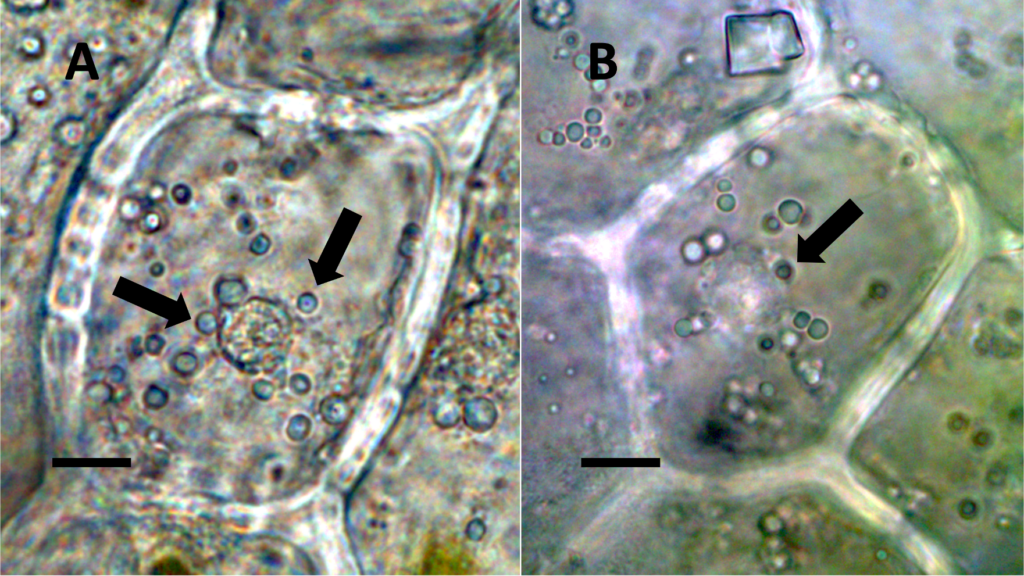
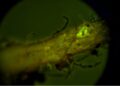
Bacteria in epidermal cells of hosta leaves fix nitrogen for the plant.

We looked at non-photosynthetic cells, with the idea that the photosynthetic cells are going to be inhibiting nitrogen fixation. We saw that there are microbes going in both photosynthetic and non-photosynthetic cells, but they’re really accumulating in these non-photosynthetic cells, and they appear to be fixing nitrogen. 

Hosta leaves are variegated — they have green and non-green areas. If you look at epidermal cells in the non-green areas (or light green) — where there aren’t chloroplasts — you’ll see a nucleus in the center and little vesicles filled with bacteria. The vesicles actually come out of that nucleus, and they’re going over to the paraplasmic space on the edges of the cells. 

The hosta plants cultivate bacteria in the nuclei. They’ll put sugars in there. Then they will release the bacteria into the cytoplasm, where they then begin to hit them with superoxide. The ethylene that the microbes produce triggers the superoxide. This leads to the production of nitrogen that the plant can use.

This raises a lot of questions. These epidermal cells — these particular cells that have these bacteria — are not active in photosynthesis, so maybe they’re not doing anything else but fixing nitrogen. 

These cells have two compartments: the main cell compartment and the nuclear compartment. Why would the plant put microbes in the nuclear compartment? Well, they probably do that because it’s a part of the cell where there’s not a lot of oxygen, which would inhibit nitrogen fixation by the microbe. The microbes are shielded from oxygen. We think that what happens is that the plant fixes nitrogen in the nucleus, where there’s low oxygen and where there are high sugars, and then it sends the microbes out to the cytoplasm, where the nitrogen is extracted from the microbes.

Some kind of foliar feeding — food for microbes — might give some benefits to these associations in leaves. We’re working to discover the specific nutrients that bacteria need to fix nitrogen from the air, and that’s what we want to use for foliar fertilization. 

Foliar fertilization is something that’s been around a long time and it is controversial, but because we now know that there are microbes in the leaves, it now makes sense. Instead of putting all our inputs in the soil, where it’s going down and running off, maybe we want to put some on the leaves.

Dr. James White is a professor of plant biology at Rutgers University. He will be speaking at the Acres U.S.A. Healthy Soil Summit in Sacramento this August.


← Previous Mobile Meat Slaughter: Silver Bullet or Siren Call? Next Colorado Cattle Cover Croppers →
Tags: June 2022
James White

James White

Dr. James White of Rutgers University has been at the forefront of the discovery of the phenomenon of rhizophagy.

Next Post

July 2022 • Issue #613

  • Trending
  • Comments
  • Latest
The Most Important Livestock in Our Fields

The Most Important Livestock in Our Fields

July 1, 2024
Glyphosate Does What It’s Designed to Do — Kill

Glyphosate Does What It’s Designed to Do — Kill

February 19, 2025
The Take-Half, Leave-Half Fallacy

The Take-Half, Leave-Half Fallacy

July 1, 2025
White snakeroot

Toxic Forages?

September 1, 2025
We Don’t Need Another Bridge — We Need an Off-Ramp

We Don’t Need Another Bridge — We Need an Off-Ramp

3
Under One Roof

Under One Roof

3
A Rose By Any Other Name

A Rose By Any Other Name

2
Terra Preta’s Biological Advantage

Terra Preta’s Biological Advantage

2
Don’t You Dare Disparage Sugar!

Don’t You Dare Disparage Sugar!

February 3, 2026
February 2026 • Issue #656

February 2026 • Issue #656

February 1, 2026
Fungal Exchange Capacity

Fungal Exchange Capacity

February 1, 2026
ECO-MEETINGS

ECO-MEETINGS

February 1, 2026

Recent News

Don’t You Dare Disparage Sugar!

Don’t You Dare Disparage Sugar!

February 3, 2026
February 2026 • Issue #656

February 2026 • Issue #656

February 1, 2026
Fungal Exchange Capacity

Fungal Exchange Capacity

February 1, 2026
ECO-MEETINGS

ECO-MEETINGS

February 1, 2026

About ACRES USA

Acres U.S.A.® Magazine

Acres U.S.A.® is North America’s oldest publisher on production-scale organic and regenerative farming. For more than 50 years, our mission has been to help farmers, ranchers and market gardeners grow food profitably and sustainably, with nature in mind.

Visit Our Advertisers

Magazine Issues

  • News
  • 2025
    • June 2025
    • May 2025
    • April 2025
    • March 2025
    • February 2025
    • January 2025
  • 2024 Articles
    • December 2024
    • November 2024
    • October 2024
    • September 2024
    • August 2024
    • July 2024
    • June 2024
    • May 2024
    • April 2024
    • March 2024
    • February 2024
    • January 2024
  • December 2023
    • December 2023
    • November 2023
    • October 2023
    • August 2023
    • July 2023
    • June 2023
    • May 2023
    • April 2023
    • March 2023
    • February 2023
    • January 2023
  • December 2022
    • November 2022
    • October 2022
    • September 2022
    • August 2022
    • July 2022
    • June 2022
    • May 2022
    • April 2022
    • March 2022

Contact Acres U.S.A

  • Contact Us
  • About Us
  • Advertise With Acres U.S.A.
  • My Subscription

Learn

  • Resources
  • Events
  • Magazine
  • Newsletters
  • Free Articles
  • Webinars
  • Online Courses
  • Bookstore

Our All Socials

Follow With Us...

  • My account
  • News
  • Ecological farming
  • Refund and Returns Policy
  • Privacy & Policy

© 2024 Acers USA Magazine

Welcome Back!

Login to your account below

Forgotten Password? Sign Up

Create New Account!

Fill the forms below to register

All fields are required. Log In

Retrieve your password

Please enter your username or email address to reset your password.

Log In
No Result
View All Result
  • HOME
  • ARTICLES
    • News
    • Farm
    • Ecological farming
    • Livestock
    • Crop
      • Crop management practices
      • Cover crops
      • Crop nutrition
      • Crop protection
      • Crops
      • Ag technology
    • Soil
    • Opinion
  • RESOURCES
    • Magazine
    • Online Learning
    • Newsletters
    • Blog
    • Free Articles
  • MAGAZINE ISSUES
    • 2025
      • June 2025
      • May 2025
      • April 2025
      • March 2025
      • February 2025
      • January 2025
    • 2024
      • December 2024
      • November 2024
      • October 2024
      • September 2024
      • August 2024
      • July 2024
      • June 2024
      • May 2024
      • April 2024
      • March 2024
      • February 2024
      • January 2024
    • 2023
      • December 2023
      • November 2023
      • October 2023
      • August 2023
      • July 2023
      • June 2023
      • May 2023
      • April 2023
      • March 2023
      • February 2023
      • January 2023
  • ABOUT US
    • Our History
    • Our Staff
    • Contact Us
    • Community
      • Soil Health Primer Resources
  • EVENTS
    • Eco-Ag Conference
    • On-Farm Viroqua Event
    • Farm Weird
  • SUBSCRIBE
  • Login
  • Sign Up
  • Cart

© 2024 Acers USA Magazine

Are you sure want to unlock this post?
Unlock left : 0
Are you sure want to cancel subscription?