
Understanding disturbance and succession helps us as eco-farmers to use our management to “steer” our site toward greater resistance to pests and disease
Whether we are row-croppers or graziers, what we do to interact with ecological succession determines the health and fertility of our present and future resource base. Let’s quickly review a simplified version of how ecological succession operates from the perspective of an ecological farmer.
At some point in time, some type of disturbance created a starting point for ecosystem development. Let’s say it’s a wildfire. After the fire dies, the exposed rock and soil is at first colonized by annual plants — “weed” seed that was not incinerated — and fire-tolerant perennials sprout up. Roots and root exudates from this first regrowth charge the mineral soil with carbohydrates, from sugars to lignin and cellulose. The soil life begins to thrive on the new food source, and suddenly there is an availability of plant nutrition in order to grow the next successional stage of vegetation.
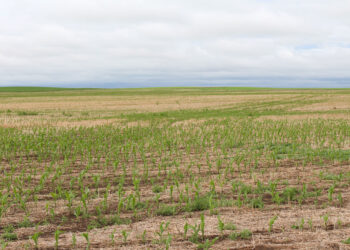
Beneficial organisms, as well as pests and diseases, find their way to the site. The diversity of plants on the site is low, as is the diversity of insects and diseases. In year one, “pest” populations (corn earworm, cabbage looper, etc.) are somewhat low, but as the years progress, pest populations build up. Fields that have been in continuous corn for half a century, for example, have had that many years of pests built up with no corresponding increase of pest predators, due to lack of habitat. Crop losses can be significant.
The ecological farmer in our example decides to under-sow the row crops with a low-growing legume such as white clover, and then to follow the main crop with a winter cover crop. The soil remains covered, soil life is protected and fed, and pest predators find rudimentary habitat in order to survive until the next breeding cycle. With cover crops alone, we can decrease pest damage because of increased fertility and predator populations. (There are examples where certain cover crops do increase specific insect pests — striped cucumber beetle for one — but that is advanced fine-tuning, an exception that proves the rule.)
Topsoil fertility can be incrementally built this way through the years, and pest/predator populations can stabilize, with pest damage trending lower than in a simplified “main crop / no cover” system. This has been proven over and over again for decades.
The farmer in our example, being an avid Acres U.S.A reader, plants a farm perimeter of regionally adapted oak trees, as well as rows of oaks between crop fields in an alley cropping fashion. This provides habitat and regular food supply to insect-eating birds, amphibians, predatory insects and spiders. The benefits of a single row of oak trees between crop fields (pest control, nutrient cycling, windbreak effect) will outweigh any downsides for decades to come.
The farmer allows the winter cover crop to grow to maturity, under-sows the grain crop with perennial pasture mix, and then harvests the grain. Ecological succession has proceeded forward in time. More soil-building has occurred. Habitat diversity has increased, and where there were few predators to eat pests (corn borer, for example), there are now a variety of species all eating corn borers, depressing their populations. As the crop in the field changes to a summer-harvested grain, and with no corn to eat, the rug gets pulled out from under the corn borer populations, and they collapse.
By following natural succession, the farmer has increased soil health and fertility, increased the populations of beneficials, and crashed the pest populations. Once a season or two goes by, the farmer can go back into the alley, disturb it again with light tillage, and return to the original main crop, with dramatically reduced pest populations.
As the farmer in this example continues farming, the soil improves in tilth and fertility because of continued plow-downs of cover crops and continual cover. The full spectrum of soil organisms has an undisturbed refuge in the soil within rows of trees, and the microbes quickly recolonize the lightly tilled alleys. Pest populations are constantly being knocked back because of crop rotation and the continually improving habitat for beneficials. Water infiltration increases as perennial roots, earthworms and other burrowing animals maintain open channels in the soil. The organic matter sponge increases water and nutrient holding capacity.
At any point in time, as the ecosystem has matured, the farmer in this example (who’s not so young anymore!) may decide to let the under-sown pasture mix persist and become the main crop. The farm has now become a “mid-succession” perennial farm: permanent grasslands between rows of trees. The land has gone through the successional phases, from disturbed/bare ground to annual plants and weeds, to a successional shrubland (when the trees are small), to a grassland, to a savanna.
Many farmers don’t want to follow this path because they’re concerned about decreasing crop yields. Their concerns aren’t entirely unfounded. Individual crop yields (corn, for example) may indeed decline. However, soil fertility increases, pest control issues decrease, and additional yields eventually come online. Remember the Land Equivalent Ratio! In agroforestry systems (walnut and corn as one example), individual crop yields may be less (20 percent less corn and 50 percent less walnuts), but the total crop is greater than either individual crop (80 percent + 50 percent = 130 percent).
In addition to the benefits incurred by the LER, the ecosystem itself now has a greater sunlight gathering capacity. Instead of being a relatively two-dimensional surface, such as a soybean field, the green leafy solar panels are now deeply three-dimensional — soybeans all the way up to oak trees. Sunlight capture increases as the leaf area increases.
Figure 1 shows that the Net Primary Productivity (total photosynthesis minus energy used to maintain and grow the plant) in cultivated crops is 600 grams per square meter of land, whereas savannas have an NPP of 900. Managing your farm so as to follow ecological succession — by transitioning through time from annual crop fields to a perennial savanna system — allows us to increase soil fertility, decrease pest populations, increase predator populations, increase water infiltration and retention, and have higher total yields. This is no joke! This is how nature rolls and has been doing so since the dawn of time, without a single input cost.

In closing I’ll point out that yes, total site productivity (NPP) increases even more as the woody canopy closes, until, as in the case of a temperate deciduous forest, there is twice the potential energy capture as in a crop field. Our balancing act as land managers continues as we strive to keep our farms and ranches in the “sweet spot” for our particular context, where we maximize productivity and ecosystem benefits while simultaneously producing food, living a good life with our families and communities, and generating the revenues we need to pay our bills into the future.
Mark Shepard is a land designer and consultant and is the author of Restoration Agriculture, Water for Any Farm and the Water for Any Farm Technical Manual.