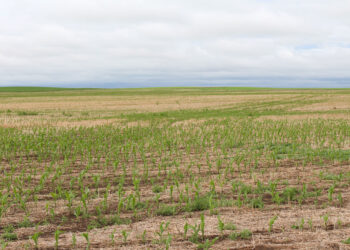


Soil Microbes Remember Drought and Help Plants Survive
A new study from University of Kansas researchers analyzed soils collected across Kansas to test the role of “legacy effects,” which refers to how soils at a given site are shaped by microbes that have adapted to the local climate over many years. The results were published in Nature Microbiology.
“The bacteria and fungi and other organisms living in the soil can actually end up having important effects on things that matter, like carbon sequestration, nutrient movement and what we’re particularly interested in — the legacy effects on plants,” said co-author Maggie Wagner.
“We got interested in this because other researchers, for years, have been describing this type of ecological memory of soil microbes having some way to remember from their ancestors’ past,” she said. “We thought this was really fascinating. It has a lot of important implications for how we can grow plants, including things like corn and wheat. Precipitation itself has a big influence on how plants grow, but also the memory of the microbes living in those soils could also play a role.”
According to Wagner, legacy effects have been observed before, yet the details remain unclear. A clearer picture could eventually assist farmers and agricultural biotechnology companies that aim to leverage beneficial microbes.

The team sampled soils from six Kansas locations, spanning the wetter eastern region to the higher, drier High Plains in the west, which receive less rain because of the Rocky Mountains’ rain shadow. The goal was to compare how legacy effects varied along this climate gradient. Wagner and her colleagues evaluated how the microbial communities from these soils influenced plants.
“We used a kind of old-school technique, treating the microbes as a black box,” she said. “We grew the plant in different microbial communities with different drought memories and then measured plants’ performance to understand what was beneficial and what was not.” The researchers exposed the microbial communities to either ample water or very limited water for five months to reinforce contrasting histories of moisture availability.
“Even after many thousands of bacterial generations, the memory of drought was still detectable,” Wagner said. “One of the most interesting aspects we saw is that the microbial legacy effect was much stronger with plants that were native to those exact locales than plants that were from elsewhere and planted for agricultural reasons but weren’t native.”
To begin testing how plant identity interacts with microbial legacy, the team compared one crop (corn) with one native grass (gamagrass). They note that additional species will be needed to confirm the pattern, yet the early results suggest that native plants may align more strongly with local microbial histories.
Beyond plant performance, the researchers examined gene activity in both microbes and plants to explore potential mechanisms behind legacy effects at the molecular scale. “The gene that excited us most was called nicotianamine synthase,” Wagner said. “It produces a molecule mainly useful for plants to acquire iron from the soil but has also been recorded to influence drought tolerance in some species. In our analysis, the plant expressed this gene under drought conditions, but only when grown with microbes with a memory of dry conditions. The plant’s response to drought depended on the memory of the microbes, which we found fascinating.”
Death Valley Plant Grows Faster as the Temperature Rises
In California’s Death Valley, where summer heat often surpasses 120 degrees Fahrenheit, survival appears almost impossible. Yet, among the cracked soil and intense sunlight, one native plant not only endures but flourishes.
That plant, Tidestromia oblongifolia, has helped scientists at Michigan State University reveal how life can persist in such extreme conditions. Their findings offer a potential guide for developing crops that can survive in an increasingly hot climate.
In a study published in Current Biology, researchers Seung Yon Rhee and Karine Prado report that T. oblongifolia actually grows more quickly under Death Valley’s summer conditions. The plant accomplishes this by fine-tuning its photosynthetic system to resist the damaging effects of heat.
For Prado, the project began with a simple question: how can this plant remain green and healthy when most others would wither within hours? “When we first brought these seeds back to the lab, we were fighting just to get them to grow,” Prado said. “But once we managed to mimic Death Valley conditions in our growth chambers, they took off.”
Prado used custom-built growth chambers to reproduce the desert’s harsh light and extreme daily temperature shifts. The results were astonishing. In just 10 days, T. oblongifolia tripled its biomass. Meanwhile, other related species known for their heat tolerance stopped growing entirely.

After only two days in extreme heat, T. oblongifolia expanded its photosynthetic comfort zone, allowing it to keep producing energy efficiently. Within two weeks, its optimal photosynthetic temperature rose to 45 degrees Celsius (113 degrees Fahrenheit) — higher than that of any major crop on record.

“This is the most heat-tolerant plant ever documented,” Rhee said. “Understanding how T. oblongifolia acclimates to heat gives us new strategies to help crops adapt to a warming planet.”
Using a combination of physiological tests, live imaging, and genomic analysis, the research team uncovered how T. oblongifolia coordinates multiple biological systems to survive. Under Death Valley-level heat, the plant’s mitochondria — the structures that generate energy — move closer to the chloroplasts, where photosynthesis occurs. At the same time, the chloroplasts reshape into distinctive “cup-like” forms never before observed in higher plants. These adaptations may help the plant capture and recycle carbon dioxide more efficiently, maintaining energy production even under stress.
Within 24 hours of heat exposure, thousands of genes adjust their activity. Many are involved in shielding proteins, membranes and photosynthetic machinery from damage. The plant also increases production of an enzyme known as Rubisco activase, which helps keep photosynthesis functioning smoothly at high temperatures.
“This research doesn’t just tell us how one desert plant beats the heat,” Prado said. “It gives us a roadmap for how all plants might adapt to a changing climate.”
Where Rain Comes from Matters for Agriculture
Most of the world’s crops depend entirely on the weather. More than 80 percent of global farmland is rainfed, meaning harvests rise or fall based on the water that arrives from the sky. But not all rain is created equal. A new study from Stanford University and the University of California San Diego highlights a fundamental but often overlooked question: Where does agricultural rainfall come from? The answer offers a new way to assess drought risk and forecast food insecurity.
Using satellite data and advanced atmospheric models, researchers traced rainfall back to its source — either evaporation from the ocean or moisture recycled from land through soil evaporation and plant transpiration. Their analysis, published in Nature Sustainability, reveals that regions relying more heavily on land-generated moisture are significantly more vulnerable to crop losses when the rains weaken.
The team identified a critical threshold: once roughly 36 percent of cropland rainfall comes from land, the likelihood of water stress increases sharply. This dividing line effectively separates secure farming regions from those on the brink. Areas above this threshold tend to experience more frequent and intense droughts, especially during critical growing periods.
Several major farming regions sit on the risky side of this line. The U.S. Midwest — home to one of the most productive corn belts in the world — depends heavily on recycled land moisture. This helps explain why drought impacts there have intensified in recent decades and why dry spells may reinforce themselves. Higher drought pressure in the Midwest does not only threaten local yields; it has the potential to shake global grain markets.
Tropical East Africa is another region where the source of rainfall matters deeply. Rapid cropland expansion and deforestation are reducing the very forest cover that helps generate downwind rain. In these landscapes, the act of clearing land for more farming can directly reduce the rainfall that crops depend on, creating an escalating cycle of food insecurity.
The study implies that regions that rely heavily on land-sourced moisture should prioritize irrigation, soil-moisture management, and water storage, since local conditions dictate rainfall stability. Protecting upwind forests and native ecosystems is not simply an environmental measure — it is water management. Meanwhile, regions receiving most of their rainfall from ocean sources may benefit from adapting planting schedules to large-scale climate patterns such as monsoons or El Niño.
By tracing water’s atmospheric “fingerprints” through isotopic satellite measurements, the study opens a new window into the climate system. It enables scientists to follow the path of rain from its origin to the field it nourishes, offering farmers and policymakers a clearer map of where the next system stresses may emerge.
| This study is directly related to the conversation about the large (ocean-originating) and small (land-originating) water cycles. Land stewards — i.e., farmers — can actually do much to support the small water cycle and to “grow rain.” See our interview on this subject with Alpha Lo in the November issue of Acres U.S.A. |
Lines of Defense: Why Do We Put a Premium on Pure Black Cattle?

Fly pests are a constant nuisance on pasture, reducing cattle comfort, eating time and productivity, and pushing up production costs via insecticides. A recent open-access study published in PLOS ONE suggests an impractical yet insightful solution: painting cattle with zebra-style black-and-white stripes dramatically reduces biting-fly attacks.
Researchers at the Aichi Agricultural Research Center in Japan tested six Japanese Black cows on pasture in two seasons, comparing three treatments: plain black coat (control), black with wide black stripes painted on, and black with white lacquer stripes painted in ~4–5 cm width. They tied the animals side by side, observed bite counts (on body and legs) and measured fly-repelling behaviors such as head throws, ear beats and foot stamps.
The results were striking. Cows with zebra-style white stripes had fewer biting flies — about 50 percent fewer landings — than controls or black-stripe painted animals. They also exhibited fewer energy-intensive fly-avoidance behaviors (such as head throws and leg stamping) than the other groups. Frequency of simple skin twitches increased slightly, interpreted as a lower-cost response when fly-loads are low.
Why does this work? Earlier laboratory and field studies have shown that tabanid flies (horseflies, stable flies) are less likely to land on surfaces with narrow alternating stripes or bright-dark changes in reflectance or polarization. The authors suggest that stripes disrupt the visual or motion-detection mechanisms of biting flies, making the cow’s body less detectable or landing-friendly. Reducing insects’ distractions and animal stress may also lead to better weight gains, longer grazing times and lower veterinary or chemical costs.
The study won the 2025 Ig Nobel prize for biology — a satirical prize awarded annually since 1991 to “honor achievements that first make people laugh and then make them think.” Actually painting zebra stripes on black cattle is of course a ridiculous idea. Yet this study demonstrates that breeding for purely black Angus cattle may be just as ludicrous.