

Unearthing Solutions to Heavy Metal Contamination
Heavy metals pose a significant and insidious threat to the health and sustainability of our agricultural systems. From arsenic and lead residues from historical practices to ongoing contamination by cadmium and mercury from modern industries, these toxic elements compromise the safety and integrity of our food supply. This article explores the origins of heavy metal contamination, their damaging effects, and the innovative strategies to reduce their uptake in plants and subsequent exposure to humans.
Occurrence and Sources
Heavy metals exist naturally within the Earth’s crust, mostly in forms unavailable to plants and humans. However, human activity has drastically accelerated their release into the environment. The Resource Conservation and Recovery Act identifies eight metals of particular concern: arsenic, lead, cadmium, chromium, mercury, selenium, silver, and barium. Zinc is also a prevalent heavy metal contaminant given its use in agriculture and in metal alloys. These metals can enter agricultural soils through various pathways, including atmospheric deposition, industrial activities, soil disturbance through development, pesticide use, and wastewater irrigation.
Of all these activities, industry remains the major source of contamination and exposure risks, releasing lead, zinc, and cadmium, to name a few. Mining generates vast amounts of waste containing heavy metals that contaminate surrounding air, water, and soil. For example, mercury and arsenic pollution are often linked to gold mining activities. In other industrial sectors, inadequate treatment or the careless disposal of waste and sewage sludge releases a broad spectrum of heavy metals into agricultural environments. These sources can contribute zinc (up to 500 mg/kg in manure), chromium (10-100 mg/kg in compost), and trace amounts of silver and nickel to soils.
| Heavy Metal | Anthropogenic Sources | EPA Limits: Agricultural Soil (mg/kg) | EPA Limits: Residential Soil (mg/kg) | EPA Limits: Drinking Water (μg/L) | Concentration Ranges in Contaminated Sites (mg/kg) |
|---|---|---|---|---|---|
| Arsenic (As) | Pesticides, wood preservatives, mining | 18 | 0.68 | 0.05 | 50-600+ |
| Lead (Pb) | Battery manufacturing, industrial activities | 120 | 400 | 15 | 10-500 |
| Cadmium (Cd) | Industrial emissions, phosphate fertilizers | 32 | 7.1 | 1.8 | 1-30 |
| Chromium (Cr) | Electroplating, leather tanning | N/A | 0 (total) | 0.3 (hexavalent) | Varies widely; 100-2000 |
| Mercury (Hg) | Coal burning, gold mining | N/A | 11 | 0.63 | 1-10 |
| Selenium (Se) | Coal burning, mining, smelting, ag runoff | 0.52 | 390 | 100 | 1-10 |
| Zinc (Zn) | Mining, smelting, sewage sludge | 160 | 23000 | 6000 | 50-300 |
| Silver (Ag) | Photographic processes, electrical contacts | 560 | 390 | 94 | Less common; up to 5 |
| Barium (Ba) | Mining, drilling, alloy production, smelting | N/A | 15000 | 3800 | 1000+ |
| Crop | Plant Part(s) Affected | As (mg/kg) | Cd (mg/kg) | Cr (mg/kg) | Cu (mg/kg) | Hg (mg/kg) | Pb (mg/kg) | Zn (mg/kg) |
|---|---|---|---|---|---|---|---|---|
| Rice | Grain, roots | 0.01-0.2 | 0.05-0.4 | – | – | 0.01-0.05 | 0.2-0.4 | – |
| Wheat | Grain, roots, leaves | – | 0.05-0.2 | 0.1-1 | – | – | – | 20-100 |
| Potato | Tubers | 0.01-0.1 | 0.05-0.3 | – | – | – | 0.1-0.5 | – |
| Soybeans | Seeds | – | 0.05-0.2 | – | – | – | – | 20-50 |
| Lettuce | Leaves | – | 0.2-0.5 | – | – | – | 0.3-3 | 50-100 |
| Spinach | Leaves | – | 0.1-1 | 0.5-2 | – | – | – | 50-150 |
| Tomato | Fruit, leaves | – | 0.05-0.1 | – | – | – | 0.1-0.5 | 20-50 |
| Carrot | Roots | – | 0.05-0.3 | – | – | – | 0.03-0.1 | – |
| Corn | Grain, leaves, stalk | – | 0.01-0.1 | – | – | – | – | 20-50 |
| Alfalfa | Leaves, stems | – | 0.05-0.2 | – | – | – | 0.2-0.8 | 20-60 |
| Strawberry | Fruit | – | 0.01-0.05 | – | – | – | 0.05-0.2 | 10-30 |
| Apple | Fruit (especially peel) | 0.01-0.05 | 0.01-0.03 | – | – | – | 0.02-0.1 | – |
| Grapes | Fruit, leaves | – | 0.01-0.05 | – | 5-30 | – | – | 5-20 |
Historic pesticide use in orchards, primarily applied during the early to mid-1900s, has left a pollution legacy that will persist well into the foreseeable future. Even though pesticides containing arsenic and lead have been banned since the 1960s, residual soil lead and arsenic levels can still be found in the thousands of parts-per-million today. Most of these lands have been sold for development, increasing exposure risks to residential communities specifically in the apple-producing regions of the USA.
Today, high levels of metals in agriculture still pose a risk. Phosphate fertilizers contain varying levels of cadmium — sometimes up to 300 mg/kg — creating significant soil contamination risks with continued use. Also, some livestock manures, especially poultry manure, may contain elevated arsenic levels due to feed additives.
How Plant Type and Soil Factors Affect Metal Uptake
Aside from plant physiology, the uptake of heavy metals by plants is initially influenced by soil properties, which are critical in determining the bioavailability and subsequent absorption of these metals. Notably, soil pH is a paramount factor; metals become more soluble and bioavailable in acidic conditions, thereby enhancing plant uptake.
Organic matter within the soil plays a dual role; while it can immobilize metals, diminishing their availability to plants, the decomposition of organic matter may release these bound metals, making them accessible for absorption once again.
Additionally, the presence of other ions and soil constituents affects metal bioavailability through competitive interactions, such as phosphate ions competing with metal(oids) like cadmium and arsenic for plant root uptake sites. These complex interactions among soil pH, organic matter content, and the presence of competing ions underscore the nuanced balance that governs the bioavailability of metals and their uptake by plants.
Aside from soil chemistry, crops themselves differ in their susceptibility to heavy metal uptake and movement throughout the plant, with different species accumulating specific metals in various parts of the plant. For example, due to the aquatic nature of its production, rice grain demonstrates an unfortunate ability to accumulate arsenic (0.01-0.2 mg/kg) and cadmium (0.05-0.4 mg/kg) directly in the grain. While these levels might seem small, rice is a staple of many diets worldwide, and even moderate amounts can significantly impact human health.
Leafy vegetables, on the other hand, are particularly sensitive to lead and cadmium uptake, with crops such as spinach showing alarming uptake rates (lead: 0.3-3 mg/kg in leaves; cadmium: 0.2-0.5 mg/kg in leaves).
Impact on Food Safety and Human Health
Long-term ingestion of heavy metals, also called chronic exposure, even in trace amounts, poses severe health risks. For example, arsenic is a well-known carcinogen that induces cancers of the skin, lung, and bladder. Long-term arsenic exposure has also been linked to cardiovascular disease, skin lesions, and impaired cognitive development in children. Lead is acutely toxic to the nervous system, especially in children and pregnant women. It hampers brain development, causes behavioral problems, and leads to anemia, kidney damage, and high blood pressure.
Classified as a probable carcinogen, cadmium causes kidney dysfunction, osteoporosis, and reproductive problems. In the rice-producing regions of Thailand, for example, it was revealed that zinc mining waste was the source of elevated cadmium concentrations in rice grains, resulting in thousands of cases of renal damage and kidney failure throughout that region.

Remediation Strategies and Mechanisms
The primary approach for reducing exposure risks and plant uptake of heavy metals and metalloids in the environment is topsoil removal and replacement. This is mostly applied in areas around schools and hospitals since it can cost tens of millions of dollars to undertake, which is not feasible for large residential or agricultural areas.
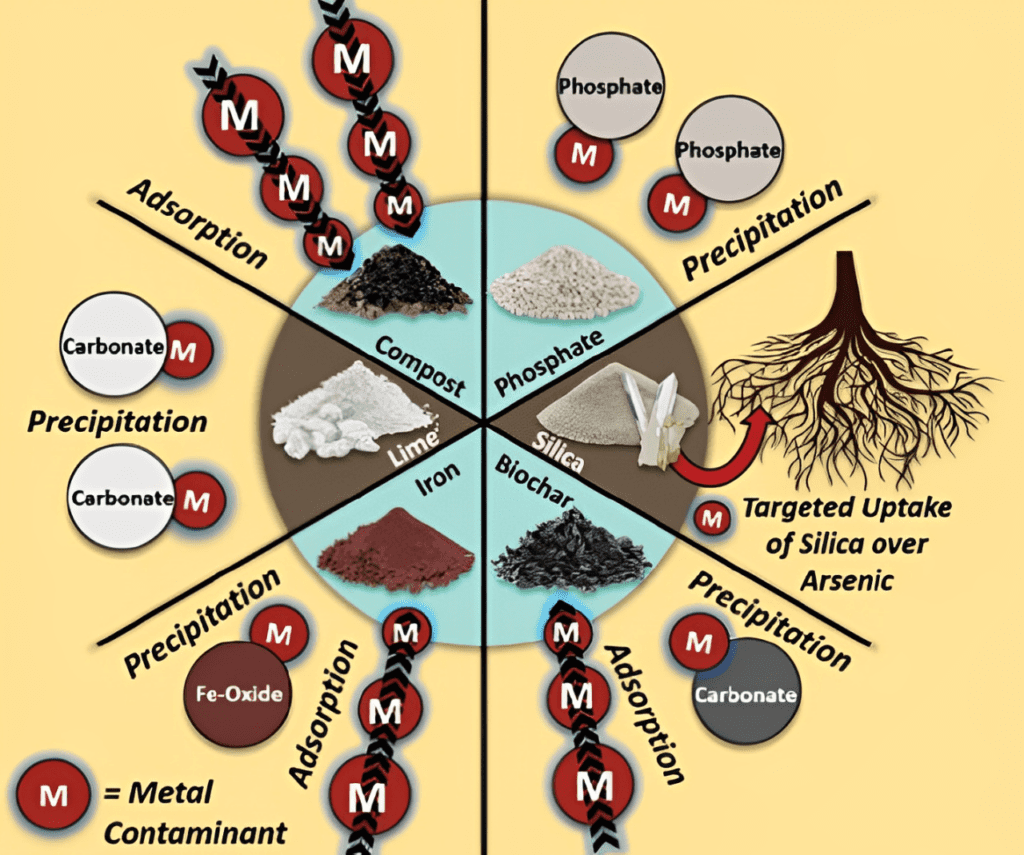
Outside of physical removal, applying an amendment that will change the form of the metal in the soil is the most economically effective strategy. Fortunately, there are feasible tools to accomplish this approach. Figure 1 provides a summary of some of the most well-studied amendments and the mechanisms involved regarding how they immobilize metals in soil.
BIOCHAR: A Heavy Metal Sponge
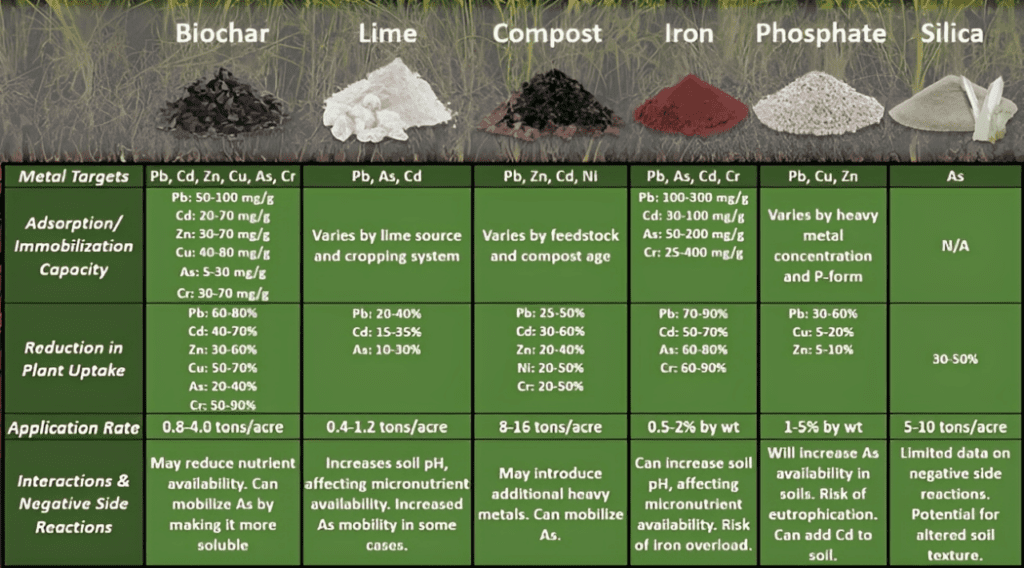
One of the most well-studied tools is biochar. Biochar is produced by taking agricultural residues and applying a controlled burning to produce a highly reactive adsorbent that can effectively reduce metal transport and uptake. Biochar’s highly porous structure and vast surface area allow it to physically trap heavy metal ions through adsorption. This process involves both positively and negatively charged heavy metal ions being attracted to oppositely charged sites on the biochar surface. Additionally, biochar’s alkalinity (high pH) further reduces metal solubility, which limits plant uptake. This also promotes the precipitation of metals as well, particularly on the surface of the biochar.
Some studies have found enriching the biochar with iron enhances its effectiveness at capturing multiple heavy metals and metalloids of differing charges (positive and negative). Introducing iron, especially zero-valent iron, triggers precipitation of the metals with iron oxides. For example, arsenic readily forms insoluble compounds with iron, thus restricting its availability to plants. Impregnating biochar with iron combines the adsorption mechanisms of biochar with precipitation, offering even greater remediation potential.
COMPOST: Organic Matter as a Binding Agent
While compost can contain trace heavy metals, its primary role in remediation lies in its high organic matter content. Decomposing organic matter promotes the formation of stable complexes with heavy metals, effectively immobilizing them. This reduces their bioavailability and potential entry into the food chain.
LIMING: Reduce the Risk by Changing the pH
Liming soil to reduce plant uptake of heavy metals and metalloids is a common and effective approach. Lime raises soil pH, creating a less favorable environment for heavy metal uptake by plants. As soil becomes more alkaline, many heavy metals form less soluble compounds, minimizing their potential to move within the soil and into plant tissues. Lime needs depend greatly on current soil pH, buffering capacity, and contamination levels. Just as metal uptake is reduced with lime, increasing the soil pH too much can reduce nutrient access as well, impairing fertility and production in the long run.
PHOSPHATE AMENDMENTS: A Strategic Approach to Immobilize Metals
Adding phosphate encourages heavy metals, particularly lead, to form insoluble lead-phosphate compounds. This effectively immobilizes lead, decreasing its bioavailability. This has also been shown to work with other metals, such as cadmium and zinc. As with any amendment, over-application of phosphate can impair environmental quality with time, contributing to nutrient leaching and water pollution. Soil testing and specific product choice matter (some phosphorus sources, like certain manures, may themselves have trace metal contaminants).
PHYTOREMEDIATION: A Novel Approach by Harnessing Nature’s Filters
Selected plant species accumulate significant amounts of heavy metals in their aboveground biomass. These plants are called “hyperaccumulators.” Following harvest, plants are carefully disposed of to remove accumulated metals from the site. For example, bracken fern plants have been extensively studied for their ability to hyperaccumulate large amounts of arsenic from soil. The challenge is getting these unique plants to establish and grow in soils where they may not commonly dominate. In some cases, certain plants immobilize heavy metals within their root systems and the surrounding soil (phytostabilization), reducing their mobility and potential for contaminating crops or leaching into groundwater.
Quantifying Applications
Remember, application rates for all amendments are best guided by thorough soil testing and site-specific analysis.
As a general remediation approach, here’s an example:
Imagine a 1-hectare (2.5-acre) plot with lead contamination of 500 mg/kg (significantly exceeding the U.S. EPA limit of 120 mg/kg). A remediation plan might include:
- Soil and plant tissue analysis: Detailed testing to determine pH, organic matter content, and other metal levels to fine-tune amendment choices. Initially, testing plants that are commonly grown on the affected soil will tell you if and how much of the lead the plants are taking up. In some cases, it can be quite minimal, so checking is a good start.
- Biochar addition: Start by adding about a half to one ton of biochar per acre for increased binding capacity. Application of biochar as close to the root zone as possible has shown the greatest reduction in heavy metal uptake in certain crops.
- Iron amendment: On top of the biochar, adding zero-valent iron or ferrous iron to raise soil iron levels to around 2 to 5 percent will facilitate lead precipitation and stabilization onto the biochar.
- Monitoring: The best way to test if the strategy worked is by growing some of the same crops and testing the plant tissue. You can test the soil, but the lab should use an extract that correlates to “plant-available” forms, such as ammonium acetate at pH 4.8 (Modified Morgans) or a DTPA solution (mild chelator). Keep testing to track lead levels in subsequent crops and soil over time, potentially fine-tuning amendments or transitioning to phytoremediation.
Conclusion
Remediating heavy metal contamination in agricultural soils relies on understanding the diverse mechanisms employed by different strategies. Using the power of adsorption, precipitation, organic matter binding, and pH manipulation alongside plant-based solutions opens new pathways towards protecting our soil, our food, and the ultimate health of our planet. Continued research and the responsible integration of scientific advancements further bolster our ability to create a sustainable future free from the insidious legacy of heavy metal contamination.
Patrick Freeze is a soil health scientist, research and development manager, and technical specialist at Ward Labs. He earned his Ph.D. in soil chemistry from Washington State University, where he studied soil health and heavy metal chemistry as a USDA NIFA Needs Fellow and in Thailand as a U.S. Fulbright Scholar.