

Understanding fungal-to-bacterial ratios — and their modern history — can help growers improve their fields
Eco-ag farmers understand that soil biology is an important driver of soil quality and fertility. This theme has been a staple of Acres U.S.A. since this magazine was first published in June, 1971. Just like the information age, this agricultural knowledge base has evolved and keeps expanding in depth, empowering farmers to improve their soil and crop health.
Sustainable farming systems — organic, eco-agriculture, biodynamic, regenerative — place a keen emphasis on soil organic matter with its attendant soil biology. These soil features are linked at the hip: you can’t maintain soil biology without decomposing and stable organic matter, and you can’t synthesize soil humus without soil microbiology. The organic farming movement gained know-how from soil microbial pioneers like Selman Waksman, Ehrenfried Pfeiffer, Hans Peter Rusch, Nicolai Krasilnikov, Rauol H. France and Anne France-Harrar. Dr. William Albrecht wrote a chapter on soil organic matter in the classic 1938 Yearbook of Agriculture: Soils and Men.
Rauol H. France, known as the Father of Soil Ecology, was director of the Munich Biological Institute. He published on protozoa, plankton, soil biota, microscopy and soil ecology from the 1890s to 1940s. He co-founded the journal Mikrokosmos and wrote Das Edaphon, which described the ecology of soil-dwelling microorganisms. His wife, Anne France-Harrar, was invited by the Mexican government to help remediate degraded soils. From 1955 to 1961 she prepared quality composts and manufactured microbial cultures such as the “Edafil” compost inoculant, “Edaphon-humus” soil inoculant, and “Petrofil bricks” containing lithobionts — microorganisms that inhabit rock surfaces and cause rocks to disintegrate into soil. Nicolai Krasilnikov’s Soil Microorganisms and Higher Plants, first published in Russian in 1958, was translated into English in 1961 and became a classic reference point in modern biological farming systems; it is available for download on the Soil and Health Library.
In the U.S., the premier soil microbiologist working biodynamic agriculture, Dr. Ehrenfried Pfeiffer, established the Pfeiffer Biochemical Research Laboratory in New York. Pfeiffer’s lab prepared the biodynamic preparations, green manure and compost inoculants with over 55 microbial species, and the picture-forming paper chromatograms. His bacterial inoculants were used to turn municipal waste into compost in Oakland, California. “The City with Golden Garbage,” featuring Pfeiffer’s new methods in Oakland, was highlighted in the May 1952 issue of Collier’s magazine. Pfeiffer published research reports on soil humus and biology in the Bio-Dynamics Journal that were later reprinted in early editions of Acres U.S.A.
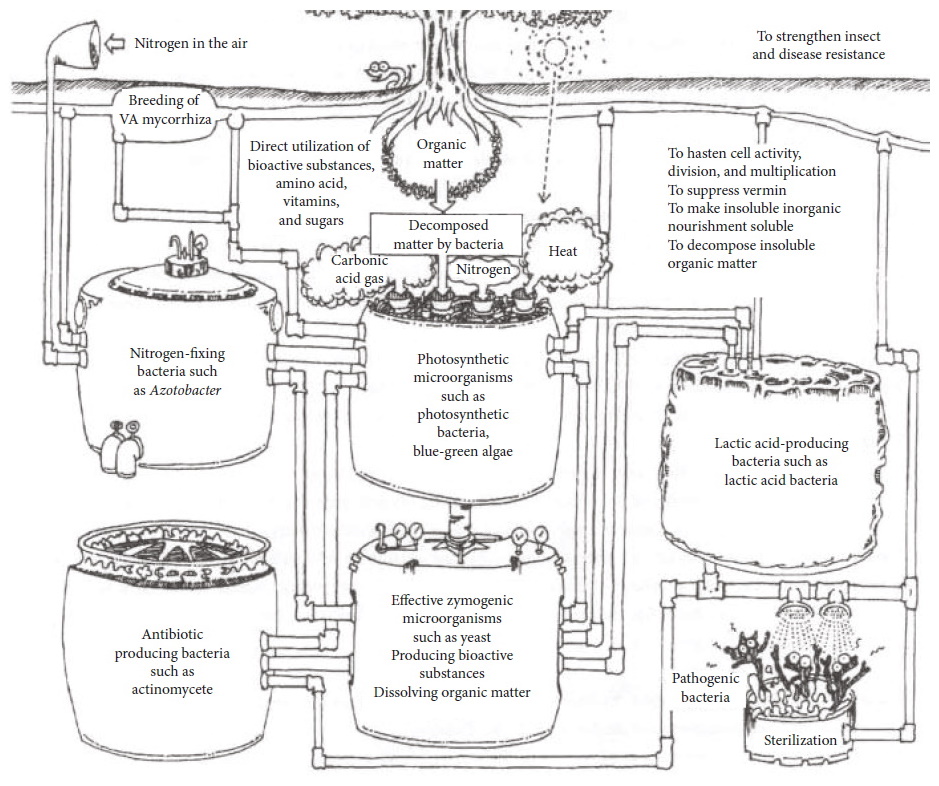
For roughly its first two decades, speakers and products featured at the Acres U.S.A. conference focused on microbial inoculants, humic acids, composting technology, conservation tillage and digestion of crop residues. Soil biology during this era was categorized in broad terms, with a functional view of microbial organisms: nitrogen-fixing bacteria, legume inoculants, mycorrhizal fungi, residue digesters, antibiotics from actinomycetes and healthy soils leading to natural disease-suppression.
The late 1980s and early 1990s was the tipping point that led to the modern era of soil biology in regenerative agriculture. Siegfried and Uta Luebke presented “A Window into the Soil” on soil microbiology and Controlled Microbial Composting at the 1986 Acres U.S.A. conference. Their slides added a new dimension to sustainable farming conferences: high-resolution microscopic images of soil microbiology in composts and soils. In the wake of the Chernobyl nuclear accident, a radioactive cloud settled across Austria and surrounding countries in Europe. Food safety regulations forced farmers to discard fresh produce, dairy and meat products raised on pastures. One notable exception was root vegetables at the Luebke’s farm. By way of well-developed humus and a biologically active soil, the root crops on their farm excluded cesium uptake.
In Asia, parallel nature farming movements were co-evolving in Korea and Japan. The Life in the Soil video, produced by Sakura Motion Picture Ltd, in association with MOA Productions and the Nature Farming International Research Foundation, was released in 1990. This video — which featured spectacular videography of microorganisms inhabiting the rhizosphere, expanding root hairs and microbial invasion of decaying leaves — was shown at practically every major organic farming conference in the U.S. over the next ten years. Proceedings of the First International Conference on Kyusei Nature Farming, published in 1989, featured the all-purpose microbial inoculant known as EM-Effective Microorganisms, developed by Dr. Teruo Higa in Japan.
Dr. Elaine Ingham’s lectures on the soil food web at an Acres U.S.A. conference in the late 1990s, in concert with the publication of the Soil Biology Primer by USDA in 1999, was like a lightning rod that helped usher in the modern soil health movement. Especially in contrast to post-WWII industrial agriculture, with its heavy emphasis on chemical fertilizers, this expanding awareness of soil microbial ecology and its ability to facilitate nutrient access in the vast natural forests, prairies and wetlands that blanket planet Earth helped farmers grasp natural ecosystem processes. A constant theme in every biological farming system is to mimic nature — employing biodiversity, multi-species cover crops, intercropping, crop residue mulches, sod-forming forage rotations, grazing animals and less soil disturbance — to take advantage of these ecosystem processes and to reduce fertilizer inputs.

A holistic theme in the Primer is that soil biology is more than just classification of soil micro- and macro-organisms. A key message is that aboveground vegetation is mirrored by a belowground soil food web. More importantly, living plants, with their root exudates and decaying plant parts, are the primary driver of soil biological structure.
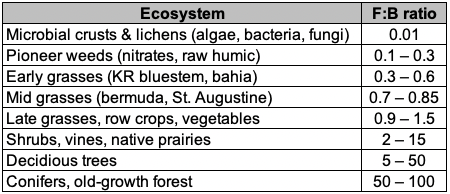
Over time, the type of vegetation occupying a site has a strong influence on soil ecology, which is expressed as fungal-to-bacterial ratio, or F:B. Calculated by comparing the total amounts of bacterial and fungal biomass, F:B is a powerful indicator of the condition of soils, composts, natural ecosystems and cropping systems.
Essentially, F:B is an indicator of plant succession, or the change in species composition, of a landscape over time — from pioneer species to climax vegetation. Invasive weeds are strongly bacterial dominated; improved pastures and turf grasses are slightly bacterial-dominated; native grasses, vines and trees are increasingly fungal dominated. Disturbance — for example, soil tillage and overgrazing — encourages a bacterial bloom and resets the stage for succession; this is why weeds are considered pioneer species: they quickly occupy bare ground.
In non-disturbed perennial crops, with their accompanying deposits of lignocellulosic mulch and plant debris, fungi survive and form hyphal networks. The soil food web becomes increasingly more complex and fungal rich. Greater fungal biomass is associated with greater ecosystem functioning, nutrient cycling, production of organic acids and symbiotic mycorrhizal fungi.
Farmers can obtain an accurate assessment of F:B by sending soil samples to commercial labs that offer 1) the Soil Food Web test, measured via direct microscopy; 2) PLFA, or phospholipid fatty acid; or 3) the do-it-yourself kit from microBiometer. The Soil Food Web test is offered by Earthfort Labs in Oregon and the Soil Food Web New York Lab. The PLFA test is offered by Ward Laboratories and RegenAg Labs, both in Nebraska. On-farm microscopy has become popular as a way to obtain a qualitative assessment, but the lab and kit versions are more reliable for a verified F:B assessment. Interestingly, the microBiometer has a very high correlation (R = 0.93) with digital microscopy.
An eye-opening encounter on a ranch project in Texas altered my understanding of the F:B ratio in contrast to the way it was portrayed in the Soil Biology Primer, which categorized grasslands as bacterial. In 2007, I was hired on as a soils consultant with Sustainable Growth Texas LLC, a soil food web services company founded by Betsy Ross. A remnant tallgrass prairie on this ranch southwest of Fort Worth — fenced off from lease tenets, who tend to overgraze — had a F:B ratio of 7:1. Further testing on client projects found fungal-rich prairie sites in multiple locations, including the Gulf Coastal Prairie near Houston. This provided a new view for managing pastures, landscape and prairie restoration projects. When the George W. Bush Presidential Library was built in Dallas, our team was hired to provide fungal-heavy landscape soil specifications and site applications to establish the prairie landscape.
Soil food web assessments with the F:B ratio provide a roadmap for managing cropping systems, pastures, perennial trees and vines, and native hayfields. Using this knowledge, farmers can employ bio-augmentation (adding microbes) and bio-stimulation (feeding microbes) amendments, compost extracts, mycorrhizal fungi, and other carbon inputs that encourage a functioning soil food web and avoid lower-successional influences.
While it’s popular to talk about dialing-in the F:B for specific crops, in my view it is more like a spectrum that you push; it takes time to alter F:B, but you can achieve benefits from soil microbial community functioning right away. The Johnson-Su compost bioreactor technology is exciting because this kind of on-farm compost produces a fungal-rich inoculum. One of the batches at New Mexico State University had an F:B ratio of 10:1. This is a desirable substrate to make a fungal-heavy liquid compost extract, which can then be tank-blended with microbial food additives as a bio-spray for applying to soils to regenerate croplands and pastures.
Steve Diver is the farm superintendent of the horticulture research farm at the University of Kentucky. He started attending Acres U.S.A conferences in 1985.