
Acres U.S.A.® Magazine
  • Articles
    • News
    • Ecological farming
      • Climate
      • Environmental Issues
      • Farm management & planning
      • Human health
    • Livestock
    • Farm
    • Crop
      • Crop management practices
        • Ag technology
        • Cover crops
        • Crop nutrition
          • Crop protection
          • Diseases
        • Crops
        • Fruits
    • Soil
    • Opinion
  • Resources
    • Magazine
    • Online Learning
    • Newsletters
    • Free Articles
    • Blog
  • Magazine Issues
    • 2025
      • October 2025
      • September 2025
      • August 2025
      • July 2025
      • June 2025
      • May 2025
      • April 2025
      • March 2025
      • February 2025
      • January 2025
    • 2024
      • December 2024
      • November 2024
      • October 2024
      • September 2024
      • August 2024
      • July 2024
      • June 2024
      • May 2024
      • April 2024
      • March 2024
      • February 2024
      • January 2024
    • 2023
      • December 2023
      • November 2023
      • October 2023
      • August 2023
      • July 2023
      • June 2023
      • May 2023
      • April 2023
      • March 2023
      • February 2023
      • January 2023
    • 2022
      • December 2022
      • November 2022
      • October 2022
      • September 2022
      • August 2022
      • July 2022
      • June 2022
      • May 2022
      • April 2022
      • March 2022
      • February 2022
  • About Us
    • Our History
    • Our Staff
    • Contact Us
    • Community
      • Soil Health Primer Resources
  • Events
    • Eco-Ag Conference
    • Farm Weird Event
    • Viroqua On Farm Event
  • Subscribe
  • Login
  • Register
No Result
View All Result
  • Articles
    • News
    • Ecological farming
      • Climate
      • Environmental Issues
      • Farm management & planning
      • Human health
    • Livestock
    • Farm
    • Crop
      • Crop management practices
        • Ag technology
        • Cover crops
        • Crop nutrition
          • Crop protection
          • Diseases
        • Crops
        • Fruits
    • Soil
    • Opinion
  • Resources
    • Magazine
    • Online Learning
    • Newsletters
    • Free Articles
    • Blog
  • Magazine Issues
    • 2025
      • October 2025
      • September 2025
      • August 2025
      • July 2025
      • June 2025
      • May 2025
      • April 2025
      • March 2025
      • February 2025
      • January 2025
    • 2024
      • December 2024
      • November 2024
      • October 2024
      • September 2024
      • August 2024
      • July 2024
      • June 2024
      • May 2024
      • April 2024
      • March 2024
      • February 2024
      • January 2024
    • 2023
      • December 2023
      • November 2023
      • October 2023
      • August 2023
      • July 2023
      • June 2023
      • May 2023
      • April 2023
      • March 2023
      • February 2023
      • January 2023
    • 2022
      • December 2022
      • November 2022
      • October 2022
      • September 2022
      • August 2022
      • July 2022
      • June 2022
      • May 2022
      • April 2022
      • March 2022
      • February 2022
  • About Us
    • Our History
    • Our Staff
    • Contact Us
    • Community
      • Soil Health Primer Resources
  • Events
    • Eco-Ag Conference
    • Farm Weird Event
    • Viroqua On Farm Event
  • Subscribe
No Result
View All Result
Acres U.S.A.® Magazine
No Result
View All Result
Home Magazine issues May 2023

A Small-Scale Solution for Land Management

Acres U.S.A. by Acres U.S.A.
June 2, 2024
in May 2023, Reviews
0
A Small-Scale Solution for Land Management
0
SHARES
5
VIEWS
Share on FacebookShare on Twitter

The Two-Wheel Tractor Handbook: Small-Scale Equipment and Innovative Techniques for Boosting Productivity, by Zach Loeks

Two-wheel tractors are to farming what Kitchenaid stand mixers are to food preparation.

No one uses a Kitchenaid for large-scale for-sale food production, but if you have one, you’re a pretty serious home cook — you don’t need one if all you’re going to do is mix up some eggs to scramble every once in a while. The Kitchenaid is a serious mixer that does a great job reliably, for years on end, with little to no maintenance. It also has a variety of attachments that work well — a pasta maker, a meat grinder, a processor for applesauce and tomatoes — but these tools wouldn’t be enough for commercial production or for more than one family.

Likewise, the two-wheel tractor fills its niche perfectly in the agricultural world. Large-scale producers with their “real” four-wheel tractors scoff at what they think of as a glorified rototiller, but anyone who uses one is way more seriously into food production than a suburban raised-bed gardener. Two-wheel tractors are incredibly simple to maintain compared to their four-wheel cousins. And there are dozens of attachments that make it indispensable for smaller-scale farmers and serious homesteaders.

In other words, two-wheel tractors and a perfect example of a scale-appropriate tool. And now there’s an entire book dedicated to their uses and functions: The Two-Wheel Tractor Handbook by Zach Loeks.

Loeks is a small-scale grower in New Mexico who has used two-wheel tractors his whole life. Through this book he aims to “return the two-wheel tractor to its rightful place as a small-scale solution for land management, especially for diversified and highly profitable stewardship of farms, homesteads, and landscapes.” 

The book does a good job of explaining the “why” of a technology like the two-wheel tractor. They originated nearly 150 years ago, and non-PTO versions were used extensively for tillage applications in the U.S. in the middle part of the last century. But they really became useful when engineers added the PTO and the swiveling handbars, which enable implements to be attached either in front of the engine (like a sickle-bar mower, flail mower or snowblower) or behind it (like a rotary plow or power harrow). 

Two-wheel tractors became particularly popular in Italy in the 20th century. Smaller farming plots due to centuries of land division, along with its undulating or even mountainous terrain, meant that a smaller machine was often more useful than a larger one. Four-wheel tractors can be especially dangerous on slopes; steel-cage wheels — some of them with spikes — enable two-wheel tractors to be used on incredibly steep hillsides. 

The convergence here in North America at the beginning of this century of a revival in both market gardening and the homesteading/permaculture movement has made two-wheel tractors more popular than ever. They are a staple on small market farms for forming beds (with the rotary plow or tiller), chopping cover crops and crop residue (with the flail mower) and developing perfect beds for direct seeding (with the power harrow or tiller with precision depth roller). Homesteaders use them for garden preparation but also for splitting firewood, carting around woodchips, pumping water, clearing snow and a number of other tasks.

I have to confess that I’m biased in this conversation — I own a BCS 853 and about a dozen attachments and am a huge fan. I use my BCS practically daily for all of the uses mentioned above, plus some. The generator keeps my essential appliances functioning during power outages. The log splitter does its part in keeping us warm all winter. The potato digger lifts spuds at harvest time. The attachment that gets the most use is probably the humble cart, which moves firewood, compost and anything else around my 10 acres.

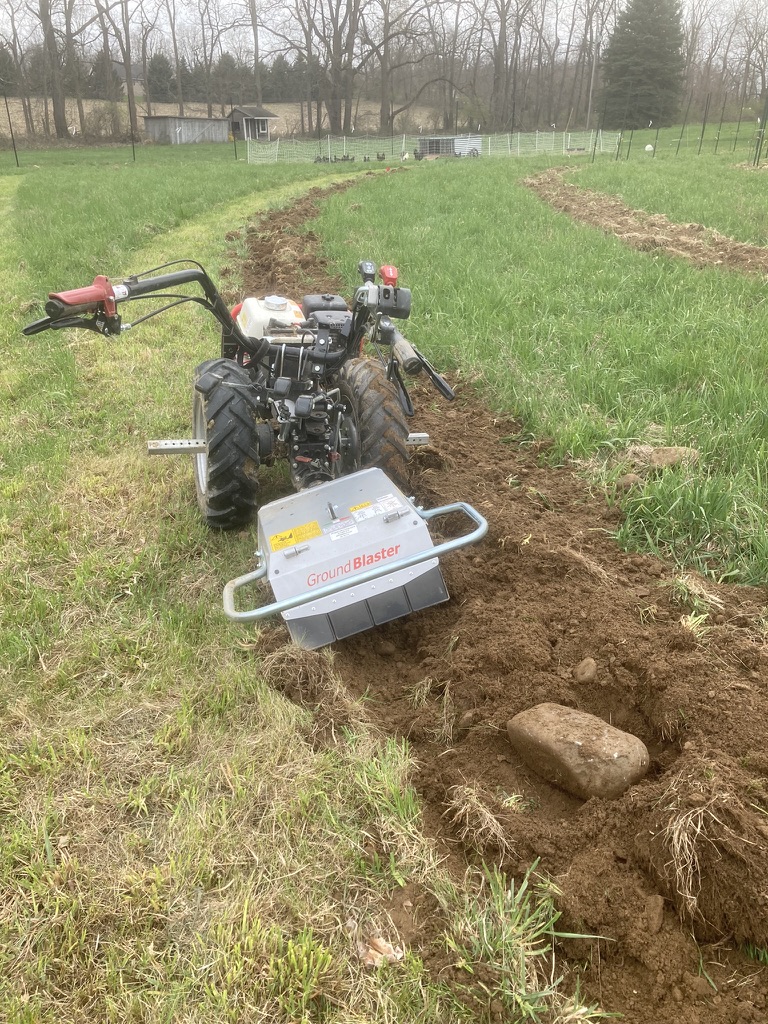
All of these functions would be possible on a four-wheel tractor. The reason I — and many others — chose a two-wheel tractor boil down to two things: maintenance/simplicity and cost.

As Loeks explains, and I can corroborate, a two-wheel tractor is powered by a simple 13-hp engine that doesn’t require any electronics. In other words, I can maintain it myself (particularly with the aid of the incredibly helpful videos and documents available from Joel Dofour of Earth Tools in Kentucky). And I don’t need to maintain multiple engines for a tiller and a logsplitter and a generator — it’s just the one.

Cost-wise, compared to a small four-wheel tractor, the BCS is a no-brainer. I splurged on every implement I wanted (minus the haymaking equipment … I’m still considering that!) and spent less than $25,000. To get a small Kubota and the same functionality would easily cost twice as much — probably three times. Plus I get the exercise. Admittedly, I don’t have the bucket or towing capacity of a four-wheel tractor. But I have three very kind neighbors who do, and most anyone who lives rurally probably do as well.

The Two-Wheel Tractor Handbook has many helpful diagrams and infographics. Anyone considering buying a BCS or Grillo will benefit immensely from Loeks’s in-depth discussion of all the pros and cons of purchasing the machine and the different types of implements. He takes a very holistic, systems-based approach to decision-making that will benefit new and old two-wheel-tractor users alike.

Loeks also includes a comprehensive system on the use of two-wheel tractors to form different types of garden beds. I’ll admit that my bedmaking was a bit haphazard this past year — I eyeballed a lot of it, and this was fine for growing food for my family. But professional growers will want more precision, and Loeks describes the best techniques for doing so on a number of different scales.

He also provides a number of helpful case studies of growers who have successfully adapted the two-wheel tractor to their environment, along with photos and diagrams that show what’s possible with this tool.

This book will be of particular usefulness to newer farmers/homesteaders, but all users will benefit from it. I picked up a few helpful tips, particularly related to maintenance.

Two-wheel tractors aren’t for everyone. But at the right scale — the quarter-acre intensive market farm to the 10- or 20-acre homestead — it’s the perfect tool for the job. 

Paul Meyer is the editor of Acres U.S.A. magazine.
← Previous Honoring the Soil Next ECO-MEETINGS →
Tags: May 2023Reviews
Acres U.S.A.

Acres U.S.A.

North America’s oldest publisher on production-scale organic and regenerative farming. For more than 50 years, our mission has been to help farmers, ranchers and market gardeners grow food profitably, regeneratively, and with nature in mind.

Next Post

What’s Inside? May 2023 • Issue #623

  • Trending
  • Comments
  • Latest
The Most Important Livestock in Our Fields

The Most Important Livestock in Our Fields

July 1, 2024
Glyphosate Does What It’s Designed to Do — Kill

Glyphosate Does What It’s Designed to Do — Kill

February 19, 2025
The Take-Half, Leave-Half Fallacy

The Take-Half, Leave-Half Fallacy

July 1, 2025
White snakeroot

Toxic Forages?

September 1, 2025
We Don’t Need Another Bridge — We Need an Off-Ramp

We Don’t Need Another Bridge — We Need an Off-Ramp

3
Under One Roof

Under One Roof

3
A Rose By Any Other Name

A Rose By Any Other Name

2
Terra Preta’s Biological Advantage

Terra Preta’s Biological Advantage

2
Don’t You Dare Disparage Sugar!

Don’t You Dare Disparage Sugar!

February 3, 2026
February 2026 • Issue #656

February 2026 • Issue #656

February 1, 2026
Fungal Exchange Capacity

Fungal Exchange Capacity

February 1, 2026
ECO-MEETINGS

ECO-MEETINGS

February 1, 2026

Recent News

Don’t You Dare Disparage Sugar!

Don’t You Dare Disparage Sugar!

February 3, 2026
February 2026 • Issue #656

February 2026 • Issue #656

February 1, 2026
Fungal Exchange Capacity

Fungal Exchange Capacity

February 1, 2026
ECO-MEETINGS

ECO-MEETINGS

February 1, 2026

About ACRES USA

Acres U.S.A.® Magazine

Acres U.S.A.® is North America’s oldest publisher on production-scale organic and regenerative farming. For more than 50 years, our mission has been to help farmers, ranchers and market gardeners grow food profitably and sustainably, with nature in mind.

Visit Our Advertisers

Magazine Issues

  • News
  • 2025
    • June 2025
    • May 2025
    • April 2025
    • March 2025
    • February 2025
    • January 2025
  • 2024 Articles
    • December 2024
    • November 2024
    • October 2024
    • September 2024
    • August 2024
    • July 2024
    • June 2024
    • May 2024
    • April 2024
    • March 2024
    • February 2024
    • January 2024
  • December 2023
    • December 2023
    • November 2023
    • October 2023
    • August 2023
    • July 2023
    • June 2023
    • May 2023
    • April 2023
    • March 2023
    • February 2023
    • January 2023
  • December 2022
    • November 2022
    • October 2022
    • September 2022
    • August 2022
    • July 2022
    • June 2022
    • May 2022
    • April 2022
    • March 2022

Contact Acres U.S.A

  • Contact Us
  • About Us
  • Advertise With Acres U.S.A.
  • My Subscription

Learn

  • Resources
  • Events
  • Magazine
  • Newsletters
  • Free Articles
  • Webinars
  • Online Courses
  • Bookstore

Our All Socials

Follow With Us...

  • My account
  • News
  • Ecological farming
  • Refund and Returns Policy
  • Privacy & Policy

© 2024 Acers USA Magazine

Welcome Back!

Login to your account below

Forgotten Password? Sign Up

Create New Account!

Fill the forms below to register

All fields are required. Log In

Retrieve your password

Please enter your username or email address to reset your password.

Log In
No Result
View All Result
  • HOME
  • ARTICLES
    • News
    • Farm
    • Ecological farming
    • Livestock
    • Crop
      • Crop management practices
      • Cover crops
      • Crop nutrition
      • Crop protection
      • Crops
      • Ag technology
    • Soil
    • Opinion
  • RESOURCES
    • Magazine
    • Online Learning
    • Newsletters
    • Blog
    • Free Articles
  • MAGAZINE ISSUES
    • 2025
      • June 2025
      • May 2025
      • April 2025
      • March 2025
      • February 2025
      • January 2025
    • 2024
      • December 2024
      • November 2024
      • October 2024
      • September 2024
      • August 2024
      • July 2024
      • June 2024
      • May 2024
      • April 2024
      • March 2024
      • February 2024
      • January 2024
    • 2023
      • December 2023
      • November 2023
      • October 2023
      • August 2023
      • July 2023
      • June 2023
      • May 2023
      • April 2023
      • March 2023
      • February 2023
      • January 2023
  • ABOUT US
    • Our History
    • Our Staff
    • Contact Us
    • Community
      • Soil Health Primer Resources
  • EVENTS
    • Eco-Ag Conference
    • On-Farm Viroqua Event
    • Farm Weird
  • SUBSCRIBE
  • Login
  • Sign Up
  • Cart

© 2024 Acers USA Magazine

Are you sure want to unlock this post?
Unlock left : 0
Are you sure want to cancel subscription?