

Breeder Dave Christensen has spent his life trying to develop the most resilient and nutritious corn in the world
Acres U.S.A. Can you start by describing your background? Did you grow up on a farm?
Christensen. What I’ve done in corn breeding doesn’t have anything to do with how I grew up. I grew up in rural southern California. It was wonderful — I lived in the country with a whole lot of land around us, but it wasn’t a farm. My uncle had a huge ranch in Tulare, California. As a teenager I worked with him, and I loved agriculture.

I went to agriculture college at Cal Poly. I was really interested in genetics, but I have a mental inability with math. Genetics takes a lot of math, so I really don’t use any complicated genetics in my breeding work. I’ve got younger friends — three or four younger guys who are copying my vision but breeding corn for their locations — and they’re really smart. The guys who work with me are brilliant, way more than me, and can figure anything out genetically. So, I’ve got buddies to answer my tricky genetic questions.
Acres U.S.A. You’re the visionary.
Christensen. Yeah, but they have their own visions too.
After college, I went in the Air Force for four years in Tennessee and Arkansas. I loved the rural environment, and I was really interested in meeting the old-time hillbillies and learning how to tan hides. I grew up with great grandparents — I was the oldest child of oldest children — so I heard the stories of us being the first people to go into Kentucky and the first people to get in wagon trains and come west. I loved all of that stuff, and I always wanted to tan buckskins. I met a few guys in Indiana that were developing a frontier movement as a hobby — just for fun.
We made friends, and we all vowed to move to Montana and start a community, and we did. When I got out of the service, I was the first one to move there, with my wife and two kids. We moved to the Flathead Indian Reservation, and I was a cowboy there. Our goal was to live off the land and to feed ourselves. We started a garden, and we wanted to create food for ourselves if we had to, just for the fun of it.
And the very easiest grain to grow is Indian corn. It’s grain on a handle. Harvesting and taking care of wheat is much more complicated. So, I was trying to find corn that would mature in the short northern growing season. Before climate change, in the mountains of Montana, there wasn’t any corn that would mature. I started talking with the real old guys — I was in my twenties and they were in their nineties — about how they grew up on homesteader farms, and their only grain was Indian corn. They called it squaw corn. The first homesteaders in Montana grew Indian corn. They got it from Mandan Indians in North Dakota. There was a nurseryman named Oscar Will who was growing Mandan Indian corn and selling it to people moving west. I found some old timers who still had some seed, and it was the only variety of corn that would mature where I was living.
Then I discovered the National Seed Bank, and they had several lines of Northern Indian corn. The word got out that I was collecting old seeds, and people would send me stuff. I developed a population starting 53 years ago — a composite of Northern Indian corns — and I expanded that. I just kept researching and trying hundreds and hundreds of different corns to see which would mature and which had traits that were desirable for where I lived. The population included corns from New Mexico, 8,000 feet in the mountains, and also Canadian corns. I probably put about 70 different lines into my founding population, which I call Painted Mountain corn. That’s my basic gene pool.
Acres U.S.A. Can you talk about some of the particularities of your corn? It’s long and thin, right? Why are those traits important?
Christensen. Well, it sounds crazy, but when I was 17, I had a dream about black corn. I had no interest in corn at the time. Didn’t know anything about it. But one night I had a powerful dream where I walked into a grocery store and saw a bin of multicolored corn, and right in the middle were two long, skinny, black cobs. To the human eye, they weren’t beautiful. The skinny ones looked weird compared to the average colorful, fat cobs. But there was an amazing power and beauty to them. I don’t have any words for it. The dream was so powerful that I couldn’t think of anything else for the first half of the next day.
Then, a day or two later, I was walking past a grocery store. I had completely forgotten about the dream. But I went in and turned the corner and saw a bin of corn, and those two black corns were sitting there exactly like they were in my dream, and my mouth fell open. So, I bought those two black ones. I didn’t think they were pretty, but they were really important to me. I’d never heard of anybody having a dream that came true.
I kept those ears through college and through the military service. When I got a chance to plant them, they had gone sterile, but it didn’t really matter — they were just freaks from a gene pool from Southern California or someplace; they wouldn’t have grown in Montana. But the purpose of those cobs was to show me what I was supposed to develop. I had been so impressed that I just tried to develop it. It didn’t exist. I had to create it. I tried and tried to get the corn darker and darker, but there weren’t any black ones.
During this process, we lived at the foot of the Crazy Mountains in Montana, and we had a freak storm on September 1 that gave us two feet of snow. All of my corn experiments were frozen and destroyed because they weren’t mature yet. I was trying lots of different corns — high-protein corns from Germany and everything. But I felt like God was telling me, “Take the cobs and just peel the husks back. You think they’re ruined, but just do it and look.” And I did, and I noticed that the long skinny ones had dried before they had frozen, and they were not destroyed. So, a light bulb went on in my head — that’s why the cobs in my dream were so skinny — because they would dry and withstand an early freeze.
I knew right then that this was why I was supposed to breed thin cobs. It doesn’t matter how long they are —- they can be really long, and you can get your production with length, as long as you keep them thin. I also felt like I was supposed to breed for all kinds of cold-hardy traits. That was my job.

Then we had six years of drought, and weeds didn’t even come up in Montana. This was back in the early eighties. So, I tried all the corns from the National Seed Bank that come from the Southwest that are drought hardy — only the fast-maturing ones that might have a chance of maturing up here. I got a package of a hundred kernels of each line, and I only had room in my experimental garden to plant four seeds of each.
One package was from the north side of Black Mesa in Arizona, and most of the seeds were white, yellow, and blue, plus there was one red kernel. I planted the red kernel and three others, and none of them did well here in Montana because those seeds were used to southern daylight and southern temperatures. But some of them matured, and I peeled back the husk on one cob, and it was shiny black. And a second cob was also black.
They weren’t thin — they were large, wide Southwest corns — but they had the black color, and the light went on inside me. After years of trying to create a black corn, it was handed to me. I still don’t know how this happened except that the red kernel must have just gotten the right genes from a mixed field in which the predominant colors were yellow and white. I got the gene for black, as long as I kept it homozygous — they have to get the right genes from both parents. I started breeding that to my Montana Painted Mountain corn, and I kept breeding it until the corn was 99.5 percent Painted Mountain but still carried the gene for the Navajo black color. There wasn’t anything else about the Navajo corn that really worked here in Montana.
Another really cool thing is that since then I’ve learned that there are other morado corns. Morado means “so dark purple that it’s black” — that’s a Spanish word. There are other morado corns in Mexico and in South and Central America, but they only have one layer of pigment for color. Corn has two layers that can potentially be pigmented: the hull — the outer layer that you can peel off — and the first layer of cells on the starch. The gene I got from the Navajo corn is the only gene for morado corn in the world that has two layers of pigment. The Navajos are not the only ones that have that — there might be a few other Southwest tribes that have that same gene — but most other black corn does not have two layers of pigment.
And I think that was a gift from God — statistically it was really unlikely that I would get a kernel that wasn’t black that produced black children, and then that it would happen to be the only one in the world that had two layers of pigment.
I also tested it to find out how the antioxidant capacity compared on different colors of corn, and my black corn is through the roof. The other morado corns of the world are extremely high, but mine is 30 percent higher than other morado corns in antioxidants. And I’ve done so much work to improve it that I think it’s even higher now.
The pigments — the anthocyanins — in corn have tremendous healing power. I had blood panel recently, and previously I hadn’t eaten a lot of my own corn, even though I should have. But for two months prior to my blood panel, I ate my own black corn every day, and I stopped taking the statin that the doctor had prescribed. He didn’t know I’d stopped taking it that year, and he said, “Look what I’ve done for you — I’ve made you into young man!” My cholesterol is down below 200. My triglycerides are down a hundred from what they were. I didn’t have kidney or thyroid trouble, but it was edging up toward the questionable area, and they went right back down to 0. My PSA for prostate was 12, and it dropped to 4. They’d never heard of that. My testosterone jumped 125 points. Everything just cleaned up. I’ve got the blood panel of a young man, and I’m 81, and that’s just from eating this corn. So, I’m trying to discipline myself to eat it all the time. It’s really healing.
Acres U.S.A. And is all of your corn still long and thin?
Christensen. Yeah — so it’ll dry in time. Before climate change, that was absolutely essential. And my cobs are as skinny as I can get them. And now, with climate change, we’ve got another month or six weeks or two months of growing season, so I can afford to make them wider and even longer — bigger plants that take longer to mature. I used to have to get down on my knees to harvest my corn; the plants weren’t even halfway to my waist. Now some of my plants are over my head, but I don’t want them to be that tall. They don’t stand up to the wind.

But climate change is allowing much bigger plants. My Painted Mountain corn — my main gene pool — I’m keeping it eight rows of kernels around, but much longer now. Some of them are 14 inches long, although that’s the exception. Ten inches is not unusual if we get rain. But I’m starting other lines of corn, and some of them I’m allowing to have more rows of kernels. I’ve got a Blue Mesa Maize, and I’m allowing it to have eight to 10 rows of kernels. And I’ve got a second line of that that I’m allowing to have 12, maybe 14 rows of kernels. That’s for people who live in a warmer climate and can afford to have bigger corn; they don’t need it to dry so early.
Acres U.S.A. Can you talk a little bit about how your corn has been planted in places like Siberia and even North Korea?
Christensen. Sure. My corn has been tried by people all over the world, and this really amazes me. People from other countries look at American catalogs to see if we have any extreme-weather-resistant crops and buy my corn. I’ve gotten letters from every continent — Norway and Germany and Romania and Australia and Greenland and Africa.
But the funny thing is that corn is specific to different climates. My corn is extremely stress hardy, but it’s stress hardy for drought and short seasons, with freezes and heat and cold. It doesn’t really tolerate a lot of wet weather, where there are diseases from dampness. You wouldn’t want to plant hundreds of acres of my corn in a rainy climate, although I have people growing it in the rainiest parts of the world, and they say it does fine. I think it’s because they’re not exposed to hundreds of thousands of acres of corn all grown solid, where diseases multiply.
But yes — North Korea is really unique. They were trying American seeds, and they tried my corn, and it did really well. I was able to go there in the early 2000s. My corn was not really needed in the southern part of North Korea because it was warmer, but in the northern part of North Korea, near the border with China, the weather’s much colder, and it’s a mountainous climate — really steep mountains — and they couldn’t grow corn there. The only thing they could grow was a primitive local barley. But my corn was producing three times as much grain for human food as their barley was. So, they wanted me to teach them more about how to grow it and breed it and save it.
Acres U.S.A. Can you talk a little more about the height of the corn plants? Was all Indian corn originally so short that you’d have to be on your hands and knees to harvest it? And what happens when you try to make it taller so that it could be machine harvested? Do you lose some of the traits?
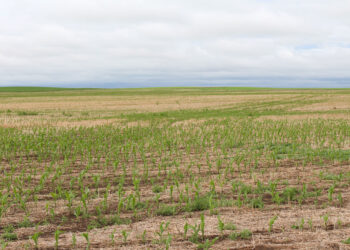
Christensen. The corn I was discussing earlier was very short because of the extreme weather that year. Some of Painted Mountain’s ancestors were that short, but that particular crop just didn’t hardly get any water. But most of those plants had two big cobs on them that were about seven inches long. I selected for plants that could produce big cobs and a lot of grain under stress, even if the plants were short.
I’ve crossed all kinds of things. Some of them were that short. Most of my main line was descended from Mandan Indian corns from Mandan, North Dakota. That’s the farthest north that any tribe grew corn — in the north part of North Dakota. And that corn, on average, depending on how much water it gets, is four or five feet tall. That’s how most of my corn is.

Some of the Indian corns I’ve bred were six feet tall — so there’s different genetics floating around in there. And as climate change has warmed this area up, my corn has gotten taller. But I don’t want it to get much taller. I really want it to be short, because tall, skinny corn plants blow over in the wind, and they’re not as efficient in desert conditions. Short, compact plants are much better.
Corn naturally gets taller and taller, especially if you plant it close. If you plant it really close, like most modern people do, a tall plant is going to give you a big cob, and a shorter plant is going to give you a puny little cob. You keep selecting the bigger cobs, and every year your corn plant gets taller and skinnier, but I try to avoid that. We plant them far apart, so every plant has an equal chance, and I try to keep it short. That’s just for standard handpicked corn.
But, of course, height is an important factor for machine harvesting — not the height of the plant, but how high the cob is placed on the plant. With Indian corn, the cobs started growing right out of the ground almost. In some of the lines, the cob would be a couple feet off the ground. The second cob would be lower. Very few of the ancestors of Painted Mountain were tall enough that a machine could pick them.
We grow 15 acres of corn organically. We can’t use chemicals, so that’s a lot of hand weeding. And it is a lot of labor to hand pick it all at harvest time. My partners and I work 10 hours a day at harvest time. I envy people growing modern hybrids that can be harvested in a few hours.
I have been breeding for higher-placed cobs, not because I ever foresaw machine harvesting in my lifetime, but I wanted my corn to be useful for breeders so that if somebody wanted a fast-maturing, drought-hardy corn with all my other good traits, they could crossbreed it to something that was machine harvestable. My plants are closer to machine harvestable than the Indian corns were. I’ve been trying very hard to breed for higher-placed cobs on short plants, but this is difficult to do because the shorter plant is going to have a lower cob.
One of my lines is just reaching machine-harvestable height. And then I have a Homestead Hero line, which is bred from modern corns and is machine harvestable. But my Indian corns still aren’t.
Plant height is not the only consideration. Indian corns have lots of suckers. If you give them water, they might have five suckers, and the suckers come on later. And if you have a short season, the first cobs on the main stock to mature will be dry, but the later-appearing cobs on the suckers will still be mushy and not dry. Then, when you combine them, you get some that are mature and some that are mushy, and the whole thing is ruined. Machine harvesting really depends upon hybrids where every plant is exactly the same. The plants all mature at the same time. The plants are all ready and the grain is all dry at the same time.
Acres U.S.A. Right. You never see any suckers on modern corn.
Christensen. I’m heading my corn in that direction. I’m getting rid of suckers, and I have fewer of them now. My corn will have either zero suckers to maybe three, but it depends on how much water you give it. If it’s under drought stress, there’ll hardly be any suckers. But if you have rain that year, you could have more suckers than you want for machine harvesting.
There are other things that are necessary for machine-harvestable corn, and Indian corn is just not ready for it. But we are going to machine harvest my Blue Mesa Maize this year with a corn picker. It just picks the cobs, and then you have a chance to look at them. If something is off type — not genetically desirable for seed stock — we can pull that out. If something’s not mature, we can remove it. If something has been bird damaged and mold got in and the cob is spoiled, we can remove it. The picker is probably going to pick up 90 percent of the cobs, and we have the ability to reject the ones that would not make good genetics nor good food.

A farmer named Ole Norgaard in Northern Montana grows my black Morado corn, and he makes corn flour and cornmeal out of it. This year, for the first time, he combine-harvested it, which means he doesn’t look at the cobs. The combine runs the whole plant through. It separates the cobs, and then it takes the kernels off the cobs. Some of the kernels are cracked, some of them don’t mature, and a very small amount are off color — not pure black. So, he purchased a seed color sorter. It’s an amazing thing. One kernel at time drops through, with three cameras on it, and a little blast of air will blow it out if it’s not a perfect black. So, the Morado is now being fully machine harvested.
The bottom line is that I really don’t care if not all of my hardy native corns are machine harvestable. There will never be millions of acres of my corn in Iowa. I’m growing it for the starving farmers of the world who don’t have millions of dollars to buy machinery. They’ll grow an acre for their family and will be happy to hand-harvest the efficient plants. Modern hybrids suck a lot of nutrients out of the land quickly. They require chemical fertilizers and nitrates, which poison the environment. And they only get 8.5 percent protein. My efficient native plants get 12-14 percent protein grown on stripped soil. I believe these native lines have the ability to produce their own nitrogen. And because my corns are open-pollinated and genetically diverse, you can start with a handful of seeds and your great, great grandchildren can still keep growing it.
I have been working on this for 53 years. It is my job to breed and select so that every year my genetic lines get more nutritious, get more stress hardy, have better plant conformation, and have prettier colors and higher yields.
Acres U.S.A. And can you talk a little bit about yield? People are always interested in that, of course, even though I’m sure what you’re more concerned would be a metric like nutrition per acre.
Christensen. The number one thing I care about is yield per acre during a stressed year. We could breed for fatter cobs that give a higher yield in years that they have more time — a longer season, with better weather. We could breed for plants that yielded more if there was irrigation or rain. But my goal is to breed for yield in the years that there is horrible stress.
This year we had ample water, but last year we had barely ample water, and we had huge yield. We had no idea how much we were going to get. I think we had 18 tons of corn or so last year, and we had never had anything like that at all. We get two tons of corn traditionally, but the two years before that, we had no water during the growing season at all.
There’s no irrigation up here, and the corn can be really stressed. We have to plant down four inches deep to get to some moisture. And the corn has to live on what water is in the soil from winter. In a good year, we get 12 inches of moisture a year, and none during the growing season some years. Even when it’s really drought stressed, I’m just absolutely amazed that most every plant makes a respectable small cob, and some make really big cobs if there’s moisture in that particular piece of the soil.
This corn has been through a hard bottleneck for surviving horrid droughts.
Acres U.S.A. Your goal is really producing high-nutrient corn for the really extreme periods.
Christensen. The big problem in the world is desertification. Seventy-five percent of the world is becoming more like a desert, which means it’s hotter and drier. And in the 25 percent of the world that are actually getting more water, the water is often coming as rivers in the sky that can cause flash flooding; they’re getting less usable water that sinks in.
So, I’m breeding for the major global problem — drought stress. Most of my customers who are growing corn for food around the world are dealing with drought. Because of climate warming, the short season is not the problem that it used to be. However, there’s erratic weather changes. Like a few years ago, we had an Arctic storm come in on September 1 and freeze everything solid. So, it’s good to have a crop that will mature fast instead of taking longer, even though climate change allows a longer growing season in most years — you can lose everything if you don’t have a longer year. Also, if you’ve got weather disasters — we’ve had horrible hailstorms that destroy everything — the quicker you can get it in the ground and get it harvested, the less it’s sitting there exposed to a disaster.
I’m going for quick maturing, which cuts down yield, but it increases yield under difficult years.
Acres U.S.A. What efforts have been made to breed some of your traits into more conventional corn? Not genetic modification in a lab, but through traditional techniques — incorporating the resilient nature of your corn for wetter environments?
Christensen. Yes, I am also breeding wet resistance. Anything that has a drop of mold on it doesn’t get planted. I’m trying to help people in wetter places too. And I do have a line of blue flint that is made for wetter climates.
There are a few people who are using my corn for crossbreeding, but these are small, visionary people like myself — they’re not hitting the big markets. Years ago, some Canadian breeders were crossbreeding to my corn for high production and fast maturity, because the fast-maturing Canadian corns were teensy little things.
But now GMO has come in, and university research is shrinking. The big companies are taking over, and they’re solving all their problems through GMO. But they’re making a mistake because the corn that has been grown in this area for 200 years is going to have a hundred different genes that help it survive drought stress. GMO is trying to breed in one gene for drought stress, taking it from a shellfish or who knows what. One gene does not really give regional adaptation.
I think people are going to need something that’s regionally adapted, and a very few individuals are realizing that and are doing that breeding work. But they’re not affecting the market in any significant way. It used to be that every farmer in America saved his own seed and didn’t do hybrids, and they adapted it to their region. But there’s almost nobody doing that today.
My corn is beautiful, and color sells. I would guess that at least 90 percent of the people buying my corn are buying it for ornamental value. But I’m trying to create a food to feed starving people around the world. Protein in my corn goes up to 14 percent. My Homestead Hero has got amino acids that only exist in legumes. Nutritionally and survival wise, I’m trying to create something that people will be living on after I’m dead.
That’s my vision. I’m preparing for a day when we might really need the hardiest corn in the world.
| You can purchase Dave’s Painted Mountain Corn and Montana Morado Maize at northfrontierfarms.com, or at other places online. |