


US Supreme Court Rules in Favor of Bayer in Monsanto v. Durnell
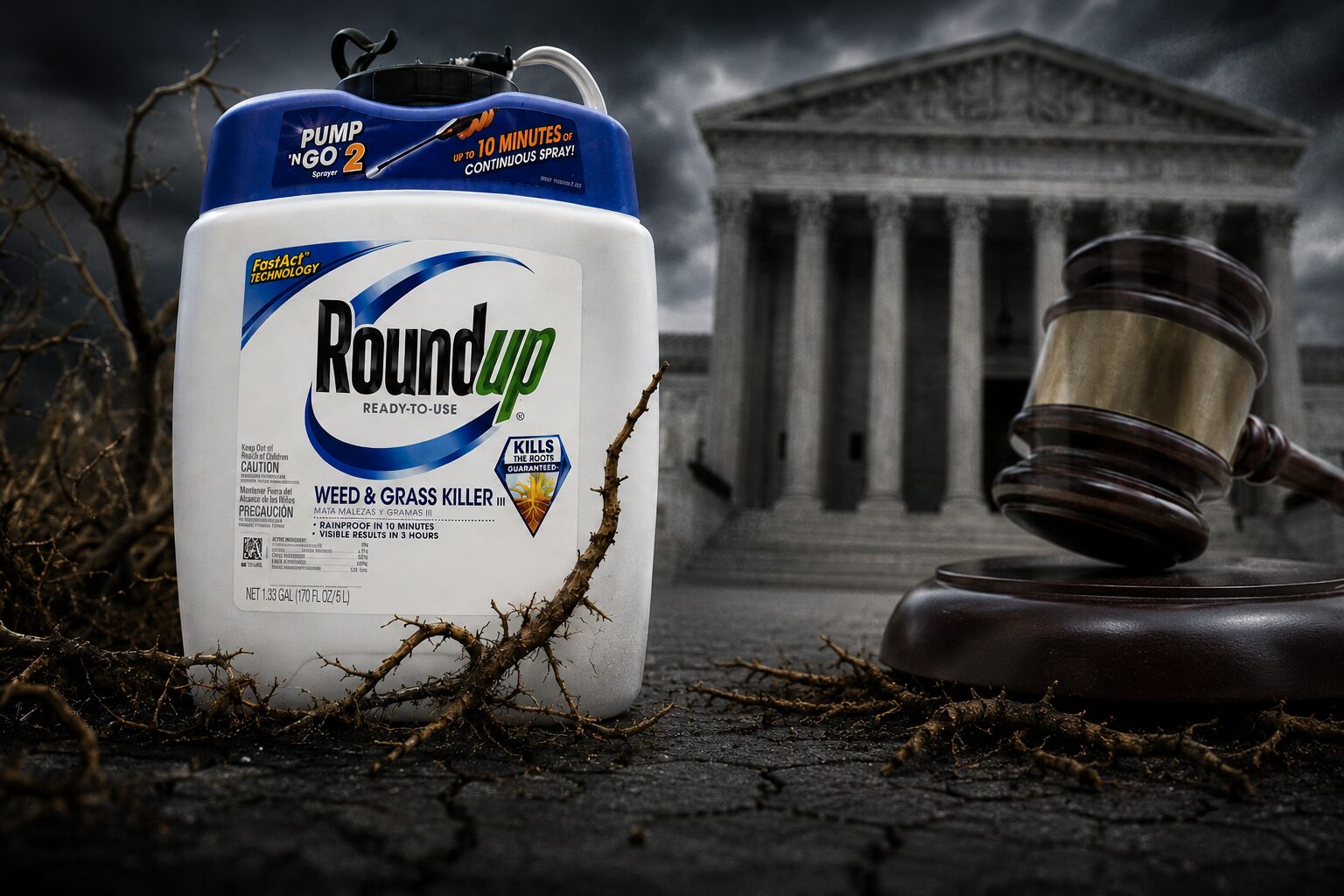
Over the past decade, over 100,000 people have sued Monsanto (a division of Bayer) for not warning on the label that its glyphosate-containing herbicide, Roundup, could be carcinogenic.
That stops now.
In a historic ruling issued on June 25, 2026, Monsanto v. Durnell, the US Supreme Court decided that the Environmental Protection Agency (EPA) has sole authority over pesticide labels. The court ruled that for either states or chemical manufacturers to deviate from the approved EPA label by adding a cancer warning is actually illegal.
“After EPA approves a pesticide’s label at registration, manufacturers are legally required to use that label—unless and until EPA approves or requires a label change and amends the pesticide’s registration,” the court ruled. “Absent such an EPA-approved or EPA-required label change, the pesticide manufacturers may—and indeed legally must—use the pesticide label approved by EPA at registration.”
The EPA’s website states, “There are no risks of concern to human health when glyphosate is used in accordance with its current label…Glyphosate is unlikely to be a human carcinogen…The benefits of glyphosate outweigh the potential ecological risks when glyphosate is used in accordance with labels.”

The EPA last reassessed the scientific literature on glyphosate toxicity in 2022. That assessment was based, in part, on an influential peer-reviewed scientific journal article from 2000 that was retracted last year when the publisher discovered that the paper had been ghostwritten by Monsanto employees. Considering that EPA administrator Lee Zeldin has been stacking the EPA’s Science Advisory Board with chemical company representatives, it seems unlikely that the agency will change its position on glyphosate’s carcinogenicity any time soon.
Bayer is celebrating the Supreme Court decision, hailing it as an important milestone in “the company’s multi-pronged containment strategy,” which also includes wrapping up the remaining lawsuits with a $7.25 billion “nationwide class settlement.” Bayer CEO Bill Anderson, who was “tasked with bringing a close to the protracted litigation that’s already cost the company more than $10 billion,” has “vowed to largely contain the situation by the end of 2026.” So far, he seems to be succeeding.
“Glyphosate-based herbicides are a foundation of modern, sustainable agriculture,” Bayer said in its June 25 press release. “Their safe and effective use supports food security, keeps production costs affordable, makes no-till, sustainable farm practices possible, and allows farmers to do more with less.”
“This is great news for all farmers in the country,” said Jed Bower, president of the National Corn Growers Association.
Many eco-farmers will disagree. It’s actually only great news for Bayer. But we need to remember that no court ruling or government regulation is forcing any farmer to use glyphosate or any other chemical. The best way forward is for eco-farmers to develop, demonstrate, and promote soil-building organic systems that work without glyphosate.
Bayer’s motto is “Health for all, Hunger for none.” It’s up to eco-ag to prove that we can reach that goal without glyphosate or any of Bayer’s other products.