
Replicating, not “mimicking,” the grazing patterns of wild ruminants
The one consistent claim of all forms of regenerative grazing is that they “mimic the grazing behavior of wild ruminants” such as bison, which created the grasslands of North America. Even the most rudimentary regenerative grazing program is probably better than set stock grazing, but we need to realize that while we can somewhat mimic natural grazing patterns, we have to be careful to balance the needs of the soil with the nutritional needs of our livestock.
Fluctuating Densities and Forage Selection
The goal of most regenerative programs is achieving enough herd density to maximize the benefits to soil fertility. While ultra-high densities occur in nature, they are by no means the normal situation.
Prior to the arrival of Europeans in North America, animals would concentrate during the breeding season into ultra-high densities for a month or so. Then the herds would break into family units (which would number in the thousands) and graze at a density reflecting the forage quality and density. Not having the luxury of hay or feed supplements, these animals were highly selective in their forage selection.
While we are used to our cattle chasing fresh, washy grass in the spring, wildlife are busy chasing the high-nutrition weeds, forbs, and buds of woody plants because they have the most nutrients. Herd densities ebb and flow with the concentration of the best feed available at the present moment. When the selected plants are scattered, herd density spreads out to match availability. If selected plants are numerous, herd density will increase to match plant density, resulting in ultra-high densities of 800,000 pounds an acre or more.
Unlike our fenced-in herds, that density generally won’t last on any one acre for more than an hour or so, because they graze through it, taking the top one-third to half of the plants while moving through the area. This means that equal herd densities of a wild herd grazing through, compared to a domestic herd being held for a half a day or more, will be different. The trampling of the wild herd grazing through will be less than the domestic herd, while leaving more solar panel behind for faster plant recovery and allowing for more plants not ready to be grazed to reach peak nutritional levels for subsequent herds.
Subsequent herds? We have been trained to think of areas being grazed once, then left alone to recover and rest for a year or more. The reality is that an area might be grazed several times a year, by different species, all selecting for different plants each grazing event. It is important to realize that all species changed their diet throughout the year to match their nutritional needs.
Instinctive Migratory Grazing
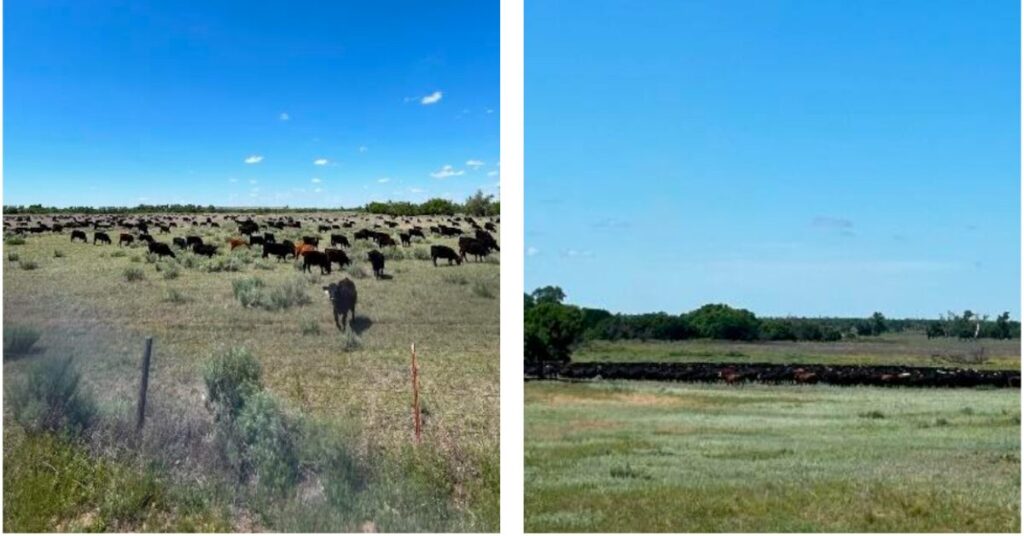
Instinctive Migratory Grazing (IMG) begins by rebooting the dormant herd instinct into livestock so that they graze in the same manner as bison herds used to — with strong emphasis on “used to.” Some believe that we need to increase bison numbers and turn them loose so they can build the prairies back. The problem is, after decades of being handled, or fed, by humans, they have lost their herd instinct, along with most of their grazing behaviors. Now, when left to their own devices, their grazing behavior is much like that of set-stock cattle. However, it is possible to turn that around — as Pedro Calderon is doing with the American Prairie bison herd in Montana.
When we look at large herds of wild ruminants grazing, they tend to face the same general direction as they graze, not staying in one place, but slowly, and constantly, moving forward as they graze. The speed in which they move forward as they graze, as well as their density, is constantly moving to fit the forage quality and density.
Periodically, especially in dense forage, the lead animal will pick up its head and walk forward, then begin grazing again. When this happens, the whole herd will move up, fitting between the lead animal and the last spot it was grazing.
There also appears to be silent communication within the whole herd. You see this happen when a single animal (which can even be the last animal in the herd) changes course to follow feed in a different direction. Within a couple of minutes, the whole herd will silently change direction to follow that animal to the new feed, once again adjusting their grazing density and speed to fit the context of forage density.
This is the behavior we want to duplicate in our domestic grazing animals. By using the right stockmanship techniques, and synchronizing the water and rumination schedules, we have successfully instilled this behavior in herds from as small as ten to more than five thousand.
Taking Advantage of Murmuration Instincts
Part of human nature is that when we’re immersed in something, we’re often unaware of how we’re doing things as we’re doing them. One of the joys of teaching is when students make observations that make me aware of things I may have missed. Josh and Gwen Hoy from the Flying W Ranch at Cedar Point, Kansas, cued me into both “proactive stockmanship” and the fact the stockmanship was inducing a murmuration effect in cattle.
Their observation was that most stockmanship, whether conventional or low stress, is based on pressure and release and is highly reactive. Something goes wrong and we hurry up to apply pressure where it is needed to achieve the effects we want. Things tend to fall apart when we create unintended pressure in one area of the herd while correcting the original mistake. While things tend to fall apart slower using low-stress methods, Josh started to question whether they are “low stress” or “slow stress.” He made the observation that our proactive stockmanship doesn’t require us to hurry to apply pressure, but to achieve the desired result by simply changing posture in relation to where we need to correct, without hurrying up to apply direct pressure.
The conversation then moved to a nature show they had watched on murmuration, which is when flocks of birds or schools of fish suddenly change direction. The program included satellite video of a million head of wildebeest changing direction simultaneously as the lead animal changed his direction.
As part of the learning process, I often have students ride directly in back of me so they can have a close-up view of what I’m doing rather than watching from a distance. Rather than approaching an animal, or animals, and pressuring them, I approach them from the direction I want them to go, and, using lateral motion, the animals will circle around and past me in the desired direction.
Gwen observed that a series of things happen when I do this, which I was blissfully unaware of. Oddly enough, after consciously thinking about it, I do basically the same thing when I’m working on foot:
- I drop my cow-side shoulder as I shift my weight in the saddle, which puts a slight curvature in my spine.
- As the horse adjusts to what I’m asking, its spine develops the same curvature.
- As I approach the “bubble,” or area of influence, of the cow, the same curvature appears in the cow’s spine as it begins to turn around.
- I hold the same relative position on the cow as she turns around, then straighten my horse (or my own posture) once the cow is headed in the desired direction.
Rather than using “low stress” pressure, we are basically removing direct pressure and replacing it with how cattle react to each other. Roughly 99 percent of everything we do elicits the reaction of cattle to go around and by us, or simply by us, in the direction we want them to go. These reactions are actually natural for cattle, and indeed all grazing animals, domestic and wild. Elk, antelope, deer, and (if you’re quick enough) even rabbits have the same reactions to this kind of stockmanship.
Moving to Align Rumination Schedules
Not all cattle are on the same water or rumination schedules. The rule of thumb is that cattle will generally graze for four hours, then ruminate for four hours. In order for a group of cattle to behave as a herd, they must have the rumination schedule synchronized.
To do this, we use the above stockmanship principles to gather the herd to water. Once cattle have watered, we hold them until they lie down and ruminate, making sure that no cattle leave the immediate area until 75 to 80 percent of the cattle are up and wanting to graze. We then start the cattle using the above principles, approaching them from the direction we want them to go, without applying direct pressure.
Depending on the specific context, we will keep moving forward to a prescribed spot, then ride in front of the herd so they are following us, then slow down until the herd is grazing, then leave. The next morning, rather than being scattered across the pasture, there will be four, sometimes five, distinct groups of cattle. Repeating the previous day’s procedure, we bring them to water, holding them until the whole herd is ready to graze before moving them to the next area to graze. Generally, when we show up on the fifth morning, all of the cattle are grazing as a herd, heading into water, and ruminating, then returning to graze as a herd.
I recommend checking on the herd two or three times a week for a couple of weeks. Making short moves within the pasture is enough to keep them rebooted and acting as a herd. After that, with the exception of extremely rough ground, they will stay together for weeks without falling apart, or re-grazing areas. In addition to grazing for nutrition, they tend to move further from water to ruminate and will ruminate in a slightly different area every day. This action will result in two areas per day of supercharged fertility, boosting mycorrhizal fungi, as well as leaving more ligneous plants behind acting as solar panels to speed up plant recovery.
The benefits go beyond simply replicating the grazing patterns of wild ruminants. It uses less labor to move the herd. The largest herd I’ve moved by myself out of a 3,000-acre pasture was over 5,000 head. When it is time to work them in the corrals, they go in willingly and are easy to sort, as they understand when to go past you; they will stop if you simply back up a step.
The result is cattle that graze as wild ones do, fitting the landscape in a way which fences cannot, while increasing animal performance through less stress. It makes working with your cattle a relaxing and rewarding experience.