A group of seven New England graziers tested virtual fencing — for now, at least, whether it’s a cheap investment or an expensive mistake depends on your circumstances
The promise of virtual fencing is compelling: GPS-enabled collars teach livestock to respect boundaries through audio warnings and, if necessary, an electric pulse. No posts, no wires, no branches shorting out your hot fence. You draw the paddock on your phone, and the animals stay in it. When it’s time to move them to new grass, you edit their paddock or draw a new one and “move” the collars.
This all sounds good, but it’s a major investment, so most farmers are still a bit skeptical. Small-scale farmers in particular doubt whether the technology is designed with them in mind. In New England, where the trials described below took place, there are a few other potential issues. Aside from small herds (the seven farmers in this trial ranged from 10-60 animal units), we have oddly shaped fields and topographies, spotty connectivity, and only six months of grazing to capture the potential benefits.
Momentum Ag coordinates farmer-led trials across the Northeast. We look at innovative techniques and technologies that have clear ecosystem benefits and ask farmers whether they are practical and profitable. In the case of virtual fencing, the benefits are pretty clear: more frequent rotations, longer rest periods, carbon sequestration, and the ability to exclude animals from waterways and environmentally sensitive areas. With a grant from the Massachusetts Society for Promoting Agriculture, we distributed one NoFence collar to each of seven grazers across Massachusetts. We chose NoFence because it uses cell service, not base stations, and they make both small ruminant and cow collars.
Each farmer tested the collar, walking paddock boundaries, playing with the app, and observing accuracy and battery life. We hosted webinars with farmers who currently use collars, and we met virtually as a group a few times. At the end of the season, each farmer sat for an extensive interview about whether this technology might fit their operation.
An important caveat up front: this was a one-collar per farm trial, meant to be a quick initial assessment. Most farmers didn’t want to commit the time to training animals before getting acquainted with the basics. Others don’t have the handling system in place to put collars on the whole herd or even a subgroup. So everything that follows comes with the understanding that a full herd deployment might reveal different dynamics.
However, all of the farmers told us the single collar was valuable. Some discovered collars would definitely work (or wouldn’t), and a couple were left with a clear set of questions to answer. We think the one-collar method is a cheap, easy, practical first step.
It’s also worth noting who signs up for a trial like this. Not surprisingly, these are farmers who are already rotationally grazing. That matters because a farmer going from continuous grazing to frequent rotations could expect to see significant gains in forage and carrying capacity that might justify the collar cost. But going from 24-hour moves to 12-hour moves isn’t likely to supercharge your carrying capacity.
What we found is that the collars’ value hinged almost entirely on a single question: Are you grazing your home farm, or are you expanding onto leased land?
What Everybody Agreed On
As a piece of hardware, everyone liked the collar itself well enough. This was true across beef, sheep and goats. One participant said the collars were a little “clunky” and would “feel dated in ten years” (fair enough) but that it still functioned. A few had concerns about the solar panel getting beaten up when animals stick their heads through feeder panels, but we weren’t able to test that. (We know some farmers are using collars for winter bale grazing, so we imagine it’s OK.)
Everyone found the app basically intuitive. Jo Douglas of Leaf to Beef on Martha’s Vineyard grazes about ten feeders entirely on leased land. She noted that the app had improved since the summer. There are frequent updates.
Battery feedback was more mixed. The batteries shipped with little to no charge. I was told they would charge up if left in the sun, but the time to charge varied collar to collar. Charlotte Senders runs the livestock operation at Hampshire College Farm, where she grazes about ten beef cows, and her collar spent weeks crawling from four to fourteen percent, whereas Wenona Racicot at Chockalog Farm (25 head) in Uxbridge, Massachusetts, said hers took just a few days. It seems like below a certain percentage, the solar panel has trouble and you should really use a charger. But once the collar is up above 20 percent or so, solar will maintain and increase the charge: Quentin Antes of Antes Farm (50 head) in Conway, Massuchesetts, has had a collar on a cow since July — seven months, including three months of low light — and it worked its way up to 90 percent. The point is, if you’re going to use these, start with a full charge and try to get them off the animal for a recharge before they drop below ~20 percent.
Connectivity was, surprisingly, a non-issue for most participants. There was one participant who really didn’t have enough bars to bother with the trial. But everyone else felt like even in poor coverage fields, new paddocks would eventually load. Plus, NoFence recently released HerdNet — if even one collar gets cell reception, it uses bluetooth to communicate the new paddock to all the other collars. Between that and new cell towers, we aren’t too worried about connectivity. Still, this is a great reason to start with one collar; without adequate service, you got nothing.
Virtual Collars on the Home Farm
Four of our seven participants graze on home farms with a perimeter fence. They move animals daily or every other day. For all four of them, collars didn’t pencil out.
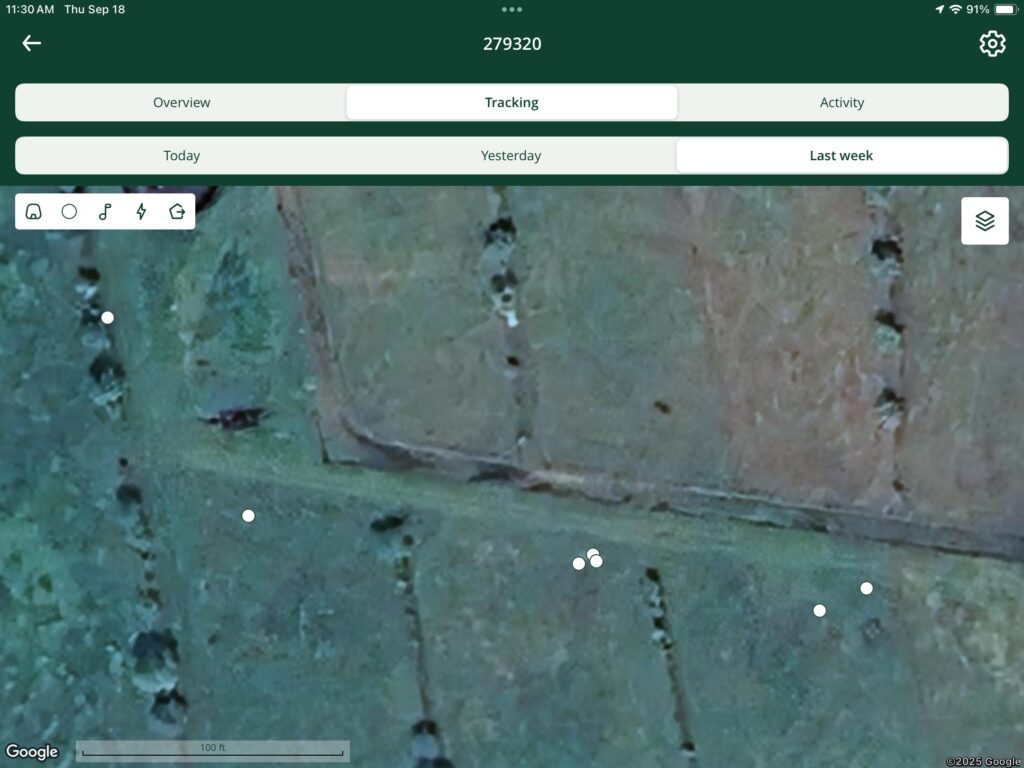
The first issue was paddock size. Most of these home-graziers are making one-third-acre breaks or smaller. For them, there are two separate accuracy questions. First, how closely does what you see on the app line up with reality? The answer was “pretty close,” but not close enough for small herds. In Figure 1, the collar was on a golf cart that was always on the road in the center of the picture, just north of the white location dots. I.e., it was consistently off by about 25 feet. We often saw the same issue when drawing the paddock — where you drew it on the app was up to 25 feet away from where you consistently heard a tone in the field.
Second, how consistent is the location of the virtual barrier from the perspective of the collar? We found that the barrier moved about ten feet in either direction as you approached it with the collar at different times.
Taken together, this meant that the collar might get a tone as much as 35 feet from where you intended. Whether this wander is trivial or meaningful depends on your farm.
I want to be clear: this is a remarkably capable technology. But it’s not RTK. For farmers with small pastures, small herds, and constraints right next door — roads, neighbors, a golf course — the ability to place the line exactly where you want it really matters. And even if you accept the offset, that ten feet of wander creates a problem in small paddocks.
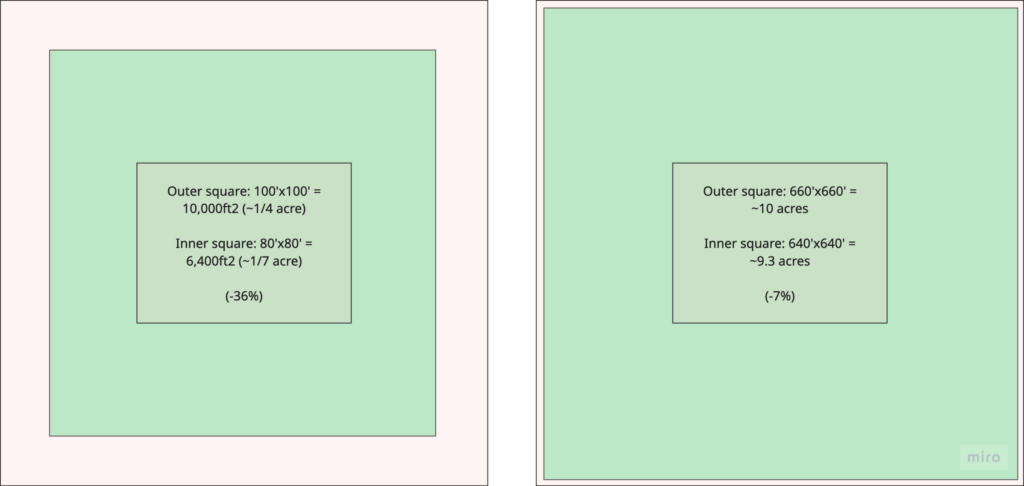
Imagine a quarter-acre break, roughly a hundred feet square. If the effective boundary shifts inward ten feet on all sides (very unlikely, but possible), you’ve lost over a third of the area, whereas in a ten-acre square, ten feet off the perimeter is barely noticeable. The ratio of edge to interior is just fundamentally different at small scales (see Figure 2). For three of the four home-farm graziers, switching to collars would actually require bigger paddocks than what they currently build.
A final note related to accuracy and paddock size: two farmers had the experience of approaching the virtual boundary with the collar and very suddenly hearing the tones go off rapidly and then delivering a shock. They were worried that an animal might be surprised and not have time to react before getting shocked. In larger paddocks with more interior space, this may not matter, but in a small paddock where ⅓ of the area is near the barrier, it might.
The second issue was labor. We anticipated huge labor savings, but that didn’t really play out for home-farm graziers. John Collector and Brooke Bullock graze beef and sheep at Stonebridge Farm in Chesterfield, Massachusetts. John estimated they’d save twenty minutes/day at most because they still have to move water regardless. Over a grazing season, that’s 60 hours. If they used those 60 hours to work an off-farm job at $35/hour, they’d break even on subscriptions and hardware depreciation for the 30 collars they currently need. (Collar plus battery: $250 depreciated over 10 years = $25/year. Subscription: $45/year. Total: $70/year*30 = $2,100.)
But, they’re actively growing their flock of St. Croix on the home farm; while each additional sheep adds almost no labor, it does require another collar and subscription.
For home-graziers who are doing the labor themselves, the savings is theoretical. But if you’re currently paying someone to move fence, or you would actually use those saved hours to generate income, then you can realize those savings.
The third issue was our little, strangely shaped New England fields. Most participants graze small fields that have one or more sensitive boundaries (roads and neighbors), and they feel they’d still need perimeter fencing. Once you’ve fenced the perimeter of a five-acre field, running polywire cross-fence is easy. So the collars are competing against a system that’s already pretty fast.
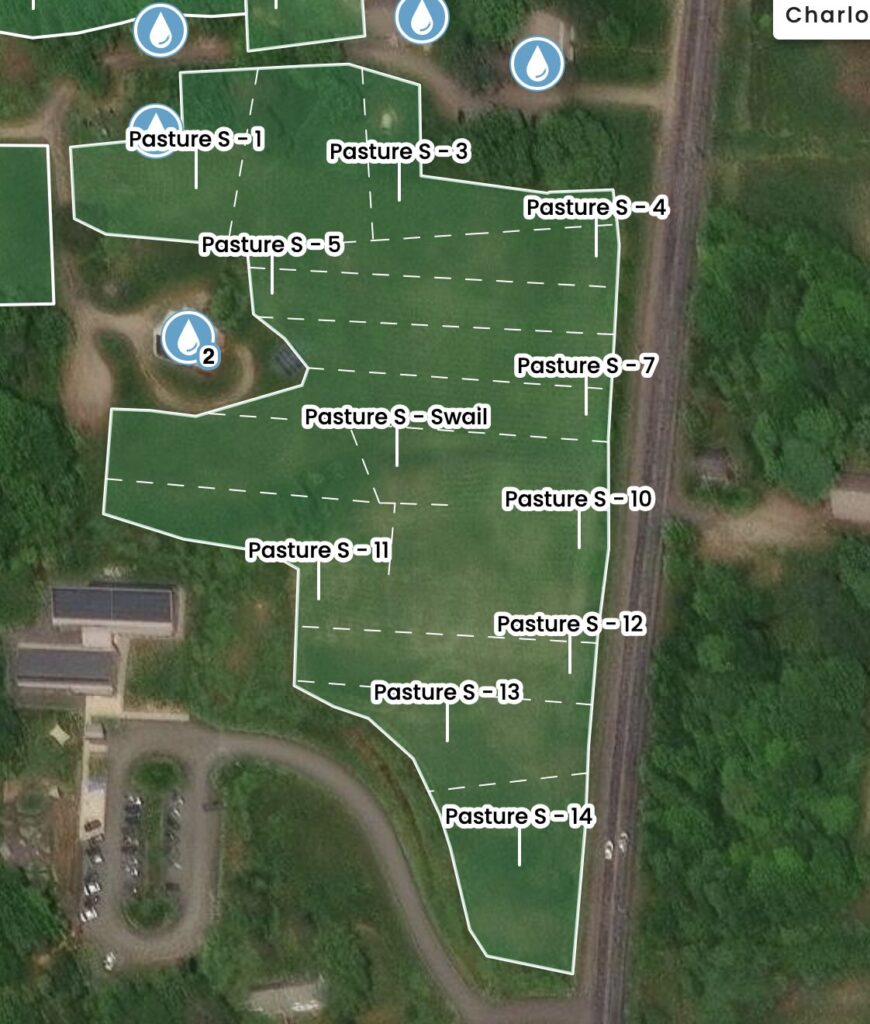
You also lose the corners and odd geometry. Lots of fields end in a triangular point or are narrow strips that the virtual boundary simply can’t use efficiently. Those awkward shapes can be a not-insignificant percentage of grazing land, and a real bummer to lose if you’ve been improving those spots. For lease grazers, losing a weird corner of a field is fine — you probably weren’t going to fence that ground anyway, and the technology is unlocking the central five acres you otherwise couldn’t have grazed at all. But Figure 3 shows a pasture map at Hampshire College Farm. Look at the S-14 triangle — it’s one-third acre with roads on two sides. If you want to use it — and she does — you’ve got to run a hot perimeter.
The fourth issue was the marginal increase in carrying capacity for farmers who are already rotationally grazing. For most home-farm graziers, the interest in collars was motivated by the desire to optimize grazing with more frequent moves and longer rests. But if you’re already doing a good job, the incremental increase in forage quality or carrying capacity is theoretical and hard to predict.
Bart Niswonger and Eliza Lake operate Kinne Brook Farm in Worthington, Massachusetts, where they run 45 grass-fed Highland cattle on 80 acres of pasture (some of which is also hayed). Bart estimates collar subscriptions and depreciation (on the steer, mom, and replacement calf) would eat ~20 percent of his per-animal profit. To breakeven would require the collars to increase carrying capacity by ~20 percent, or nine animals — “a really high bar for someone already moving every 48 hours.”
The more obvious way to increase carrying capacity with collars would be to add leased land, but Bart thinks the leases they have access to are about half as productive as their home farm, so 20 percent more forage would be 40 percent more acres — 32 more acres just to break even.
Virtual Collars on Leased Ground
Three participants are grazing leased land, and for them, the return on investment (ROI) was immediate, or nearly so.
Jo Douglas buys feeders in May, grazes them across as many as ten leased properties on Martha’s Vineyard for six months, and sends them to the processor in October. She doesn’t own an acre (because land on the Vineyard can run a million dollars per acre). She’s driving twenty-five minutes to reach many of her pastures.
For Jo, the collars definitely save labor. But more than that, they unlock an entirely different operational model. Instead of trailering animals between properties every few weeks, she can place a group sized to a property at the start of the season and graze them through. She can move paddocks from her phone instead of driving out to pull polywire. She can take on additional leases without worrying about fencing infrastructure on land she doesn’t own. If the collars allow her to add just one more steer, that more than covers subscription and depreciation for the other twelve animals. It helps that she gets feeders fairly cheap and sells beef on the island for a premium, but she’s also super light on capital.
Quentin Antes has 50 beef on 75 acres of home pasture with perimeter fencing, and he can lease at least 40 more acres of nearby, unfenced land, some of it wooded and none of it producing high-quality forage. “The collars are best for the expansion component,” he said. “Fencing through wooded areas on forty acres is otherwise unfeasible.” It doesn’t pay to install fencing on poor ground, but moving through quickly with collars keeps costs low, enables relatively high weight gains, and improves pasture over time.
A third participant outside the original cohort reinforced the pattern. Elspeth Robertson-Dubois at Finicky Farm runs about 45 goats and 250 sheep on contract grazing sites in three Massachusetts counties. She bought eight collars as a small trial and used them successfully on goats this season in difficult-to-fence gullies and steep terrain — the kind of conservation grazing that’ll drive you crazy with electric netting. She estimates the labor savings from virtual fencing across her dispersed sites would equal a full-time fencing position.
The common thread is simple: these farmers are doing something they couldn’t do without the technology. They’re not trying to shave twenty minutes off a daily routine that already works. They’re accessing land, eliminating drives, and scaling operations in situations where polywire doesn’t pay.
It’s also worth noting that our lease-based graziers were rotating less frequently than the home-farm group — as infrequently as twice a week, compared to daily or every-other-day at home. That makes sense because it’s harder to get there, but it also means the marginal benefit of more frequent moves is larger for lease grazers. They will likely see increased carrying capacity through daily moves and pasture improvement, but the collars will pay for themselves through labor savings, so that ends up being icing on the cake.
The Hidden Cost: Handling
Most of the beef farmers we worked with don’t have great handling infrastructure. They can get an animal into a pen for the vet, but they don’t have an efficient way to collar, adjust collars on growing animals, or swap batteries on the whole herd. (This is a problem for small ruminants too, but less so, of course.)
Quentin Antes has headlocks in the barn where he’ll collar animals before moving them to leases, and he already has a few headlocks in remote pastures for preg checks and could do more if necessary.
Another option is a self-locking feed wagon. Jo Douglas is planning to purchase one for around $7,000, but that’s almost double the cost of collars for her twelve beef ($300*12 = $3,600). And since she’s a nomadic grazer in a populated area, the wagon has to be road-legal, which means recurring costs for registration, insurance, and excise tax. With depreciation and maintenance, we estimated those costs at $500/year — nearly the same as eleven subscriptions at $45/year.
The farmers who dropped out early because of cell reception issues flagged handling right away. They have a barn with 30+ headgates, but with 100 head, moving the whole herd across a large property and then sorting and pushing them through could take an afternoon.
Like many problems, handling can be solved with money or time. Either way, it’s important to think it through.
Water Moves
You can move the fence on your phone, but you still have to move the water in real life. For home-farm grazers with daily breaks, water moves with the animals every single day to eliminate backgrazing and spread manure evenly. As several participants pointed out, the time spent moving water is often about half the total daily chore, and collars won’t change that.
There’s also an infrastructure question. Many of our participants protect their hoses, floats, and valves by running polywire over or around the water setup to keep cattle from stepping on hoses and fittings. Without that physical barrier, the watering system needs to be more bulletproof. Again, there are solutions out there, but it means rethinking a system that currently works.
Lease grazers generally handle water differently. Most backgraze: the water gets set up wherever it’s practical — near a hydrant, a well, or a truck-accessible spot — and the animals graze forward from there. It’s not the tightest grazing management, but it’s workable, and it’s the same system they’re currently using.
Who Should Be Looking at This?
If you’re expanding onto leased or unfenced land — especially remote properties where driving time and infrastructure costs are real barriers — this technology is probably ready for you now. The ROI was clear for our participants.
If you’re a home-farm rotational grazier with good perimeter fencing, a small herd, and paddocks under ~1/2 acre, the technology probably isn’t there yet. The boundary precision needs to tighten before it can match what you’re already doing with polywire. The labor savings are real but modest, and you’re unlikely to meaningfully increase carrying capacity through pasture improvement.
One scenario we didn’t test: a farmer going from continuous grazing or very infrequent moves to daily rotations could see real gains in forage and carrying capacity — perhaps enough to justify the cost.
This is a snapshot, not a verdict. We expect that our findings don’t match the experiences of some graziers out there, but we hope to give interested farmers a jumping off point to think about whether collars make sense for their farm. We believe virtual fencing is the future. But, at present, whether it’s a cheap investment or an expensive mistake depends on your circumstances.