
An experienced biological farmer’s plan to regenerate a leased farm
Transitioning is about changing to another way of farming. Transitioning is often associated with changing from conventional farming methods to organic, but it can also be about making other types of changes. The transitioning I’m talking about here is regenerating soils to higher levels of performance with fewer problems and more resilience.
We need to make changes to the way things are going in agriculture and how the land is treated. There’s no question modern-day farming has produced large piles of crops and large numbers of livestock — but at what cost? With what interventions? Modern farming is dependent upon manufactured fertilizers, applying chemicals to crops every year, and lots of drugs in the livestock. If we want to change this in order to stop the loss of topsoil and nutrients, and to restore our land to fertility and productivity, we need to restore soil health. But what is soil health? And what is soil regeneration?
A good definition of soil health is “having the capacity to function without intervention.” That means having productive soils without the need for all the modern agricultural chemicals. Regeneration, meanwhile, means rebuilding soils so they have beautiful soil structure, which results in good water infiltration; a loose, crumbly structure with plenty of homes for your soil life; and lots of organic matter that holds minerals in a carbon/biological cycle.
My family’s farm is organic, so synthetic chemical interventions aren’t an option, but we also don’t want to farm that way. We are convinced we can build soils; grow healthy, high-yielding crops; and have healthy livestock without all the interventions. Our goal is to have healthy, mineralized soils growing healthy, mineralized crops that can tolerate lots of weather extremes — which seem to be more the norm these days.
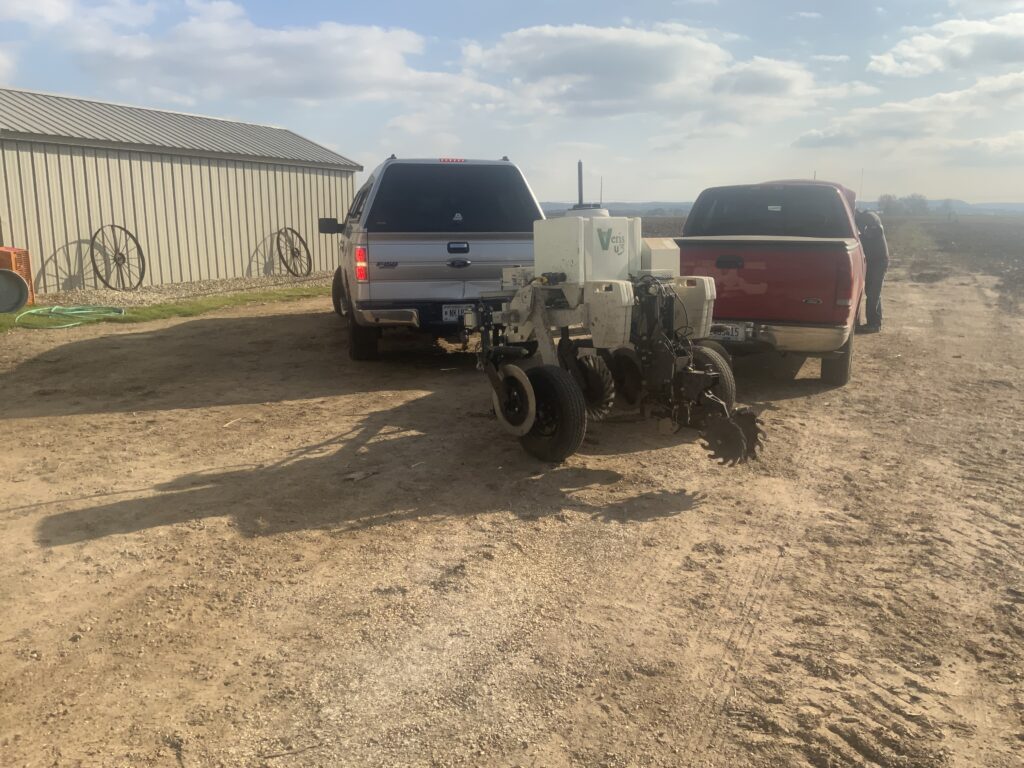
The New Land
I will go through an example of how we achieve this, based on a new piece of land we have just rented. It’s 180 acres with light soils and irrigation. It was farmed conventionally, growing corn on corn for the last nine years. The farm has had a lot of soluble fertilizer applied, especially nitrogen. The previous farmer used conventional tillage and would do a fall discing each year along with spring field prep. The farmer also used biotechnology and applied chemicals and water as needed. The crops didn’t look bad, even though they were essentially hydroponically grown, utilizing the top 4-6 inches of the soil as the medium.
Before we start working with the soil on new land, we take soil tests, learn as much of the land’s history as we can, and come up with a fertility plan. We like taking over conventional land from a farmer who applied a lot of fertilizer or manure. When a lot of inputs have been applied, we know that we have a reserve of P, K and other nutrients we can tap into. If the farmer didn’t use much fertilizer, there’s a lot more fixing to do and a lot more investment to make the soil productive.
You can see from the accompanying chart of soil test results that our fertility levels are pretty good. The pH is low, so fixing the soil here means applying lime, calcium and traces. Besides balancing minerals, we will also work on the soil’s physical structure and biology by growing cover crops, adding manure and compost, and deep ripping where the soil is compacted.
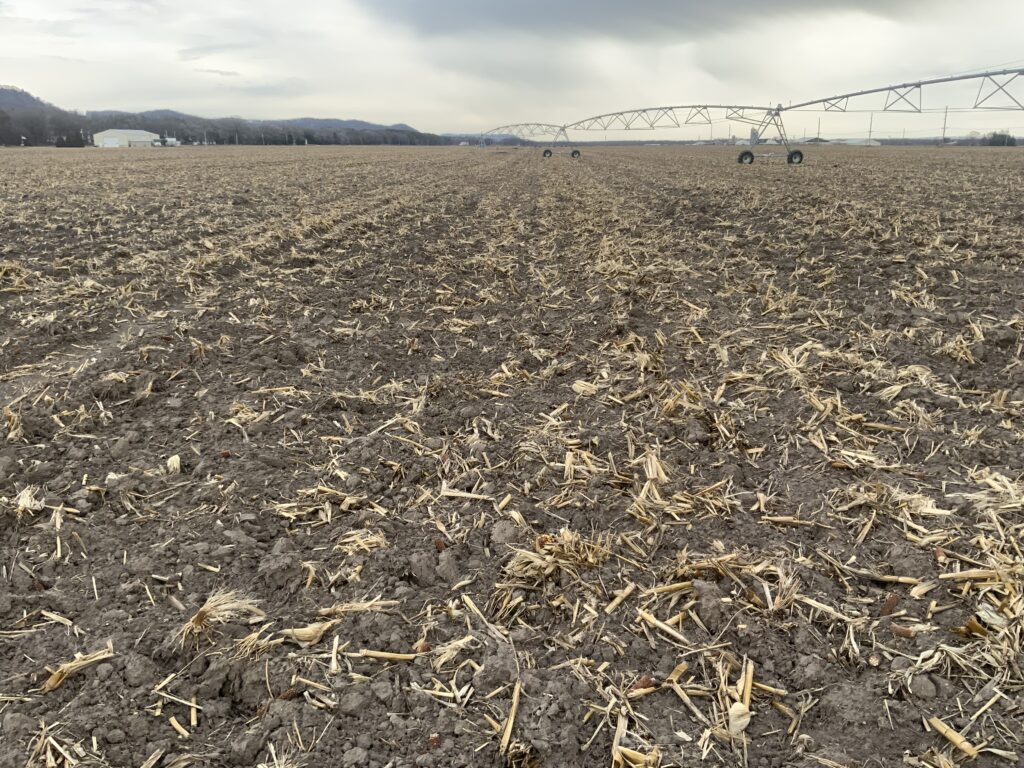
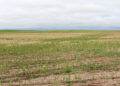
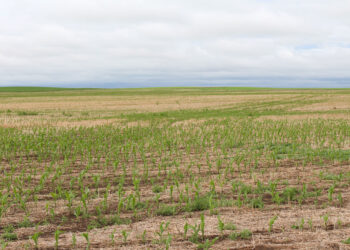
As you can see from the photo of the farm field, the land has level, black-looking sand. We always want a seven-year lease when we rent new land so that we have the first two years to spend fixing the land and the next five years farming it. The organic rules require 36 months during which no prohibited substances may be applied, which equals a summer and fall prep period and two growing seasons. When we take over the lease in the fall, by the following summer 12 months will have passed since the last time chemicals and conventional fertilizers were used.
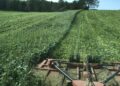
The previous farmer didn’t take soil samples, so there are no previous soil tests available. You can tell from just looking at the pictures of the field that the soil doesn’t appear to be in terrible shape — but you can’t tell what the mineral content is.
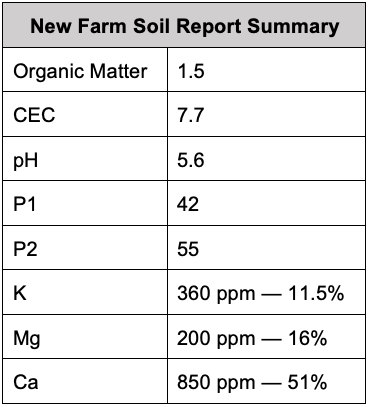
We test for four main reasons: First, what type of soil do we have? We know it’s sandy, but we need a starting point. Next, what are the cation exchange capacity (CEC) and organic matter (OM) numbers? CEC and OM are what they are. We can change them, but that is a longer-term project. Third, what is the pH? The pH level will tell us something about how the land was farmed — whether the farmer ever applied lime. And lastly, where are the P, K, Mg and other mineral levels? This gives us clues as to the fertilization history of the farm and lets us know what minerals need to be applied to address deficiencies and to balance the soil minerals.
We tested the farm using two different labs and methods. The first method was grid sampling (64 samples over the 180 acres). These tests also included a biological test and a carbon measurement of both stable and soluble carbon. The purpose of these tests was to get a base point for monitoring the field over time as we make changes.
The second testing method was using a Veris machine. This measures conductivity in the soil and should pick out differences in soil type. The Veris test gave us 15 soil tests and just looks at major minerals — a good starting point. Both tests also measured pH.
These tests are important for giving us a baseline of soil nutrient content and production potential, and they let us know where to start fixing minerals. Measuring soil health and testing plants will come later, when we know we’re on the road to fixing minerals and want more clues about the soil and plant health.
Whichever lab you use for analyzing your soil samples, remember that a soil test is about adding the elements that are low and not adding more of the elements the soil already has enough of. We re-mineralize and fix soils and expect them to provide the fertility for the crops we want to grow. We are not plant manipulators.
Balancing the Soil
The first thing we noticed about the soil tests was that the farm has a very low pH. Why are these fields so acidic? This soil is sandy and has had heavy applications of nitrogen and acidic fertilizers. That combination will lead to lower and lower pH over time. When you see a pH below 6.2 on a soil test, you need to take the rest of the test with a grain of salt. That’s because low pH influences nutrient availability, and as pH increases, your nutrient levels for some elements — particularly phosphorus — will change. This isn’t because mineral levels changed, but because the test on a low-pH soil isn’t entirely accurate.
The next thing we looked at was calcium. The base saturation of calcium is only 51 percent, which is low. There can be a couple of reasons for this. First, I’m sure lots of potassium chloride (KCl)was used. This is a very soluble mineral and will form calcium chloride in the soil and leach calcium. In addition, we know high levels of soluble nitrogen were applied, and over time that will acidify soils. Second, this soil has probably never had lime. The good news is that liming will address both the low pH and low calcium levels.
I usually recommend calcitic lime (calcium carbonate) in southern Wisconsin because the soils are usually very high in magnesium. However, on this farm, magnesium levels are also low, so we can add the local dolomitic lime (calcium magnesium carbonate) and not have to worry about applying excess magnesium. Applying the local dolomitic lime will be a very inexpensive way to address the pH problem and is cheaper than other fertilizers. The soil is so low in calcium and magnesium that some areas of this farm will require 1 to 1.5 tons of dolomite lime, then additional high-calcium lime — another ton to start with. I would rather use small amounts over a couple of years, then take soil tests again in three years to check our progress and adjust as needed.
So, we have a starting point and a plan. The next thing to look at on the test is the P and K. These, for the most part, are high — especially the K. I usually look for a base saturation of 3-5 percent and at least 125 ppm, and this soil is at 11.5 percent base saturation and 360 ppm. This is great for us, as low K levels are expensive and require time to fix, especially when using only organic inputs.
Remember, the previous farmer was a good conventional farmer, which means he used enough fertilizer but was weak on the liming and on feeding soil biology — that’s why he grew corn and not soybeans, as soybeans are a biological crop and require a higher-pH soil. As we fix the soils, we know there is a good reserve of both P and K to tap into. We shouldn’t deplete these levels as we farm this land, since we apply minerals every year and our farming system only removes grain and not a lot of minerals.
The last thing we need to address is sulfur and trace minerals. Sulfur and boron are both anions, which means they leach and don’t build up in the soil over time. We will apply those annually to make sure our plants are never deficient. We will also apply a trace mineral blend to start out with, as trace minerals haven’t been used on this farm in the past and levels are low.
Addressing Biology and Physics
What we need to fix besides the minerals is the biology and soil structure. We’ll start this coming spring by planting an oat crop, under-seeded with clover. The oats will either be harvested for grain (if we find a market for it, offsetting some of our costs) or mowed down for soil building. The straw stays, as does the clover grown under it.
Once this is done it will be August, and we will apply lime, run our in-line ripper 12-15 inches deep, and apply manures and/or compost (we have a beef herd, plus there is poultry manure available in our area). Sulfur, boron and other traces will be added as needed. By October the clover should be knee high, and we will lightly work it into the soil with our vertical tillage machine and plant cereal rye. We are developing rye markets for seed, feed, food and distilling, and the plan is to harvest the rye seed the next July.
The following spring we will frost-seed a four-way clover-alfalfa mix over the top of the rye. We harvest the rye when it’s ready, then clip the clover-alfalfa mix and add more compost or manure and minerals as needed. That fall we will clip again, leaving all the clover and straw material on the soil.
The following May, when the clover-alfalfa crop is about a foot tall, we will shallow incorporate it. The legume mix is very succulent at this point, and it is very digestible. It’s bacteria food with lots of soluble nutrients — perfect for feeding a grass crop like corn. The rye and legume blend allows us to grow and incorporate lots of biomass and to put many minerals in the carbon/biological cycle. With all the legumes grown, we measure over 300 units of N put back in the soil. After taking down the young spring cover crop, we plant corn.
This process takes us through the transitional period, and when the corn is harvested in the fall it will be our first organic crop. During transition we will have put on a lot of minerals, balanced the soil pH with lime, and built biomass and soil health with the different cover crops we’ve planted.
Our rotation has now been started: one year of rye soil-building, one year corn. The soil will be regenerated over time, our inputs stay low, our need for nitrogen is very low and we’ll get what we need from the clover, chicken manure and compost. By clipping cover crops every year, very few weeds will go to seed, and the soil structure keeps improving. The only input beside seeds and some trace elements is the compost/manure with added sulfur and boron.
Soil health and organic matter will be improved by adding cover crops, compost/manure, ripping for water infiltration and aeration, and keeping roots growing in the soil on the rye year. That’s why the rye crop is so valuable in the rotation: the rye is one year of less tillage, good weed control and adding carbon to the soil.
With this rotation we will be able to regenerate this land — transitioning it both to organic farming and to greater soil health and resiliency.
Gary Zimmer is the co-owner of Otter Creek Organic Farm in southcentral Wisconsin and the founder of Midwestern BioAg. He is the author, with his daughter, Leilani, of The Biological Farmer and Advancing Biological Farming. He has attended every Acres U.S.A. conference for the past 40 years and has been a presenter for the past 30.
Are you working to transition some (or all) of your land to regenerative?
Share your experiences with the Acres U.S.A. community by telling us about it via email, social media, or mail. We would love to hear how you’re transitioning your land and what you’ve learned along the way.
Email: editor@acresusa.com
Social Media: Facebook,
Instagram,
Twitter,
LinkedIn
Mail: P.O. Box 1690, Greeley, CO 80632
Sign up for our newsletters at ecofarmingdaily.com to learn lots more about the transition process!
Find Fellow Growers in Your Area
One of the most important things for beginning and continuing the transition to regenerative agriculture is finding fellow growers, farmers, or ranchers in your area who are already doing it. A good resource to begin this search is the Regenerative Farm Map from Regeneration International.
Email: editor@acresusa.com
Social Media: Facebook,
Instagram,
Twitter,
LinkedIn
Mail: P.O. Box 1690, Greeley, CO 80632
Sign up for our newsletters at ecofarmingdaily.com to learn lots more about the transition process!