

How to help growers transition acreage to agroforestry
How can we fund regenerative agroforestry?
Agroforestry is the intentional integration of trees and farming. It produces on-farm income and ecological benefit, without much compromise between the two. Practices range from multi-species orchards to windbreaks, silvopasture, alley cropping, forest farming, and multi-strata agroforestry. A constellation of private businesses, non-profits, and the USDA have set out to accelerate agroforestry. They’re seeking to answer questions like, How can agroforestry become fundamentally accessible to farms and financial institutions? How can trees re-enter the current working iteration of agriculture in the United States? How can we establish agroforestry as a cornerstone of agriculture? If farming is land stewardship, to what end are we stewarding our landscapes? What is our collective holistic context?
Right before our eyes is an incredible opportunity to create functional landscapes that yield clean and stable watersheds, biodiversity, carbon drawdown, and — at the same time — meaningful work, thriving rural economies and the ability of a household to thrive.
Traditional agricultural lending doesn’t always align with the timeframe required to realize the benefits of regenerative agroforestry, though. Here’s the business case for agroforestry and how we can collectively fund ecologically sound farms that create shared value.
Agroforestry Planning Solutions
Regenerative agriculture and agroforestry create their own positive feedback loops. While the definition of “regenerative agriculture” is as diverse as the farmers that employ it, its common themes involve a marked increase in both profit and ecosystem services over time, along with a healthy allocation of that value throughout the associated human communities.
We must then ask the question, to what extent is an agroforestry system regenerative? And who is it benefitting? The answer lies in understanding the economic value: costs, revenues, net income, yield, labor and infrastructure — along with the ecosystem services created: water filtration, biodiversity, flood control, stream perennialization and more. Carbon storage is often a good proxy for these benefits and is generally straightforward to measure when it is visible in aboveground woody plants. Agroforestry is at least often regenerative, if not inherently so. Understanding the economic benefits opens our doors to funding, and understanding the ecosystem benefits opens the doors to society. We must quantify both as best we can.
| Scalable Agroforestry Systems Chestnut-Hay Alley Cropping: Chestnuts are a high-value perennial starch. This system is best for well-drained acidic soils. Management is more intensive than a timber crop but less intensive than a fruit crop. Black Locust Silvopasture: Black locust is a fast-growing hardwood that yields rot-resistant timber. This system does best in moderately drained, slightly alkaline soils. Management is less intensive than a nut crop. Hybrid Poplar Riparian Buffers: Hybrid poplar is a fast-growing timber species. This system will see higher growth rates in moderately drained soils, but it tolerates poorly drained soils and a wide pH range. Management is minimal, but returns are also below market rate. Silver Maple Sugarbush: Silver maple can be tapped for sap, which is used to make syrup. This system is specific to sites with at least a 3 percent slope, and trees will tolerate seasonal flooding and saturation. Silver maple amounts to a conservation planting that will add taps to an existing sugaring operation. Hickory Nut Conservation. Bitternut hickory produces nuts that can be pressed for oil. The species tolerates heavier soils and mild saturation. Quick-Return Agroforestry Systems Elderberry with alley-cropped vegetables or silvopastured poultry. Elderberry thrives in fertile, well-drained soil and can tolerate seasonal flooding, but it dies in hydric conditions. Juicing is recommended, and value-adding increases returns. Blackcurrant is a deer-resistant shrub fruit that livestock generally avoid. It can be harvested by hand or by machine and tolerates seasonal flooding, although it needs weed-free soil at establishment. Willow coppices provide woody florals for the flower farmer and one-year cuttings for the basket maker. Willow tolerates a wide range of pH, along with wet feet, but growth will stagnate under grass competition. |
Business planning is imperative in agroforestry. We can quantify the benefits and map out the implementation of a tree-centric farm. Fortunately, doing so is now faster than it used to be. Until recently, agroforestry planning almost exclusively centered on conservation. A trained analyst could quantify the economic value of tree systems with GIS and spreadsheets. It would take 40-80 hours to plan a farm. The process was time-intensive and inaccessible to most.
Through a combination of venture capital and grant funding, though, geospatial agroforestry software is now available to help farmers do this. Maps are the input, and 30-year financial projections are the product. A user can log in and access a variety of templatized crops or can create their own adventure. Crop options include cold-climate products such as chestnuts, black locust timber and mechanically harvestable shrub fruit, as well as tropical species. Financial projections enable project development. In the same way that an architect creates a house’s to-code blueprint for a building contractor and a bank, the farmer can now plan a long-term tree-crop enterprise, be that an orchard, silvopasture, windbreaks or multi-strata agroforestry.
Agroforestry Contracting
Agroforestry contractors are helping move the industry forward. In the same way that irrigation and fencing contractors offer their services, these private and public TSPs (technical service providers) utilize their experience to reduce risk. There is a remarkable business opportunity for resourceful farmers to plant trees on their own land and on neighboring parcels. Planting trees the right way, the first time, ensures smooth operational success over the long haul — and that often means contracting work out.
Good site preparation is imperative when planting trees. Adequate soil structure and biology will accelerate growth rates enough to compensate for waiting an additional year before planting. Cover cropping with summer annuals, for instance, will increase permeability via root action. Leaving a mowed cover crop on the soil surface will increase water retention. Inoculating that carbon, living and dead, with indigenous microorganisms, moves dead subsoil toward chocolate-cake topsoil. Chestnuts, for instance, are mulched with woodchips and tree-tubed for deer protection.
The capital required for a large-scale agroforestry planting is substantial, and trees pay back over a long time period. At-scale projects are accessible to NGOs, brands and individuals with the ability to fund large tree systems. As agroforestry matures to the point of trees being standard farm infrastructure, though, capital will become more available to a wider range of farmers and landowners. This is admittedly a chicken-egg scenario: the desired proof of concept is in tension with the needed startup capital; this has spurred action by both the private sector and USDA.
Agroforestry Financing
For the past 20 years, while interest in agroforestry has generally been high, the rate of adoption hasn’t been anything to shake a stick at. Given that agroforestry produces both market goods and pollution-reduction benefits, we encounter the perennial question of how trees should be funded. When farmers make it clear that ecology is important, the public sector will respond (this is happening in real time). In this regard, the private sector can take decisive action on profitable tree systems in the near term.
A new program called Agroforestry Partners is pioneering equity financing of agroforestry systems. Equity financing allows an investor to purchase shares of an enterprise — in this case, tree assets — and expect a return, either via selling their shares at a later date, a percentage of revenue generated, or something akin to a dividend. Agroforestry Partners raises funds to deploy directly into tree assets, with a long-term lease on the land underneath. The business engages with high-quality, vetted, low-risk land partners.
The idea is to establish trees as a bankable asset, with both equity and debt options. Over the next five years, the industry should get to the point where a qualified farmer can apply for a tree mortgage the same way they would for an equipment or building loan. The objective is to de-risk agroforestry for traditional agricultural lenders and to drastically increase the rate of adoption. It is much easier for USDA to subsidize a practice that farmers are actually doing.
In October of 2022, U.S. agroforestry was awarded a grant of $60 million. Led by the Nature Conservancy and Propagate Ag, the Expanding Agroforestry Production & Markets for Producer Profitability and Climate Stabilization project is funded through the USDA’s Partnerships for Climate-Smart Commodities initiative. This is a sweeping subsidy for the planning, installation and success of useful trees across the eastern United States, Midwest and Hawaii. Direct-to-farmer incentive payments come in at $36 million. CSC is explicitly designed to catalyze further investment into agroforestry, while increasing on-farm income and providing ecosystem services. 30,000 acres of new agroforestry plantings should spur hundreds of thousands more.
It is safe to say that USDA views agroforestry as both a leverage point in quality of life across rural America and as a climate solution — and it is seeking to prove the science accordingly. Lastly, the program is designed to be highly collaborative: between businesses, academic institutions and nonprofit organizations, we’re looking at a constellation of capacity, desire and action.
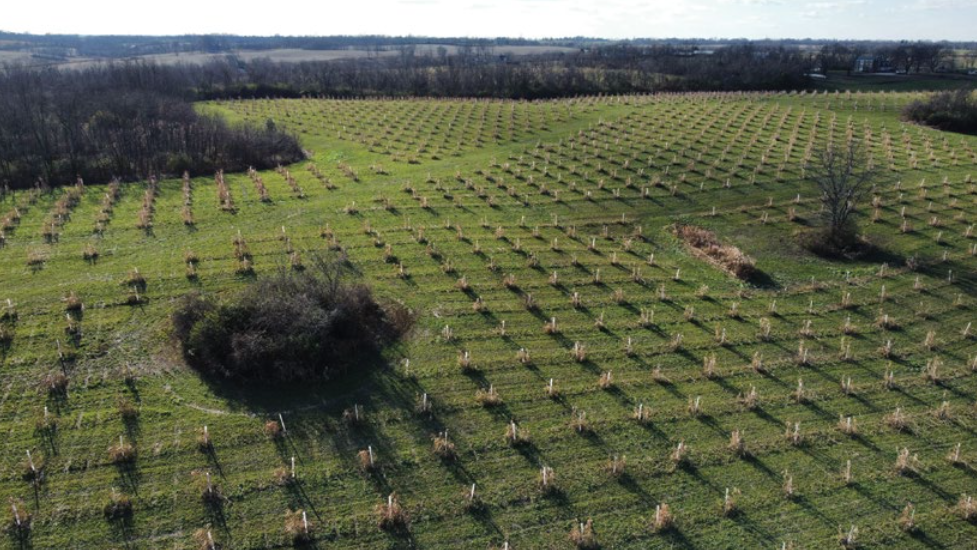
| On Chestnuts Chestnuts are a perennial starch that have accompanied human civilization for thousands of years. With the functional extinction of the American chestnut, there is a dearth of supply, though “chestnuts roasting over an open fire” remains ingrained in our collective memory. Roasted chestnuts taste like a baked green plantain with a hint of maple. Growing practices are inherently regenerative: the trees draw down vast amounts of carbon, sequester value in rural communities and benefit from mycorrhizal networks and living soil biology. One acre of chestnuts produces about 2.5 million calories at maturity, which, for reference, is enough to feed three people all of their daily calories for one year. Cattle and other livestock can be integrated into the understory of a chestnut system, and if managed correctly, this silvopasture will augment tree health, will comply with food safety regulations, and might yield an additional 200,000 calories per acre in meat and fat. Chestnut site selection is vital for success. Chestnuts do best on deep, well-drained acidic soils that are not susceptible to flooding or prolonged saturation. Castanea mollissima is hardy to USDA zone 5, but yields will be greater with a warm April and May. Even if the minimum annual temperature isn’t very low, a long growing season is important. For instance, Montreal and Bar Harbor, Maine, are both in zone 5, moderated by the St. Lawrence Seaway and the Atlantic Ocean, but May in Maine is cold and rainy, and thus chestnuts are not a good fit there. South of 43 degrees latitude is usually a good cutoff, and below 1,000 feet of elevation for northern sites is usually a safe bet. Chestnuts can be harvested by hand or machine. Farms with strong social infrastructure will find hand labor more accessible, and mechanization is a good fit for more remote farms. Chestnuts take one to two minutes per pound to harvest by hand, 30 seconds per pound to harvest with a ground-driven push-harvester, one to three seconds per pound with a sweeper harvester, and two to nine seconds per pound with a vacuum harvester. Farms larger than 10 acres should consider mechanical harvesting, depending on their access to capital and broader financial context. Costs of installation, revenue and returns will vary. Bare-minimum installation costs across years one and two come in at $2,700-4,000 per acre, inclusive of labor. Revenue at maturity ranges between $13,000 and $26,000 per acre. Those interested can swiftly progress from back-of-the-napkin calculations to creating a malleable financial model in Propagate Ag’s Overyield software. |
How Farmers Can Plug In
There are numerous ways to get involved with agroforestry, from planting trees to launching a career as an agroforestry contractor. For more information and resources, those interested should reach out to Climate Smart Commodities regional partners: Tuskegee University in the Southeast, University of Missouri in the Southern Midwest, Savanna Institute in the Northern Midwest, University of Virginia in the Mid-Atlantic, Propagate Ag in the Northeast, and the Hawaii Ulu Cooperative in Hawaii.
The United States needs agroforestry contractors. From machinists to foresters to lifelong farmers, there are great careers open to those with interest and talent in working with trees. And there’s always room to start or expand a tree nursery, focusing on in-demand stock.
Lastly, don’t be afraid to plant a few trees. Or a few thousand!
Harry Green is the chief research officer at Propagate Ag, a software, development and financing company that makes it easy for farms to transition acreage to agroforestry (propagateag.com).