
Biological seed treatment provides the highest ROI of any amendment — and it can be created on-farm
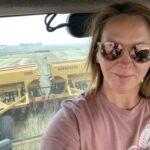
I constitute 50 percent of the aboveground workforce on my family’s no-till farm. My husband, Kelly, is the other half, and all of the other essential workers exist below our feet or roam freely in nature.

We raise small grains and a family on 2,800 acres in central North Dakota. Our journey into regenerative farming is a tale of transformation. Prior to 2013 we farmed 7,500 acres using high-input no-till methods. But we decided to redefine our approach. Shedding the shackles of synthetic fertilizers, insecticides, seed treatments and fungicides, we embarked on a mission to let the land breathe. In our bid to minimize disruption, we opted for limited, targeted herbicide over traditional tillage passes, in order to suppress weeds early in the growing season and give our crops the opportunity to canopy. It’s a gamble — a dance with nature — in which herbicides are seen as a lesser evil, keeping the soil life intact.
In a biologically active soil system, the tiny heroes — the soil microbiome — play a crucial role. The massive army of soil biology on our farm acts as a natural clean-up crew, metabolizing herbicides, breaking them down, and sometimes even feasting on them. This is a far cry from the environmental toll of herbicides on lifeless dirt that washes downstream. For us, it’s not just about farming; it’s a holistic approach where human health, animal health and planet health are all tethered to soil health.
We believe that much of the credit for forming this active microbial ecosystem is due to our introduction of native indigenous microorganisms — IMOs — into our cropping system — specifically in applying IMOs to our seeds prior to planting. It has been a gamechanger for us.
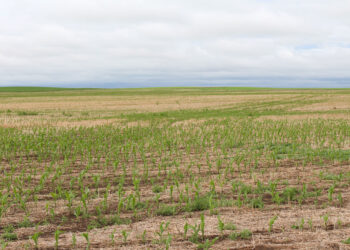
In 2019, our farm embarked on a daring experiment: going completely fertilizer free on every inch of our cropland. It was a bold move, and as we stood on the precipice of a nutrient-free frontier, we stumbled upon the captivating concept of the rhizophagy cycle, thanks to the groundbreaking studies by Dr. James White and his team at Rutgers University. This mind-bending cycle explained the miracle happening beneath the soil, revealing that our thriving crops were engaging in a sophisticated dance with the earth.
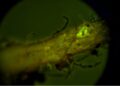
Picture this: plant roots delicately sipping on entire cells from the soil, extracting the precious nutrients and then graciously returning them to the earth. It was a botanical ballet, a symphony of symbiosis. Imagine our amazement when this intricate dance confirmed what we had been witnessing in our fields. Timing, as they say, is everything, and this scientific revelation was the missing piece in our transition. Our crops flourished — healthy, resilient and abundant—without the addition of N, P, K, S or Zn.
Our five-year odyssey to purge synthetic fertilizers from our system had reached its end, and we stood at the crossroads of a revelation: the real key to vibrant plants, impervious to pests and disease, was not in a chemical formula but in the bustling world of soil biology. Not just any biology, mind you, but a diverse community of yeast, bacteria, fungi and algae, all living in harmony beneath the surface.
Now the question became: where could we find this lively coalition? The obvious candidates — compost and the Johnson-Su bioreactor — seemed promising but came with their own set of challenges. Composting required a Ph.D. level of knowledge, and the bioreactor demanded a level of patience neither I nor the North Dakota weather were willing to provide.
In the face of these dilemmas, the seemingly mundane “bug in a jug” — purchased microbial amendments — seemed like our only lifeline. Yet Kelly refused to surrender to the over-the-counter prescription of biology. Instead, he embarked on a journey to connect the dots between Korean Natural Farming, bio-complete compost, and the indigenous systems thriving around our croplands. Kelly, being the observant genius he is, studied our native areas. What he found was a utopia — no diseases, no pest invasions, just thriving wildlife and a microscopic orchestra of fungi, algae, lichens, bacteria and yeast, all harmonizing in perfect balance. Nature, it seemed, held the secret to abundance.
Armed with this realization, Kelly posed a critical question to himself: “How can we import this native harmony back into our cropping system?” The answer manifested itself in the form of an indigenous microorganism solution. Kelly devised a simple yet ingenious method of borrowing indigenous microorganisms from our native areas, nurturing them, brewing them into an aerated concoction, and unleashing this biological powerhouse onto our seeds. The process uses nothing more than supplies from the local hardware store. It was a marriage of ancient wisdom and modern innovation — a nod to nature’s intricate dance that now resonates in every green shoot that graces our farm. We borrow an army of microbes, fungi and yeast from our native areas, multiply them in an aerated brewing step, and then unleash this powerhouse onto our seeds.
Why is bio-priming seed the best way to use this incredible IMO product? Per John Kempf in a Future of Agriculture podcast interview, “The single greatest ROI application, consistently, is a well-designed seed treatment. It is inexpensive, low cost per acre, and delivers over and over and over again.” Biological seed treatments are the unsung hero, the MVP, of the farming world, delivering bang for your buck every spring.
And what could be more well-designed than biology borrowed from a native, thriving soil system? Creating your own IMOs is a doable reality. You can learn the ropes, build your own brewer, and create your own biological amendment for $1 per acre over 1,000 acres. We’ve seen the results firsthand — a thriving biological soil system that’s not just the backbone of our farm but a testament to what’s possible.
To make the IMO solution, we “borrow” a few pounds of native microbes from healthy places on our farm. Then we feed it beta glucan and oats from our farm — the oats help with the fungal growth, and the immune builders in the beta glucan are beneficial for the soil microbiome. We feed it for ten days, and then I brew it for 24 hours.
We use an auger to apply the homemade IMO to the seed. The solution is infused through a hose, and it mixes all the way up the auger. The seed can be a little bit wet, as long as it’s not enough to germinate the seed; keeping the seed in the dark after application is important. The microbial communities form a biofilm and encapsulate the seed. When we put them in the ground, when the seed germinates, it has all that microbial life on the seed surface, ready to go to work for it.
We’re not just talking about healthier crops; we’re talking ecosystems, animal health, plant vigor, and the very essence of human well-being. It’s the kind of revolution that starts in the soil but has ripples that touch every aspect of our farms and communities.
We should not underestimate the importance of being self-sufficient on our farms. Now, I’m not saying we should be hermits, barricading ourselves from the world. But here’s the lowdown: when we open the floodgates to too many outside “experts,” it’s like handing over the reins of our farms to folks who are just pushing the next silver bullet. We can’t be rolling the dice on our livelihoods. We need to be the true-blue experts in our own fields, grounded in our observations and intuition.
We’re not in this alone. Learning from others and having mentors is the farmer’s version of a secret handshake. It’s golden. Yet, regenerative practices and tips from trusted advisors can’t be the end of the road. We need a commitment that runs deep.
Picking up regenerative practices and soaking in wisdom from our savvy advisors is like planting the seeds of change. But that’s just the warm-up; once we’ve taken the plunge, there’s no going back to the old playbook. It’s not like upgrading from dial-up to broadband; it’s a quantum leap — a renaissance of ideas, methods, practices and even our spirits. The old “way we always did things” becomes ancient history.

Let’s dream big. When farmers worldwide jump on this journey to regenerate our soils, we’re not just talking about crops; we’re talking about flourishing ecosystems and thriving communities.
Did you enjoy this article AND the interview with Rick Clark? Listen to Rick interview DeAnna on his Farm Green Podcast (farmgreen.land/podcast).
DeAnna Lozensky is a regenerative farmer, mother and wife. Learn more about her on X (@Ndfarmgirl1) or at guardiangrains.com, where you can sign up for her husband Kelly’s five-part video series on how to make the IMO solution they use on their farm.