

Organic pioneer Eliot Coleman defends intelligent tillage and green manures as tools for building and sustaining fertility
Acres U.S.A. You have a new book — The Self-Fed Farm and Garden — what inspired you to write this book?
Eliot Coleman. This book is about a lot of subjects that have been on my mind for a while as I have watched organic sort of get cheapened by its association with a lot of ideas from the wider world. One of the ones that most bothered me recently was a bunch of potential organic farmers who have been preaching that all you have to do is purchase enough commercial compost to cover your farm six inches deep. If you do that, they say, then all of a sudden you’ll have no weed problems because the weed seeds that are six inches down won’t make it to the surface. You’ll have a very fertile field, and all you have to do is put seeds in there and you have an instant organic farm. It seemed like so many of the things today, where people don’t want to take the time to do what needs to be done to move into a new game.
Acres U.S.A. Right. It takes time to build up the soil. You couldn’t do it instantly like that.
Coleman. These are people, I guess, who have no idea what building the soil seems to mean. If they think they can do that by just laying down six inches of compost, they are woefully misinformed.
Acres U.S.A. If you could sum up the most important theme of your book in one sentence, what would that be?
Coleman. In one sentence, the theme is to return organic to the systems with which it began, and that supported it, during its early years. And by that I mean processes, not products.
Acres U.S.A. You give a really solid historical case for defining organic farming as the biological soil and health-centered system, not just input substitution or a marketing label. Do you think it’s possible to reclaim the word “organic” and restore it to its original meaning?
Coleman. That’s a very good question. I’ve been working with the Real Organic Project for many years now in order to try and keep the USDA from being able to include hydroponics and CAFO livestock in their definition of organic. The USDA was the wrong organization to give control of organic when it was just burgeoning into something legal because they have always been against it, and they are not any better now than they were all of those many, many years ago when these first ideas surfaced.
When these ideas first became common, we were told by every professor at every university in the country who was involved in agriculture that what we were trying to do was impossible. And yet I have a copy on my shelf of the 1938 Yearbook of the Department of Agriculture, and it reads like an organic farming textbook. They knew all these things. They were just trying to prevent the ideas from getting any more currency than they had. And they did a powerful job of objecting to what all of us “alternative” farmers were saying and doing.
Acres U.S.A. How do you feel about the current movement? Many people think the word “regenerative” is better now than “organic.” How do you feel about all that?
Coleman. It was Bob Rodale who first suggested the use of that word in order to make organic sound more like it was on top of modern thinking. Rodale’s present “regenerative organic” just causes more trouble because it puts those two words together. The farmers who are presently celebrating regenerative are just large-scale Midwestern farmers who spent many decades degenerating their soil using chemical farming technologies and now they’re trying to pretend that they can solve all of that and erase all those defects by claiming they have a new system which they’re going to call “regenerative.” And it’s the usual hype and shallow presentation that the USDA has been doing with organic since the start.

Acres U.S.A. What are the top five historic organic farming books that you think every farmer who wants to get into real organic farming should read?
Coleman. The one book that I always used to give to beginners, especially when they came to work here at the farm, is Make Friends with Your Land by Leonard Wickenden. Leonard Wickenden is a fascinating character. He gave a presentation at a government investigation of food quality in which he did the most unbelievable job in answering and shutting down all the senators and congressmen who were trying to ask him difficult questions. He was probably the best spokesperson for organic farming that ever existed because, first off, he was a professional chemist and a past president of the American Chemical Society. So, to have this gentleman who on his own was a passionate fan and follower of organic agriculture, it’s too much to believe that it was actually true.
Then, if I were to look at my own background, the next book I read was Selman Waksman’s textbook, Soil Microbiology. I came upon that because it was on the front shelf of my neighbor Scott Nearing’s library of books on organic. Selmon Waksman was not an organic farming, but everything he believed about soil microbiology was down the line of what organic farming thinks is going on in the soil and needs to go on in the soil. Soil Microbiology was probably the most influential initial book I read on exactly what’s going on in the life in the soil — it’s the background of everything that makes the difference in organic farming.
A third one is Dan Barber’s The Third Plate. The other one I would bring up is P.H. Hainsworth, Agriculture: A New Approach. Hainsworth was a market gardener in England back in the early days, and he was truly a master of what he was doing, and that is the book I always used to give to people back before my first attempt to write something almost as good as that. His book is definitely for market gardeners; it’s a classic book for people who are large-scale farmers who aren’t thinking like us market gardeners do.
There are lots of other books out there written by early British farmers who really did a great job of expressing what they were doing and how it might be significant. There’s obviously Albert Howard. Another good one might be Lord Northbourne’s Look to the Land. This is the book that I think is usually credited with creating the word “organic growing” for what we’re doing because he was fully aware of the importance of organic matter in the soil.
There are lots of other good books, like Ehrenfried Pfeiffer’s Biodynamic Farming and Gardening, which was the first book out after Steiner’s lectures to try and define what biodynamic farming was all about. Obviously, the Rodale people published a lot of useful things. I have a couple of large volumes on the shelf in my library, like the Encyclopedia of Organic Farming and How to Grow Vegetables and Fruits by the Organic Method that were truly well-done books at the time they came out.
And if they want something absolutely fascinating to read, John Weaver’s Root Development of Field Crops and Root Development of Vegetable Crops and how the real key is the root systems of plants and how they work.
There are plenty of good books, but whether they are what today’s youngsters should start with, that’s a good question. I suspect that Wickenden’s Make Friends with Your Land is probably the best first book for somebody who has no idea what we’re talking about.
Acres U.S.A. Which early organic thinker most shaped your worldview? Was that Wickenden or someone else?

Coleman. Well, it would have been Wickenden. Even before that — even though he wasn’t an organic thinker — was Selman Waksman, because soil microbiology is what’s going on in the soil and what’s creating everything that makes it a living system of agriculture. It’s probably worth including that in a definition because bags of chemical nitrogen are not alive, but truckloads of composted horse manure are alive. “Life factor” is an important part of what makes organic farming work.
Acres U.S.A. You mentioned in your book the British system of ley farming.
Coleman. Yes. L-E-Y is how they ended up spelling it. It started out as L-E-A. But the whole idea was that they started out feeding livestock from a very deeply rooted pasture. And then after four years of that, they would till that up and then get four years of grain and fodder crops off that land. They used the sod, which they felt at the time was the equivalent of a well-decomposed compost, by tilling it under as the foundation of the four years of grain and fodder crops, before sowing it right back down to pasture again. So, the years in pasture were the years adding organic matter, and the years in field crops were the years cashing in that added organic matter. It was as close to a perpetual agriculture as anything I’ve ever encountered.
Acres U.S.A. So, all of the people who practiced ley farming, they all had animals, and of course that was what it was — a pasture. How did you get the idea to adapt that, when it was originally for a grazing system, to your crops-only farm where you’re growing vegetables?
Coleman. Right. We had decided years ago that the trouble with livestock, especially with all the regulations, was they had to be slaughtered in legal slaughterhouses, and there weren’t any around here. We asked ourselves, what is a good animal crop that fits in with an organic farm? And it turned out to be eggs — eggs from pastured chickens.
So, we used to sow a pasture, and we had our hens housed in the same mobile greenhouses that we used for crops, both winter and summer. And we would tow that greenhouse a little further onto a pasture and give the chickens housed in there more access to grass. They were our livestock, and they were scratching and eating and getting a whole lot of nutrition from that field. But also they were pooping on it, and that gave us the animal manure, after we had tilled it up and put it back into a vegetable rotation, to have something very similar to what the ley farmers had in England.
Acres U.S.A. You also make a strong case for intelligent tillage, similar to what Edward Faulkner talked about in Plowman’s Folly. What’s your opinion on how the herbicide-dependent no-till movement gained preeminence over the other practical forms of conservation tillage that are more compatible with organic farming?
Coleman. Well, obviously the herbicides had the backing of all the companies that make them and have far more credence than a bunch of hippies out here in the field. They have access to money and to the press, and they can push their ideas endlessly, like herbicides as a substitute for tillage — especially the people today who celebrate Edward Faulkner as the father of no-till. As I say in the book, these people should be embarrassed they didn’t read past the title of his book.
Faulkner was 100 percent in favor of tillage. He was just in favor of a non-inversion tillage. He understood that just using a plow that inverts everything and buries the green matter from the surface in an airless system in the bottom of the furrow — that was definitely a negative. But mixing all of that organic matter through the top few inches of the soil with either a disc harrow or a rototiller, which is what I have been using for years, is the best way to create fertility. Everybody is against tilling because it causes the organic matter to break down, but if it doesn’t break down, you’re not creating more plant food. And if you don’t have a system that is set up to turn your added organic matter into more food for more plants in the future, you don’t have anything going on that’s going to give you a product to sell.
Acres U.S.A. There are a lot of farmers who think that if they till it all, that that will be contributing to climate change, and they won’t sequester any carbon. How would you respond to that?
Coleman. When organic matter decomposes in the soil, it forms carbonic acid with the carbon dioxide in the soil and water, and that carbonic acid is more effective at etching nutrients out of the mineral parts of the soil than water or anything else. So, by tilling under a green manure or something like that, you’re creating the carbonic acid that then can attack the soil particles and extract potassium or phosphorus from them, and you’re creating soil fertility.
I think when Faulkner wrote Plowman’s Folly, it was such a shock at the time to all the ag professors of the day who couldn’t believe that this guy was using fertilizers but was also no longer plowing. I mean, my gosh, how are you going to prepare your soil? And those of us who got into small-scale farming as vegetable growers, when we started out years ago, none of us had money to buy a tractor, so we all started with rototillers, and they were the simplest, most effective way of preparing a soil for crop growth. Back to the ’60s when I started, that was what we all did, and it worked because we were mixing the organic matter into the top few inches of the soil, where it decomposed, where it created carbonic acid with the carbon dioxide. And therefore we were able to create a fertile soil by having tilled under the organic matter we had grown.

Acres U.S.A. You emphasize that soil exhaustion is really organic matter exhaustion, not mineral exhaustion, and that we should think of soil more as a biological system than a bank account. How does that shift in thinking change the way a farmer makes soil fertility management decisions?
Coleman. It’s interesting — a very long paper to that effect is I think the lead article in the 1895 USDA publication. It was celebrated back in 1895 — but we were told in the 1960s that this was foolishness! But it isn’t reliant on purchasing fertility, and now the ag industry has managed to even convince organic farmers that they have to buy in their fertility. This is such a ridiculous way to think of it. I can grow organic matter and then mix it into the soil and create carbonic acid that etches all those nutrients — right where my plant roots are looking for them. This is just one of the more miraculous systems that human beings have learned to take advantage.
Acres U.S.A. Would you say that if a farmer keeps that organic matter active and cycling and building, that the fertility issues will take care of themselves?
Coleman. Absolutely. And if you’re not tilling, basically you have all this dead organic matter lying around in the upper levels of your soil; but if it isn’t being decomposed, you’re not creating any fertility. I don’t understand the idea that a process that encourages the organic matter to not decompose is somehow wonderful — I’m talking about no-till — when you can grow all the organic matter you want and mix it into the soil and create fertility that way. Human beings, I think, if they can find a way to condemn some practice, like tilling, they usually just jump on it.
Acres U.S.A. Green manures are the heart of your self-fed farm system. Could you briefly summarize some of your favorite green manure crops and how you use them?
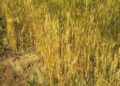
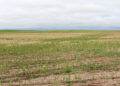
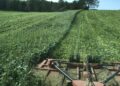
Coleman. Sure. We sow rye and vetch in October, after we’ve harvested potatoes and cabbages and all of the storage crops, and we then leave that in the soil for 19 months. So, we’re sowing it in October, it comes up in spring, and we leave it to grow until the first couple of weeks in August, when it’s dry. By then the rye is thoroughly headed out. The vetch vines are climbing the rye straw and have seeds on them. Then we mow that right down to the ground by backing through the field with the back plate on our flail mower raised and with the depth roller removed. We let the blades go right down next to the soil.
Then we have a two-inch mulch of shredded rye and vetch straw over an enormous number of seeds — about 20 times the normal seeding rate. After a little rain and time, all of those seeds germinate, and they grow up through the straw mulch, and it looks like a golf fairway. We leave that through the winter and finally till it under the following April, until there has been enough new growth of the vetch plants and the rye plants to give us a little extra nitrogen to help decompose all that straw. Then by a month after that, we’re ready to use that field again to grow crops.
We do that on the one-third of our land that is in storage crops every year. It seems to work well. The rest of the farm is growing crops that aren’t in the ground for a long time, and the minute they’re finished, we till their residues into the surface of the soil, which means we avoid all the work of hauling them off to the compost area. Then we sow a green manure, chosen to be part of a crop rotation to benefit the next crop that is planning to be planted on that field.
This has created so much less work than we ever did before. It has made it possible for me to continue farming into my mid 80s. And we’ve recently leased this farm to an energetic young couple who are now doing a wonderful job, keeping all our long-term customers happy by providing them with the same quality of organic matter and highly nutritious vegetables that we have been raising.
Acres U.S.A. When you use so many cover crops in the rotation, does that help with weeds — because you’re filling up the soil so quickly with cover crops?
Coleman. It does. Let’s say we have crops in our rotation like sweet corn or storage cabbages that really create an enormous amount of organic matter in their first year. We just shred those with the flail mower at the end of their production time and then till them in shallowly and sew a green manure over them, and that field is then growing fertility for future crops.
I look out the window at the fields on this farm — and I only have three acres to look at — but every field out there is either growing a crop to sell at our next farmer’s market, or at our next trip to the store, or is growing next year’s fertility. This is a pretty exciting thing. And since we are using green manures one after another, they don’t all come mature at the same time. There is always a field or two out there ready for being planted into whatever the next crop is. So this is definitely a perpetual system.
Acres U.S.A. It’s easy to imagine that farmers would be concerned about the idea of having a third of their land in rye-vetch every year and not producing something they can sell. How do you help them think of it as not a cost but as growing their own fertilizer that’s building soil health?
Coleman. Well, rye and vetch are great winter crops, and I couldn’t have lettuce out there through our hard winters here. The rye and vetch are doing a wonderful job preparing for the future.
And then of course the advantage is that we don’t have to buy any inputs except for the green manure seeds we initially bought. But now we’re even saving our rye and vetch seeds and from a bunch of our other green manures. This is an amazingly self-contained system that is totally free from the risk of bringing in chemicals by mistake with any of the fertilizer materials that regular growers are bringing into their farm.
Acres U.S.A. How many years has it been since you’ve brought in any outside fertility?
Coleman. We started this project about seven years ago, and in that time we haven’t brought in any seaweed because there was an article in the Bangor paper about how the Indian reservation up the Penobscot River from us was telling their people not to eat fish from the river because there was a landfill up there that was leaking nasties into the river that were polluting the fish. That’s the river that flows down right past the beaches where I collect seaweed. The minute I read that, I thought, okay, so much for getting more seaweed — that seems like a potentially polluted source.
We used to buy compost from a very successful local dairy farm; they were the only organic dairy farm around that was composting their own manure and then selling it. We know the people running the farm, and they were very conscientious.
Acres U.S.A. If you were starting a new farm today, would you want to start off right away doing what you’re doing now, or would you do what you did in the 1960s and bring in some limestone, some rock phosphate, compost — things to help jumpstart the soil restoration?
Coleman. I would bring in a little phosphate rock or basalt or limestone, or even the clamshells I used to bring in in the old days. That’s all pretty pure stuff, especially the rock powders, because those rocks were laid down back in God knows when. And if you can easily get an analysis of the rocks you want to bring in to make sure there isn’t anything bad, that’s bringing in nutrients in the form that already exists in the soil.
I have always been in favor of rock powders, and so are all of my European organic farming friends. In fact, basalt powder is a major input over there, and there are all sorts of people in countries like Brazil — in a far more tropical climate than we are — who have found that bringing in purchased fertilizers like potassium costs them a lot of money and is nowhere near as successful as using their own waste basalt to fertilize the fields. This has become very important in Brazil to save them money and to make them far more independent of all of those outside sources of nutrients.
Acres U.S.A. So, it would be a matter of analyzing your underlying rocks and figuring out if they’re deficient in something major like phosphate or calcium or something, and then bringing in rocks from somewhere else that have those missing nutrients.
Coleman. Yeah. I suspect if we had used the most deep-rooting green manures and those most capable of acquiring phosphate for a year or two or three at the start of this farm, we wouldn’t even have needed the rock phosphate, but we were in a hurry to put the farm into production. We also had access to a large horse manure pile on a nearby farm. I used to trade the horse owner’s mother vegetables for all the loads of horse manure I hauled away, and there was nothing bad in that horse manure because all they did was feed hay.

That was probably a big part of getting this farm started quickly, but once it was off and running, we didn’t need any more inputs from outside the farm. When we realized that we were paying $75 a yard for the compost we’d been getting from this organic dairy farm, we stopped immediately because that was money we didn’t need to spend, and we could grow all of that organic matter right here on the farm. And that’s what farms do — they grow organic matter. Let’s get on with it, people, because it works!
Acres U.S.A. What about soil acidity? Where you are in Maine, the soils are very acidic, and a crop like vetch may not even grow until you put some lime down.
Coleman. Yeah. At the start, we bought limestone, and we would get trucks in here to spread limestone all over the acreage. But as I mention in the book, I had a neighbor who had a business shucking clams, and he would show up every afternoon with something close to a thousand clam shells, and I would take them out and spread them on the fields where nothing was growing and then till them in with my rototiller, and that broke them up into smaller particles. But by God, that was fantastic. That gave me a limestone source in my soil that could be drawn on for years to come.
In fact, one year when we were putting in a whole asparagus bed, we brought in limestone pebbles and added them to the soil because the one trouble we had had earlier with asparagus was that there wasn’t enough lime in the soil. That was a great way to make sure we had enough there for year after year with a perennial crop.
Acres U.S.A. For someone who’s farming organically, but they’re still kind of in that input-substitution mindset, and they’re bringing in a lot of outside fertility, how long do you think it would take them to fully transition to a completely self-fed model the way you do it?
Coleman. I think at most three or four years. We are running trials on two recently cleared acres to see how long it’ll take to get the fertility up to a level that we think is necessary to run a successful organic vegetable farm. From the first couple of years results, it’s looking like that’ll be three or four years.
Acres U.S.A. Do you think a self-fed farm ever requires purchased inputs of trace elements?
Coleman. The one we have found that we do bring in is boron, and we bring in a product called granubore that’s just granulated boron in small particles. We do that because that’s the one trace element that we have seen signs of our soil needing a little more than it can produce from its own resources, or from the rock powders that we’re adding or we have added to it in the past.
And that’s okay. That seems like a small cost, and it isn’t very much every year to make sure we’re not getting hollow heart in celeriac and not having problems with beets, both of which need boron.
Acres U.S.A. What are the top reasons any organic vegetable grower should consider transitioning to the self-fed farm model?
Coleman. Depending on how much you’re presently spending on bringing in inputs, first off, you’re going to save money. Second off, you’re not going to be taking the risk of accidentally bringing in pollutants that you don’t want. That’s why we stopped bringing in seaweed. We had no absolute proof that what was running down the Penobscot River was going to cause trouble, but it just seemed safer. Let’s not take this risk.
Acres U.S.A. When you say that it saves money, do you have any rough estimate of how much per acre a farmer could save by growing their own fertility?
Coleman. As I said, for a few years before we started this self-fed farm thing, we were purchasing compost from an organic dairy farm that was costing us $75 a yard. For a farm business like ours, that was a very expensive way to keep our soil going. We quickly discovered it made just as much sense to grow that organic matter here in place. And if I grow a green manure, it’s growing while I sleep — organic matter builds up in my soil, right where I want it. I mean, this is such a logical and simple solution. I can’t believe how easy it’s been for the chemical companies to convince farmers that it isn’t worth doing.
Acres U.S.A. What’s the first step somebody could take to work on developing a system that works as well as yours?
Coleman. I try and detail in the book which green manures we use and when, and how, and which are useful if they winter kill, because then you can plant them in October and they’ll cover the soil over winter when you couldn’t grow crops anyway. They are dead in the spring, and you can just rake up the residue and not even have to till — you just plant right away. And the nitrogen, if they’re legumes, is right there in the soil where you want it.
I have tried to put into this book what has always been bothering me about what goes on in much of organic these days. I’m mainly thinking of vegetable growing because that’s what I do for a living, but I want all organic growers to realize how important the way they take care of their soil is to the quality of the plants they’re then selling to their customers. I want to go to sleep happily at night, knowing that I’m doing everything I can to nourish the people who are kind enough to support us, and to help them live as healthy a life as they possibly can.