Coupling the treasures of ancient landraces with the agronomic achievements of modern varieties
Conventional breeders often focus on developing field corn that produces maximum yield under optimal nutrient and weed conditions provided by the use of mineral fertilizers, herbicides and fungicides. They tend to breed corn that has very upright leaves—these leaves enable farmers to plant more seed and pack in more plants per acre. Under optimal rainfall, the resulting high plant densities allow farmers to achieve maximum yields.
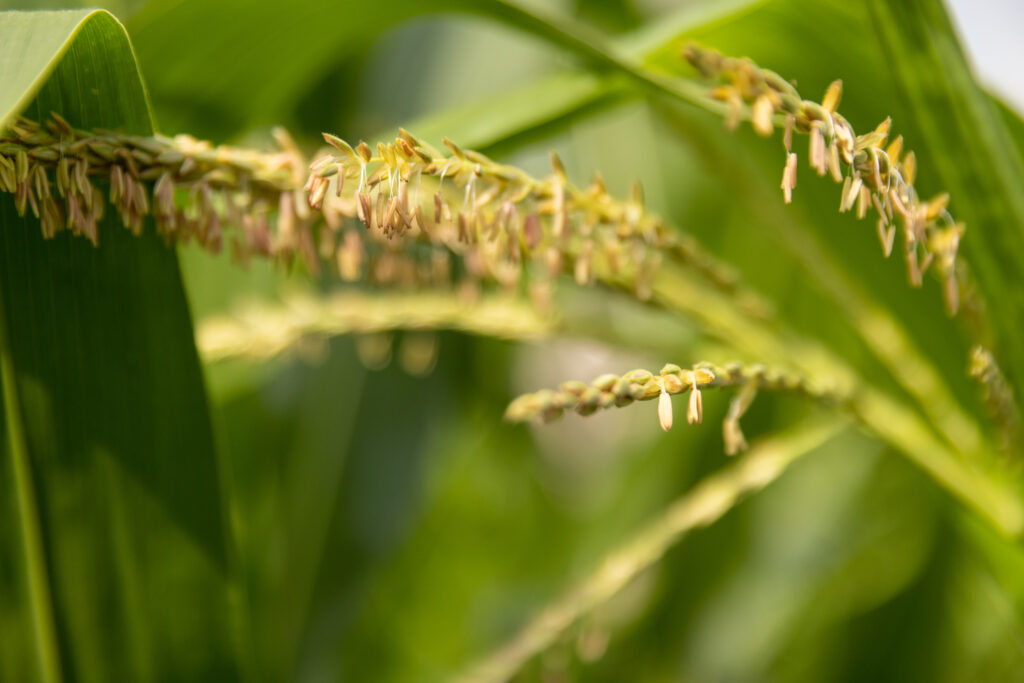
Mirroring the leaves, these high-yield plants have vertically oriented roots that are especially adept at obtaining nitrate from deeper levels of the soil. The corn has small tassels, which produce little—but adequate—pollen, as excess pollen production is considered to be a waste of energy. Nutritional value and taste are not viewed as being important in these breeds.
This combination of traits results in the kind of industrial corn that is considered optimal for conventional farming. By default, this corn has become the predominant option for organic farmers. However, today’s uncertain and stressful climate conditions, coupled with the need for more nutrient-dense food with less nitrogen inputs, means organic farmers need other options.
Understanding these needs, the Mandaamin Institute was formed to focus on breeding crops, especially corn, for organic farmers. Named for the Ojibwe word for corn or corn spirit, the Mandaamin Institute is a non-profit research organization located in the Lake Geneva-Elkhorn region of southeast Wisconsin. This name is especially fitting because it recognizes where corn originated and promotes the respectful attitude and approach we try to develop in ourselves and in our breeding methods. Our overall effort is to couple the treasures found in ancient landraces of corn with the agronomic achievements of modern corn.
This project started in 1986, when Walter Goldstein met with a group of organic farmers in Jefferson County at a Michael Fields Agriculture Institute field day. These farmers wanted Goldstein to breed open-pollinated corn that would stand well at modern planting densities. These farmers knew that the ancient races of corn had excellent nutritional quality, taste and mineral content. As a result, Goldstein bred open-pollinated corn for 14 years as a part-time hobby at the Institute and on his own farm, and he supplied farmers with seed of open-pollinated corn that would stand better in the field.
Things changed at the turn of the millennium with the widespread introduction of genetically engineered corn. Organic farmers were outraged and afraid of contamination. There were listening sessions with these farmers at the Upper Midwest Organic Farming Conference, the Practical Farmers of Iowa conference, and the Minnesota Organic Farmer winter meeting. Goldstein asked farmers what kind of corn they needed; the vast majority answered that they wanted new kinds of hybrids that had the nutritional advantages of open-pollinated corn but the yields of modern corn.
Credit: Anders Gurda
Consequently, Goldstein obtained funding and bred hybrid corn for organic farmers with help from the USDA and Iowa State University, including professors Linda Pollak, Kendall Lamkey and Paul Scott. Interested organic farmers helped practice selection and testing of the newly developed hybrids. In 2011, a set of the corn was taken from MFAI and further developed by the newly formed Mandaamin Institute breeding program. This program now has 53 growing seasons, with selection taking place in Wisconsin in the summer and in Puerto Rico or Chile in the winter. Selection occurs under organic and biodynamic conditions with limited or no fertilization — and sometimes plenty of organic weeds!
Breeding Goals
The Mandaamin Institute uses a pedigree breeding program. This involves crossing two good parents and then self-pollinating the subsequent offspring for many generations while selecting for plants that are well adapted. They should have developed useful traits such as good emergence, vigor, grain yield, nitrogen efficiency and grain quality. As the selection process proceeds, the new populations are crossed with an established and reliable parent. The resulting hybrids are tested for yield under organic conditions alongside commercial, high-yielding corn hybrids. Only those inbreds and hybrids that have competitive or superior vigor, yields, grain dry-down, standing ability, nitrogen efficiency and nutritional value get advanced toward commercialization.
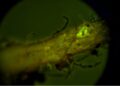
This work has broadened to focus on nitrogen-efficient field and sweet corn that possesses partnerships with microbes. In 2009, ancient landraces were discovered that appeared to be fixing up to half the nitrogen in their grain from the air, based on natural abundance of isotopes. The fixation appears to be associated with bacteria that are carried in the seed, infect the seedling, are exported out of the root hairs to colonize the soil, and, finally, are reabsorbed, partially multiplied and consumed in the plant’s roots.
These bacteria are called endophytes. Endophytes are non-harmful organisms — often bacteria or fungi — that grow inside plants. The seed-borne partnership with these organisms is called rhizophagy. James White, from Rutgers University in New Jersey, has especially studied rhizophagy with Mandaamin corn. Rhizophagy strongly stimulates root-hair production, root branching and root-tip production. Within these structures, bacteria multiply and N2 fixation occurs — as measured by 15N gas uptake by seedlings. The partnership between the plant and these microbes stimulates higher levels of plant resiliency and induces microbial fixation of nitrogen, especially in foliar tissues as a protective mechanism against oxidation. Studies conducted with Rutgers University show that microbes in the Mandaamin corn live in plant hairs, the plant’s epidermis and the corn husks.
Conventional corn shows much lower incidence of these beneficial rhizophagy partnerships. Conventional corn also has endophyte communities, but they are dominated by the fungus Fusarium. While Fusarium may provide some benefits to the plant, it also produces terrible mycotoxins in grain and silage. With Mandaamin varieties, selection under organic-biodynamic conditions probably encouraged and helped evolve the beneficial partnerships with bacteria while dissuading Fusarium domination. These beneficial partnerships enable the Mandaamin inbreds and hybrids to grow well under organic conditions, by fostering mineral uptake and nitrogen efficiency from consumption of microbial biomass and nitrogen fixation. This trait has been incorporated into several of the Mandaamin Institute’s inbreds, including the family C4-6.
The Mandaamin Institute works with Foundation Organic Seed company in Onalaska, Wisconsin, to sell several of its hybrids. Several individual farmers have also been selling Mandaamin’s pollinated varieties. Mandaamin’s work has attracted funding from many different sources, including private donors and smaller foundations. USDA grants, the Ceres Trust, the Wisconsin Corn Promotion Board, and many generous organic farmers have contributed funding, land, help, observations and ideas to the project.
Credit: Anders Gurda
Field Trials
Mandaamin’s hybrid plants look somewhat different than conventional hybrids. They have broader, more horizontal, shadier leaves and broader-rooted, finely branched, healthier rooting systems. This combination, coupled with their unique endophyte partnerships, leads to greater uptake of minerals from the soil and greater competitiveness with weeds. In general, Mandaamin inbreds thrive more under low-input conditions than conventional inbreds, making it easier to produce hybrid seed under organic conditions. The inbreds and hybrids are more robust, more flexible in their body formation, and not as clonal or uniform in their end appearance as most commercial inbreds. Under low-density conditions, the Mandaamin corn hybrids appear to be better at flexing to produce multiple, large ears than some conventional hybrids.
The Mandaamin Institute hybrid 17.46, which has half of its parentage from nitrogen-fixing C4-6, was recently compared with yields of the commercial check FOS8500 on 14 farm sites in Wisconsin over two years as part of OREI- and SARE-funded projects. Yield averages were 139 bu/acre and 144 bu/acre, respectively, for the two hybrids. The Mandaamin hybrid had approximately a quarter more minerals in its grain (an average of over 15 different minerals) and higher protein and methionine contents. The Mandaamin hybrid yielded considerably better when no manure was used. On the other hand, multiple trials showed that fresh manure, directly applied before planting, seemed to depress yields and nutrient uptake for C4-6-based hybrids while increasing yields of the commercial hybrid or of other Mandaamin Institute hybrids.
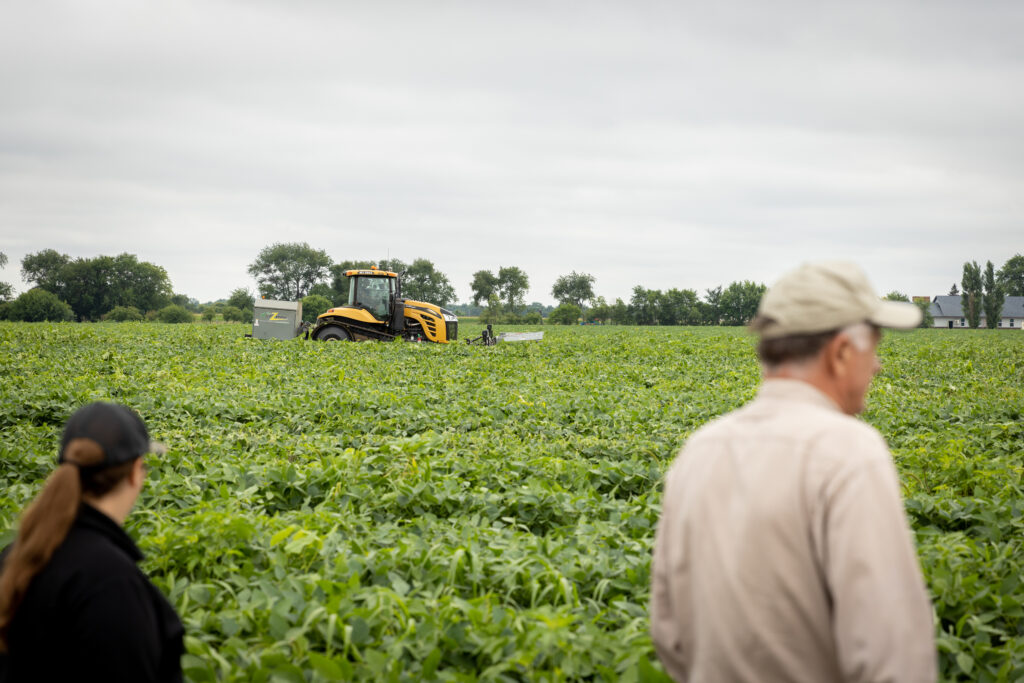
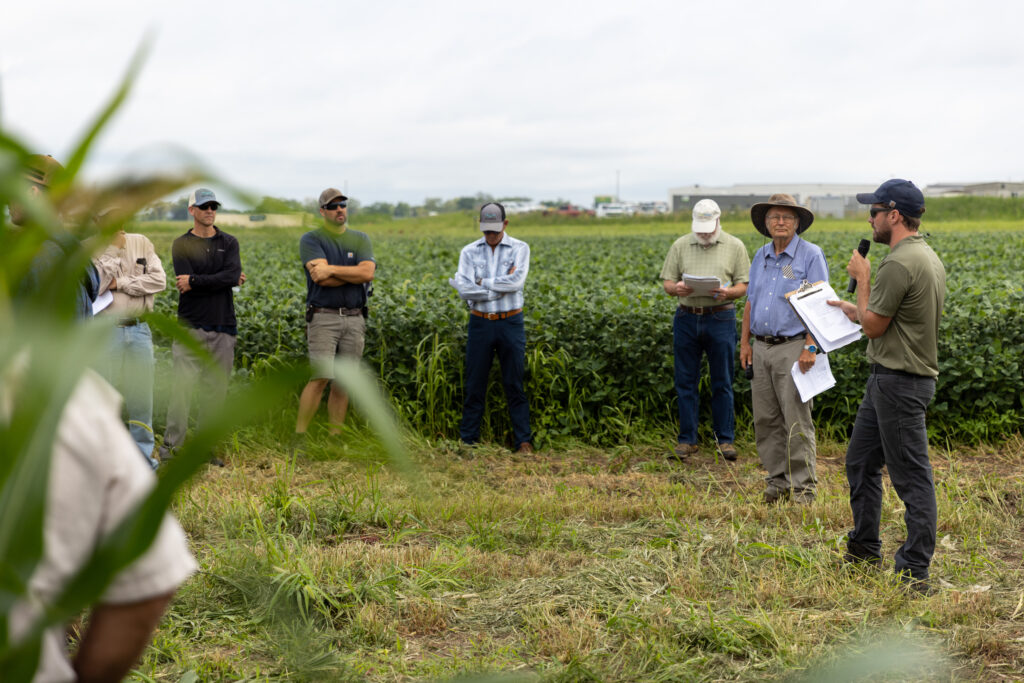
Partial confirmation of these results was shown at a Marbleseed/OGRAIN field day hosted at the farm of Randy and Willie Hughes in Janesville, Wisconsin, in August, 2022. The Hugheses’ trials with Mandaamin corn enabled the Mandaamin Institute to show the 17.4-6 hybrid under larger-scale field conditions. There were four 20-acre plots. These were:

1) Mandaamin 17.4-6 after wheat + fall application of manure;
2) Pioneer 0076 with Terafed/CX-2;
3) 17.4-6 after wheat/clover;
4) Viking corn + utrishna
The Hugheses had not been able to apply their usual rates of chicken manure to plots due to quarantine of manure caused by avian flu.
The Mandaamin corn looked great, with dark coloration and lots of ears, compared to the other corn, which looked nitrogen deficient. Tissue analyses showed this to be true. The corn in plots one and two was also measured for chlorophyll content using a Minolta chlorophyll meter, with ten plants analyzed randomly across each plot. Plot one had a chlorophyll rating of 54, meaning the plants were getting sufficient nitrogen. Plot two had a chlorophyll rating of 48, meaning the plants lacked nitrogen. At the field day, Willie Hughes explained that the non-application of manure would enable them to greatly reduce the costs associated with growing organic corn.
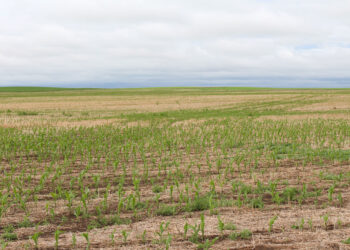
Weed competition is a major issue for organic farmers and seed producers. Studies funded by the Organic Farming Research Foundation on competition between corn, weeds, giant ragweed and sunflowers showed that Mandaamin corn fostered about one third less weed biomass and weed scores than conventional hybrids. We suspect that the endophytes in the Mandaamin corn, coupled with horizontal, branched roots and more horizontal leaves, may increase the ability of the corn to compete with weeds for nutrients. In general, the poorest weed competition has been observed with commercial inbreds that have upright leaves and vertically oriented roots.
Nitrogen fixation may also help the corn compete with weeds. The Mandaamin Institute’s randomized, replicated yield trials in 2020 inadvertently took place in a uniform thistle patch. Only the top Mandaamin hybrids with nitrogen-fixing parents were able to produce normal yields for the area (about 140 bu/acre) under these thistle-infested conditions. In 2021, we regrew some of the same top-yielding hybrids on a high-fertility site without manure, where weed pressure was minor. Those Mandaamin hybrids yielded more than twice as much as the 2020 commercial control when weed pressure was high and yielded the same as the 2021 commercial control when weed pressure was minor.
Credit: Anders Gurda
Selection Traits
Selection of the Mandaamin varieties focuses on nutritional value, with emphasis on increasing methionine and carotenoids in the grain. The grain of our varieties has softer seeds, with test weights around 54 lb/bu. The softer seed is associated with a shift away from alpha zein (the gluten of corn) as the main storage to better-quality proteins with higher contents of essential amino acids, which are needed for optimal livestock nutrition. Methionine is the major lacking ingredient for organic poultry production — quantities of methionine are often insufficient in feed. Because corn often composes 60 percent of such diets, corn bred with more methionine would reduce dependence on expensive soybean meal, sunflower meal or synthetic methionine. Organic poultry producers are allowed by USDA regulations to utilize two pounds per ton of synthetic methionine over the lifetime of layers, but these guidelines will sunset in 2028.
Carotenoids are also important for poultry producers because orange yolks in eggs and orange skin in broilers are desired by many consumers, and that affects price. This orange color can be increased by feeding corn with a high carotenoid content.
Studies with the University of Illinois, funded by OREI (CASH project, professors Ugarte, Wander, Bohn and Andrade), compared two Mandaamin hybrids with commercial hybrids on organic farms in 2018 and 2019. Unreplicated strip trials were planted on 13 farm sites in the central (Illinois, Indiana) and 13 sites in the northern (Wisconsin) Corn Belt regions.
The difference in yield between the hybrids was not statistically significant. However, the highest-yielding Mandaamin hybrid averaged 10 percent less yield than the controls over all sites. However, the Mandaamin hybrids had 10 to 18 percent more protein, 32 percent more oil, 10 to 15 percent more lysine, 33 to 42 percent more methionine and 10 to 16 percent more cysteine in their grain than did the commercial checks. They also had 23 to 25 percent higher methionine contents in their protein than did the checks The Mandaamin corn had more carotenoids; 44 to 63 percent more zeaxanthin, 48 to 150 percent more β-cryptoxanthin and 38 to 65 percent more β-carotene.
These differences were all statistically significant at the 95 percent security level. Furthermore, mineral analysis revealed that the Mandaamin hybrids had 17 to 24 percent more iron, 22 to 32 percent more manganese, 13 to 54 percent more copper and 11 to 12 more zinc in their grain than did the controls.
In summary, the high methionine and carotenoid corn outperformed the commercial corn in delivering significantly more methionine, carotenoids and trace minerals at comparable yield levels. Pierre Meyer from Alltech modeled three rations that would meet the nutritional needs for organic layers utilizing corn, soybean meal and synthetic methionine. The first was a conventional feed with organic corn, the second included Mandaamin corn with 1.2 lb/ton of synthetic methionine, and the third included Mandaamin corn with no synthetic methionine.
The two alternative feeds that included high-methionine corn were $29.61 and $31.20 cheaper, respectively, than the conventional ration in cost per ton of feed because use of the high-methionine Mandaamin corn reduced the need for organic soybean meal. Based on bushel weight, this meant a potential premium of up to $1.29 or $1.36/bushel for sold corn. This premium represents 11 percent more than for conventionally bred organic corn and appears to be approximately equivalent to the yield reduction associated with the best yielding of the Mandaamin corn. However, this calculation does not take into consideration any extra value for poultry health, reliability of production or end-product quality associated with other components of the Mandaamin corn, such as carotenoids and minerals and any effects on the health of the birds. For example, eggs with high carotenoid content have been observed to bring higher retail price in several cities. Furthermore, eggs from birds raised with no synthetic methionine in their feed could potentially bring a higher price from some consumers.
All this needs to be confirmed by larger-scale feeding trials coupled with marketing. Small-scale studies in the past, sponsored by Organic Valley and the University of Minnesota (including Nick Levendoski and Jacquie Jacob), showed the same production for broilers and layers when high-methionine corn from the breeding program was substituted for corn plus synthetic methionine in the diet. Interestingly, researchers observed that rations fed with the high-methionine corn induced feeding frenzies in the birds. This may mean that nutritional or taste factors in the corn may affect animal well-being — an intangible factor with financial consequences that lies at the core rationale for organic farming.
Walter Goldstein is the research director for the Mandaamin Institute. This article was originally published in Marbleseed’s Organic Broadcaster, Volume 30, Issue 5.