

Diversifying who you sell to can provide a better safety net for your farm
Growing your product is only half the battle — you don’t get anything until you’ve sold it. Where you sell your product can be a part of your farmer safety net if you approach it deliberately.
The challenge with writing an article like this, of course, is that the audience can fall anywhere from row crop growers on thousands of acres to small market gardeners on less than an acre.
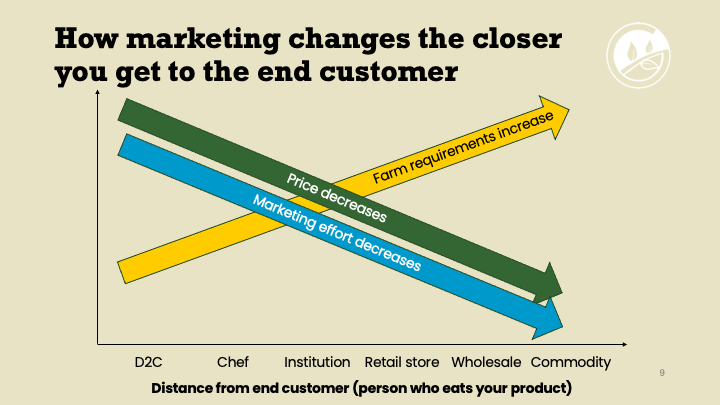
Regardless of where you currently sell — whether a row cropper on thousands of acres or a market farmer on one — it’s worth asking how you can increase your share of the food dollar. Figure 1 shows in general how time, expense and certification requirements change as your sales channels move further away from the end customer who eats your food.
The other aspect to this is how much you’re growing. If you’re using a market garden setup on a few acres or less, even if you specialize in certain crops, you’re going to be focusing on markets that are either direct-to-consumer or only have a single middleman between you and the consumer. It’s simply not possible to produce enough product to make a living wage if you’re selling at commodity prices.
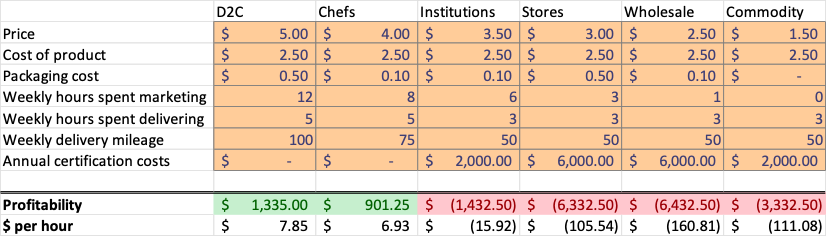
Look at Figure 2, which represents a farmer growing 1,000 pounds of sweet potatoes. With a small amount of product, you’re likely to have a higher cost to produce that product. If your tractor costs $30,000 and you’re producing 1,000 lbs of produce, each pound needs to include a larger portion of that tractor payment than if you produced more.
As you can see in this example, it’s only profitable for this farmer to sell direct-to-consumer or to other high-value customers — i.e., high-end chefs. If they discount their product any further, they actually lose money on the transaction — or they simply don’t pay themselves at all.
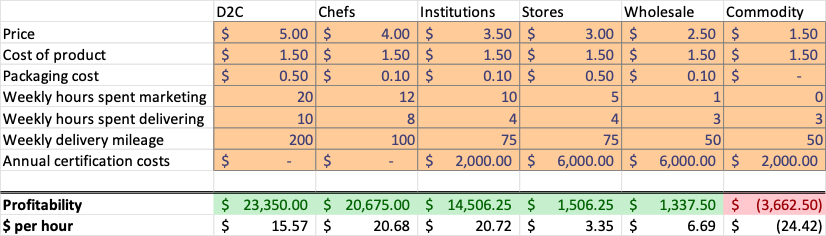
In Figure 3, however, a farmer with 10,000 pounds of sweet potatoes has more flexibility with where they sell; and in some cases, may be able to pay themselves more by selling at a lower price. This is because of the trends seen in Figure 1 — you get more of the food dollar selling direct-to-consumer, but you also spend more time finding and selling to those customers. If you can drop all 10,000 pounds of sweet potatoes at the local hospital or school system and get paid in one chunk, that’s less effort than finding 2,000 customers to each buy 5 pounds of sweet potatoes.
Now, the downside to this is that if your hospital or school system decides not to accept your sweet potatoes, you have 10,000 pounds of sweet potatoes and no buyer. This is where our previous article about diversifying customers comes into play. Since this farmer can make a profit across multiple sales channels, they can hedge their bets by selling half to an institution, some wholesale, and some to chefs or consumers.
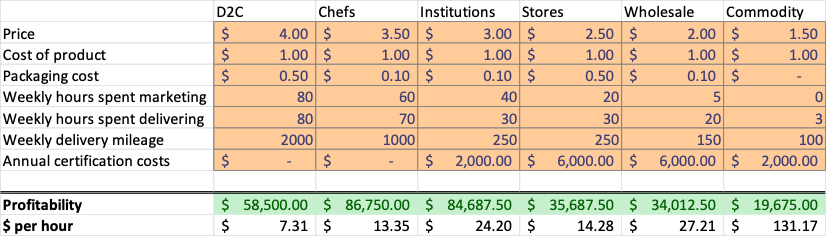
In the final example, Figure 4, we have a farmer with 50,000 pounds of sweet potatoes. You can see that they’re making profits across the board, but they’re actually doing best hourly by selling to a commodity or aggregate buyer. This farmer would probably do best by selling to a mix of aggregate and institutional buyers, perhaps with some store contracts mixed in. But they could further increase their share of the food dollar by working with those buyers to develop products around their farm.
When a farmer is growing thousands of pounds of sweet potatoes, or thousands of acres of grain, they have options other than sending it straight to the standard buyer for a set price. Food companies are increasingly looking for organic ingredients to respond to consumer demand; can you reach out to those companies to get a higher price for your crops? Can you collaborate with a manufacturer to create vertical integrations? Consider the farmer selling peppers to a salsa company, kernza grains going into the value chain to make pasta for Patagonia, or tomatoes grown specifically for high-end soups. These are all ways to increase your percentage of the food dollar that don’t require you to take your goods to a farmers market or run a CSA.
The mechanism will be different for each farm, but take some time to brainstorm what might work for your situation and what the steps might be to implement the ideas you come up with.
Kirsten Simmons is the co-founder and Chief Farming Officer for Good Agriculture (goodagriculture.com), a company dedicated to helping farmers find funding, manage finances, reach new customers and get certified. She also farms at Ecosystem Farm (ecosystemfarm.com), the only u-pick strawberry farm inside Atlanta.