
How I transitioned to organic crop production — via livestock
During my first 17 years in agriculture, I farmed 25-45 cow/calf pairs and a 100-sow farrow-to-finish hog operation. We were also in the soybeans and wheat seed business, until the GMO soybeans arrived in 1995 and 1996. I tried to transition to them but found that to be a losing proposition on a seed operation my size. I started raising food-grade soybeans for export to Japan directly from our cleaning facility. I had several farmers growing these for me. I used the seed-cleaning facility to store, package and ship them.
Then I started growing dry beans and popcorn. One of my buyers asked me if I could grow organic popcorn. That was my introduction into organics. I had to do something to survive, with a family of four boys on only 900 acres; commodities were not paying the bill.
I finally had the opportunity to try some organic popcorn once I got out of the farrowing business and sold my sows. They had been on 10 acres of grass for many years, and no chemicals had been applied. It was the short-rows part of an “L-shaped” field that I was growing conventional popcorn on, right across the electric fence.
What Are You Sold to Grow?
One day, when I was scouting across the field for root worm beetles eating the silks, I noticed a sudden lack of beetles on one row. When I walked out to end of that row, it was right where the organic field started. This was before we needed to separate our organic with a buffer strip. I scouted the rest of the organic field and never saw a beetle. I had to ask myself — “WHY?” I had to spray the conventional field with insecticide due to the population of the beetles, but I did not spray the organic. The organic part of the field out-yielded the conventional by 300 pounds per acre, and I got three time the price for it, with no synthetic inputs.
That experience got me thinking about what else I could do. I had a market for organic popcorn, soybeans and wheat. I also knew how to raise cattle, and I had recently read up on holistic management in Alan Savory’s Holistic Management: A New Framework for Decision Making.

Just by coincidence (actually, there are no coincidences in life!), shortly after finishing the book, I had a conversation with a crop consultant I had never met. We were grilling pork chops for the local county pork producers’ organization. Another friend was telling us about some highly erodible land on his farm that was a pain because he was getting tired of mowing it. I suggested that he intensively graze it. The consultant asked me what I knew about intensive grazing. I said not much, but I had just read this book about it. He asked me why I wasn’t doing it, and I told him that it sounded great, but I asked, “If it works, why isn’t anyone else around here doing it?” His answer was convincing. He said, “Who is going to make money off of you doing this? The guy that sells you fence once in 20 years, or the guy that sells you forage seed once every couple years?” He said, “Farmers only grow what they are sold to grow, and nobody is going to be able to sell anything to you for holistic grazing.”
There is a joke: “Why don’t farmers where tennis shoes? Because seed, chemical and fertilizer companies don’t give them away.” Once we wear their logos, we about have to keep buying their products because we are walking billboards for them. I even used to give away hats in my seed business for this reason.
About that same time, I came across this quote from Sir Albert Howard: “Mother earth never attempts to farm without livestock.” It made sense for me to mimic Nature whenever possible. I now drive around the country and see all the lost opportunity in the way pastures are grazed. I see a few cows, set stocked, on large acres, and the grass is barely tall enough for the livestock to get a bite longer than an inch or two. You see erosion even in the driest of areas, from light rains that run off the soil and never get infiltrated below a couple of inches — if even that much.
Grazing to Grow Organic Crops
That was the final straw that broke my resistance to trying the grazing model to transition to organic crop production.
I found the grazing community to be very friendly and willing to share their ideas and experiences. We were all part of the group that was trying to succeed in agriculture when the conventional margins were getting so thin we could not survive without getting bigger.
I started grazing in 2001, in southeast Indiana. I used intensive grazing to transition to organic production so I would have a revenue stream during the transition. We had 300 acres that was partially fenced in, and we built an addition 5.3 miles of fence in one summer. The previous fall and spring, we planted various cool-season grasses and some legumes with varying maturities to stage our pasture rotations. We used wheat, rye, triticale, oats and spelt for our nurse crops. All this was according to a grazing specialist in my area who helped me set up the pastures. We harvested the grains off and then got one cutting of what I called “stray” in August. This is a combination of straw stubble and hay from the forages growing through the stubble. My cows stay fat and healthy that next winter.

The next season, we started grazing. We had mobile water tanks that we moved around to help with the “direct-deposit-manure-application” system I had envisioned. We placed the mineral feeders on diagonally opposite sides of each paddock so the cattle would not congregate around one area. Altogether, I had 560+ head of stockers, cows and replacement heifers on 300 acres of grass. I was able to harvest enough forage to feed my 25 cows and their calves through the winter and to keep the other custom-grazed animals fed from April to October.
My 12-year-old son could move the 203 head of stockers anywhere on the farm by himself with the help of two lead steers, Sammy (2,570 pounds) and Teddy (2,860 pounds). The owner of the stockers said, “You may be able to move old cows like that, but wait until you have to move a herd of stockers that have only seen humans twice in their lives, and neither experience was good — once was at vaccination/castration time and the other at the sale barn.” I had those stockers trained within 48 hours with the help of Sammy and Teddy.
As I later learned, it is the biology from not only the manure coming out the back end of the cattle, but also the microbes from the rumen that get inoculated onto each bite of forage the cattle take. These microbes are the balancers of the soil chemistry when we allow them to thrive. My soils’ CEC and organic matter doubled in two grazing seasons. The soil not only increased in its infiltration rate; it became more drought resistant as well.
Heavy rainfall soaked into the ground. One example of how soil health improves water infiltration is on one particular 37-acre field. It was mostly flat with no field tile and had a slight slope toward the road. When I farmed it conventionally and we had a one- to two-inch rain event, it would wash across the road up to the neighbors’ front porch, bringing corn stalk and muddy water with it. Then I went to no-till and it quit running across the road but did fill the very shallow and narrow road ditch. Once I planted it to reed canary grass and started grazing it, a five-inch rain would not even fill the road ditch, and the water in the ditch was clear enough you could count the pebbles in the bottom.
On the drought-tolerant side, I had a field of organic popcorn next to my neighbor’s field of conventional GMO corn, with nothing but a fence between us. During a very hot and dry season, his corn was rolled up like pineapple leaves and my popcorn was standing there with its leaves laid flat and taking in the sun. It yielded normally, while the conventional corn in the area was hurt severely on yield.
Soil and Economic Improvement
My highest-yielding soybeans in 31 crop years was on organic food-grade soybeans (58.6 bushels per acre). I had only gotten about 35 bushels per acre when I was growing conventionally. No insects, no disease, and no weeds. My highest-yielding popcorn, both in whole-farm average and individual field, came in the organic system.
A farm magazine came out to interview me for a story on organic farming. He asked if popcorn was more vigorous than field corn due to the color and growth he saw in V3 popcorn that had no in-row fertilizer applied at planting. I grew my own nitrogen with the intensive grazing.
I was asked to speak at Purdue’s Top Crop Farmer workshop after I had transitioned to organic with intensive grazing. This was in the mid-2000s. They wanted me to speak about “real-life economics of transitioning to organic farming.” I wasn’t sure a crowd of 3,000-plus-acre farmers would be interested in organic farming, but they insisted. I drew up my actual five-year budget on transitioning. I used this to prove that you have to look at the long-term financial impact of crop rotation and livestock integration on the health of the soil and spreading out market and weather risks.

The best part came later in the day. An economics professor gave a similar speech and started by saying that she wanted everyone to know that she never met me before and had not talked to me about this topic. She then went on to say that she was pleased that her theoretical budget was very similar to my actual budget. She came out with almost exactly my results.
Many growers successfully transition to organic or ecological/regenerative practices without adding livestock. For me, though, livestock were instrumental in the process — it’s the way nature does it, and that made sense to me.
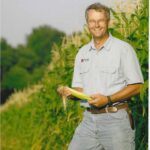
Gary Reding is the owner of Cascades Consulting, LLC, located in Fort Collins, Colorado. He farmed for 31 years in southeast Indiana on a diversified family farm with livestock, grain, seed and forages. In 2009, he branched out into consulting across North America, working with farms and ranches in the US, Mexico and Canada, with a focus on operations transitioning out of conventional practices.
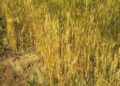
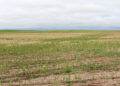
Holistic Grazing Works — In a Vastly Different Environment In the following years I had the opportunity to consult on a 34,000-acre desert ranch in northern Mexico. They could only support 500 cow-calf pairs on 34,000 acres. They had the cows in 19 different paddocks, with set-stock grazing. That’s almost 70 acres per cow.  Fence line during drought — During the drought, both the farm (right) and the neighbors’ farm (left) was bone dry. (Courtesy of Gary Reding) They suffered a long-term drought with no measurable rain for 18 months. I had been going there for a few months in the summer and had not seen a blade of grass on any of the ranch. The cactus was wilting and falling over. That’s when you know you have been dry for too long. The neighbors started losing cattle to the drought, but when I was called in, this ranch had not lost many cows yet. They had plenty of browse to keep them alive, and the cowboys had started feeding them some hay as well. The cows that did die had full bellies of prickly pear cactus in their rumens — high fiber with low protein intake. Once we got the calves sold off, we gathered the cows into a single location and fed them a ration to carry them through to the next rain … we hoped. The cows’ last standing browse plant was quajillo shrubs. These shrubs were so dry that they started concentrating their toxins as a protection mechanism to a point where it was toxic to the cows. They lost one cow to this, and we pulled the rest of them up to one paddock and had to start feeding them. It finally rained 2.5 inches on the ranch and 5 inches up in the nearby mountains. The desert just exploded with growth. There was grass growing where I had not seen it before, and many desert flowers were busting out in full bloom. It was a beautiful sight.  Growth flush — Rain brought an amazing flush of growth to holistically grazed land. (Courtesy of Gary Reding) Once we got the rain, I set up a grazing plan with the help with the cowboys, who knew every plant in the desert the cattle would eat, when it would be in its prime, and where they were on the entire ranch. At first they opposed having the cattle all in one herd, until they realized how easy it was to manage one herd instead of nineteen. As they learned to move the cattle early enough to not eat the forages into the ground, and then to let the paddock rest, they gradually improved their carrying capacity. When I went back a few months later, I could see a definite difference between their side of the property fence lines and their neighbors. The ranch had been set up properly with water supplies and fencing for the purpose of rotational grazing. After seeing the improvement of the grasses and other plants, they continue to do rotational grazing, and the ranch is far better off for it. It has become a model for neighboring ranchers in the area.  Fence line during drought — During the drought, both the farm (right) and the neighbors’ farm (left) was bone dry. (Courtesy of Gary Reding) |