
The role of investment capital in fueling profitable regenerative agriculture
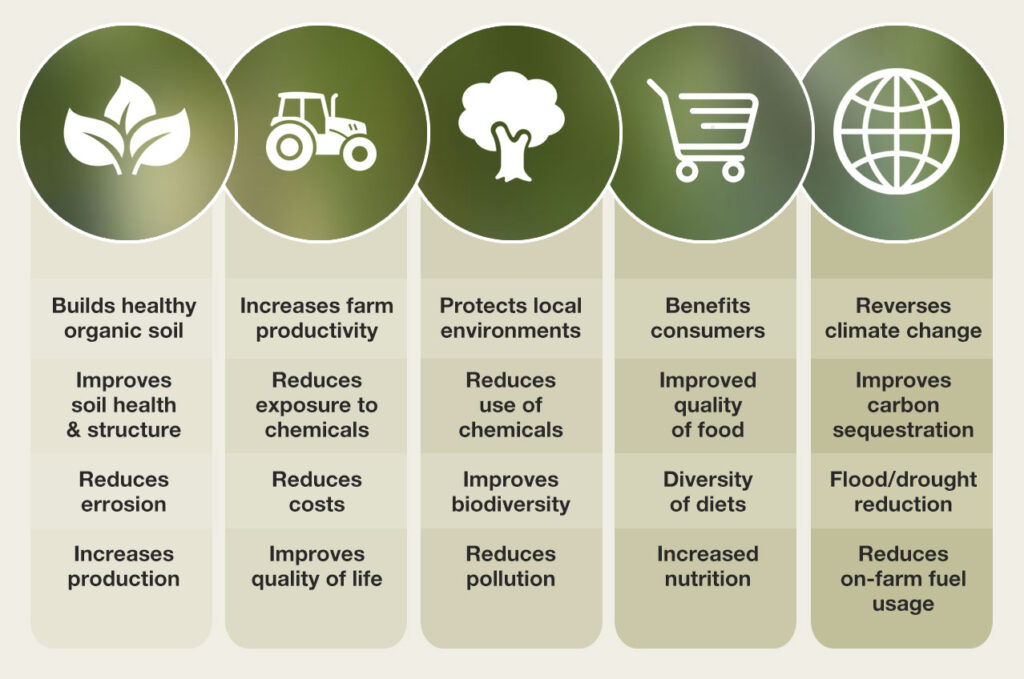
The numerous beneficial outcomes associated with using regenerative production practices have gained much attention in recent years. This increasing attention has tended to emphasize the agronomic, operational, environmental, consumer and climate-level benefits, while the economic outcomes of transitioning to regenerative agriculture have garnered far less attention.
However, the financial outcomes are critical to the discussion of transitioning to regenerative agriculture because the prospect of positive financial returns is crucial to incentivize what can be risky, wholesale change. In other words, if the economic outcomes don’t exist, we won’t be able to scale the transition to regenerative agriculture.
What’s the Deal with Yields?
One of the biggest misconceptions about regenerative agriculture is the assumption that regenerative agriculture leads to lower yields and therefore is not profitable. That, however, is an oversimplification of what is at work in these systems. Like many things in agriculture, the answer to whether yields decrease with regenerative farming practices is “it depends” — in large part on crops and local conditions.
There is an increasing body of research seeking to understand the connection between yields and profitability in regenerative agriculture. Here are some of the highlights:
- Rodale Institute has been running side-by-side field studies for the last 40 years, comparing organic and conventional agriculture. Their results have shown that after a one- to two-year transition period (when yields do tend to decline), there is no difference between conventional and regenerative farming in terms of yields. In stressful conditions, particularly during droughts, the organic fields perform better because they are more resilient. This is because the soil contains more biomass and can therefore absorb more water.
- The American Farmland Trust looked at the economic impacts of switching to regenerative management on eight farms across the U.S. representing crop and livestock production. The case studies examined which practices on each farm created an increase or decrease in income and costs. Overall, all eight farms showed meaningful growth in net per-acre income with the regenerative practices.
- South Dakota State University surveyed farmers to compare the profitability, resilience, and optimism of regenerative vs. conventional producers. The poll found that:
- 31 percent of regenerative practitioners increased their profitability in 2019, compared to just 12 percent of conventional practitioners;
- 83 percent of regenerative practitioners expected their operations to be more resilient to extreme weather, compared to 60 percent of conventional practitioners; and
- 69 percent of regenerative practitioners — compared to 36 percent of conventional — expected increased profits over the next three to five years.
- A 2018 study written by Jonathan Lundgren of Ecdysis Foundation and Claire LaCann investigated how moving to more regenerative systems might affect yields, pests and profitability on 20 farms. The researchers looked at soil organic matter, pest presence, crop yield and profit. As expected, crop yields decreased in regenerative systems, and 29 percent. But that is not the whole story. The study found that the farms with regenerative practices were 78 percent more profitable than conventional plots.
The increase in profitability in all these cases can overwhelmingly be explained by two main factors: input costs and end markets. Regenerative agriculture can be significantly more profitable than conventional agriculture because the system of practices can lead to lower input costs and because of the ability to grow higher-value crops and access new markets and premiums. As an additional benefit, increased resilience, reducing risks associated with volatile weather.
Explaining Better Economic Outcomes
Let’s walk through these, starting with one of the biggest economic drivers of the transition to regenerative farming: input costs.
Farmers are operating on thin margins — low commodity prices, combined with rising input costs, led to stagnation or decline in overall farm profitability in 2019. Rising input prices continued to impact profitability in 2021 and show no sign of letting up. A December 2021 DTN report explained that whereas fertilizer expense typically accounts for about one-third of a corn farmer’s input costs, in 2022 that cost may rise to 45 percent or higher.
A March 30, 2022 DTN report on fertilizer prices explains that several types of fertilizer products continue to reach new records, which is likely to have a big impact on corn breakeven levels.
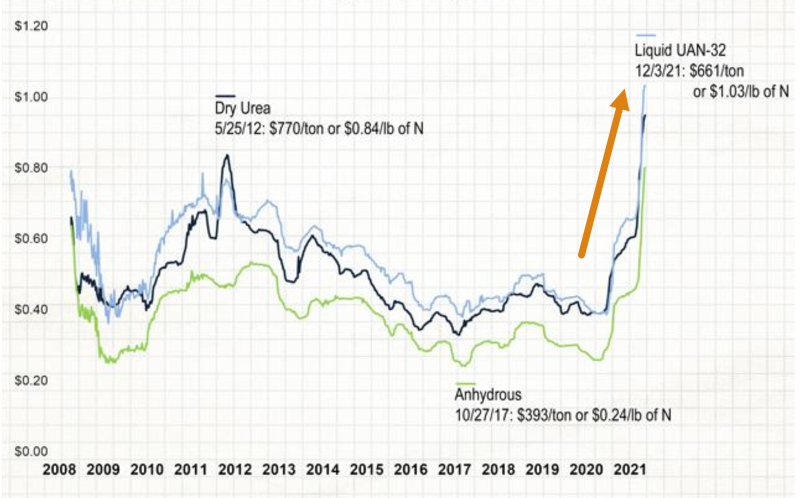
Given the significant role that input costs play in overall expense, you can understand how reducing or eliminating this could support positive economic outcomes, profitability and increased interest in regenerative practices. Revisiting the 2018 Lundgren & LaCann study mentioned earlier, we can compare the revenue and costs of conventional and regenerative production systems.
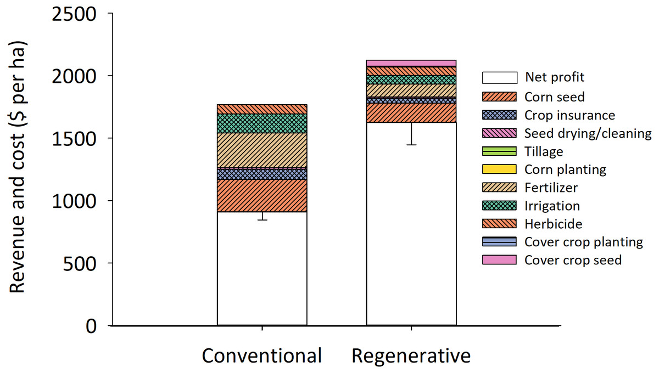
The chart shows the comparison: the heights of the bars represent average gross profits across 40 fields on 20 farms. Profit was calculated using direct costs and revenues for each field and excludes any overhead and indirect expenses. Regenerative cornfields implemented three or more practices such as planting a multispecies cover mix, eliminating pesticide use, abandoning tillage and integrating livestock. Conventional cornfields used fewer than two of these practices. The study found that the regenerative systems had 70 percent higher profit than conventional cornfields. Specific to input costs, you can see that corn seed costs and irrigation costs (represented by orange and green) went down, and fertilizer costs (represented by tan) went down significantly.
The study concluded with two keys to success for this approach to farming:
- By promoting soil biology, organic matter and biodiversity on their farms, regenerative farmers required fewer costly inputs like insecticides and fertilizers and managed their pest populations more effectively.
- Soil organic matter was a more important driver of proximate farm profitability than yields were, in part because the regenerative farms marketed their products differently or had a diversified income stream from a single field.
Market Demand for Regenerative
The second driver of profitability in regenerative agriculture — new markets and access to premiums — comes from the ability to diversify into higher value crops that can be marketed at a premium.
We know consumer awareness of “regenerative” remains low — only 16 percent of consumers ages 16-44 are aware of regenerative agriculture, according to data from consumer brands carbon management platform Planet FWD — but this number is growing. Consumers today are increasingly seeking to understand where their food comes from and how it was produced. They want their food to also reflect their values — and today that means that it’s good for people and for the planet. Planet FWD explains that:
- 55 percent of all growth in consumer packaged goods came from sustainably marketed products from 2015 to 2019
- Consumers will pay a 39 percent premium for sustainably marketed products compared to conventionally marketed counterparts
- 69 percent of consumers have changed the products they use due to concern about climate change
These trends will continue to drive demand and premiums for regeneratively produced goods.

So then, if the agronomic, ecological and economic outcomes are there, why are there still barriers to adoption?
Barriers to Adoption
Jennifer O’Connor and Guidelight Strategies (funded by Patagonia) conducted a study on this very topic. Among the many barriers that the report identified, these stand out:
- Behavior and cultural change: Changing away from the predominant paradigm and mindset for farming is difficult. The conventional way of farming is embedded in all the systems that farmers work in — cultural, operational, financial and more.
- Trusted technical assistance: Farmers and ranchers are extraordinarily busy people, managing complex businesses in a risky, low-margin and ever-changing environment. This reality makes taking time to learn about and experiment with new management practices a slow and time-consuming process. Without technical assistance, many farmers do not have the resources, time or energy to learn about, plan, implement and monitor new practices on their own.
- Regenerative supply chains: Success for regenerative producers, in large part, relies on premium end markets — if the end markets or the processing infrastructure to create the end products don’t exist, then the premium could be forfeited and the incentive to transition is also hindered.
- Financial capital and incentives: One of the biggest barriers to farmers actually adopting regenerative techniques is the added costs and risks in changing any given practice. Even if regenerative can lead to better economic outcomes, there is still initial risk during the process of the change — when transition costs are highest and premiums are not yet attainable.
You can explore all the barriers identified in this report at forainitiative.org/wp-content/uploads/Barriers-to-Adopt-Regnerative-Agriculture-Interactive.pdf
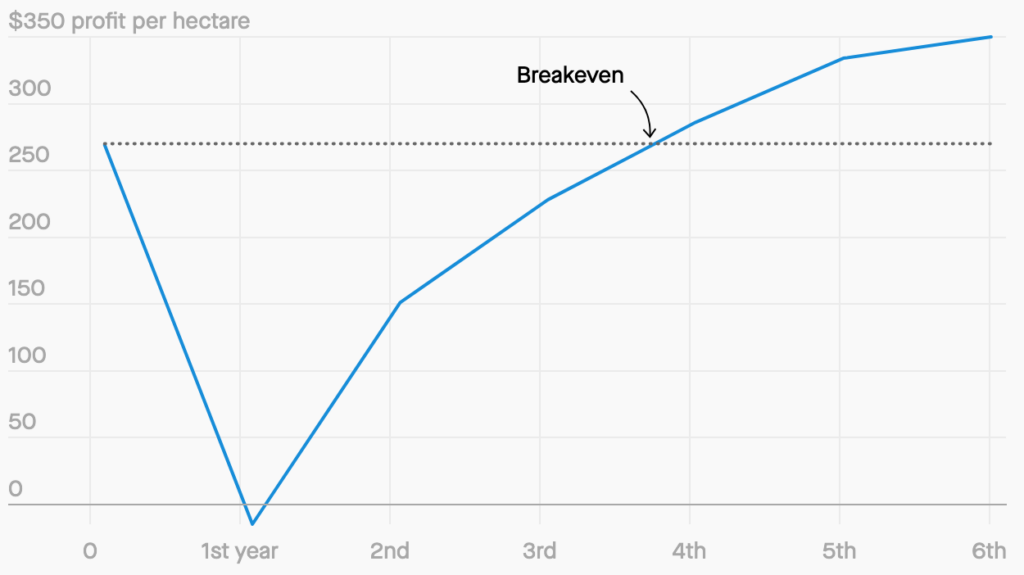
A recent Bain and Nature United study explains the financial risk of transition well: “While beginning the process of changing farming techniques, initial yields will be lower, leading to less marketable produce and less profit … it will be four years until a farmer would break even and make the same amount they would have before transitioning.” However, other studies have said breakeven could be achieved at two or three years.
The key is that after breakeven, the farm is better positioned to reach higher profits than if the farm had not made the transition. There’s great potential for longer-term resilience and economic success, but risk in the near-term that inhibits adoption. In light of this, where do the solutions lie?
What Role for Investment Capital?
In 2020, $972 billion in capital flowed to agriculture from capital allocators, according to the USFRA Transformative Investment Report. As one might expect, very little of this flowed to regenerative agriculture. In fact, to that point (in 2020), only $47.5 billion in investment in regenerative had been executed, according to the 2020 Soil Wealth Report.
Despite a healthy skepticism from farmers about outside investment in agricultural operations, an increasing number of investors and funders are seeking to use their capital to advance the goals of scaling regenerative by addressing barriers — including risk, lack of capital, technical assistance and new markets. Farmers are looking at shifting practices and mindset, and the capital flowing into agriculture is doing the same.
A new crop of investors seeking more than just capital returns is emerging. These collaborators want to build solutions and generate impact. They are looking for some of the same public and private benefits that drive farmer and consumer interest, according to the Soil Wealth Report. These include nutrient cycling, carbon storage, sustainable livelihoods, improved yield stability, water quality and quantity, public health and nutrition, and more.
This group of capital allocators is starting to understand the interconnectedness of the food system — particularly that soil health and the way we do agriculture impacts the entire system. Because of this, we are seeing increased capital flow to regenerative farming and food. $22.8 billion of the $47.5 billion already invested in regenerative agriculture in 2020 was in farmland and real assets. We also see increasing investment in new solutions and technology that support the farmer and enable regenerative production. Examples of this include investments in inputs (like biologicals) and tools and services (think innovative fencing systems for pastured livestock). On the consumer end of the value chain, we’re seeing investment in new food brands and technology to support consumer packaged goods in measuring the impact of their supply chains.
As awareness of this opportunity increases, more innovation is going into designing financial vehicles that address the barriers to regenerative adoption, including risk, capital, technical assistance and new markets. Just as the approaches to the way we farm need to and are shifting, so too are the approaches to investing in agriculture. This evolving approach to investment seeks to de-risk transition, and there’s an increasing number of organizations taking this on.
An organization that stands out in its effort to de-risk transition is Mad Agriculture’s Perennial Fund. The non-profit developed a new type of loan to address the gaps that exist from a lack of adequate bank and Farm Bill funding for land stewards. What’s different about this vehicle is that the team understands the risks of transition and has developed a system to address the barriers that can get in the way of success. They have set up a long-term (10-year) revolving operating loan that is low-cost and offers flexible repayment options so that producers aren’t bearing the brunt of expense during the riskier transition period. The Fund’s team works with growers to assess resources, create a transition and business plan, and provide technical assistance throughout the transition. The team also works to secure end markets for regeneratively produced products to ensure those transitioning are able to capture the premium value of their regenerative crop.
rePlant Capital, whose mission is to improve farmer profitability and environmental outcomes through financing the transition of farmland to regenerative and organic agriculture, is another example of a capital allocator taking an innovative approach. In collaboration with farmers, agronomists and food companies, rePlant seeks to build a new financial system that can support the scaling of a new agricultural approach to provide important ecosystem services. They do this by deploying capital to farms through an evergreen private debt fund. One unique way they approach some of the barriers is by working through the supply chain to support farmer transition. For example, the company dedicated 40 percent of its $50M initial fund to supporting farmer partners of Danone North America. By making loans to Danone’s farmers, rePlant is ensuring there is a long-term, stable buyer for the farms’ products. This also makes the loans more creditworthy.
These are only a few examples. There is an entire ecosystem of financial vehicles developing to support the transition to a regenerative food system. They do this by innovating to finance not only farmers but also the technology and tools that enable transition on the farm, the processing and infrastructure that can help get regenerative products to premium markets, and the food companies that are building regenerative supply chains and consumer products. This, in turn, will continue to reduce the barriers inhibiting adoption of profitable regenerative farming.
Sarah Day Levesque is GM, Events & Media at Acres U.S.A. and Managing Director of Regenerative Food Systems Investment (RFSI). This article was based on a February 2022 presentation on the same topic. To learn more about RFSI’s work and how investment can move regeneration forward, visit RFSI-Forum.com.