
Redirecting a fraction of biofuel subsidies toward domestic organic berry production could benefit farmers, strengthen food safety, and improve public health
Berries are a vitally important slice of the food pie if progress is to be made in making America healthy again. Nearly two-thirds of people recognize berries as an excellent source of antioxidants, and they are correct!
Check out the wild, low-bush Maine blueberries in the table below — hands down, they’re the antioxidant rockstars of the U.S. food supply. Blueberries are also a part of Maine agriculture holding on by its fingertips because of the flood of mostly hydro-berries coming from Peru, Chile, and Mexico.
The typical American diet delivers 3,000 to 5,000 total antioxidant units per day. The numbers in Table 1 are based on the ORAC measure of total antioxidant activity and USDA data. Antioxidant measurement methods are imperfect. Opinions differ over how many units are needed for optimal health. But almost everyone agrees that average intakes in America are far too low, and increasing intakes will improve public health outcomes.
Optimal health likely requires at least 10,000 antioxidant units per day, ideally split between morning and later in the day because antioxidants go through our GI tracts pretty quickly.
We Desperately Need More Berries
Let’s say RFK and the government establish 10,000 antioxidant units as the MAHA goal. At such an optimal level of intake, the average calorie in a person’s daily diet would need to supply about five antioxidant units (10,000 antioxidant units/day divided by a typical 2,000-calorie daily diet). Yet nearly 60 percent of the calories in the average U.S. diet come from sugary ultraprocessed foods that are largely devoid of nutrients. That means the rest of the food a person eats every day needs to be packed with far more than five antioxidant units per calorie.
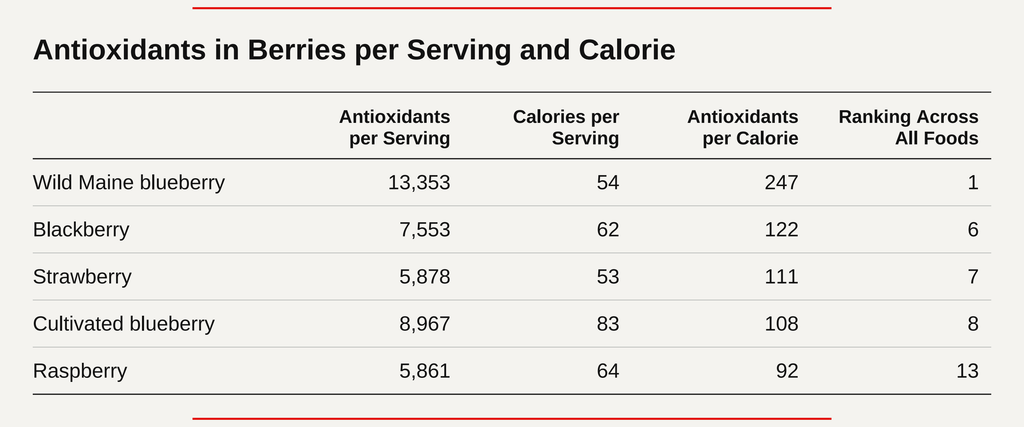
Take another look at the antioxidant table (Table 1). It shows that berries supply around 100 or more antioxidant units per calorie — just the sort of super-nutritious food people need to get and stay healthy. And, by the way, the antioxidant levels in organic berries are 15 to 25 percent higher per calorie than in conventional berries.
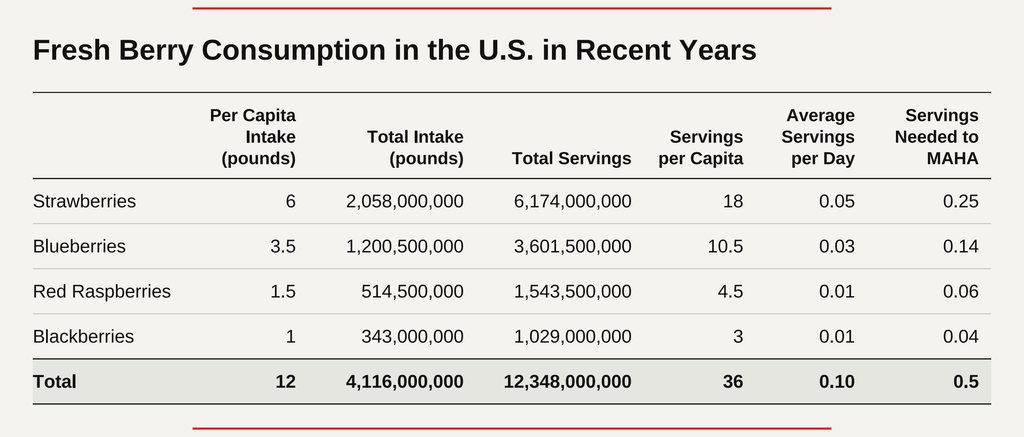
So, are Americans reaching for berries? Regrettably, the average American consumes only about one-tenth of a serving of fresh berries on a daily basis (Table 2). Strawberries account for about one-half of daily berry intake. Total berry consumption needs to increase at least fivefold to make America healthy again. Processed berry consumption adds about another 0.03 serving to daily intake, or about one-third of fresh consumption.
Unfortunately, a huge percent of the fresh and frozen berries consumed in the U.S. are imported. Berries should be king of the superfood mountain, and mostly U.S. grown, because kids love them and there are so many ways to consume them.
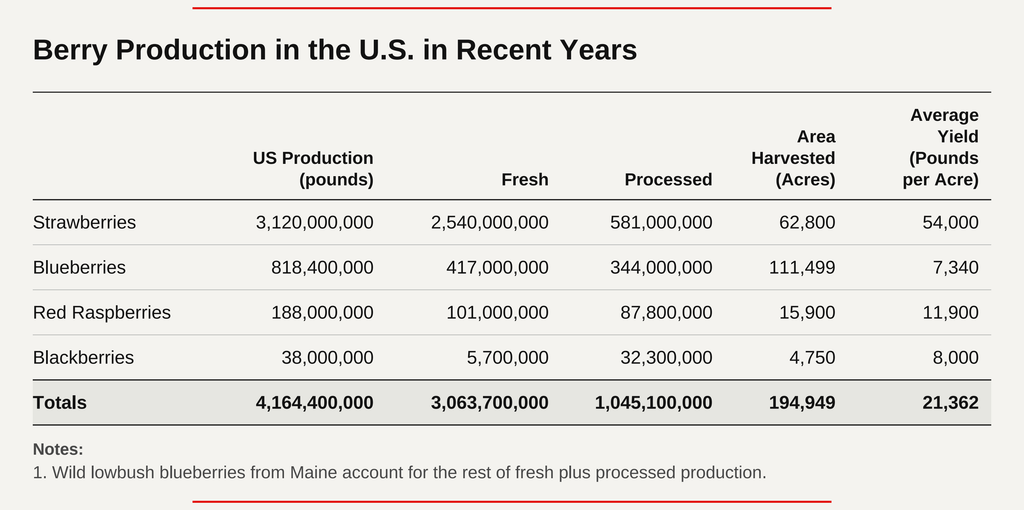
There have been about 200,000 acres of berries harvested in the U.S. in recent years, as shown in Table 3. The health-promoting nutrients produced from harvesting an average of 20,000 pounds of berries per acre are off the charts.
To meet demand for berries to promote public health in America, annual production will need to increase by at least 800,000 acres, to about 1 million acres. If we can grow berry production to 1.5 million acres, we could markedly lessen reliance on imports and expand production to meet public health goals. It is especially crazy that the U.S. imports so many frozen berries that could easily be grown here.
Today in the U.S., close to 60 million acres are devoted annually to biofuel production. A shortage of productive land is not what is holding back berry production. The solution is clear as a bell: fixing stale, broken policies that lock farmers into more corn and soybeans and empowering farmers who want to grow healthy human foods.
Pesticides and Organic Brands
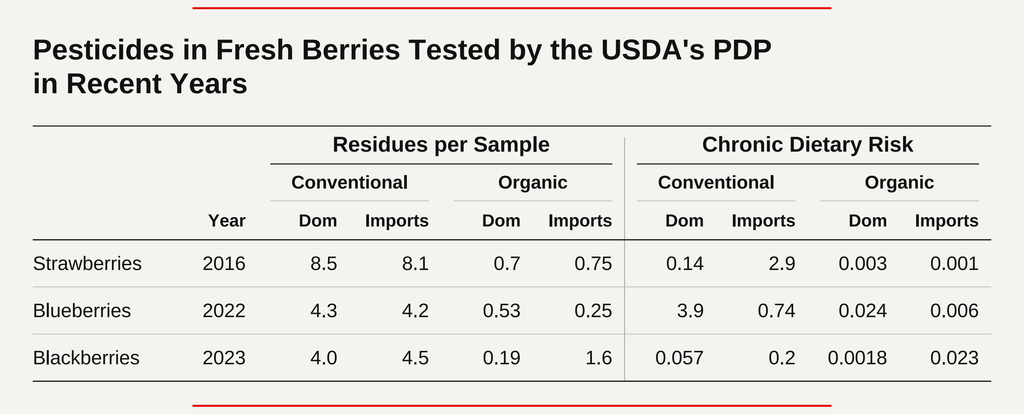
What about pesticides in berries and the impact of organic farming? There is good news, but challenges remain. The data in Table 4 are calculated via the Dietary Risk Index (DRI) model and are based on actual pesticide residue levels in food tested by USDA, combined with the chronic toxicity of pesticides according to the EPA, and pesticide dietary exposures among four-year-old children.
The good news:
- Chronic pesticide dietary risks are twenty times lower in domestic versus imported conventional strawberries, and over three times lower in blackberries.
- Just a few pesticides account for most of the risk in conventional berries, and there are usually dozens of much safer alternatives.
- Over one-third of the residues in organic blueberries and blackberries are spinosad, a biopesticide allowed for use on organic farms.
- About two-thirds of residues in organic berries are inadvertent (very low-level residues likely from drift, carryover in soil, irrigation water, or processing plants), and even fewer exceed the NOP threshold (greater than 5 percent of the applicable tolerance).
Years of data now confirm that organic berry farmers are unequivocally delivering on their promise to dramatically reduce pesticide dietary risk. “Experts” who argue otherwise are all spin and no science.
But there is not-so-great news too:
- Conventional strawberry samples contain, on average, over eight pesticide residues.
- Imported conventional strawberries pose unacceptably high dietary risks.
- Dietary risks in conventional blueberries are very high because of residues of phosmet (an old organophosphate insecticide).
- Residues of high-risk insecticides continue to account for most of the riskiest samples of fruits and vegetables.
What about organic as a share of overall supply? In 2025, organic produce accounted for 13 percent of total produce sales and 8 percent of volume. Market share is increasing, but not nearly fast enough to make America healthy again.
Organic berries grew by an impressive 12 percent in 2025, but mostly from hydroponic imports. Sales across the total berry category topped the list of organic produce items, reaching $2.4 billion. Packaged salads were second, with $1.4 billion in sales. Organic berries are already big business, are growing fast, and are increasingly moving offshore.
But how can we grow organic berry sales to at least 80 percent of the market? Easy answer: give the American public the facts about how dramatically families can reduce their pesticide dietary risks by choosing organic. They will also benefit from more nutrients per calorie and will enjoy the richer, more complex flavors of organic berries.
The Food Safety Connection
In mid-September, the FDA announced the end of an outbreak of E. coli O145:H28 infections in Florida and Georgia caused by frozen organic blueberries and mixed berries imported from Chile that were sold in Walmart and Publix stores. While there were only 17 confirmed cases, the FDA suspects there were hundreds more not reported or detected.
A case can be made for importing some fresh berries in parts of the year when fresh berries cannot be grown at scale in the U.S., but there is zero need for imported frozen berries, whether organic or conventional. Based on years of data from the government, it is crystal clear that the safest and highest-quality berries are grown in the U.S. Here at home, we can trace berries and other produce back to where they came from more quickly and accurately, so the source of outbreaks can be identified sooner, isolated, and hopefully removed from the food supply.
This is key for consumers, who would like our government to pay a lot more attention to food safety as a core national security and public health goal. It will also benefit our fruit and vegetable growers who too frequently suffer huge losses when a dangerous outbreak occurs, but the FDA struggles to pinpoint the source. Just ask commercial-scale leafy green growers coast to coast how this summer’s Cyclospora outbreak impacted their bottom lines.
Hydro-Berries?
If we want to get serious about making America healthy again, berry production in the U.S. needs to grow dramatically. There is a place for some hydroponic berries and other hi-tech indoor systems that do not entail roots drawing nutrients from healthy soils.
This is why a key first step is to fix a deep, festering, divisive problem with today’s National Organic Program rules: allowing hydro-grown produce to bear the USDA’s organic seal.
If USDA does not act, and soon, Congress can and surely will, because selling soil-less hydro-grown food bearing the USDA organic label is a big, fat lie that consumers are beginning to catch on to. Plus, certifying hydro-berries and produce as organic has opened the door to poorer quality, not-always-safe imported produce that crowds out the higher-quality, safer produce we can grow here at home. Eating far more berries — and other superfoods like leafy greens, tree fruits, carrots, and nuts- is the only way to make America healthy again, especially for pregnant women and children.
We need to adopt whatever public policies are needed to ensure that most of the growth in fruit and vegetable production happens on organic farms in the U.S. — farms that are dedicated to enhancing soil health and public health. For decades, the American public has very generously subsidized biofuel production, a technology that delivers a mixed bag of declining benefits and rising environmental, public health, and climate costs.
Shifting just a small portion of the taxpayer dollars currently subsidizing biofuels to investments in berry-production infrastructure and farming systems would deliver a panoply of economic and health benefits for farmers and eaters.
Charles Benbrook is an advocate for health-driven transformation in all things food and ag. He has served as an expert witness in recent litigation against Bayer/Monsanto.