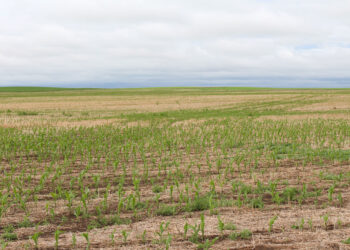

Understanding disturbance and succession helps us as eco-farmers to use our management to “steer” our site into a direction of health, fertility and stability
As farmers and ranchers, we are all ecosystem managers. Whether our system regenerates the soil and the local ecosystem depends on what we actually do with and to our system and how those management decisions affect the process of ecological succession.
According to the AI definition du jour, ecological succession “is the process by which the composition of species within an ecological community gradually changes over time, typically progressing from a pioneer species to a more complex and stable ‘climax community’ following a disturbance or the creation of a new habitat.” Whether we are row croppers or graziers, what we do to interact with succession determines the health and fertility of our present and future resource base.
Let’s quickly review a simplified version of how ecological succession operates. At some point in time, there was some type of “disturbance” that created a starting point of ecosystem development. Let’s use the eruption of Mount St. Helens in Washington as an example. There were places downwind from the eruption where volcanic ash (sand and gravel) was deposited six to 10 feet deep (the eruption of Novarupta volcano in Katmai National Park buried one valley over 600 feet deep in ash!). The ash was first colonized by the windblown seed of annual plants. At the same time, seed that had not been incinerated by the high temperatures also sprouted.
A “weedscape” resembling an abandoned crop field was phase one. This eventually filled in until it was a grassland. In the grassland, sun-loving shrub species began to colonize the site, followed eventually by longer-lived trees. There are now places in the debris path some 40 years later that are a young, closed-canopy forest. Those forests will persist there possibly for centuries and will represent a “stable state” that will look like the evergreen forests of the Pacific Northwest.
At any step in the ecosystem development, the topsoil (originally non-existent) could be observed to be increasing in depth, fertility and species diversity. What could also occur at any stage in time is that the developing ecosystem could be “disturbed” again — by wildfire, wind or ice storm, another eruption, or whatever kind of insult the site could experience. After said disturbance, the plant communities, and their dependent animal communities, micro and macro, would re-colonize disturbed patches, and the process of succession would continue again. The type of ecosystem we would see aboveground (weed field, grassland, shrubland, young forest, mature forest) would depend on the type and the frequency of the disturbances that happened to it.
Understanding disturbance and succession helps us as eco-farmers to use our management to “steer” our site into a direction of health, fertility and stability — the “stable states” described by ecologists. Let’s go through an example of this using a newly purchased abandoned crop farm.
“In the beginning” the young farmer or rancher purchases the land and immediately decides to put down a quick cover crop to hold everything in place. This mimics wind-blown seed of the “temporary” plants that colonize the site. Roots and root exudates charge the mineral soil with carbohydrates from sugars to lignin and cellulose. The soil life begins to thrive on the new food source, and suddenly there is an availability of plant nutrition in order to grow the next successional stage of vegetation.

If this process is interrupted by tillage or another volcanic eruption, what little organic matter is in the soil is oxidized into the atmosphere, and liquid nutrients are leached away. The site becomes less fertile. The soil is in a state of degeneration. This has been the history of annual agriculture for centuries and is why crop yields were in decline, causing humans to search for something they could add to the soil to help plants grow better. At the extreme, this practice has led to hydroponics, where the soil is nothing more than a medium to hold plants in place while we add liquid nutrients to keep the plants alive.

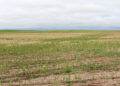
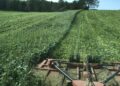
If we are going to grow annual crops (most grains and vegetables) we will need to either add fertility to the system or manage our system in such a way that the natural process of soil regeneration can occur as best as it can within our context. Under-sowing row crops with a low-growing legume such as white clover, and following our main crop with a winter cover crop, is one way to keep the soil covered and to feed the soil life with the carbohydrates it needs. Adding some crop fertilizer (exogenous fertility inputs that mimic flood deposition of nutrient-rich sediments, manure from migratory animals, etc.), and adding various biologicals as found in compost teas, vermicompost extracts and ferments, can accelerate the nutrient conversion in the soil.
Annual crops grown with under-sown companion crops and followed with winter cover crops can grow quite well, and the soil can incrementally build through the years. As long as the recovery exceeds the removal, we are on the path to creating healthier soils with increasing yields.
After a year or two of experimenting with winter cover crops, perhaps the farmer decides to begin practicing crop rotation. Management has changed. After the main crop is harvested, perhaps a winter grain is chosen as the cover crop, and in year two, instead of lightly incorporating the green cover crop into the soil, the farmer decides to over-seed the field with a cover crop mix and let the grain crop mature.
Management has changed again, and the soil building process has accelerated. There is more gain than setback. More hard, woody organic matter is now on the site (both above- and belowground). Harvesting the grain crop “releases” the cover crop mixture, and it quickly grows to dominate the site. This cover crop can then be grazed, bringing more exogenous fertility to the site.
Look what has happened: in only one calendar year of changed management, the farmer has increased soil health and fertility while still having 100 percent of the land in row crops. In spring of year three, the farmer could decide to disturb the site again and go back to the first crop (corn or potatoes, for example), and the soil is more fertile than when they started. Tillage has been reduced to once every two years, which reduces compaction, which allows for water and roots to penetrate more effectively, and a virtuous cycle has begun. Soil organic matter begins to increase, which increases water storage capacity and provides additional nutrients as the humus and roots decompose.
If all farms were to begin adding a winter cover crop to their program, the cumulative change across American farmland would be huge! Adding a winter grain to the scheme could reduce tillage (or herbicide burn-down) on American farmland by 50 percent in a mere two years, while still having our farms fully cropped (yes, there would be an increase in small grain production and a decrease in corn, but food and/or animal feed would still be produced).
This agricultural ecosystem would resemble a Mount St. Helens ash field being disturbed every three years or a river floodplain being coated with silt every few years — this is how our grain-based annual agriculture originated.
Next month we’ll continue to look at how disturbance and succession can be implemented on ecological farms.
Mark Shepard is a land designer and consultant and is the author of Restoration Agriculture, Water for Any Farm and the Water for Any Farm Technical Manual.