

Sweet potatoes need not be merely for Thanksgiving dinner — Dr. Janice Bohac is developing varieties that can produce more than four times more ethanol per acre than corn
Acres U.S.A. What’s your background — how did you get interested in sweet potatoes?
Janice Bohac. I have a Ph.D. in plant breeding and genetics, and I was a sweet potato breeder for the USDA Agricultural Research Service for about 20 years.
Sweet potato had a lot of potential back in the old days. My predecessor was working on sweet potatoes for gasohol, so I decided to take early retirement and bought my own research farm, and I’ve continued to work in this area.
Most people don’t realize that sweet potato is the sixth largest crop in the world, but 90 percent of the world’s sweet potatoes are grown in Asia, and 90 percent of those are grown in China.
Acres U.S.A. And this is sweet potatoes proper, not yams.
Bohac. Correct. Yams are Dioscorea — a different genus altogether, not related to sweet potato.
I think of sweet potato as being parallel with corn. You’ve got your vegetable sweet corn, which is handled very carefully and is expensive to grow but is very profitable. And then you’ve got all the other kinds of corn, particularly field corn, that go into a lot of industrial uses — fuel ethanol of course being one of them. Sweet potatoes are used this way in China. There are varieties to eat, but they also have other varieties that they extract the starch from and use for making paper, coatings, munitions and all kind of industrial uses. It’s like how we use corn starch.
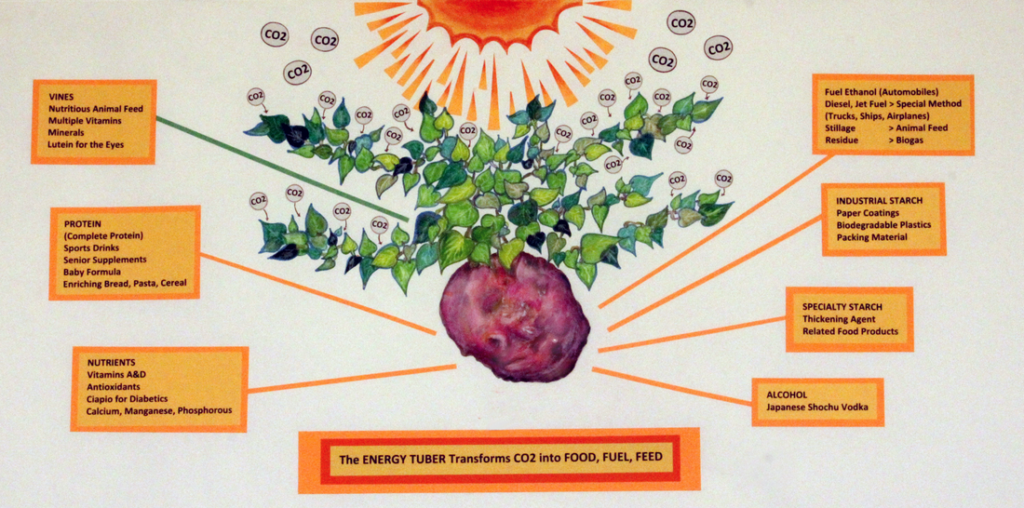
So, there are a lot of uses for sweet potatoes. Its biggest selling point is that it can yield a whole lot more than corn per acre — four-and-a-half or five times as much starch per acre as corn. It’s an indeterminate crop, which means the longer you grow it, the bigger it gets. And it doesn’t waste a lot of energy. With a corn plant, you grow stalks and stems and a cob, and the only part you really want are the kernels. Same thing with soybeans — the only part you want is the oil that’s in the seed.
Whereas sweet potatoes are kind of like a solar panel. You’ve got a big leaf, like a solar panel, and you’ve got a vine — think of that like a cable. The cable goes down underground to the potato, which is where it’s storing all its energy. It doesn’t waste a lot of energy making a lot of structure.
It’s a crop that needs a long growing season, but it grows in poor soils. One of the big things I worked on at USDA was breeding for insect resistance and nematode resistance, and we have varieties with excellent resistance to 14 insects and root-knot nematodes. We have allelopathy in some of the lines for weeds. So, we have a lot of interesting traits.
Acres U.S.A. We grow sweet potatoes here in southern Michigan, and the yield is incredible, and they don’t seem to have much pest pressure. But we’re not maximizing yield like you could do in the South. And deer love them.
Bohac. Yes, I have the same problem. I have electric fence all around my research farm.
Acres U.S.A. But sweet potatoes wouldn’t necessarily be in a third crop, correct? If by some miracle crop insurance subsidies went away and farmers were forced to do things in a more ecological nature and have more crops in their rotation, it’s not like sweet potatoes would be a great third or fourth crop for a grower in Iowa or Illinois to integrate with their corn and soybeans, right?
Bohac. No, we’re looking at Sunbelt states. BBI International puts out maps every year of where all the operating ethanol, biodiesel and biomass plants are. Right now they’re all clustered in the Midwest; there’s about five in California, but they’re bringing corn in from the Midwest for those plants. That makes it a little less green, doesn’t it?
In the southern states, where you have longer growing seasons and land prices are more reasonable, you think this could be an industry. But the number one reason is that there isn’t good seed stock. Corn gets maybe half the yield here in the South compared to the Midwest, and we’re having more and more problems with high temperatures.
But sweet potato loves the heat. It fixes a lot of CO2. Our varieties can fix more CO2 per day than any other temperate crop during the growing season. We did some preliminary work with a local professor here with his LI-COR to measure CO2 and photosynthesis rates. It was August and 95 degrees, and the sweet potato plant was just taking in the CO2and photosynthesizing. He was impressed. I said, “What would corn be doing?” He said, “It’d be shut down because it’s so hot.” Sweet potato is indeterminate; it doesn’t mature at any point and stop growing like the grain crop would.
Acres U.S.A. What would you say are some of the reasons sweet potatoes have not been adopted as a fuel crop? I would speculate that, at least here in the Midwest, we get told, “don’t till, don’t till — no-till is better.” The thought of digging to harvest sweet potatoes is probably anathema to many farmers these days.
Bohac. I actually think there are various reasons — climate change and all these wars we’ve gotten sucked into in the Middle East, and even just air pollution — this is really why we started using fuel ethanol. The so-called clean-air cities needed to oxygenate their gas better, and they were using MBTE, which was very toxic. It was getting into groundwater. So, they were looking for a safer alternative. And ethanol, if you mix a 10 percent blend, does help oxygenate. And as climate change has gotten more and more severe, we’re definitely looking for alternatives.
In 2010 or 2011, I started seeing all these editorials about food versus fuel and turning straw or corn stover into fuel. It’s very attractive idea. It just doesn’t work. Nobody has built a commercial, successful, long-term cellulosic ethanol plant yet. It takes one mole of sulfuric acid or very specialized, expensive enzymes to break the glucose units in cellulose. Starch and cellulose are both polymers of glucose, so if you want to break that bond between the glucose units in starch, the enzymes in your mouth can do that. It costs maybe 2 cents a gallon to use those enzymes. With cellulose, the enzymes they have are very expensive genetically engineered bugs.
Think about a cellulosic ethanol plant — you need Ph.D.’s and engineers and all kinds of safety protocols to run that facility. What if those bugs escape and start multiplying and swapping genes with wild types? Not a good thing.
USDA and DOE built a demonstration plant in Vero Beach, Florida, to do cellulosic ethanol from wood pallets and things like that, but when they got the plant operating, it started emitting cyanide. Structural plant materials often have very toxic compounds in them. Whereas with the food part of the plant — we bred that out.
But all of the grants for ethanol research were for cellulosic crops only; because my crop was a “food crop,” they wouldn’t fund us. In 2014 or 2015, we were finally able to get a small grant with the state of Florida. They had a program they ran for 12 years called Farm to Fuel. We connected with a professor there who was an ag engineer, and we did an initial greenhouse gas analysis with that grant.
I would say that the only other big downside to sweet potatoes is that we’re about 50 years behind on mechanization compared to corn. We’ve tested different, less-labor-intensive transplanters. For harvesting, there are all kinds of fast and efficient harvesters for potatoes; we’re pretty certain those could be adapted for sweet potatoes.
Acres U.S.A. Those probably wouldn’t work in harder clay soils in the Southeast, though, right?
Bohac. We actually have a lot of sandy soils in the coastal plain, which runs from Florida all the way up to South Jersey. If you draw a line down South Carolina, around Columbia along I-95, the soils up there start turning to clay. But the coastal plain soils are perfect for sweet potato. They’re not very high in organic matter, but sweet potatoes don’t use a lot of nitrogen. If you put in nitrogen, it starts washing away after a certain point. And then you want a high phosphorus-to-nitrogen ratio during potato bulking. But if you have a high nitrogen-to-phosphorus ratio, you get a lot more vine and a lot less potatoes. It influences partitioning.
Acres U.S.A. So, theoretically, if farmers were growing this, and if there were a refining opportunity where sweet potatoes were being grown, would it turn into the same product as corn ethanol?
Bohac. It’s better than corn. In theory, ethanol is ethanol. A plant can use corn sometimes and sweet potatoes sometimes, and maybe grain sorghum — they’re all starch crops.
We ran some fermentation trials at the National Corn Ethanol Research Center. Typically, corn takes 48 hours to completely break down the starch into sugar and then ferment that to turn it into ethanol. With sweet potato, it took 24 hours to come to completion, which would save a lot of electricity or natural gas.
The reason for this is that there are a lot of resistant starches in corn. You have structures that are pretty complicated. You’ve got a pericarp — the skin around the corn — it’s pretty tough. There’s all kinds of cellulose and little fibery things in the corn. And it’s not very uniform. Whereas sweet potato, in contrast to even sugar beet, is basically a bowl full of starch and sugar.

This particular variety we’ve been working on is about 33 percent dry matter, and 90 percent of that is starch and sugar — so it’s almost all carbohydrate. It has a little hemi-cellulose — the little string that you might see in a sweet potato. That’s easily broken down with a little bit of acid. It’s really not like cellulose.
Acres U.S.A. How many pounds per plant are you getting?
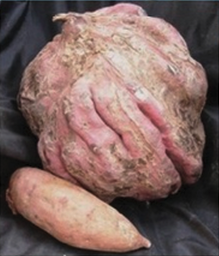
Bohac. It varies. I did my Ph.D. work on regular potatoes, and it was amazing to me the plant-to-plant variation in the number of potatoes that would set. It’s better to look at averages. We’re getting about 45 tons per acre. The typical orange sweet potato is maybe 12 tons per acre. And of course, we can use everything — we don’t care if it’s crooked or the end got cut off or whatever.
So, 45 tons per acre, with 33 percent dry matter, ends up being 15 tons of dry matter per acre, of which 13.5 tons is carbohydrate. The rest is a very valuable storage protein that could be used as a food product. The first thing the processor would do would be to mill that out for the food market — like how they’re using pea protein now to make Beyond Burgers and all kinds of drink supplements. I think it could replace casein because it’s non-GMO; this is a white sweet potato, so it’ll make a dry powder that’ll be very nice.
Acres U.S.A. And you’re not using genetic modification in your breeding efforts, correct?
Bohac. No. In the ’90s, this controversy about genetic engineering and Roundup Ready came up, and people were all upset about it. USDA is sensitive to this kind of stuff, and our lab had been selecting for naturally Roundup-resistant clones, and we were in fact making some progress on that. And when our scientists tried to get the papers published, they made them water it down and make it sound like these were just breeding lines being released — that they weren’t specifically for herbicide tolerance, because they didn’t want the controversy.
The same thing happened with the project I was working on — food versus fuel. We had to say we were working on a food crop — because what’s going to happen to our Thanksgiving sweet potatoes? The world’s going to starve without them! But we knew that the world was going to get a very nice protein, plus fuel, plus the vines, which make excellent cattle feed. In much of the world, people feed the vines to cattle and pigs and other livestock.
Acres U.S.A. What about planting and cultivation — how does that work for commercial-scale sweet potatoes?
Bohac. They get transplanted into beds as plants. Typically, at least on the East coast, we don’t like to use slips because that may bring some disease and maybe nematodes and things you don’t want to carry over. So we transplant cuttings, and they’re planted 12 inches apart within the bed, with 36 inches between rows. They need plenty of room to spread out.
As far as weeding, we cultivate until the vines get too big.
Acres U.S.A. Your primary goal in developing this breed of sweet potatoes is for aviation fuel; lead-free aviation fuel is the holy grail, right?
Bohac. Right. It’s what they call sustainable aviation fuel. The biggest concern is to reduce greenhouse gases and any other pollution. All those trails you see coming from jet planes, it’s all the junk. There’s a commitment by the Commercial Aviation Association to switch to biofuels — 50 percent by 2035 and 100 percent by 2050. That’s a big goal. They’re going to have to really increase feedstock. They’ve been making it from grease and leftover oils — soybean oil, anything like that. But that’s not going to work; it’s too expensive, and there’s a limited amount of those feedstocks.
To produce biodiesel, for example, soybean oil makes about 70 gallons of oil per acre and canola might do 110. Corn makes 300 to 400 gallons per acre of ethanol in the Midwest, but my sweet potatoes can produce 1,800 gallons of ethanol per acre. So, the land use is problematic if you’re going to use vegetable oil; with ethanol, you can get much higher amounts with sweet potatoes.
There’s a plant in Soperton, Georgia, that just opened that’s using a process called alcohol-to-jet fuel. It marries two very proven, scalable technologies. The first is taking corn, or sweet potato or sugar beet or whatever, and make it into ethanol. We know we can produce 50 million gallons a year in a plant, and it’s affordable. Then they take the alcohol and marry it to another process used in the petroleum industry — they take petroleum, which has long hydrocarbon chains, and they crack it into short chains, and then they have a series of catalytic steps that puts on a carbon and puts on a hydrogen and puts on a hydroxide, etc., through a number of steps. At the end, you have jet fuel.
So, they figured out how to take ethanol as a starting material — not petroleum — and do the same thing. With this technology, sweet potato makes a whole lot more sense to use as a feedstock than corn. The biggest challenge we have, according to our analysis, is that this plant in Georgia uses natural gas to process the fermentation and distillation of the stock. If we change that to renewables, we drop it way down.
The point is that by marrying two very proven and scalable technologies, biofuel-based jet fuel is possible, and it’s cleaner. You don’t have all those trails. The engines run cooler, and they aren’t going to need as much maintenance. The military is pretty excited about this, and the commercial industry is too. If they tried to use some exotic weed as a feedstock, or tried to get it all from oil crops, I don’t think it would be affordable.
Acres U.S.A. How would sweet potatoes fit into a rotation in the coastal region in the Southeast?
Bohac. It could just fit into the rotations we already have here — cotton, soybeans, corn. There’s peanuts sometimes, instead of soybeans. Land use is a concern. I’ve done some calculations that show that we could reduce some of the cotton acreage —we have 20 million acres in our state, and we have 11 million acres of pine trees. So, we could take out some non-food crops and still not affect the food crops at all.
Acres U.S.A. And if you’re rotating it with peanuts, you already have a crop where you’re plowing to harvest a crop. I assume it wouldn’t use the same equipment, but it’s the same idea.
Bohac. We don’t want our soil blowing away like in the Great Depression, and we’ve got colonies of microbes we don’t want to disturb too much, but in terms of fertility, we can reestablish those things even if we do plow.
Acres U.S.A. Absolutely. Tilling likely isn’t the great evil that a lot of people portray it as. Glyphosate and herbicide use is far more concerning than some degree of intelligent, responsible tillage. Like you said, the microbiology can be reestablished very quickly. And in no-till you can even get worse compaction in the long term — and stratification of nutrients. Zealous no-tilling is way overhyped.
Speaking of crops that have to be dug up, why have you focused on sweet potatoes as opposed to a crop like regular potatoes, which are already grown on a large scale here in the states?
Bohac. Sweet potatoes just have more starch and better yield. In Europe they have these potatoes that are higher in starch than a typical one you’d buy, but they still aren’t that high — they don’t have 33 percent dry matter like we have — that just doesn’t exist in potato. The CX1 — my high-yielding variety for ethanol — has similar properties to potato starch.
But potatoes have an upper limit on how much they can yield. First of all, you grow them in cooler climates; sweet potatoes can grow in very hot climates. But secondly, potatoes are tetraploid; they have four sets of chromosomes. Sweet potatoes are hexaploid, and size is very much related to the number of sets of chromosomes you have. Like strawberries — little wild strawberries are diploids, but beautiful (not always so tasty!) strawberries in the store are octoploids. That’s how you get the size. Sweet potatoes just have a lot more potential because they’re hexaploids.
I look at this crop as being like soybeans, when they were first introduced in the early 1900s. No one grew it; it was a Chinese crop. I see this like the new potato and the new corn, because it can be used for multiple things. And in hotter climates, we’re going to need crops that can take the heat.
Acres U.S.A. You need a Henry Ford for sweet potatoes — he was the guy who made the soybean what it is today, for better or for worse.
Bohac. It’s good in a lot of ways, but we now need to be smarter — we need to work more with nature than we used to. And remember that Henry Ford designed the original Model-T to run on corn ethanol. In a sense this is “re-search” — we’re going back, to find what might’ve been a better way of doing things.
| Learn more about Dr. Bohac’s work at carenergyinfo.com. |