

Plants Might Be Helping Each Other More Than Thought
Contrary to the long-held belief that plants in the natural world are always in competition, new research has found that in harsh environments, mature plants help smaller ones — and both thrive as a result.
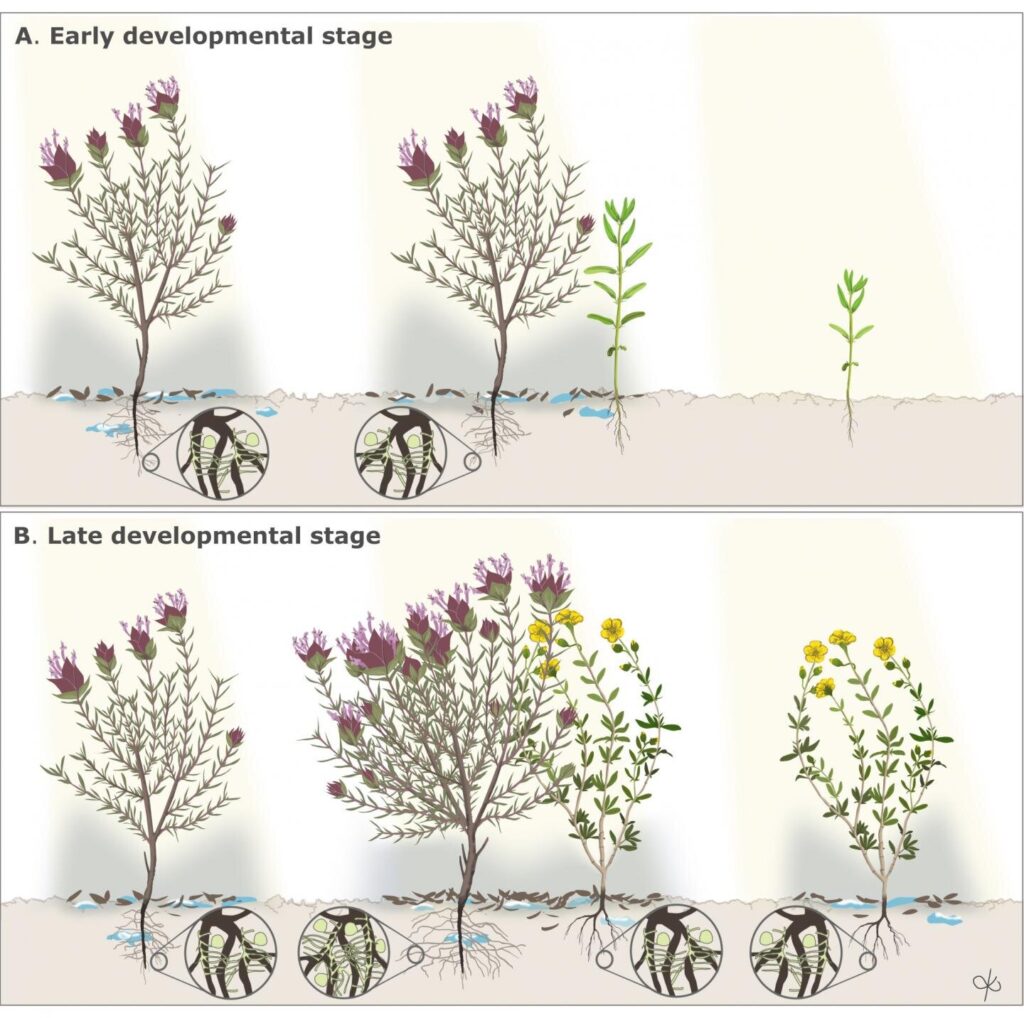
A study examining plant interactions in a hostile environment over their lifespan found that plants sheltering seedlings help the smaller plant survive and are more successful themselves — a process in ecology called facilitation. The study focused on adult and seedling plants in the “ecological desert” of gypsum soil in the southeast of Spain.
The findings could have significance for those managing harsh environments, including coastal areas. “If you’re a seedling in a barren landscape — the top of a mountain or a sand dune, for example — and you’re lucky enough to end up underneath a big plant, your chances of survival are certainly better than if you landed somewhere on your own,” stated one of the researchers.
“What we have found — which was surprising — is an established large plant, called a ‘nurse,’ shields a seedling. It also produces more flowers than the same plants of similar large size growing on their own.”
This win-win for adult and seedling plants in harsh environments has not previously been reported. By studying plants’ entire lifespan, the researchers were able to discover that benefits for both plants stack up over time. The seedling benefits from shade, more moisture and more nutrients from the leaf litter of the nurse plant, and probably also from higher numbers of bacteria and fungi in the soil.
Another benefit of nurse-seedling partnerships is that more varieties of plants growing together can trigger a positive cascade of effects in the environment. For example, vegetation patches with nurse and facilitated plants with more flower density might be able to attract higher numbers and diversity of pollinators in an area, in turn supporting insect and soil life and even providing a greater range of different fruit types for birds and mammals.
| Why does this matter for growers? The idea that biodiversity produces a win-win situation is not that surprising to ecologically minded farmers. But it’s encouraging to see research that is able to document the cooperation that often does occur in nature — contrary to the popular conception of dog-eat-dog evolution. What’s not clear from this study alone is how agricultural crops in healthy soils respond to lack of competition versus having other similar plants present. Weeds obviously reduce plant growth because they compete for resources with cash crops, as does tighter seed planting; the key for growers is to identify the situations in which the principle reported in this study applies. |
Modern Tomatoes Can’t Get Same Soil Microbe Boost as Ancient Ancestors
Tomato plants are especially vulnerable to foliar diseases, which can impact yield — requiring a number of pesticides in conventional crops and making organic production especially difficult.
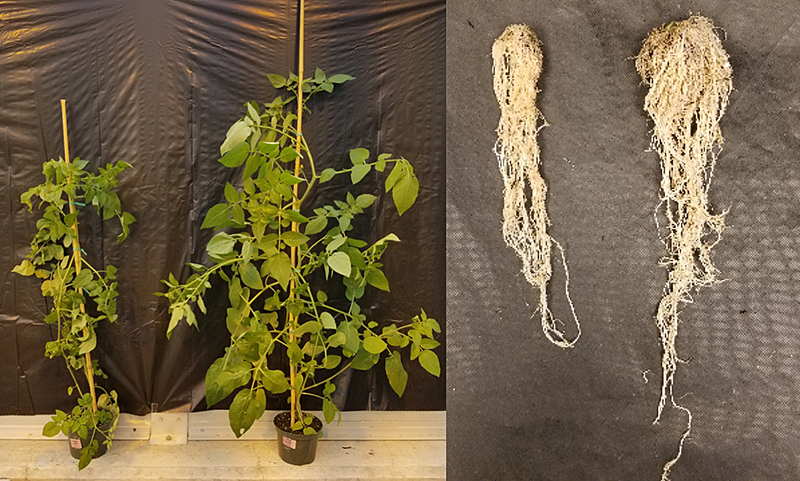
A Purdue University-led team of scientists has evidence that tomatoes may be more sensitive to these types of diseases because they’ve lost the protection offered by certain soil microbes. The researchers found that wild-type tomatoes that associate more strongly with a positive soil fungus grew larger, resisted disease onset and fought disease much better than modern plants.
“These fungi colonize wild-type tomato plants and boost their immune systems,” said Lori Hoagland, an associate professor of horticulture at Purdue. “Over time, we’ve bred tomatoes for yield and flavor, but it seems they have inadvertently lost their ability to benefit from these soil microbes.”
Hoagland and her team inoculated 25 diverse tomato genotypes — a range of wild types to older and more modern domesticated varieties — with Trichoderma harzianum, a beneficial soil fungus often used to prevent malicious fungal and bacterial diseases.
In some of the wild-type tomatoes, the researchers saw up to 526 percent more root growth in plants treated with the beneficial fungus compared with those that weren’t treated, and as much as 90 percent more plant height. Some modern varieties had as much as 50 percent more root growth, but others showed no increase. Height in modern varieties increased about 10-20 percent — far less than the wild types.
The researchers then introduced the plants to two disease-causing pathogens — Botrytis cinerea, a necrotrophic fungus that causes gray mold disease, and Phytophthora infestans, a blight-causing mold that was responsible for the Irish potato famine in the 1840s.
The wild types showed increased resistance by up to 56 and 94 percent for the two pathogens. However, Trichoderma actually increased the disease levels in some genotypes — generally in modern plants.
“We saw significant response to the beneficial fungi in the wild-type plants, with increased growth and disease resistance,” a researcher said. “As we moved across the spectrum toward the domesticated varieties, we saw less benefit.”
Hoagland said her team wants to identify wild-type tomato genes responsible for soil microbe interactions and reintroduce them to current varieties. The hope is to keep the traits growers have selected for over thousands of years while recapturing those that make the plants stronger and higher yielding.
“Plants and soil microbes can co-exist and benefit each other in so many ways, but we’ve seen that the plants we’ve bred for certain traits have broken that relationship. In some cases, we could see that adding what should have been beneficial microbes actually made some domesticated tomato plants more susceptible to disease,” Hoagland said. “Our goal is to find and restore those genes that can give these plants the natural defense and growth mechanisms that they had so long ago.”
| How can growers use this information? How did modern tomato varieties lose their ability to live in synergy with certain soil bacteria and fungi? Likely because they were bred for decades to receive their nutrition from external sources — mainly applied macronutrients. As with muscles we rarely use, a vegetable’s traits that don’t get exercised atrophy.There should be concern that researchers will react to this report by calling for the reintroduction of the desired traits via modern genetic modification techniques. But for growers, the key takeaway is that varieties really do matter — and that whether selecting seed themselves or relying on a trusted seed producer, growers should choose seed that is specifically designed for regenerative and organic growing systems, in order to take advantage of the soil life they have worked so hard to cultivate. |
New Ways of Measuring Life
In keeping with this month’s theme of new technology within agriculture, here are three examples of new equipment and techniques that researchers are using to monitor — in near-real time — the behavior of living organisms.
Observing Tree Growth with Dendrometers
Our unaided ability to observe tree growth happens on the scale of weeks, if not years. But based on what we know about plant photorespiration, it’s not hard to imagine trees physically growing and shrinking in accord with a daily photocycle — if not also with other events.

Dendrometers are devices that allow researchers and growers to precisely measure — and, hopefully, gain insight from — tree growth. Different versions operate different ways, but the basic idea is that a band is wrapped around the trunk or branch of a tree and is connected to a very sensitive detector that measures the pressure on the band and converts it to an electrical signal. Modern dendrometers can detect changes in the micrometer range and are available for just a few hundred dollars.
Results show that growth and recession do, in fact, follow a daily cycle. Dendrometers can also quickly tell researchers and growers how external factors affect growth — weather events, foliar inputs, etc.
Versions of the dendrometer also exist to measure the growth of an individual fruit. It’s not hard to imagine this being useful to a grower — to observe in real time how specific irrigation or foliar inputs affect the size (if not, necessarily, the quality) of fruit.
For a good journalistic story on dendrometers, check out “A Day in the Life of a Tree” at newyorker.com.
Seeing Microbes via Microfluidic Chips
Most of what we know about soil biology comes not from direct observation of the soil but by sampling the soil and placing it under a microscope or some other laboratory device. This disturbs the original environment — particularly the delicate subterranean dwelling places of fungi and bacteria.
To try to avoid this disturbance, researchers at the University of Lund in Sweden have developed “microfluidic” chips that enable them to observe soil microbes in real time. The silicon-polymer chips imitate soil and are mixed 50-50 with real soil in the lab or in the field.
The researchers were able to directly examine the fungal highways that bacteria transit through the soil. They also observed a surprisingly large number protists — single-celled organisms different from bacteria — along these fungal hyphae. They discovered how influxes of water (via rain or irrigation) affect fungal pathways and how fungi seem to open up some passages and block others, shaping where the bacteria and protists can go.
For more information, see “‘Cyborg Soil’ Reveals the Secret Microbial Metropolis Beneath Our Feet” at theconversation.com.
Listening to the Soil
Alongside advances in being able to see soil life in action, other researchers are learning how to listen to large soil organisms such as worms and grubs, as well as plant roots themselves.
Bioacoustics — sometimes also called biotremology or soil ecoacoustics — is a new field of research that focuses on listening to the life in the soil. A simple metal rod acts as an antenna and is stuck into the ground and then attached to various listening devices. This enables researchers to hear, for the first time, micro- and macroorganisms and plants traveling, hunting and eating. Other larger creatures already do this — some birds, turtles and other animals seem to actively listen for the sounds of potential underground prey.
Larvae give out short clicks as they eat roots. Worms and plant roots produce rustling noises as they squirm through sand, silt and clay — the roots slower and more steadily than worms. Researchers can hear when plants are growing — and when they are not — in response to weather, irrigation, fertilization or other external stimuli. They are also attempting to use bioacoustics to identify subterranean pest infestations.
Check out “Life in the Soil Was Thought to be Silent. What If It Isn’t?” at knowablemagazine.org to learn more.
FDA: 59 Percent of Tested U.S. Foods Contain Pesticide Residues
A newly released document from the FDA entitled “Pesticide Residue Monitoring Program Fiscal Year 2020 Pesticide Report” shows the ubiquity of pesticides in our food supply.
About 77 percent of fruits, 60 percent of vegetables and 53 percent of grains grown in the U.S. contained pesticide residues. Over 51 percent of imported foods also had residues.
The overall U.S.-grown total — 59 percent — is up slightly from 2019.
The FDA says that 96.8 percent of domestic and 88.4 percent of imported foods they tested were not in violation of their “maximum residue limits” (MRLs). “The findings show that the levels of pesticide chemical residues measured by FDA in the US food supply are generally in compliance with EPA pesticide tolerances,” the report states.However, as reported by Carey Gillam (careygillam.substack.com), many scientists — and members of society at large — have concerns about long-term effects of even low levels of chemicals in food. EPA also does not have separate standards for infants or children, and it has raised the legal limits for several chemicals over the years at the request of manufacturers of those chemicals — including several times for glyphosate.