
Operational analysis is an important part of the farmer safety net
This aspect of the farmer safety net is something everyone can do, regardless of where you are, what you grow or who you’re surrounded by. Operational analysis is simply the process of determining how to do what you do better.
It’s easy to think you don’t need to examine your operations. They’re working just fine, right? Your product is growing well, there’s money in the bank — it’s fine. OK, maybe there isn’t money in the bank … but your time will be better spent selling your product than figuring out how to grow it better, you think.
Yes, if you have product taking up space, it is more important that you sell it. But that doesn’t change the fact that understanding where and how you spend your time on your farm will make your business more resilient.
Determining Red Flags
When considering how to approach operational analysis, first consider a few basic questions.
What hurts?
Physically, what is causing you pain? When you sink into a chair at the end of the day, is it your back that’s complaining? Knees? Shoulders? Those pains are clues to movements throughout your day that you could be doing differently. Pain isn’t sustainable in the long term, so if you’re dealing with it consistently then you need to figure out how to address it.
What time of year do you fantasize about burning it all to the ground?
Is it when you’re trying to get the hogs loaded to head to processing? When you’re stooped over the five-thousandth bush bean plant? When the temperatures hit 95+ or -20? Those fantasies are telling you something too — those are parts of your operation that are worth examining for potential improvements.
Who’s complaining?
Are you hearing consistent complaints from your staff or your customers? These complaints are signs of a process that could use improving — and one that could cost you some money in the form of lost customers or needing to hire and train new staff.
Analyzing Solutions
Now that you have a sense of the processes in your operation that are jumping up and down waving red flags, let’s take a look at how to put them in context.
What are you growing?
If you have one or two crops, this is a simple answer, but if you have a diversified operation, you can spend a lot of time getting the answer to this question out of your head. And it needs to get our of your head. When you’re keeping track of all your operations mentally, it’s incredibly easy to overlook problems and assume you’ve got it under control. Those red flags that you just identified are evidence to the contrary. So sit down with a notebook, a whiteboard, a roll of butcher paper, a spreadsheet, a mind map — whatever your preference is — and start mapping out what you’re growing.

Your goal here is to get a visual on the rhythm of your farm. When do animals come and go? What times of year are chaotic? When do seedlings get transplanted, fertilized, cultivated? How long are plants in the ground before harvest? This may sound like a waste of time, but it’s incredibly important as a foundation for the next steps of your operational analysis.
Where do you spend your time?
Now that you have a written record of what you think you spend your time on, it’s time to figure out how much your brain has lied to you.
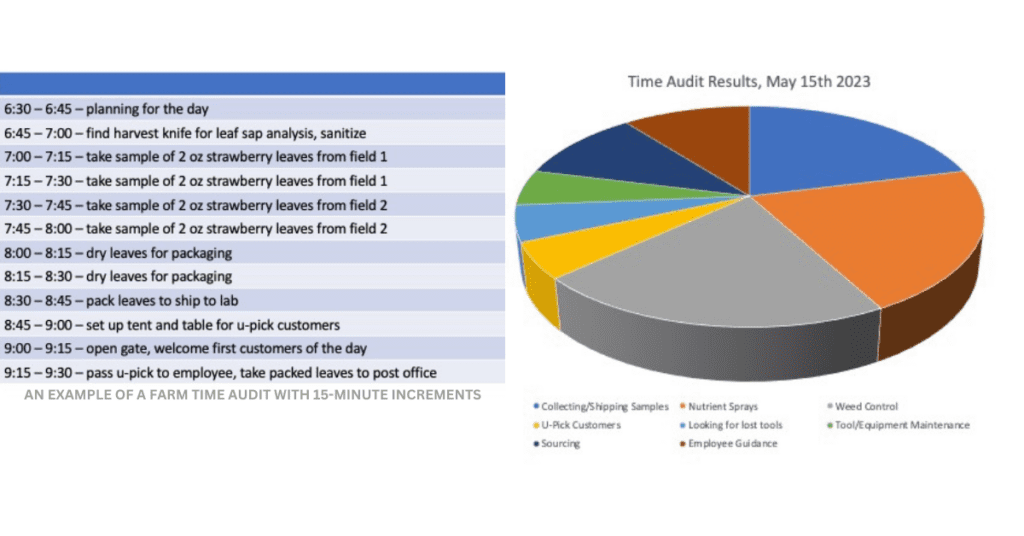
There are several ways to do a time audit, but the core of each method is the same: pick a length of time (say, 30 minutes) and pause periodically to record what you’ve done during that length of time. Do that for a few days in a row, or do it one day out of each month.
Yes, your days are never the same. Yes, this is a pain in the rear. Yes, this feels constricting, and you don’t like opening your routines up to scrutiny, even from yourself. But, do you want a resilient farm business? Do this exercise. I’ve never seen anyone go through this process and not come out with some valuable insight into their daily activities.
That said, make it easy. Pick your time increment — 15, 30 or 60 minutes. Set a timer on your phone. Keep a running note on your phone or a small notebook in your pocket or download a time-auditing app to help with the process. Tell yourself that you don’t have to DO anything with the information, if that makes you feel better about collecting it. You can conduct a time audit, look at the results, and decide what you’re doing is just fine. You’re doing this in service of your business.
What do you do once you know what you’re doing?
Once you have the results of your time audit, compare them to the brain dump you did earlier. Where was your brain lying to you?
Highlight the actions you take related to the areas where you have red flags — pains, complaints, etc. What jumps out? Perhaps there’s a specific crop that’s associated with a lot of red flags. Look at how much money you made from that crop and decide whether it’s worth the pain it causes. Maybe everyone’s life is easier if you just cut the thing entirely.
If that doesn’t make sense, then look at the time you’re spending on those red flags. What could change?
Maybe there are a lot of injuries that happen when loading animals; could you consider changes to infrastructure or how you approach those tasks? Is it worth spending some time training pigs to get into a trailer in the weeks before they go to the processor?
Maybe you spend an hour a day trying to find the tools you need to complete a task, or maybe once a week you end up repairing something that isn’t up for the job you need it for. Can you invest in tool storage near where the tools are needed? Paint tools a bright color to make them more visible if they’re left where they shouldn’t be? Hire someone to come in monthly for tool maintenance and repairs?
Do you spend 15 minutes picking off-color leaves out of each batch of arugula you wash? What’s causing the issue — is it pests, disease, nutrient deficiencies, weeds? Can you make changes earlier in the growing process to reduce the time it takes to wash and pack 50 pounds of arugula? Chances are that those changes will also increase your sellable yield at the same time as decreasing your time spent.
You can also do nothing with this information. Maybe you have a few cows and a small business selling raw milk; yes, you could save time with a milking machine, but you value the time spent with your hands on the animal and find peace in the routine of milking. That’s totally fine.
This process isn’t about making your business run with the efficiency of an Amazon warehouse — it’s about shining light on things you do without thinking about them, and consciously deciding whether those are things you want to continue doing. Very few (if any) farmers reading this magazine are answering to shareholders or others who care more about the bottom line than about human costs. A resilient farm business is about more than money in the bank — it’s about building sustainability into our lives, environments and communities, spending time doing what we love, and building connections that last.
Kirsten Simmons is the co-founder and Chief Farming Officer for Good Agriculture (goodagriculture.com), a company dedicated to helping farmers find funding, manage finances, reach new customers and get certified. She also farms at Ecosystem Farm (ecosystemfarm.com), the only u-pick strawberry farm inside Atlanta.