• Home
  • Events

    Upcoming Events

    • Menoken Farm Field Day
    • Eco-Ag Conference
    • View all events →

    Recent Webinars

    • Kyle Richardville
    • David Montgomery
    • Gary Zimmer
    • Taylor Henry
    • Fernando Falomir
    • Megan Neubauer
    • David Knaus
    • View more webinar replays →
  • Bookstore

    Books by Category

    • Soil Health
    • Livestock & Animals
    • Gardening & Homesteading
    • Farm Business
    • Health & Food

    Books by Collection

    • New Releases
    • The Albrecht Volumes
    • Acres U.S.A. Published
    • Eco-Ag Speakers
    • Soil Health Educators

    Books by Level

    • Beginner
    • Intermediate
    • Advanced
    • Kids

    Featured

    • Explore Jon Stika's New Book →
  • Resources

    Continue Learning

    • White Papers
    • Online Courses

    Where to Find Us

    • Acres U.S.A. Podcast
    • YouTube Channel
    Facebook Instagram X-twitter Linkedin
    • Join our Newsletter →
  • Articles

    Articles by Topic

    • News
    • Ecological Farming
    • Livestock
    • Soil Health
    • Opinion

    Articles on Crops

    • Cover Crops
    • Crop Nutrition
    • Disease & Pests
    • Fruits & Nuts
    • Ag Technology

    Magazine Issues

    2026
    • January
    • February
    • March
    • April
    • May
    • June
    • July
    • August
    2025
    • January
    • February
    • March
    • April
    • May
    • June
    • July
    • August
    • September
    • October
    • November
    • December
    2024
    • January
    • February
    • March
    • April
    • May
    • June
    • July
    • August
    • September
    • October
    • November
    • December
    • Explore the archives →
    • Subscribe to the magazine →
  • About

    About Us

    • About Acres U.S.A.
    • Meet Our Team
    • Our History
    • Eco-Ag Achievement Award

    Contact Us

    • 970-392-4464
    • support@acresusa.com

    Acres U.S.A. LLC
    PO Box 351
    Viroqua, WI 54665

    • A New Era of Eco-Ag →
Subscribe
HOME
Events
  • Upcoming Events
  • Menoken Farm Field Day
  • Eco-Ag Conference
View all events
  • Webinars
  • Kyle Richardville
  • David Montgomery
  • Gary Zimmer
  • Taylor Henry
  • Fernando Falomir
  • Megan Neubauer
  • David Knaus
Bookstore
  • Books by Category
  • Soil Health
  • Livestock & Animals
  • Gardening & Homesteading
  • Farm Business
  • Health & Food
  • Books by Collection
  • New Releases
  • The Albrecht Volumes
  • Acres U.S.A. Published
  • Eco-Ag Speakers
  • Soil Health Educators
  • Books by Level
  • Beginner
  • Intermediate
  • Advanced
  • Kids
Resources
  • Continue Learning
  • White Papers
  • Online Courses
  • Where to Find Us
  • Acres U.S.A. Podcast
  • YouTube Channel
Facebook Instagram X-twitter Linkedin
Join our Newsletter
Articles
  • Articles by Topic
  • News
  • Ecological Farming
  • Livestock
  • Soil Health
  • Opinion
  • Articles on Crops
  • Cover Crops
  • Crop Nutrition
  • Disease & Pests
  • Fruits & Nuts
  • Ag Technology
  • Magazine Issues
2026
  • January
  • February
  • March
  • April
  • May
  • June
  • July
  • August
2025
  • January
  • February
  • March
  • April
  • May
  • June
  • July
  • August
  • September
  • October
  • November
  • December
2024
  • January
  • February
  • March
  • April
  • May
  • June
  • July
  • August
  • September
  • October
  • November
  • December
Explore the archives
Subscribe to the magazine
About
  • About Acres U.S.A.
  • Meet Our Team
  • Our History
  • Eco-Ag Achievement Award
SUBSCRIBE

Microbial Soup for the Soil

Willie Pretorius by Willie Pretorius
March 1, 2025
0
Home Ecological farming Human health
5
SHARES
124
VIEWS
Share on FacebookShare on Twitter

Farming to optimize plant-microbe interaction is the best way to ensure the food we eat contains the phytochemicals that will make us healthy 

Willie Pretorius

It is just common sense that to be healthy you must consume healthy food.

Healthy food is defined by its ability to nourish the body with essential nutrients while minimizing harmful substances. It plays a vital role in maintaining physical, mental and metabolic health, supporting the prevention and management of chronic diseases, and promoting long-term well-being. A balanced diet incorporating a variety of healthy foods is key to achieving optimal health.

The Importance of Phytochemicals

How can this be quantified — i.e., what are the important substances that make up nutritious food?

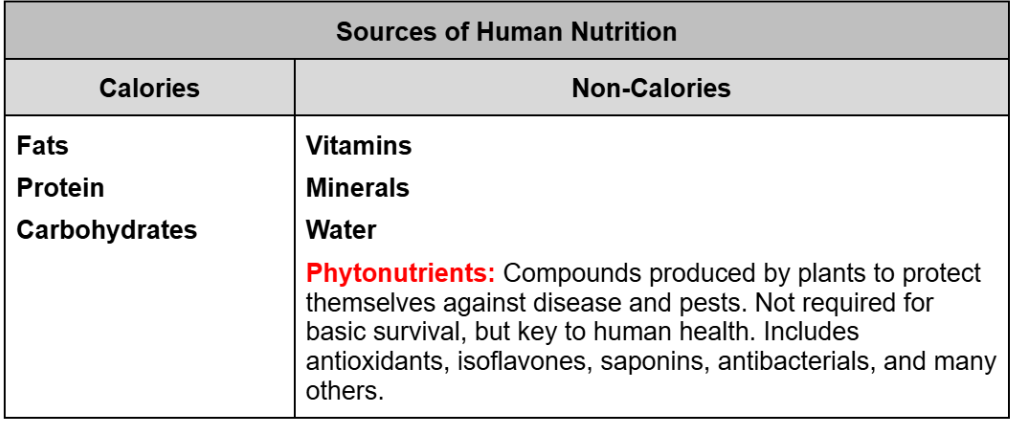
  • Healthy food is typically nutrient-dense rather than calorie-dense, meaning it provides a high concentration of vitamins, minerals, fiber and other beneficial compounds relative to its caloric content. These beneficial compounds are mostly phytochemicals — compounds produced by plants to protect themselves against disease and pests. Unlike essential nutrients, phytochemicals are not required by humans for basic survival but offer significant health benefits.
  • Many phytochemicals have antioxidant, anti-inflammatory, antimicrobial, anticancer and other health maintenance effects in humans. Although not essential (like vitamins or minerals) phytochemicals contribute significantly to disease prevention and overall well-being and are probably the most underrated component of healthy food.

There can be no argument against the fact that our food’s nutritional value has declined dramatically over the last number of years as measured by the nutrient mineral and vitamin values. We don’t have much information on the phytochemical decline, but it would be very surprising if it did not follow the same trend. 
The Decline: Breeding for Abiotic Nutrition

What are the main issues responsible for this dramatic decline in the nutritional status of food?

The desire for higher and higher crop yields has focused plant breeders on developing new cultivars that achieve this at the expense of nutritional value. These selections are usually made inside systems that use large amounts of external fertilizer inputs, which naturally shut off the ability for the plant to interact with microbes — and this interaction is what drives the plant’s biotic nutrient absorption process. 

We can divide a plant’s mineral nutrient absorption mechanisms into two broad categories: biotic and abiotic.

The biotic mechanism relies on wide and diverse soil microbial communities that locate, solubilize and transport the mineral nutrients to the root prior to the absorption process. These microbes are compensated for their service with root exudates, which contain sugars and other substances that feed them.

The abiotic mechanism relies exclusively on physical and chemical processes and is dependent on nutrients being in a soluble form and coming into contact with the plant roots. This process is highly pH dependent.

With the advent of modern high-input agriculture and the use of fertilizers, the biotic mechanisms driven by mycorrhizae root colonization and the rhizophagy cycle have been largely ignored. The emphasis has shifted to the abiotic process, with the external application of mineral nutrients in a solubilizable form. In tandem with this, the breeding and selection of new row crop cultivars made significant advances with yield increases but were selected in systems with large amounts of external applied fertilizers with little or no consideration of biotic plant-mineral absorption processes. With these biotic mineral absorption processes being largely ignored, it appears as if the genetic trait associated with biotic processes are in decline in the gene pool of these high-yielding, high-input cultivars.

These selection processes for high-yielding cultivars also result in primary metabolism becoming completely dominant in these cultivars, with a concomitant decrease in the requirement for certain essential micronutrients such as cobalt, nickel and selenium, which are required for the secondary metabolism processes. The absence of secondary metabolism, which synthesizes the important phytochemical components as well as vitamins, is therefore depleted in these crops, as are the mineral nutrients required for secondary metabolism. Scientists now believe that as many as 60 mineral nutrients are required by plants.
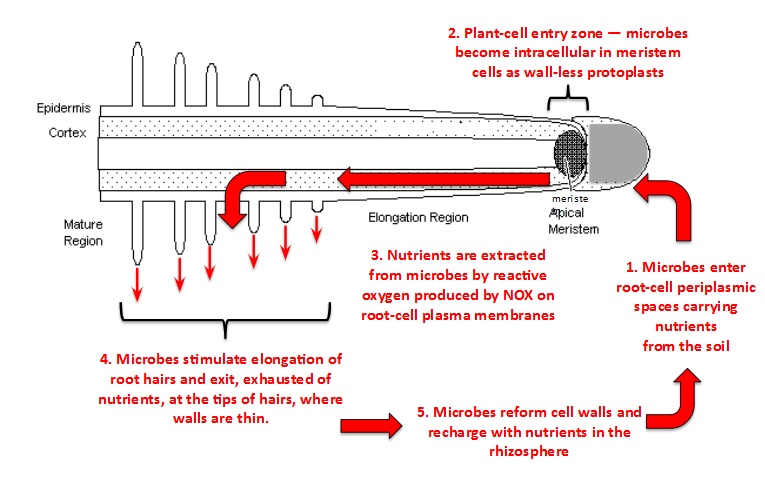
Rhizophagy diagram — Bacteria provide nutrients to plants via the rhizophagy cycle — a biotic mechanism that produces healthier plants than high-external-input systems.

It is not uncommon to see crops being grown hydroponically with only 13 nutrient elements being provided. This begs the question of whether there is any real nutrition present in these crops, as the secondary metabolism is null and void in such a growing system. This trend has implications for secondary metabolism, as several micronutrients are crucial cofactors or activators of enzymatic pathways involved in the synthesis of secondary metabolites.

Modern plant breeding and selection for higher yield, particularly in conventional high-input agricultural systems, has therefore inadvertently contributed to a reduction in the diversity of micronutrient content, reduced mineral nutrient density, reduced vitamin content and depleted phytochemical content in plants. This has led to a dilution effect: as plants are bred to produce more biomass or grain, the concentration of minerals (including micronutrients) in the harvested parts tends to decrease.

Wild relatives of crops, or older landraces, often contain higher levels of micronutrients and secondary metabolites and have high beneficial root associative characteristics. Secondary metabolites in root exudates shape soil microbial communities. Decreased production can weaken plant-microbe interactions and soil health. This is an extremely important issue, as a crop plant with weakened secondary metabolites may not have the correct signaling chemicals to attract mycorrhizae and other beneficial microbes.

The alarming consequence of this phenomenon in modern agriculture is that it appears that cultivars are adapting to the degraded soil conditions created by tilling, monocropping, fallow land and an overuse of fertilizers and chemicals, as these external inputs are regarded as substitutes for a diversity of soil life.

Mycorrhizae and Rhizophagy

What are we striving for in our food system? To produce crops with high nutritional values.

What are the basic requirements to achieve this? The first and most important component of such a system is choosing a cultivar that is adapted to a regenerative crop production system — a seed that has retained the ability to associate with the soil microbiology, thus providing all the necessary nutritional provision services. In this regard, mycorrhizae root colonization and the rhizophagy cycle are the two most well-known processes that breeders should select for.

We can confidently conclude that the present high-input agricultural cropping system is not designed to provide food with all the necessary nutritional components. Planting into — and breeding in — regeneratively prepared land that integrates cover crops and livestock is the only instrument for achieving this.

Willie Pretorius is a soil health consultant with degrees from the Universities of Pretoria and Stellenbosch. He would like to thank Dr. James White of Rutgers University for his valuable inputs for this article.

← Previous View from the Country Next Letters →
Tags: MycorrhizaePhytochemicalsRhizophagy
Willie Pretorius

Willie Pretorius

Willie Pretorius is a soil health consultant with Ward Laboratories. He has degrees from the Universities of Pretoria and Stellenbosch.

Next Post

Soil Biodiversity and Thriving Livestock

  • Trending
  • Comments
  • Latest
The Most Important Livestock in Our Fields

The Most Important Livestock in Our Fields

July 1, 2024
Glyphosate Does What It’s Designed to Do — Kill

Glyphosate Does What It’s Designed to Do — Kill

February 19, 2025
USDA organic seal over American farm land

Losing Organic Farms

September 18, 2026
The Take-Half, Leave-Half Fallacy

The Take-Half, Leave-Half Fallacy

July 1, 2025
Author photo (Wikimedia)

A Food Emancipation Proclamation

3
We Don’t Need Another Bridge — We Need an Off-Ramp

We Don’t Need Another Bridge — We Need an Off-Ramp

3
Under One Roof

Under One Roof

3
A Rose By Any Other Name

A Rose By Any Other Name

2
Beyond Glyphosate

Beyond Glyphosate

September 30, 2026
You First

You First

September 22, 2026
Blaming the Wolves

Blaming the Wolves

September 18, 2026
Running Dry

Running Dry

September 18, 2026

Recent News

Beyond Glyphosate

Beyond Glyphosate

September 30, 2026
You First

You First

September 22, 2026
Blaming the Wolves

Blaming the Wolves

September 18, 2026
Running Dry

Running Dry

September 18, 2026

Don't miss an update!

Stay informed on what's new in the Acres U.S.A. community: new articles, upcoming events and resources for regenerative farmers.

Acres U.S.A. is North America’s oldest publisher on production-scale organic and regenerative farming. For more than 50 years, our mission has been to help farmers, ranchers and market gardeners grow food profitably, regeneratively, and with nature in mind.

Facebook Instagram X-twitter Youtube Linkedin Spotify

SHOP

  • Bookstore
  • Online Courses
  • Giftcards

ABOUT

  • About Acres U.S.A.
  • Our Team
  • Eco-Ag Acheivement

LEARN

  • Events
  • Magazine
  • Newsletter
  • Webinars
  • Free Articles
  • Online Courses

Contact Us

Acres U.S.A. LLC
PO Box 351
Viroqua, WI 54665​
info@acresusa.com
970-392-4464
  • Manage My Subscription
  • Advertise with Us
No Result
View All Result
  • HOME
  • ARTICLES
    • News
    • Farm
    • Ecological farming
    • Livestock
    • Crop
      • Crop management practices
      • Cover crops
      • Crop nutrition
      • Crop protection
      • Crops
      • Ag technology
    • Soil
    • Opinion
  • RESOURCES
    • Magazine
    • Online Learning
    • Newsletters
    • Blog
    • Free Articles
  • MAGAZINE ISSUES
    • 2026
      • June 2026
      • May 2026
      • April 2026
      • March 2026
      • February 2026
      • January 2026
    • 2025
      • December 2025
      • November 2025
      • October 2025
      • September 2025
      • August 2025
      • July 2025
      • June 2025
      • May 2025
      • April 2025
      • March 2025
      • February 2025
      • January 2025
    • 2024
      • December 2024
      • November 2024
      • October 2024
      • September 2024
      • August 2024
      • July 2024
      • June 2024
      • May 2024
      • April 2024
      • March 2024
      • February 2024
      • January 2024
    • 2023
      • December 2023
      • November 2023
      • October 2023
      • August 2023
      • July 2023
      • June 2023
      • May 2023
      • April 2023
      • March 2023
      • February 2023
      • January 2023
  • ABOUT US
    • Our History
    • Our Staff
    • Contact Us
    • Community
      • Soil Health Primer Resources
  • EVENTS
    • Eco-Ag Conference
    • Farm Weird
  • SUBSCRIBE
  • Login
  • Sign Up
  • Cart

© 2024 Acers USA Magazine

Lost Password?