


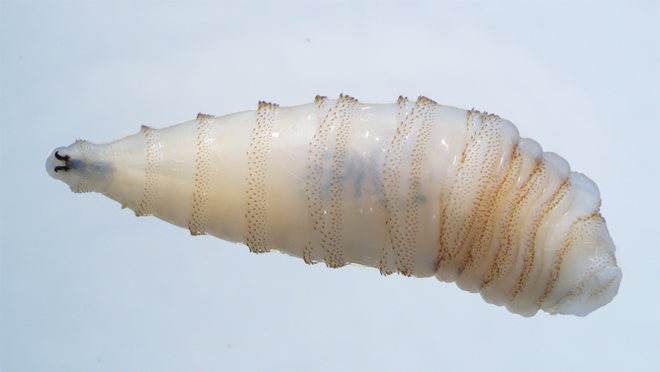

Biocontrol Success Story Unravels as New World Screwworm Reinfests Texas
It’s back. The New World Screwworm—a flesh-eating parasite endemic to the Americas—was one of biological control’s biggest success stories. Starting in the 1950s, scientists successfully eradicated the pest from the United States, Mexico, and Central America by breeding and releasing sterile male flies. There hadn’t been a case of screwworm infestation in Texas since 1986—until June 3, 2026.
The first screwworm in Texas in forty years was found in a calf in Zavala County, near the Mexican border. By June 8, four more cases had been confirmed by the USDA’s Animal and Plant Health Inspection Service (APHIS)—a second calf in Zavala County, a calf in La Salle County, a goat in Gillespie County, and a dog in Lea County, New Mexico. APHIS has launched an online dashboard to keep track of new cases, which will likely rise quickly with increased monitoring and reporting.
While individual animals can be treated for screwworm, the only known way of eradicating the pest is the same method that was so successful in the 1950s—sterile male release. “The United States has defeated this pest before, and we will do it again,” said Dudley Hoskins, Under Secretary for Marketing and Regulatory Programs.
In addition to imposing quarantines and conducting surveillance, APHIS has already been releasing sterile male screwworms into the affected areas. But it doesn’t have enough. The historic eradication effort required 500 million flies a week. The only currently operating screwworm breeding facility, located in Panama, produces 117 million flies a week. A repurposed factory in southern Mexico will hopefully soon begin producing another 100 million flies a week.
Successfully re-eradicating the screwworm from Texas may not be possible until the USDA completes its new sterile fly production facility at Moore Air Base in Edinburg, Texas, which will be able to produce 300 million sterile flies a week—but won’t be up and running until November 2027.


Texas governor Greg Abbott is doing everything possible to expedite the construction process. After issuing a disaster declaration for Zavala and Uvalde counties on June 5, Abbott said that he was willing to use state funds to ensure that construction continues “24 hours a day, seven days a week.”
Meanwhile, APHIS is implementing its New World Screwworm Response Playbook, which includes implementing a 20 km Infested Zone quarantine area in the affected areas. Livestock and pet owners cannot move animals out of infested areas until they are tested and treated by the Texas Animal Health Commission.
APHIS estimates that a widespread screwworm outbreak, which hasn’t happened since 1976, could cause a loss of up to $1.8 billion to the Texas economy. The agency will, of course, do everything in its power to keep the outbreak under control, but fully eradicating screwworm again will require collaborating with Mexico and Central American countries.
It’s a sad sequel to the biggest biocontrol success story of all time—and a reminder of just how hard it is to truly “eradicate” any kind of pest.