Letting light shine into a plant’s lower canopy can turn shaded growth into saleable yield
At a basic level, we all understand that light drives plant growth. With rare exceptions, plants do not grow without it. But beyond that broad truth, many of the practical questions about light intensity and distribution remain surprisingly underexplored in day-to-day farming: how much light is enough, where in the canopy does that light actually land, and how much control do we really have over its distribution? For growers aiming to improve efficiency, eliminate waste, and work with biological systems, the question is: Can we intentionally manage and utilize the existing natural light?
I came to this question from a background in controlled-environment and greenhouse production where I focused on ornamentals and specialty crops. Many of these greenhouse crops are extremely sensitive to light, temperature, humidity and airflow. In those systems, square footage becomes a practical unit of decision-making. When everything from temperature, humidity, light and nutrition is tightly regulated, differences in plant performance are harder to attribute to chance and easier to trace back to specific causes. That environment encouraged me to look at crop efficiency under a magnifying glass, looking at individual plant productivity — how evenly and effectively each individual plant is allowed to perform — rather than thinking in terms of acres or tonnage.
The Lower Canopy — A Silent Profit Leak?
When growers talk about “light,” we usually mean it loosely: bright or dim, sunny or shaded. PPFD (photosynthetic photon flux density) puts a number on that intuition. PPFD measures how much usable light (photons) is reaching a specific spot on the plant each second. It doesn’t measure fixture output or brightness to the human eye — it measures what the plant can actually photosynthesize.
A handheld PPFD meter lets you measure light anywhere in the canopy: at the top, in the middle, or near the base of the plant. That matters because plants don’t experience light as an average. Each leaf lives in its own light environment. The top of high-density plantings may receive what looked like “ideal” light levels at the canopy surface — 600, 700, even 800 µmol·m⁻²·s⁻¹ — while just a foot or two lower, levels could collapse to single digits. In most cases, the bottom third of dense canopies is effectively growing in nighttime conditions — that would never be considered acceptable if measured at the top.
Of course, we all take this light distribution imbalance for granted because the sun is in the sky. Once I saw those numbers, though, I couldn’t unsee them. I realized that light distribution visibility could change production decision-making. Altering plant spacing, pruning, manipulating canopy structure with intent, and increasing light utilization could impact profit — all without any additional inputs.
This question stayed with me for years until I had the opportunity to study it with academic guidance through Texas Tech University in 2025. Theoretically, if there is a way to deliver more light into and beneath the canopy, then many production systems may be accepting avoidable losses. The issue is not a lack of energy entering the system but rather the plants’ access to that energy. My formal research confirmed this: light saturates the top of the plant while the lower canopy is left starved — literally nighttime light levels — creating two very different biological environments on the same organism.
At this point it’s important to mention that those lower shaded zones serve an important ecological purpose. They help keep soil and root zones cooler, buffer temperature swings and reduce surface evaporation. The real question, then, is whether light access can be improved without compromising the ecosystem regenerative growers work hard to protect.
There was also a secondary observation that reinforced the importance of this zone. The lower third of the canopy is often where problems accumulate. Reduced airflow, higher humidity, senescing tissue and persistent shade create conditions where pests and diseases are more likely to become established and to persist. In many systems, the bottom of the plant becomes both the least productive and the most management-intensive area. That overlap — low yield potential paired with higher risk — suggested that improving light access to the lower canopy could offer multiple benefits at once: better structural development, improved uniformity and a less favorable environment for pest pressure.
I acknowledge that simply adding artificial light to the bottom of the canopy is not, by itself, a regenerative solution. Increasing energy inputs runs counter to many, if not all, growers’ goals of reducing external dependencies and improving system efficiency.
But what was the bottom third of the canopy capable of? I wanted to find out. By deliberately supplying light to the most light-limited portion of the canopy, I was able to isolate and study the relationship between light availability and what that lower canopy is actually capable of producing. The goal was not to promote under-canopy lighting as a prescription, but to use it as a controlled tool to reveal how much yield and quality potential is being left unrealized when large portions of a crop operate below productive light thresholds. Once that relationship is understood, the same principles can be applied using far more regenerative methods — reflection, spacing, canopy architecture and timing — without adding energy to the system.
Peering Into the Darkness
To understand what shaded portions of a crop are capable of, I reduced the question to its simplest form. I worked with CBD hemp, a crop that typically produces little to nothing marketable in the lower third of the canopy. The rest of the growing environment was held constant so light access remained the primary variable.
I began with defoliation alone. It quickly became clear that leaf removal helped, but only marginally. Even with aggressive defoliation, the lower canopy remained light-starved and produced little to no marketable material.
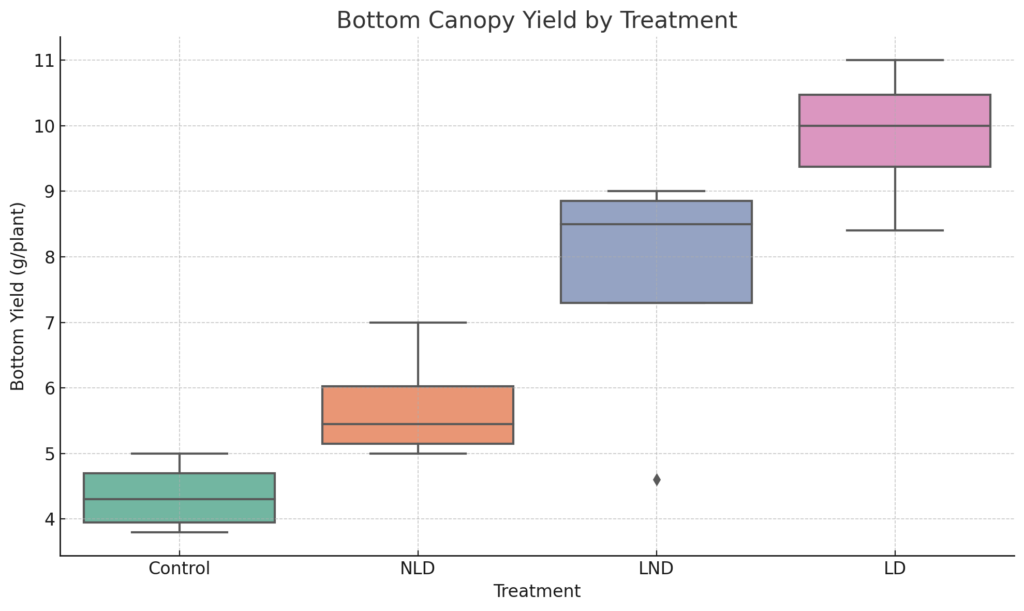
The next step was adding light directly to the under-canopy together with intentional defoliation. In addition to the 700-watt top light, I installed 300 watts of lighting at roughly soil level, facing upward. The plants were effectively sandwiched between light sources using conventional LED under-canopy fixtures. Once light reached the lower canopy, the response was immediate. Even at roughly half the intensity of the upper canopy, shaded tissue moved out of survival mode, growth filled in, and flowers firmed up. The lower portion of the plant began functioning as productive crop tissue rather than material destined for removal at harvest.
Increasing light at the top never compensated for starvation below. But once shaded tissue crossed the threshold into meaningful photosynthesis — around 300 PPFD — it expressed capacity that had been present all along.
Total yield followed the same pattern. Systems relying solely on overhead lighting produced the least usable material. Adding under-canopy lighting increased saleable yield by roughly one-third. In practical terms, the additional wattage translated almost directly into additional marketable product, approaching a one-to-one relationship between energy input and usable yield.
Adding under-canopy lighting increased power demand by roughly one-third, but it also produced a comparable increase in saleable yield. From a purely economic standpoint, the tradeoff penciled out. That alone is worth noting. More importantly, the added energy served as a diagnostic tool. It exposed how much value is quietly lost when large portions of a crop remain below productive thresholds for an entire season.
For growers, the takeaway isn’t to add more fixtures. It’s to stop treating uneven light distribution as a fixed constraint. Water, nutrients, labor and land are already invested in that lower growth. The next step is figuring out how to make better use of what’s already there.
These observations point toward a shift in how canopy performance can be evaluated and improved. In dense, high-value crops, the lower canopy is often the weakest link—not because it lacks potential, but because it lacks access.
One important takeaway is that familiar canopy management tools often serve different roles than they are credited for. Again, leaf removal alone did not solve underperformance in shaded zones, but it consistently made other improvements more effective by clearing physical barriers to light movement. In that sense, pruning and defoliation function best as enablers rather than as solutions in themselves. Their value lies in opening pathways — allowing light, air and energy to reach tissues that would otherwise remain suppressed. While timing and intensity will always vary by crop and climate, the principle remains consistent: light access, not leaf count, determines whether lower-canopy growth contributes meaningfully at harvest.
What This Means for Growers
The good news is that improving light distribution does not require adding energy. Some of the most effective tools are simple and inexpensive. Reflective ground covers — white plastic, woven poly, or reflective mulches — can redirect light that would otherwise be absorbed by soil or walkways. In greenhouses and high tunnels, light-colored knee walls, bench faces, posts and end walls can bounce lateral light deeper into the canopy. These surfaces are often overlooked, yet they represent some of the highest return-on-effort adjustments available.
Canopy architecture matters just as much. Dense upper foliage can form a permanent light cap, preventing both direct and reflected light from reaching productive sites below. Strategic, selective pruning — especially mid-season — can open corridors that allow light to move downward without compromising photosynthesis in the upper canopy. When combined with reflective surfaces, relatively small changes in spacing or leaf removal can have outsized effects on lower-canopy performance.
This way of thinking about light translates across many regenerative and protected systems. Research has shown that greenhouse and high-tunnel tomatoes, peppers and cucumbers often show improved fruit fill and uniformity when light reaches shaded fruiting zones. Perennial crops such as grapes and tree fruit respond similarly, as cluster and fruit exposure directly influences sugar accumulation, color development and disease pressure. Berry crops grown on white plastic or mulch surfaces frequently respond to reflected light with improved lower-fruit size and ripening consistency. What makes these adjustments newly accessible is the availability of affordable PPFD meters, which allow growers to see light gradients inside their crops and identify zones operating below productive thresholds.
These observations should be treated as guidance, not prescriptions. Optimal pruning intensity, plant spacing and reflectivity additions will not make sense for every crop or market. Each grower has to decide whether these principles align with their system, climate and economic goals. The underlying insight, however, is broadly applicable: when light is managed as a spatial resource rather than a single intensity number, canopy decisions become clearer, more intentional and more economically grounded.
For me, this marked a shift in how I think about crop performance. Light is a tool, not just an input. The lower canopy doesn’t need to be treated as inherently unproductive space; it represents unrealized capacity. That tissue draws water, nutrients, labor and time whether it finishes well or not.
In regenerative systems especially, the goal isn’t to add energy, but to use what’s already there more efficiently. Treating the lower canopy as productive space rather than a liability is one of the most overlooked ways to do that.